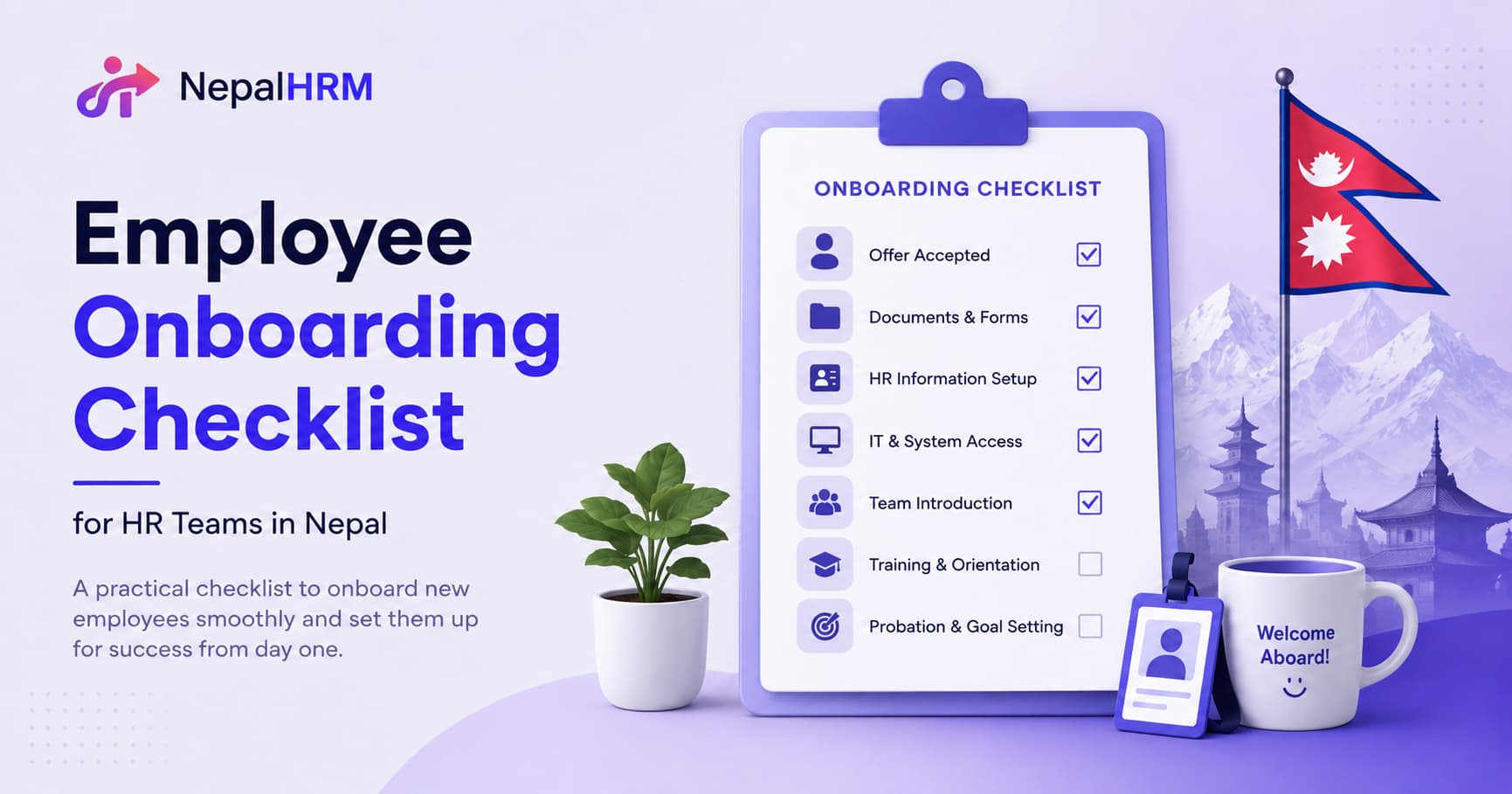
The recruitment process in Nepal is the series of steps a business follows to identify a vacancy, attract applicants, assess candidates, select the right person, and complete the employment paperwork. A proper process helps employers hire based on skills, experience, job fit, and clear selection criteria.
Many Nepali companies still recruit through personal referrals, informal interviews, and verbal job offers. Referrals are useful, but depending on them alone limits the number of candidates and increases the risk of hiring someone who does not match the role.
A structured recruitment process gives every applicant a fair opportunity. It also helps the employer maintain records, control hiring costs, reduce employee turnover, and meet Nepal’s employment requirements.
What Is the Recruitment Process in Nepal?#
The recruitment process in Nepal begins when a business identifies the need for an employee and ends when the selected candidate joins the company. It includes job planning, advertising, screening, interviewing, testing, reference checking, selection, documentation, and onboarding.
Recruitment and selection are closely related, but they are not exactly the same.
Recruitment focuses on attracting suitable candidates to apply for a job. Selection focuses on assessing those applicants and choosing the person who best matches the position.
A complete recruitment process normally includes:
Identifying the hiring need
Preparing the job description
Selecting the employment type
Setting the salary and hiring budget
Advertising the vacancy
Screening applications
Conducting interviews and tests
Checking references and documents
Selecting the candidate
Issuing the offer and employment contract
Completing onboarding
Reviewing the employee during probation
Why Do Nepali Businesses Need a Proper Recruitment Process?#
Nepali businesses need a proper recruitment process because poor hiring decisions affect productivity, customer service, team morale, and operating costs. A structured approach also makes hiring decisions easier to explain and defend.
Without a clear system, companies often experience:
Employees leaving during probation
Candidates misunderstanding the job
Unplanned salary negotiations
Different interview standards for each applicant
Delayed hiring decisions
Duplicate or missing employee records
Managers selecting candidates based on personal preference
New employees joining without clear expectations
Disputes about salary, duties, or working conditions
A written process helps the owner, HR officer, and hiring manager understand who is responsible for each hiring stage.
What Are the Steps in the Recruitment Process in Nepal?#
Step 1: Identify Why the Business Needs to Hire#
The first step is to confirm why a new employee is needed. The employer should not advertise a vacancy until the work, budget, and reporting structure are clear.
A company might recruit because:
An employee has resigned
The workload has increased
A new branch is opening
The company is launching a new service
A department needs a skill it does not currently have
A temporary project requires extra workers
An employee has been promoted or transferred
Before approving the vacancy, answer these questions:
What work will this person handle?
Is the position permanent or temporary?
Does the company already have someone who could take the role?
Is a full-time employee necessary?
Who will supervise the employee?
How will the employee’s work be measured?
Can the company afford the full employment cost?
The full cost includes more than salary. It may include allowances, recruitment fees, equipment, training, insurance, Social Security Fund contributions, taxes, leave, overtime, and other benefits.
Step 2: Choose the Correct Employment Type#
The employer should select an employment type that matches the actual nature of the work. Giving a temporary title to a role that is regular in practice does not automatically make it temporary.
Nepal’s Labour Act lists five types of employment:
Regular employment
Work-based employment
Time-based employment
Casual employment
Part-time employment
Under the Act, casual employment generally covers work performed for seven days or less within one month. Part-time employment refers to work completed within 35 hours or less per week. Whether work is regular depends on the nature of the job, not only the wording used in the contract.
The employer should define the employment type before advertising the vacancy. This avoids confusion about job duration, hours, benefits, and contract terms.
Step 3: Prepare a Clear Job Description#
A job description explains why the position exists and what the selected employee will be expected to do. It should be prepared before the vacancy announcement.
A good job description includes:
Job title
Department
Work location
Reporting manager
Employment type
Main responsibilities
Required education
Required experience
Technical skills
Communication or language requirements
Working hours
Travel requirements
Performance measures
Salary range, where suitable
Avoid using broad statements such as “handle all office work” or “perform other duties as assigned” as the main description of a role.
For example, instead of writing:
Manage social media.
Write:
Plan and publish monthly content for Facebook, Instagram, LinkedIn, and TikTok, respond to audience messages, coordinate creative work, and report monthly engagement and lead data.
The second version tells applicants what the job involves and gives the employer a basis for assessing performance.
Step 4: Define the Candidate Selection Criteria#
Selection criteria are the standards used to compare applicants. These should be agreed upon before applications are reviewed.
The criteria may include:
Minimum education
Relevant work experience
Technical knowledge
Software skills
Language ability
Communication skills
Leadership experience
Availability
Location
Expected salary
Industry knowledge
Separate the criteria into three groups:
Required: The candidate must meet these conditions.
Preferred: These qualities are useful but not compulsory.
Trainable: The selected person can learn these after joining.
This prevents employers from rejecting good candidates for minor reasons that do not affect their ability to perform the job.
Step 5: Set the Salary and Recruitment Budget#
The employer should approve the salary range before publishing the vacancy. The budget should reflect the role, required skills, market conditions, internal salary levels, and current employment requirements.
The salary should not fall below the applicable minimum remuneration set by the Government of Nepal. The Ministry of Labour published a minimum-remuneration notice in 2082 and later issued notices concerning its application and compliance. Employers should check the newest official notice before confirming a salary.
The recruitment budget may also include:
Vacancy advertising fees
Recruitment agency fees
Interview travel costs
Skills assessment costs
Background verification
Medical checks for roles where they are legally or operationally necessary
Onboarding materials
Computer, phone, uniform, or other equipment
Setting the budget early prevents delays after the preferred candidate is selected.
Step 6: Write and Publish the Vacancy Announcement#
A vacancy announcement should give applicants enough information to decide whether the job suits them.
It should include:
Company name and introduction
Job title
Main duties
Education and experience
Required skills
Employment type
Work location
Working schedule
Application deadline
Documents required
Application method
Salary or salary range, where suitable
The announcement should not include requirements unrelated to the work. Employers should use job-related criteria and avoid excluding candidates based on personal characteristics that do not affect job performance.
The Labour Act prohibits discrimination in employment and remuneration on stated grounds, and other Nepali laws also address equal treatment and employment rights. Recruitment questions and decisions should therefore remain connected to the duties of the position.
Businesses may advertise vacancies through:
Their company website
Online job platforms
Professional networking sites
Social media pages
Colleges and universities
Industry groups
Employee referrals
Recruitment agencies
Local notice boards for location-based roles
Use more than one channel when the position requires a wide or specialised candidate pool.
Step 7: Screen Applications Using the Same Criteria#
Application screening removes candidates who do not meet the main job requirements. Every application should be checked against the criteria prepared earlier.
A simple screening sheet may include:
Screening Area | Score |
|---|---|
Relevant education | 10 |
Relevant experience | 20 |
Technical skills | 25 |
Industry knowledge | 15 |
Communication | 15 |
Location and availability | 5 |
Application quality | 10 |
Total | 100 |
The exact scoring system should change according to the role.
For a software developer, technical ability may carry the highest score. For a sales officer, communication, target history, product understanding, and customer handling may matter more.
Keep notes explaining why each candidate was shortlisted or rejected. This helps when several people are involved in the hiring decision.
Step 8: Conduct a Short Initial Interview#
The first interview checks whether the candidate meets the basic conditions before a longer assessment is arranged.
It may cover:
Current employment status
Reason for applying
Relevant experience
Salary expectations
Notice period
Work location
Working schedule
Language ability
Basic understanding of the role
This interview usually takes 15 to 30 minutes.
Ask the same main questions to every candidate applying for the same position. Follow-up questions may differ, but the core questions should remain consistent.
Do not spend most of the interview explaining the company. First confirm whether the candidate matches the role.
Step 9: Use a Practical Skills Test#
A practical test shows how the candidate performs work connected to the position. It is often more reliable than asking candidates to describe what they would do.
Examples include:
A writing test for a content writer
A coding task for a developer
A spreadsheet task for an accountant
A sales presentation for a sales officer
A customer-response test for support staff
A design task for a graphic designer
A planning exercise for a project coordinator
The task should be short, related to the vacancy, and similar for all shortlisted candidates.
Avoid asking candidates to complete unpaid work that the company intends to use commercially. The test should assess ability, not obtain free labour.
Step 10: Conduct a Structured Final Interview#
The final interview should assess job knowledge, decision-making, behaviour, communication, motivation, and fit with the working environment.
Use behavioural questions that ask candidates to describe real situations.
Examples include:
Tell us about a difficult customer you handled.
Describe a deadline you failed to meet. What happened?
Give an example of a disagreement with a manager.
Tell us about a process you improved.
Describe a mistake you made at work and how you corrected it.
Explain a situation where you had to learn something quickly.
Ask follow-up questions such as:
What was your personal responsibility?
What action did you take?
What was the result?
What would you do differently now?
Use a scorecard during the interview. Do not rely only on memory or general impressions.
Step 11: Check References and Candidate Documents#
Reference checking confirms the candidate’s work history, responsibilities, conduct, and reason for leaving.
Ask the candidate for permission before contacting a current employer. Contacting the current workplace without permission could put the candidate’s job at risk.
Useful reference questions include:
What position did the candidate hold?
What were their main duties?
How long did they work with you?
How was their attendance?
How did they respond to feedback?
What were their main strengths?
Would you employ them again?
Is there anything relevant to the role that we should verify?
Document verification may cover:
Citizenship or legal identification
Academic certificates
Training certificates
Professional licences
Previous employment letters
Work samples
References
Work permits where applicable
Collect only information required for the hiring decision or employment record. Nepal’s Privacy Act protects personal information, documents, correspondence, and data, so applicant records should be stored securely and accessed only by authorised people.
Step 12: Make the Selection Decision#
The selection decision should be based on the evidence collected during screening, tests, interviews, and reference checks.
Compare the final candidates using a selection table.
Area | Weight |
|---|---|
Technical ability | 30% |
Relevant experience | 20% |
Interview performance | 15% |
Practical test | 20% |
Communication | 10% |
Reference check | 5% |
The weight should reflect the position.
Record:
The selected candidate
The reason for selection
The approved salary
The proposed starting date
Any conditions attached to the offer
The person approving the appointment
Do not select someone only because they requested the lowest salary. A poor hire often costs more through errors, lost time, repeated recruitment, and employee turnover.
Step 13: Issue a Written Job Offer#
A job offer tells the selected candidate that the company intends to employ them under stated conditions.
The offer letter should include:
Job title
Department
Reporting manager
Work location
Employment type
Proposed starting date
Salary
Main allowances and benefits
Probation period
Working hours
Documents required before joining
Deadline for accepting the offer
Conditions such as reference or document verification
The candidate should accept the offer in writing.
An offer letter does not always contain every employment condition. A detailed employment contract should be signed before or when the employee begins work.
Step 14: Prepare the Employment Contract#
The employment contract sets out the formal terms between the employer and employee. It should match the vacancy announcement, interview discussions, approved offer, and actual nature of the job.
The Labour Act and Labour Rules require employment agreements to contain prescribed information. The Rules also state that an employment agreement should disclose additional details beyond those listed in Section 11(3) of the Act.
A contract should normally cover:
Names and addresses of both parties
Job title and duties
Employment type
Starting date
Contract period, where relevant
Work location
Working hours
Salary and payment date
Allowances and benefits
Leave
Overtime
Social security
Confidentiality
Company property
Workplace policies
Probation
Notice and termination
Signatures of both parties
The employer should give the employee a copy of the signed contract.
Step 15: Register and Maintain the Employee Record#
After the candidate accepts the offer, the employer should create an employee file and update the required payroll and social-security records.
The Labour Rules require employers to maintain personal records for workers, including details such as name, address, family information, citizenship, contact number, email, and other required information.
The file may contain:
Application and CV
Interview scorecards
Practical test result
References
Citizenship or ID copy
Certificates
Offer letter
Employment contract
Bank details
Tax details
Emergency contact
Social Security Fund information
Job description
Signed policy acknowledgements
The Social Security Fund provides online systems for employer and contributor registration and record management. Employers should complete the relevant registration and contribution steps according to their legal status and the employee’s coverage.
Step 16: Complete Employee Onboarding#
Onboarding helps the new employee understand the company, role, policies, systems, team, and performance expectations.
The first day should include:
Welcome and company introduction
Team introductions
Workspace and equipment setup
Email and software access
Review of the job description
Work schedule and attendance process
Leave application process
Salary and payroll information
Workplace conduct rules
Safety instructions
Reporting and communication process
The manager should also prepare:
First-week tasks
First-month goals
Training schedule
People the employee should meet
Documents or systems the employee should learn
Dates for probation reviews
Good onboarding reduces confusion during the employee’s first weeks.
Step 17: Review Performance During Probation#
Probation allows the employer to assess whether the employee performs the role at the required standard. It also gives the employee time to assess the company and working conditions.
Nepal’s Labour Act allows an employment agreement to include a probation period of up to six months. The employer may end the employment during that period when the employee’s work is not satisfactory.
Do not wait until the end of probation to discuss problems.
Schedule reviews after:
The first week
The first month
The middle of probation
The final probation month
Assess:
Work quality
Productivity
Attendance
Communication
Teamwork
Learning progress
Conduct
Ability to handle responsibilities
Response to feedback
Keep written records of feedback and agreed actions.
How Long Does Recruitment Take in Nepal?#
Recruitment may take from a few days to several weeks, depending on the position, candidate availability, interview stages, notice periods, and approval process.
A basic timeline may look like this:
Recruitment Stage | Suggested Time |
|---|---|
Job approval and description | 1–3 days |
Vacancy advertising | 7–14 days |
Application screening | 2–4 days |
Initial interviews | 2–5 days |
Tests and final interviews | 3–7 days |
Reference checks | 1–3 days |
Offer and negotiation | 2–5 days |
Joining period | Based on candidate notice |
Hard-to-fill technical or senior positions often require more time.
The goal should not be to hire as fast as possible. The goal should be to remove unnecessary delays while giving the company enough evidence to make a sound decision.
What Documents Are Needed When Hiring an Employee in Nepal?#
The documents depend on the employer, industry, and role. A standard employee joining file often includes:
Application or CV
Citizenship or identification copy
Passport-size photograph
Academic certificates
Training or licence documents
Previous employment evidence
Reference details
Bank account information
PAN or tax information
Social Security Fund details
Emergency contact information
Signed offer letter
Signed employment contract
Signed job description
Policy acknowledgement forms
Employers should avoid collecting documents that have no connection to the job or employment record.
What Recruitment Mistakes Should Employers Avoid?#
Common recruitment mistakes in Nepal include:
Hiring without an approved job description
Advertising a vacancy before confirming the budget
Selecting candidates only through personal connections
Asking different main questions to each candidate
Hiring based only on interview confidence
Skipping practical tests for technical roles
Contacting current employers without permission
Making verbal salary promises
Delaying the written offer
Using the wrong employment type
Keeping candidate documents in unsecured files
Failing to complete a written employment agreement
Ignoring probation reviews
Rejecting candidates based on personal bias
Hiring interns or trainees to perform regular unpaid work
A recruitment checklist helps prevent these mistakes.
How Can Small Businesses Improve Recruitment in Nepal?#
Small businesses can improve recruitment without building a large HR department. The process only needs clear responsibilities, standard documents, and written decisions.
Start with these tools:
Vacancy approval form
Job description template
Vacancy announcement template
Application screening sheet
Interview question sheet
Candidate scorecard
Reference-check form
Offer-letter template
Employment-contract template
Onboarding checklist
Probation-review form
Assign one person to manage candidate communication. Applicants should know whether they have been shortlisted, rejected, selected, or placed on hold.
A professional recruitment process also affects the company’s reputation. Candidates who receive clear communication are more likely to view the employer positively, even when they are not selected.
How Should Employers Reject Unsuccessful Candidates?#
Employers should send a short and respectful rejection message once the hiring decision is final. The message does not need to give a detailed explanation unless the company has agreed to provide feedback.
A suitable rejection message should:
Thank the candidate for applying
State that another candidate was selected
Avoid unclear promises
Mention whether the company will retain the application
Provide feedback only when it is accurate and appropriate
Do not leave interviewed candidates without any response.
How Can Recruitment Software Help Nepali Businesses?#
Recruitment software helps employers keep vacancy, candidate, interview, and offer information in one place.
It may help with:
Publishing vacancies
Receiving applications
Screening candidates
Scheduling interviews
Recording interview scores
Sending candidate emails
Managing approvals
Storing documents
Preparing reports
Tracking time to hire
Software is most useful after the company has defined its recruitment stages. An unclear process remains unclear even when it is moved into an online system.
What Is the Best Recruitment Process for a Nepali Company?#
The best recruitment process is one that is fair, repeatable, documented, and suitable for the size of the company. It should help the employer assess candidates consistently without creating unnecessary interview stages.
For most businesses, the process should be:
Approve the vacancy
Write the job description
Confirm the employment type and salary
Advertise the role
Screen applicants
Conduct an initial interview
Use a practical test
Conduct a final interview
Check references
Select the candidate
Issue the offer and contract
Complete onboarding
Review performance during probation
The process may be shorter for junior or casual roles and longer for senior, financial, technical, or leadership positions.
Final Thoughts on the Recruitment Process in Nepal#
The recruitment process in Nepal should help businesses select people based on job requirements rather than personal preference or informal recommendations. It should also give candidates clear information about the role, salary, working conditions, and selection steps.
Start with a clear job description, employment type, salary range, and selection criteria. Use consistent screening, structured interviews, practical tests, written offers, proper employment contracts, secure employee records, and scheduled probation reviews.
A business does not need a complicated recruitment system. It needs a process that managers understand and follow every time they hire.
Frequently Asked Questions About Recruitment in Nepal#
What is the recruitment process in Nepal?#
The recruitment process in Nepal includes identifying a vacancy, preparing a job description, advertising the position, screening applicants, conducting interviews, selecting a candidate, issuing an offer, signing an employment contract, and onboarding the employee.
What are the main steps in recruitment and selection?#
The main steps are workforce planning, job analysis, candidate sourcing, application screening, interviews, skills testing, reference checking, selection, offer preparation, employment documentation, and onboarding.
Is a written employment contract required in Nepal?#
Employers should provide a written employment agreement that states the job, employment type, remuneration, benefits, working conditions, and other required terms. Nepal’s Labour Act and Labour Rules contain provisions governing employment agreements and the information they should include.
How long is the probation period in Nepal?#
An employer may place an employee on probation for up to six months under Nepal’s Labour Act. The employee’s performance should be reviewed and documented during this period.
What types of employment are recognised in Nepal?#
Nepal’s Labour Act lists regular, work-based, time-based, casual, and part-time employment. The correct type depends on the actual duration and nature of the work.
What should be included in a job vacancy notice?#
A job vacancy notice should include the job title, responsibilities, qualifications, experience, skills, employment type, location, application deadline, required documents, and application method.
Should employers publish the salary in a vacancy?#
Publishing a salary range helps candidates decide whether the job suits them and reduces unnecessary applications. Where the salary is not published, the employer should still approve an internal range before interviews begin.
Can an employer contact a candidate’s current employer?#
The employer should ask for the candidate’s permission before contacting their current workplace. References from previous employers may be checked earlier, provided the candidate has supplied or approved those contacts.
How should candidate information be stored?#
Candidate information should be stored securely and made available only to people involved in the recruitment process. Applications and personal documents should not be shared or used for unrelated purposes because Nepal’s Privacy Act protects personal records and information.
What is the difference between recruitment and selection?#
Recruitment attracts people to apply for a vacancy. Selection assesses those applicants and chooses the person who best meets the job requirements.
Can a small company manage recruitment without an HR officer?#
Yes. A business owner or manager can handle recruitment using standard job descriptions, interview questions, candidate scorecards, offer letters, contracts, and onboarding checklists. One person should be responsible for maintaining records and communicating with candidates.
Legal note: Employment laws, minimum remuneration notices, social-security processes, and government requirements change. Employers should confirm the current rules with the Ministry of Labour, the Social Security Fund, the relevant Labour and Employment Office, or a qualified Nepal labour-law professional before making employment decisions.