Salary Tax Calculator Nepal: PF, CIT, SSF and TDS
Enter a gross salary and read the whole breakdown: PF and CIT or SSF on basic, monthly TDS on the current IRD slabs, net take-home, and the total cost to the employer.
- FY 2083/84 slabs
- No sign-up
- Nothing leaves your browser
Nepal income tax, FY 2083/84
- Slab table applied
- FY 2083/84
- First NPR 1,000,000
- 1%
- Top marginal rate
- 29%
- Retirement deduction cap
- NPR 500,000
PF + CIT, CIT only and SSF are separate contribution systems in Nepal. Select the one applicable to your company or employee. PF, CIT, and SSF are all calculated from Basic (not Gross).
New for FY 2083/84: the separate single and married (couple) slabs have been merged into one table for all resident individuals. The 1% band now runs to NPR 10,00,000 and the top rate is 29% (was 39%).
Monthly Net Take-Home
NPR 70,050
Gross NPR 75,000, employee-side deductions only
Employee Deductions
Deducted from salaryAnnual TDS estimate ~ NPR 0
TDS is calculated based on annual taxable income (Gross - PF/CIT/SSF deductions) against the unified FY 2083/84 Nepal tax slabs.
Employer Cost
Paid on top of salaryTotal SSF deposited monthly: NPR 13,950 (31% of Basic). Employee NPR 4,950 (11%) + employer NPR 9,000 (20%).
The employer's 20% is paid on top of gross salary. It never reduces the employee's take-home.
This calculator is for demo estimation only. Actual payroll depends on company policy, salary structure, tax category, and applicable rules. NepalHRM applies the precise rules per employee in production.
Five Inputs, One Net Figure
The calculator runs the same tax and contribution logic the NepalHRM payroll engine does, so the estimate here and the payslip there agree.
- 1
Pick the contribution system
Choose PF + CIT, CIT only or SSF, whichever the employer is enrolled in. They are alternatives, not additions, and they tax differently: SSF assessees have the 1% first band waived, the other two pay it.
- 2
Enter monthly gross
Type the gross monthly salary in NPR, the figure on the appointment letter before any deduction.
- 3
Set the basic split
Move the basic percentage to match your salary structure. PF, CIT and SSF are all assessed on basic, not on gross, so this changes every deduction below it.
- 4
Add CIT, if any
CIT is voluntary and reduces taxable income up to the statutory ceiling, whether it sits alongside PF or stands alone where the employer runs no provident fund. Raising it lowers TDS without changing gross salary.
- 5
Read net pay and employer cost
Net take-home, each deduction, monthly TDS and the employer's total cost are shown together. Open the slab breakdown to see the tax band by band.
Last updated · Reviewed by Rajendra Regmi, Co-founder
Nepal Income Tax Slabs and Rates
Marginal rates on annual taxable income, effective Shrawan 1, 2083. FY 2083/84 merged the separate single and couple schedules, so one table now applies to every resident natural person and no marital status is asked for.
| Annual taxable income (NPR) | PF + CIT or CIT only | SSF |
|---|---|---|
| Up to 1,000,000 | 1% | 0% |
| 1,000,001 – 1,500,000 | 10% | 10% |
| 1,500,001 – 2,500,000 | 20% | 20% |
| 2,500,001 – 4,000,000 | 27% | 27% |
| Above 4,000,000 | 29% | 29% |
The first band is the 1% social security tax. It is waived for SSF assessees because the Social Security Fund already covers it. Retirement contributions reduce taxable income only up to the lowest of the actual contribution, NPR 500,000, or one-third of assessable income.
PF, CIT, SSF and TDS, One at a Time
Four deductions with four different rules. This is what each one does to a Nepali salary, and where the calculator applies it.
PF (Provident Fund)
10% of basic from the employee, matched by 10% from the employer. The employee's half is deducted from the salary; the employer's half is paid on top of it, so it lowers taxable income without lowering gross.
CIT (Citizen Investment Trust)
Voluntary retirement saving. It comes out of pay and goes into the employee's own fund, and because it is deductible, every rupee added lowers taxable income until the ceiling is reached. It usually sits alongside PF, but plenty of employers run no provident fund at all and deduct CIT on its own, which is what the calculator's CIT only setting prices.
SSF (Social Security Fund)
The alternative to PF + CIT: 11% from the employee and 20% from the employer on basic, 31% in total. Employers enrolled in the scheme use this instead of PF, and their staff pay no 1% social security tax.
TDS (tax deducted at source)
Income tax withheld monthly rather than paid in a lump at year end. The calculator assesses annual taxable income against the slabs above, then divides by 12 for the figure that appears on a payslip.
The deduction ceiling
PF, CIT and SSF reduce taxable income only up to the lowest of the actual contribution, NPR 500,000, or one-third of assessable income. Above that the contribution still happens; it just stops saving tax.
Basic, not gross
Nepali salary structures split gross into basic plus allowances, and every statutory contribution is assessed on basic. A structure with a low basic percentage produces a smaller PF, CIT and SSF, and a larger taxable income.
The Same Maths, Run for Every Employee
This page answers one salary at a time. NepalHRM holds the rules once in payroll settings, then applies them to the whole company every month and produces the reports the IRD asks for.
- PF, CIT and SSF are configured once in payroll settings, then applied per employee on every run.
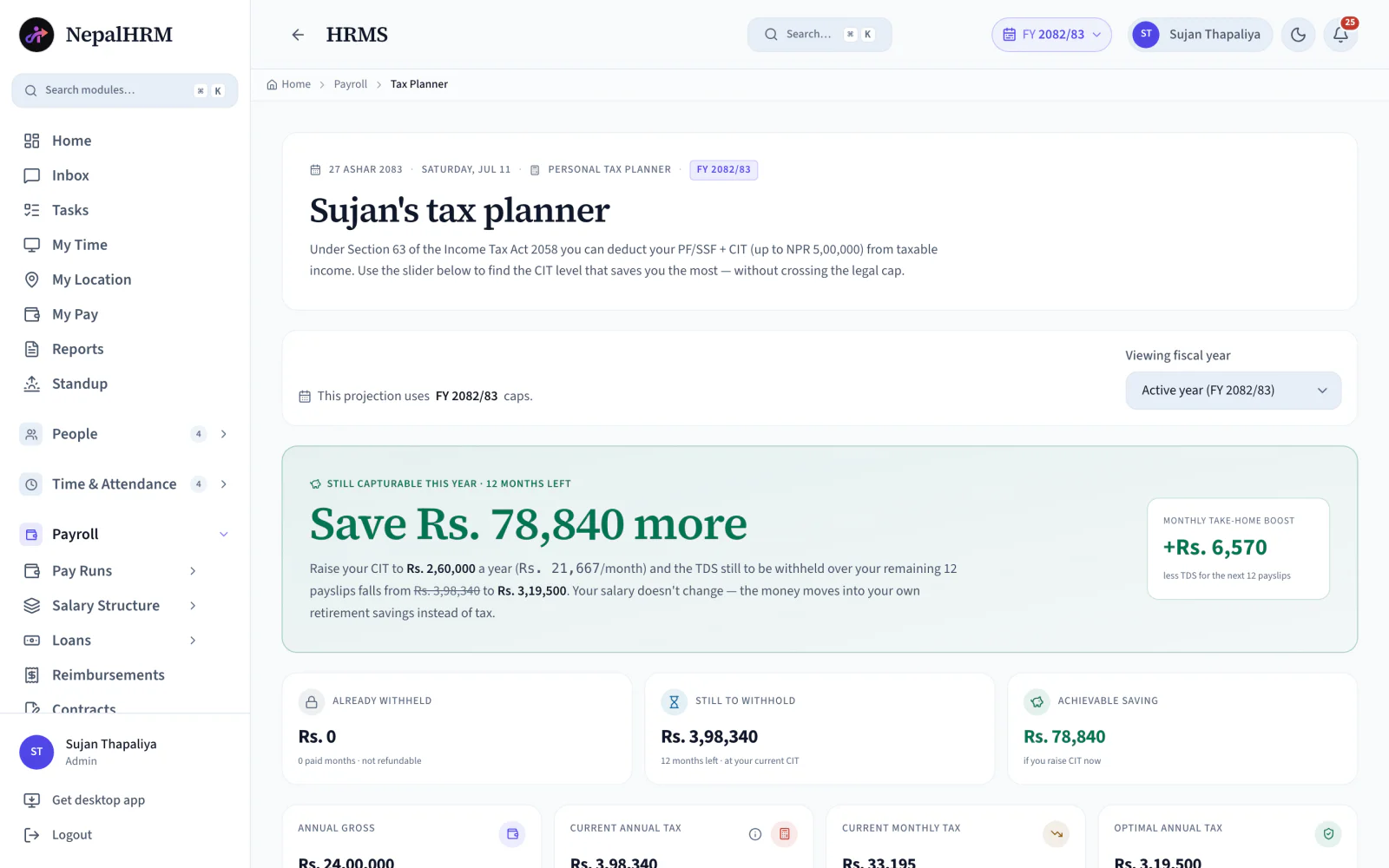
- The CIT Optimizer shows how much tax an employee can still save by raising CIT before payroll closes.
- Salary sheet, PF, CIT and eTDS reports come out of the same run, in IRD format.
- Periods follow the BS fiscal year, so slab changes land with the year rather than in a spreadsheet.
How Nepal Salary Tax Works
Annual taxable income is gross salary minus allowable deductions (PF and CIT, or SSF, capped at the lower of NPR 500,000 or one-third of income), assessed against the marginal slabs. From FY 2083/84 a single unified table applies to every resident individual, the separate single and married slabs having been merged: the first NPR 1,000,000 at 1% (the social security tax, waived for SSF assessees), then 10% to 1,500,000, 20% to 2,500,000, 27% to 4,000,000 and 29% above that. The calculator applies these slabs and divides the annual figure by 12 for the monthly TDS. Open "Show tax slab breakdown" to see each band.
They are two different social-security setups. Under PF+CIT the employee and employer each contribute 10% of basic to the Provident Fund, plus an optional CIT contribution. Under SSF the employee contributes 11% and the employer 20% of basic to the Social Security Fund. Both reduce taxable income, but the rates and the benefits differ, and SSF assessees are exempt from the 1% first band. The compare view shows net pay and employer cost for both, next to the CIT only case.
Yes. Pick the CIT only system and the CIT contribution becomes the single retirement deduction: no provident fund on either side, and no employer share on top of gross, so the cost to the employer is the gross salary itself. Tax is worked out the same way, on gross minus the CIT contribution, and the 1% social security tax on the first band still applies because only SSF contributors are exempt from it. The deduction is still capped at the lowest of the actual contribution, NPR 500,000, or one-third of assessable income.
On basic salary, not gross. Nepali salary structures split gross into basic and allowance, and all statutory contributions (PF, CIT, SSF) are assessed on the basic component. The calculator lets you set the basic percentage to match your company's structure.
Yes. It uses the FY 2083/84 slabs, effective Shrawan 1, 2083, and the standard contribution rates. That year's budget raised the 1% band to NPR 1,000,000, cut the top rate from 39% to 29%, and removed the separate married and couple slabs, so no marital-status selection is needed any more. Actual payroll also depends on company policy and any additional deductions such as insurance premiums or a remote-area allowance. NepalHRM applies the exact per-employee rules when it runs your real payroll.
This tool is for a quick estimate. Generating payslips, filing eTDS, handling PF, CIT and SSF deposits and running bank transfers for every employee automatically is what the full NepalHRM platform does. Payroll is on the Business plan, and every new account starts with a 30-day free trial.
Guides to salary tax in Nepal
What the calculator works out, and what an employer has to deduct, file and deposit afterwards.
- TDS on Salary in Nepal: Deduct, Deposit, ReportHow to work out monthly TDS on a Nepali salary: annualise, apply the slabs, divide by twelve. Plus the deposit deadline and what the employer owes if it skips it.
- eTDS in Nepal: What It Is and How to Submit IteTDS is the electronic TDS statement every withholding agent lodges with the IRD within 15 days of month end. What goes in it, how it is submitted, and the late fee.
- CIT vs PF vs SSF: Which Saves You More TaxPF, CIT and SSF all reduce taxable income, but only to a point. What each one costs, what the NPR 500,000 ceiling does, and which combination actually leaves more.
- Salary Structure in Nepal: Basic, Allowance, In-HandWhy the basic figure decides almost everything on a Nepali payslip, what the 60% convention really is, and how gross becomes in-hand pay. With worked numbers.
The terms this calculator uses
Every figure the calculator asks for or returns, defined with the rule behind it.
- Basic Salaryआधारभूत तलबThe minimum basic salary in Nepal is NPR 12,170 a month, part of the NPR 19,550 minimum wage fixed under section 106 of the Labour Act 2074 (Nepal Gazette, 2082/04/05 BS, effective Shrawan 1, 2082). Basic salary is the fixed core of an employee's pay, before allowances, overtime and bonuses, and it is the base every statutory contribution is assessed on.
- Gross Salaryकुल तलबGross salary is an employee's total earnings for a period before any deduction: basic salary plus every allowance, overtime and taxable benefit. It is the figure most offer letters quote and the one employees compare against.
- Cost to Company (CTC)Cost to company is the total annual cost of employing someone: gross salary plus the employer's own statutory contributions, festival expense, and any benefit the company funds. It is always higher than gross, and higher again than net pay.
- Net Payखुद तलबNet pay is the amount that actually reaches an employee's bank account: gross salary minus the retirement contribution, any voluntary CIT election, monthly TDS, and any other authorised deduction such as a salary advance.
- TDS (Tax Deducted at Source)स्रोतमा कर कट्टीTDS is income tax withheld by the employer from an employee's salary each month and deposited with the Inland Revenue Department on the employee's behalf. It is calculated on annual projected income and spread across the year, not charged month by month in isolation.
All HR and payroll terms used in Nepal are defined in the glossary, each with the Act or rate it comes from.
While You're Here, Try These Too
Every NepalHRM tool is free, runs in your browser and needs no account. See all of the free Nepal payroll and tax calculators.
Automate This for Every Employee, Every Month
This calculator runs the same tax and SSF logic as the product. Inside NepalHRM it runs for your whole payroll automatically, with TDS totals ready for filing.
- FY 2083/84 tax slabs
- PF, CIT & SSF handled
- eTDS-ready totals
- Free onboarding