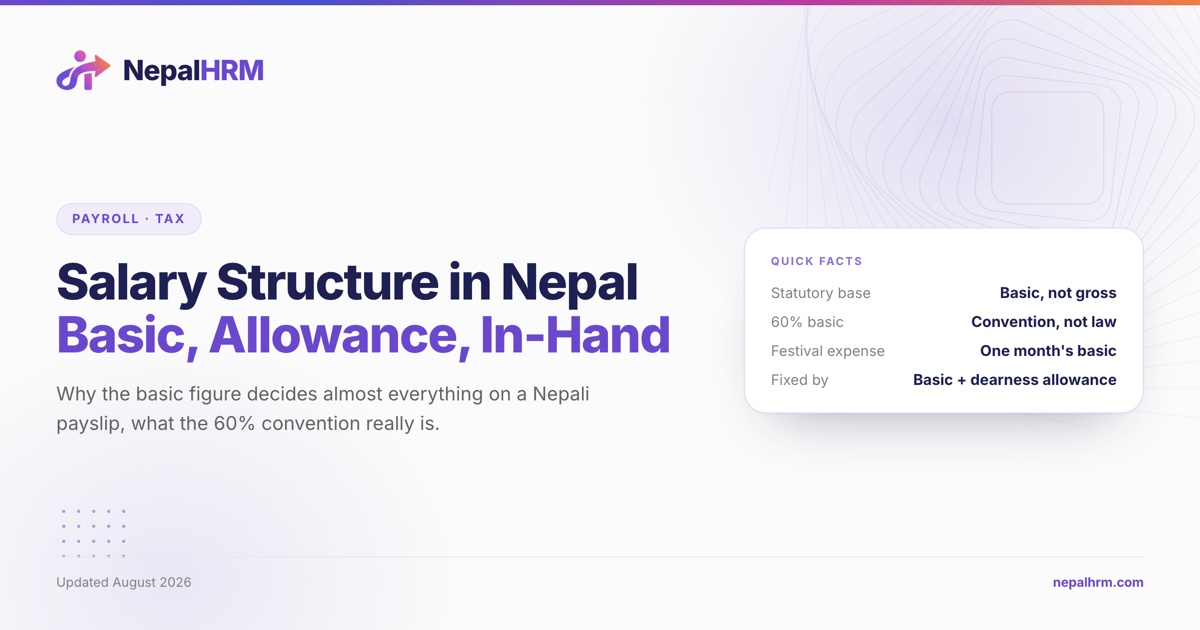
A Nepali salary has four numbers, and only one of them drives the statutory maths. Gross is basic plus allowances. In-hand is gross minus deductions. Cost to company is gross plus the employer's own contributions. But basic is the figure that sets provident fund, SSF, gratuity, overtime and festival expense, because every one of those is a percentage of basic and none of them is a percentage of gross.
That is why two people on the same gross salary can take home different amounts and cost their employers different amounts. This guide takes the structure apart. For the full monthly calculation, see how to calculate employee salary in Nepal.
Table of Contents
- The four numbers
- What is computed on basic, and what is not
- The 60% convention
- Allowances are not a loophole
- What may lawfully be deducted
- A worked structure
- Five mistakes to check for
- Frequently asked questions
- What is gross salary in Nepal?
- What percentage of salary should basic be in Nepal?
- Is PF calculated on basic or gross salary in Nepal?
- Does increasing basic salary reduce take-home pay?
- Are allowances taxable in Nepal?
- What deductions can an employer legally make from salary in Nepal?
- What is cost to company in Nepal?
- Sources
The four numbers
| Number | What it is |
|---|---|
| Basic salary | The fixed core of the package. The base for every statutory percentage. |
| Gross salary | Basic plus all allowances, before any deduction. |
| In-hand (net) pay | Gross minus employee deductions: PF or SSF, CIT, and TDS. |
| Cost to company | Gross plus the employer's contributions and accruals. |
See basic salary, gross salary, net pay and cost to company for the definitions on their own.
What is computed on basic, and what is not
This table is the reason the basic figure matters more than anything else in a Nepali offer letter.
| Item | Base | Rate or amount |
|---|---|---|
| Provident fund, employee | Basic | 10% |
| Provident fund, employer | Basic | 10% |
| SSF, employee | Basic | 11% |
| SSF, employer | Basic | 20% |
| Gratuity accrual | Basic | 8.33% |
| Festival expense | Basic | One month's basic, each year (Labour Act §37) |
| Overtime | Basic | 1.5 times the hourly basic rate (Labour Act §31(1)) |
| Leave encashment on separation | Basic | Last basic remuneration drawn (Labour Act §49(2)) |
| TDS | Total remuneration | Slab rates on the annualised figure |
The last row is where structuring games fail. Section 8(2) of the Income Tax Act 2058 sweeps in wages, salary, leave pay, overtime, fees, commission, prizes, gifts, bonus and personal allowances including dearness, subsistence, entertainment and transport. Shifting NPR 10,000 from basic to a transport allowance changes the PF and gratuity base. It does not change the tax.
The 60% convention
Nepali payroll commonly sets basic at 50% or 60% of gross. This is a convention, not a statutory ratio. The Labour Act does not prescribe a percentage, and it does not state a divisor for a daily or hourly rate either; the flat thirty-day month used across Nepali payroll is convention in exactly the same way.
What it costs to change it, on the same NPR 100,000 monthly gross, employee on PF and gratuity:
| Basic set at | Basic | Employee PF | Gratuity accrual | Monthly TDS | In-hand | Employer cost | Festival expense |
|---|---|---|---|---|---|---|---|
| 40% | 40,000 | 4,000 | 3,332 | 2,100 | 93,900 | 107,332 | 40,000 |
| 50% | 50,000 | 5,000 | 4,165 | 2,000 | 93,000 | 109,165 | 50,000 |
| 60% | 60,000 | 6,000 | 4,998 | 1,900 | 92,100 | 110,998 | 60,000 |
Reading that table honestly: a low basic raises this month's take-home and lowers employer cost, and it quietly shrinks the employee's retirement pot, their gratuity, their overtime rate and their annual festival expense by the same proportion. A high basic does the reverse. The TDS column barely moves, and it moves in the employee's favour as basic rises, because a larger contribution means a larger deduction under Section 63.
A structure built to minimise employer cost by suppressing basic is a structure that pays a smaller festival expense every Dashain. That is usually noticed.
Allowances are not a loophole
Allowances have real uses: dearness allowance tracks cost of living, transport and entertainment allowances match actual patterns of work, and the minimum remuneration is itself fixed as a basic component plus a dearness allowance.
What they are not is a way out of tax. Section 8(3) excludes only a short list from remuneration, chiefly food and tiffin provided at the work site on terms available to all employees on the same basis, and reimbursement of expenditure that serves the employer's business purpose or that is exempt in computing investment income. Everything else that reaches the employee is remuneration.
See allowance and minimum wage for how each is defined and fixed.
What may lawfully be deducted
Section 38(1) of the Labour Act 2074 states the default plainly: remuneration may not be deducted except in specified cases. Tax due under prevailing law is one of them, which is what makes TDS, PF and SSF deductions lawful. An employer inventing a deduction outside those cases is on the wrong side of that section, and the amount remains payable.
The payslip has to show the deductions it makes. See payslip, and our payslip generator for the format.
A worked structure
Monthly gross NPR 50,000, basic at 60%, employee on PF, no CIT election.
| Line | Amount |
|---|---|
| Basic | 30,000 |
| Allowances | 20,000 |
| Gross | 50,000 |
| Employee PF at 10% of basic | (3,000) |
| TDS | (470) |
| In-hand | 46,530 |
| Employer PF at 10% of basic | 3,000 |
| Employer monthly cost | 53,000 |
| Gratuity accruing at 8.33% of basic | 2,499 |
The same employee moved onto the SSF deducts NPR 3,300 instead of 3,000, pays no TDS at all because the 1% first band is not levied on an SSF contributor, and takes home NPR 46,700. Our CIT vs PF vs SSF comparison covers that choice, and the salary tax calculator will run any structure you type in.
Five mistakes to check for
- Contributing on gross instead of basic. On a 60% basic structure this overstates every contribution by two thirds.
- Quoting cost to company as though it were an offer. CTC includes the employer's own contributions, which the employee never sees on a payslip.
- Suppressing basic to cut cost. It cuts the festival expense, the gratuity and the overtime rate with it.
- Treating allowances as tax-free. Section 8(2)(b) puts personal allowances squarely inside remuneration.
- Changing the basic ratio mid-year without recomputing. Gratuity accrual, festival expense and the retirement deduction all move when basic moves.
A salary structure is a set of rules, not a spreadsheet column. NepalHRM holds basic and allowance as separate components, computes every statutory amount from the basic of the employee it belongs to, and shows both sides of the contribution on the payslip. See how payroll works, or book a walkthrough.
Frequently asked questions
What is gross salary in Nepal?
Basic salary plus all allowances, before any deduction. It is not the amount the employee receives, and it is not what the employer spends: in-hand pay is gross less deductions, and cost to company is gross plus the employer's own contributions.
What percentage of salary should basic be in Nepal?
There is no statutory percentage. Nepali payroll commonly uses 50% or 60% of gross, which is a convention rather than a legal requirement. What the Act does fix is that the statutory percentages are computed on basic.
Is PF calculated on basic or gross salary in Nepal?
On basic. So are the SSF contributions, gratuity, overtime and the festival expense. Income tax is the exception: it is computed on total remuneration.
Does increasing basic salary reduce take-home pay?
Slightly, in the month. On an NPR 100,000 gross, raising basic from 40% to 60% moves in-hand pay from about NPR 93,900 to about NPR 92,100, because the employee's own contribution rises. It also raises their gratuity, their overtime rate and their annual festival expense.
Are allowances taxable in Nepal?
Yes. Section 8(2)(b) of the Income Tax Act 2058 includes personal allowances such as dearness, subsistence, entertainment and transport in remuneration. Only the narrow Section 8(3) list stays out.
What deductions can an employer legally make from salary in Nepal?
Section 38(1) of the Labour Act 2074 prohibits deductions except in specified cases, of which tax due under prevailing law is one. Statutory deductions are lawful; discretionary ones outside those cases are not.
What is cost to company in Nepal?
Gross salary plus the employer's contributions and accruals, chiefly the employer PF or SSF share and the gratuity accruing at 8.33% of basic. It is a budgeting figure, not a take-home figure.
Sources
- Labour Act, 2074 (2017), consolidated Nepali text, Nepal Law Commission: lawcommission.gov.np. Sections 31, 37, 38 and 49 read from that text, retrieved 2026-08-07.
- Income Tax Act, 2058 (2002), Nepal Law Commission text as published by the Institute of Chartered Accountants of Nepal: en.ican.org.np. Sections 8 and 63, retrieved 2026-08-07.
- Contribution rates: Social Security Scheme Operation Procedure, 2075, Section 25, ssf.gov.np.
- Every figure in the worked tables is generated from
lib/nepal-payroll.tsandlib/nepal-labour.ts, the single sources behind our calculators. The minimum remuneration is fixed by notice rather than by the Act, so this page states its structure and does not quote a rate; see /glossary/minimum-wage.
Related reading: TDS on salary in Nepal · Payroll accounting in Nepal · Payslip generator