Nepal Leave Calculator: Balance and Encashment
Enter length of service and leave already taken, and read the whole position: home and sick leave earned, what each accumulates to against its ceiling, and what the balance is worth if employment ended today.
- Labour Act 2074
- Section numbers cited
- Nothing leaves your browser
Labour Act 2074, leave entitlements
- Home leave accrual
- 1 in 20
- Sick leave a year
- 12 days
- Accumulation ceilings
- 90 / 45
- Encashment rate
- Last basic
Deduct any unpaid absence before reading the accrual.
Home leave
Cap 90 days1 day per 20 worked · Section 43(1)
- Earned
- 54.8 days
- Balance after leave taken
- 34.8 days
- Held against the ceiling
- 34.8 days
Sick leave
Cap 45 days12 days a year · Section 44(1)
- Earned
- 36 days
- Balance after leave taken
- 30 days
- Held against the ceiling
- 30 days
Encashment is valued at the last Basic remuneration drawn, not gross, so a recent raise lifts the whole accumulated balance. The Act sets the entitlements but not the divisor used to reach a daily rate; a flat 30 days is settled Nepali payroll practice rather than statute. This is the statutory floor: a contract or collective agreement may be more generous, and unpaid absence has to come off the period worked above.
Four Inputs, One Balance
The calculator applies the accrual rule, the two ceilings and the encashment basis exactly as the Act states them, then values the result at the basic salary you enter.
- 1
Enter length of service
Years and months. Home leave accrues against the period worked at one day per 20, so this is what drives the entitlement. Deduct any unpaid absence: the calculator shows the day count it derived so you can check it.
- 2
Enter last basic salary
Monthly basic, not gross. Section 49(2) values a payout at the last basic remuneration drawn, so allowances never enter the figure and a recent raise lifts the whole accumulated balance.
- 3
Enter leave already taken
Days of home leave and sick leave used so far. What remains is the balance that accumulates, and what accumulates is what gets paid out.
- 4
Read the balance and what it is worth
Each leave type shows days earned, days left, and how much of that survives its ceiling. Anything above the ceiling is listed separately, because Section 49(3) pays it out at the end of the year rather than carrying it forward.
Last updated · Reviewed by Rajendra Regmi, Co-founder
Every Leave Type, and Its Section
The statutory floor. A contract, a bye-law or a collective agreement may be more generous, and where an entitlement is a count rather than a date, the employer or the regulator fixes the dates.
| Leave type | Entitlement | Section |
|---|---|---|
| Weekly leave | 1 day per week | 40 |
| Public leave | 13 days a year, 14 for a female employee | 41(1) |
| Home leave | 1 day per 20 worked, about 18 a year | 43(1) |
| Sick leave | 12 days a year, paid in full | 44(1) |
| Maternity leave | 14 weeks, 60 days of it paid | 45 |
| Maternity care leave | 15 days, paid | 45(7) |
| Mourning leave | 13 days, full remuneration | 48(1) |
| Accumulation ceilings | 90 days home leave, 45 days sick leave | 49(1) |
Public leave is a count of days, not a calendar: Section 41(2) leaves the actual dates to the regulator of the enterprise, or to the employer where there is none. The government's annual list is what most companies follow.
The Four Rules That Decide a Balance
Most leave miscalculations in Nepal come from one of these four, and three of them are places the secondary sources are unreliable.
Home leave accrues, it is not granted
Section 43(1) earns one day for every 20 days worked, which reaches roughly 18 days over a full year. A policy that hands out a flat annual block on day one is more generous than the Act, which is allowed, but it also means a leaver in month three has taken leave they had not earned, and that comes back in the final settlement.
The two ceilings are different numbers
Section 49(1) caps home leave at 90 days and sick leave at 45. They are frequently reported as a single 90-day cap covering both. They are not, and a settlement built on the wrong one overpays sick leave by up to 45 days of basic.
Sick leave is encashable
Section 49(2) names accumulated home leave and sick leave together as the lump sum paid when an employee is relieved of service or dies. Sick leave being purpose-specific does not make it forfeit. This is the provision most often stated backwards.
It is basic, and it is the last one
Section 49(2) sets the payout at the last basic remuneration being drawn. Basic excludes allowances, and last means a raise shortly before an exit revalues the entire accumulated balance, not only the days earned after it.
Above the ceiling is paid, not lost
Section 49(3) pays out the excess at the end of each year for anyone whose accumulated leave sits above the ceiling. The balance stops growing; the entitlement does not disappear.
The daily rate is convention, not statute
The Act fixes the entitlements and says nothing about what a monthly basic is divided by to reach one day. Nepali payroll practice uses a flat 30. A policy using anything else should say so in writing, well before anyone reaches an exit interview.
The Same Rules, Accrued Every Month, for Everyone
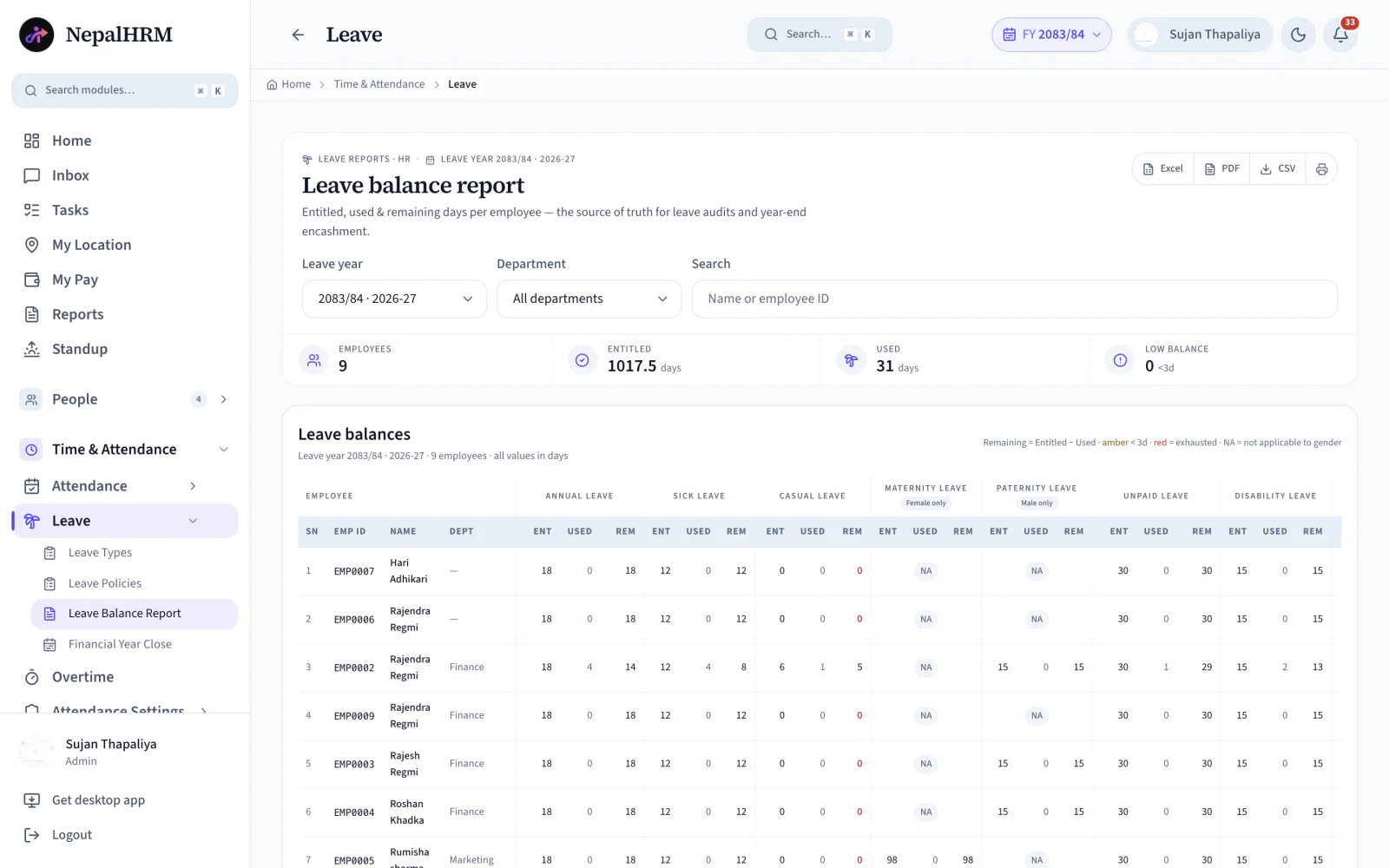
This page answers one person at a time, from figures you type in. NepalHRM holds the accrual rule and the ceilings once in leave policy, then applies them to every employee as approvals land.
- Accrual rates and ceilings are set per leave type, then applied per employee automatically.
- Balances update on every approval, so the encashment liability is current rather than reconstructed at exit.
- Current, monthly and annual balance reports export per employee, any day of the month.
- The balance feeds the final settlement, so encashment is priced from the same ledger that approved the leave.
Nepal Leave Rules, Answered
Section 43(1) of the Labour Act 2074 earns one day of home leave for every 20 days worked, so a full year reaches roughly 18 days and a joiner three months in has earned about four and a half. It accrues against the period worked rather than being granted as an annual block, which is why unpaid absence reduces it.
Two different ceilings, under Section 49(1): home leave accumulates up to 90 days and sick leave up to 45. They are commonly quoted as one shared 90-day limit, which is wrong and overstates a sick leave payout. Anything above a ceiling is paid out at the end of the year under Section 49(3) rather than carried forward.
Yes. Section 49(2) settles accumulated home leave and sick leave together as a lump sum when an employee is relieved of service or dies. Mourning, maternity and paternity leave are purpose-specific and are not encashed.
On basic. Section 49(2) says the lump sum is set by the last basic remuneration being drawn, so allowances are excluded. Because it is the last basic, a raise shortly before an exit revalues the whole accumulated balance.
Section 41(1) sets 13 paid public leave days a year including May Day, and 14 for a female employee, the extra one being International Women Labour Day. Which calendar dates those fall on is not in the Act: Section 41(2) leaves that to the regulator of the enterprise, or to the employer where there is none.
This tool answers one employee from figures you type. Accruing balances automatically for everyone, holding the policy in one place and carrying the balance into a final settlement is what the NepalHRM leave module does. Companies with up to 10 employees use it free.
While You're Here, Try These Too
Every NepalHRM tool is free, runs in your browser and needs no account. See all of the free Nepal payroll and tax calculators.
Stop Reconstructing Balances at Exit
This calculator prices one balance from numbers you remember. Inside NepalHRM the balance is already correct, because it accrued against approvals as they happened.
- Labour Act 2074 accruals
- Per-policy ceilings
- Balance reports any day
- Free onboarding