Employee Task Management Software Where the Work Meets the Record
Tasks with an owner and a due date, a written daily standup with blockers, and one-to-ones whose action items carry forward. All of it attached to the same employee record that already holds their hours, leave and objectives.
- No credit card
- Quick set up
- Free onboarding
What is employee task management software?
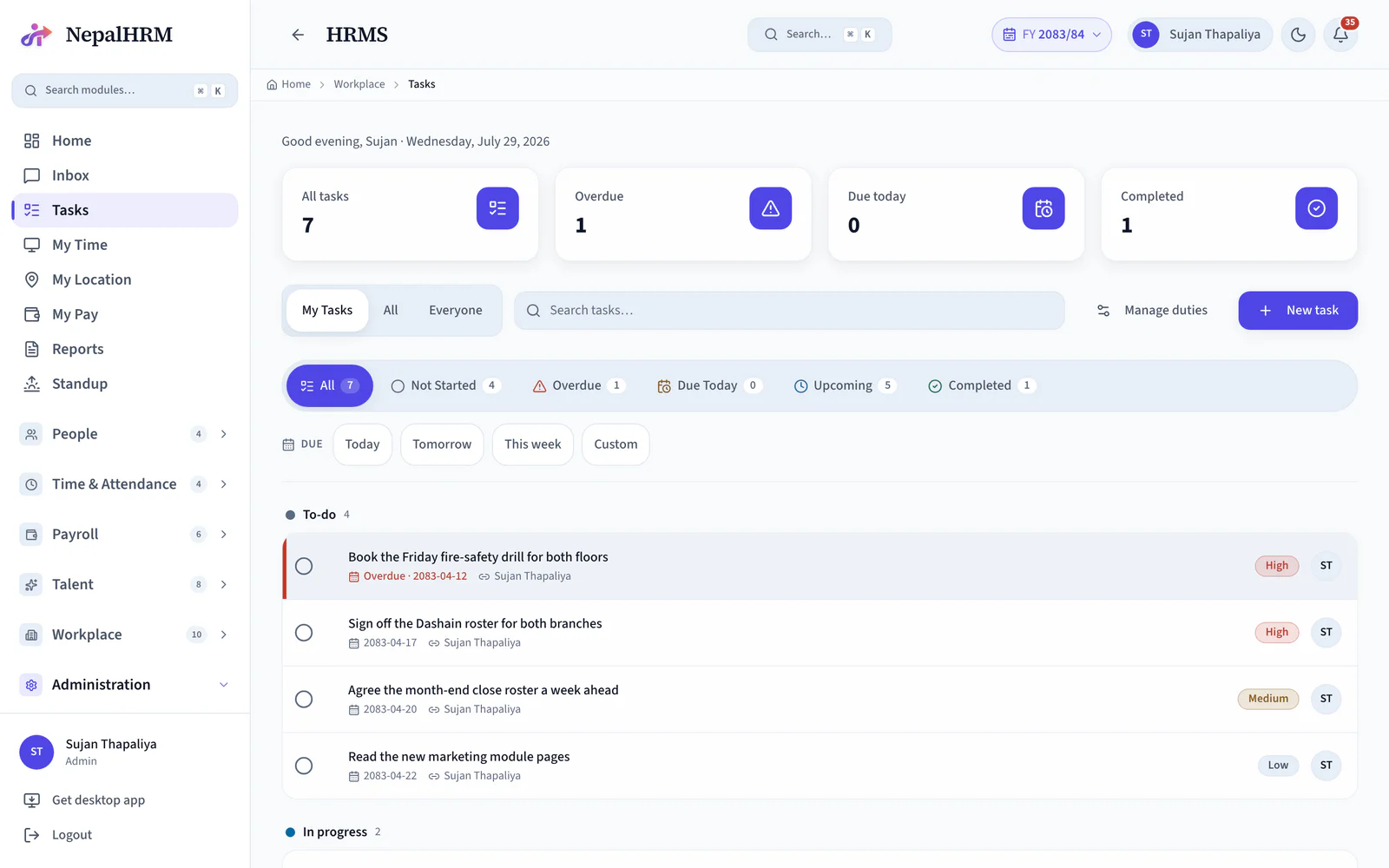
Task management software records what someone is working on and who is waiting on it, in the same system that holds their hours and their review. In NepalHRM every task has an assigner, an assignee, a due date and a priority, and a written standup replaces the status meeting: a plan in the morning, actuals at day end. The value is not the task list itself but that it reads the same employee record as everything else.
- Tasks move through four states: to do, in progress, done and cancelled.
- Every standup task gets its own code, so it can be referred to later without ambiguity.
- Unfinished work carries forward into the next day instead of being retyped.
- Blockers are an explicit flag rather than a sentence somebody said once in a meeting.
- Because tasks, hours and reviews are one system, what somebody delivered is visible next to when they were working.
Last updated · Reviewed by Rajendra Regmi, Co-founder
Written down, owned, and reviewed where it counts
- 4 States
- To do, in progress, done, cancelled
- ST001
- Every standup task gets its own code
- Carry-Forward
- Unfinished work follows into tomorrow
- 1 System
- The same record as leave, hours and reviews
Work Assigned in a Group Chat Is Work Nobody Owns
The work gets done, mostly. What is missing is any record of who agreed to what, and by when.
- Tasks handed out in a Viber group and buried by lunchtime
- A morning call to ask for status, every day, from everyone
- Blockers mentioned once, then quietly worked around for a week
- A performance review with no evidence in it except what both people remember
An Owner, a Date, and a Written Day
The point is not the task list. It is that the task list, the attendance record and the review all read the same employee.
What NepalHRM gives you
- Every task has an assigner, an assignee, a due date and a priority
- A written standup replaces the status meeting: plan in the morning, actuals at day end
- Blockers are an explicit flag, not a sentence somebody said once
- One-to-one action items carry forward until they are actually done
Task Tracking That Knows Who the Person Is
Tasks, a structured daily standup and one-to-ones, all reading the same employee record as payroll and attendance.
Tasks With Real Ownership
An assigner and an assignee, both named, plus a due date and a low, medium or high priority. Either party can act; a manager is not auto-granted somebody else's task.
Linked to the Employee
A task can point at an employee record, so context is the person rather than a board column. That link is the reason this sits in the HR system at all.
Comments and Attachments
The discussion and the file live on the task, so the reason a decision changed is still there three months later.
The Daily Standup
A morning plan and a day-end actual per person per day, with progress marked planned, in progress or done on each item.
Explicit Blockers
A blocker is a flag on the item, not a remark in a call, so it shows up on the board and can be counted.
Per-Task Verification
A team leader verifies or requests changes on each standup task individually. Pending, verified or changes requested, item by item.
Carry-Forward Chains
An unfinished task continues into the next day and keeps a link back to the one it continues, so a three-day task reads as three days.
Help Requests
Ask for help on a blocked item from inside the standup, and get a reply on the record instead of a private message.
One-to-One Meetings
1:1, Check-in, Goal Setting and Feedback meetings with an agenda, notes and a duration, optionally tied to a performance period.
Action Items That Follow You
Every 1:1 opens with the still-open items from the last few, each with an owner, a due date and an overdue flag.
Beside the Objectives
Objectives and KPIs live in the same system, so a quarter of 1:1s and the work behind them roll up under one review window.
Team Activity
What the team is working on today without asking anyone, which is the point of writing it down in the first place.
From Assigned to Evidence in a Review
Six steps, and the last one is the reason to keep the first five honest.
- To do
Assigned
Named assigner, named assignee, a due date and a priority. The task exists outside somebody's memory.
- In progress
Planned at standup
It appears in the morning plan, gets its own code, and the reviewer locks the plan once the day starts.
- Blocked
Raised
The blocker flag goes on and a help request can be raised against it, in writing, on the day it happened.
- Verified
Checked
The team leader verifies the item or requests changes. Verification is per task, not per person per day.
- Done
Completed
The day-end update records what actually happened against what was planned, with links to the evidence.
- Reviewed
Counted
The 1:1 and the review read the same record, so a performance conversation has something in it besides impressions.
Not a Replacement for Jira. A Replacement for the Morning Call
If your engineers live in a sprint board, keep it. This is for the other ninety per cent of a Nepali company, where work is assigned verbally and reviewed from memory.
Viber Groups and a Standup Call
- Assignments scroll away and get re-asked the next morning
- Everyone waits their turn for thirty minutes to say four sentences
- Blockers depend on somebody being confident enough to raise them out loud
- Nothing from the whole quarter is available when the review comes round
Write the Day Down, Then Use It
One track for the standup ritual, one for assigning and tracking work, one for turning both into a review.
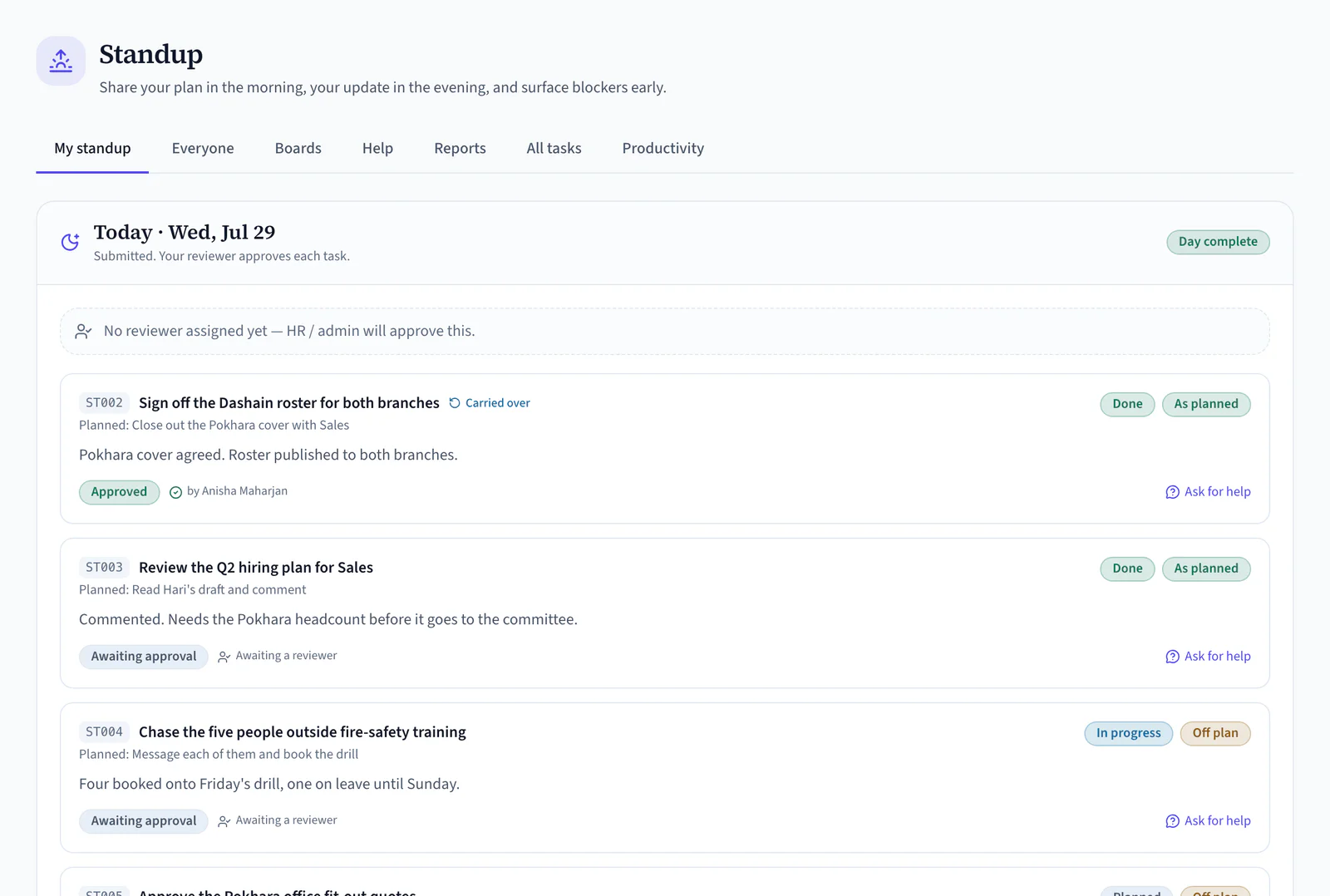
- Each person lists what they will do today. Every item gets a code from their initials and a running number, ST001 upward, so it can be referred to later.
- A team leader locks the plan once the standup is done, which fixes what was committed to. Work begins when the reviewer closes the standup.
- A blocker is an explicit flag on the item, and a help request can be raised against it so somebody answers on the record.
- What actually happened against what was planned, with progress per item and up to ten links as evidence. Unfinished items carry into tomorrow.
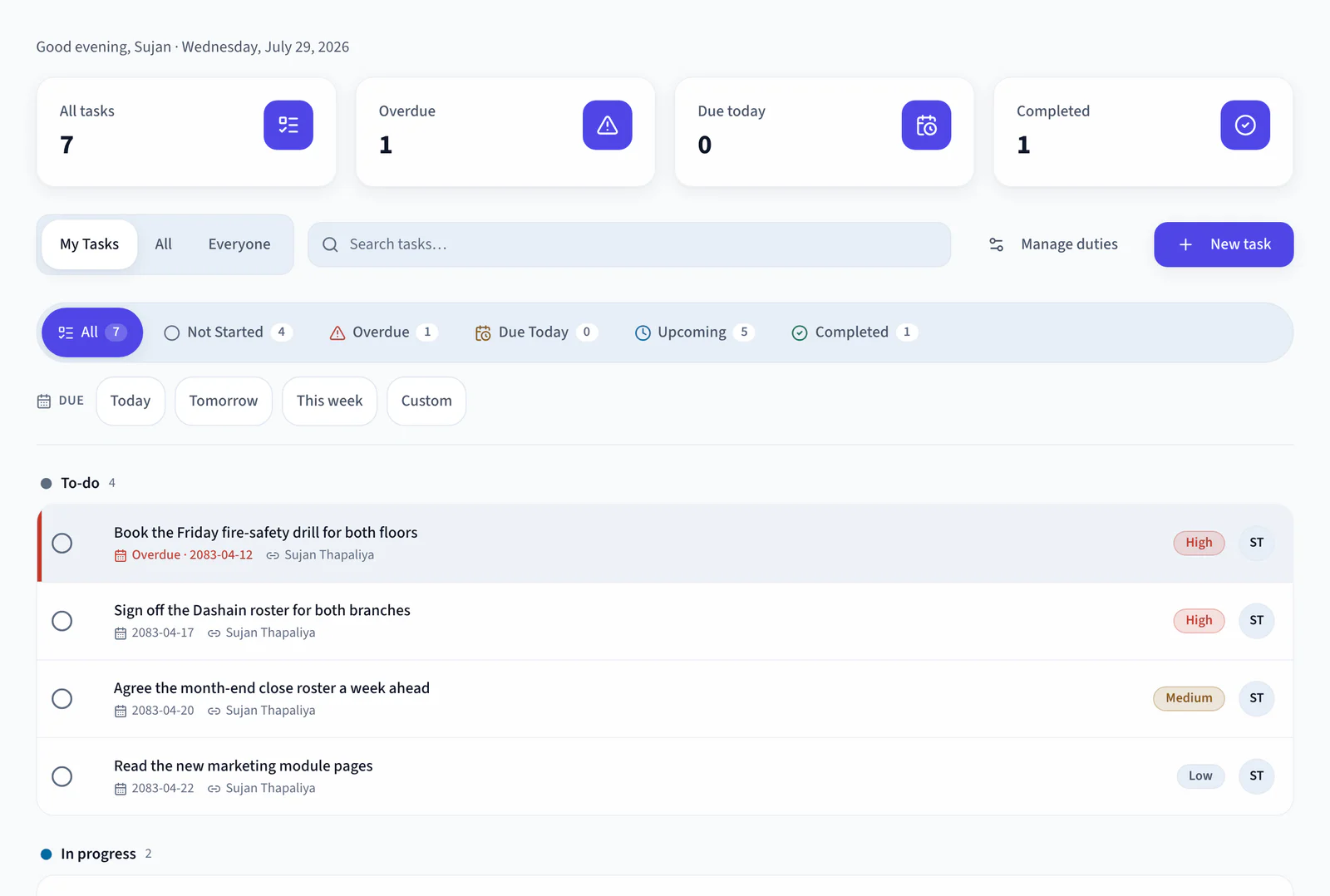
- A title, the person who has to do it, a due date and a priority. Optionally point it at an employee record for context.
- Status moves through to do, in progress and done, with comments and attachments kept on the task itself.
- The team activity view shows what everyone is working on right now, which is what the morning call was really for.
- Due and overdue work surfaces in the app and as a push notification, so following up is not a manager's second job.
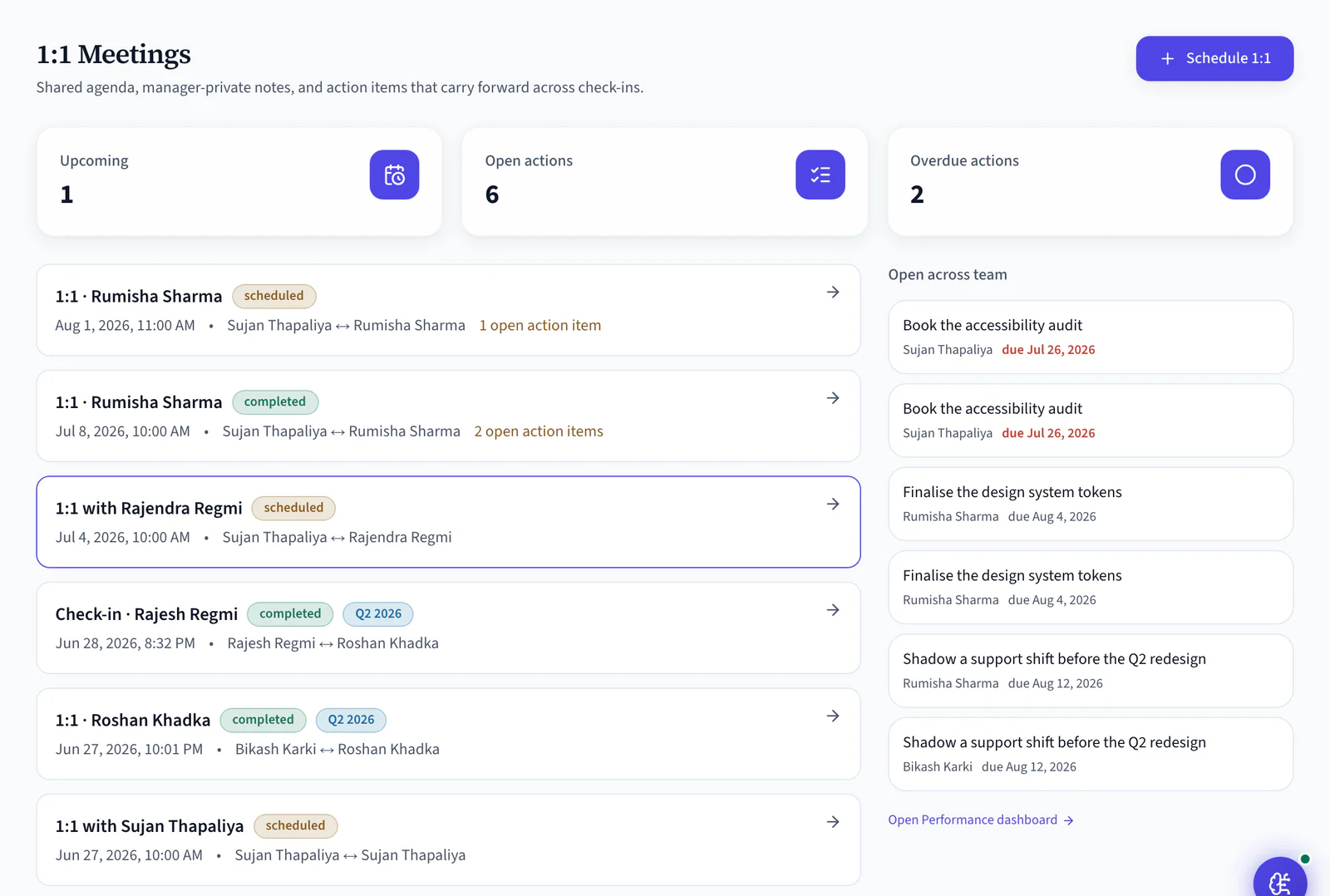
- 1:1, Check-in, Goal Setting or Feedback, with an agenda and a duration. It can be tied to a performance period so a quarter rolls up together.
- The meeting opens with still-open action items from the last few 1:1s between the same pair, so nothing quietly drops between conversations.
- Each one gets an owning employee, a due date and a status of open, done or cancelled, tracked with an overdue flag.
- The quarter's tasks, standups and action items sit against the same employee the review is about, so the conversation starts from evidence.
Planned, With a Code
Owner and Date, Always
Four Meeting Types
Written Down Once, Useful to Three People
The employee gets their day back, the manager gets a picture without a meeting, and HR gets a review with evidence in it.
For Managers
Status without the standup call
- What the whole team is working on, read whenever you want
- Blockers visible on the board rather than raised out loud
- Verify or request changes per task, not per person
For Employees
Credit for what you actually did
- Your commitments in writing, so scope creep is visible
- Blockers you can flag without interrupting anyone
- A quarter of work already recorded when the review comes
For HR
Reviews with something in them
- Action items from every 1:1, with owners and due dates
- A quarter of standups tied to the same performance period
- Objectives and the work behind them in one system
Daily Work for Nepal's Distributed Teams
Agencies, software teams, NGOs and branch operations. Anywhere a manager is asking for status by phone, a written standup is faster for both sides.
Tasks Sit Next to the Rest of the Record
The reason to run tasks inside the HR system rather than beside it: the person doing the work is already in it.
Performance Management
One-to-ones tie to a performance period, so a quarter of meetings and action items rolls into the review.
Activity Tracker
For teams that need it, the desktop tracker shows where the hours went beside what was committed to.
Employee Management
Assigners, assignees and standup boards all read the same employee records, departments and reporting lines.
Helpdesk
A request from another team belongs in a ticket queue with an owner, not in somebody's personal task list.
Employee Engagement
Announce the change once, then track the work it creates, instead of chasing both in separate chat threads.
Training & LMS
Assign the course as a task with a due date, so training shows up in the same list as the rest of the work.
Task Management is one module of the all-in-one HR software for Nepal, so an employee is created once and every module above reads the same record.
Simple, Transparent Pricing
No Hidden Fees
NepalHRM gives you enterprise-grade HR software at a price built for Nepali businesses of every size.
- All core HR modules
- Nepal payroll compliance
- PF, SSF, CIT & eTDS
- Biometric integration
- Free onboarding support
- Regular feature updates
- Multi-company support
- BS + AD calendar
Free trial available, no card required · No setup fees · Cancel anytime
Work From the Web, Android and iOS
A standup filed from the bus, a task closed at a client site, a blocker raised before the manager has finished their tea.
Frequently Asked Questions
Everything you need to know about task management in NepalHRM before you get started.
No, and it is not trying to be. There are no sprints, story points or dependency graphs here. It is for the far more common case in Nepal, where work is assigned verbally in a group chat and reviewed from memory, and where the value comes from the task sitting next to the person's hours, leave and objectives.
They are separate things, deliberately. A task carries an owner, a due date, a priority, comments and an optional link to an employee record, and that employee link is the only grouping it supports today. A Project here is a time-bound, usually donor-funded work stream that carries salary cost through allocations, so it answers a payroll and reporting question rather than a to-do one.
Each person files a morning plan of what they will do, and a reviewer locks it and then closes the standup so work begins. At day end the same person files what actually happened against each item. Items are marked planned, in progress or done, and can carry an explicit blocker flag.
No. Daily Standups is custom-priced and never bundled into a self-serve tier, so it is provisioned per company rather than switched on from a plan card. Tasks themselves are on Free, Business and Enterprise; see /pricing for the current per-employee rates and what each tier includes.
Yes. The team activity view shows current work across the team, and department standup boards show who has filed and what they committed to. A reviewer can verify a task or request changes on it individually, so feedback is per item rather than a blanket approval of somebody's day.
It carries forward. An unfinished standup item continues into the next day and keeps a link back to the item it continues, so a task that takes three days reads as one chain across three days rather than as three unrelated entries. The chain repairs itself if a link is removed.
A meeting is between an employee and their manager, and the agenda, notes and action items belong to that pair. Optionally it links to a performance period so a quarter of meetings rolls up under one review window. Treat it as a work record rather than a confidential channel; /messaging-privacy sets out the wider posture.
The review reads the same employee record, so the quarter's one-to-one action items and the objectives they relate to are available when the review opens. Objectives and KPIs live in the same system as the tasks, which is what makes a review start from evidence instead of from what both people remember.
Stop Asking for Status. Start Reading It
Join hundreds of Nepali businesses that have already moved from manual HR to NepalHRM. The morning call was never the fastest way to find out.
- No credit card
- Free onboarding
- Set up in one day
- Cancel anytime