Nepal Overtime Calculator: 1.5x Basic, and the Ceiling
Enter a basic salary and the hours worked beyond the standard week. Read the ordinary hourly rate, the overtime rate at one and a half times, what the week is worth, and whether it stayed inside the statutory ceiling.
- Labour Act 2074
- Section numbers cited
- Nothing leaves your browser
Labour Act 2074, working time
- Standard hours, day and week
- 8 / 48
- Overtime rate on basic
- 1.5x
- Overtime ceiling, day and week
- 4 / 24
- Rest after 5 hours
- 30 min
Section 31(1) rates overtime at 1.5 times basic remuneration, so allowances stay out of the hourly figure. Standard hours are 8 a day and 48 a week under Section 28(1); anything beyond that is overtime. The divisor used to reach an hourly rate is payroll practice rather than statute, and a collective agreement may set a higher multiplier than the statutory floor.
Three Inputs, One Week's Overtime
The calculator derives an hourly rate from basic salary, applies the statutory multiplier, and checks the hours against both ceilings the Act sets.
- 1
Enter monthly basic salary
Basic, not gross. Section 31(1) rates overtime against the basic remuneration receivable during regular hours, so allowances never enter the hourly figure. Using gross here is the most common way an overtime bill comes out too high.
- 2
Enter the overtime hours
Hours worked beyond the standard 8-hour day or 48-hour week set by Section 28(1). The half-hour rest after 5 continuous hours counts inside standard hours, not on top of them.
- 3
Enter days worked in the week
Only used to check the 4-hour daily ceiling. Twelve overtime hours across six days is lawful; the same twelve across two days is not.
- 4
Read the rate, the pay and the ceiling
Ordinary hourly, overtime hourly and the week's total, plus a warning when the hours exceed what Section 30(1) permits. Over-ceiling hours are still shown as payable: the ceiling limits asking for the work, not paying for it.
Last updated · Reviewed by Rajendra Regmi, Co-founder
Working Time Rules, and Their Sections
The statutory position on hours and overtime. A collective agreement may set a higher multiplier or a tighter ceiling; it cannot set a lower one.
| Rule | What the Act sets | Section |
|---|---|---|
| Standard working hours | 8 hours a day, 48 a week | 28(1) |
| Rest break | 30 minutes after 5 continuous hours, counted inside working hours | 28(2), 28(4) |
| Weekly leave | 1 day per week | 40 |
| Compulsion to work overtime | An employer may not compel overtime, with narrow exceptions | 29 |
| Overtime ceiling | 4 hours a day and 24 a week | 30(1) |
| Work on a leave day without substitute leave | Deemed to be overtime | 30(2) |
| Overtime rate | 1.5 times basic remuneration | 31(1) |
Section 31(2) leaves room for a collective agreement to provide differently, which in practice means a higher rate. The figures above are the floor the Act guarantees, not a ceiling on what an employer may pay.
Four Mistakes That Cost Real Money
Each of these produces a number that looks plausible on a payslip and is wrong, and the first two are wrong in opposite directions.
Rating overtime on gross
Section 31(1) says basic remuneration. A structure where basic is 60 percent of gross and overtime is rated on gross overpays every overtime hour by two thirds. It is the single most common overtime error in Nepali payroll, and it compounds monthly.
Paying a flat hourly figure
A fixed per-hour overtime rate agreed years ago drifts below 1.5 times basic as salaries rise, and the shortfall is the finding a labour inspection writes up. The multiplier attaches to the current basic, not to a number set once.
Treating the ceiling as a payroll rule
Section 30(1) limits how much overtime an employer may cause a worker to do: 4 hours a day, 24 a week. It does not say hours beyond that go unpaid. Withholding pay for hours actually worked adds a second breach to the first.
Missing overtime that was never requested
Section 30(2) deems work done on a weekly or public leave day to be overtime where no substitute leave was given within twenty-one days. That is overtime nobody filed a request for, and a system keyed only to approved requests will not see it.
Counting the rest break as extra time
The 30-minute break after 5 continuous hours is counted inside the 8-hour day under Section 28(4). It does not extend the day, and time spent on it is not overtime.
The hourly divisor is not in the Act
The Act sets the multiplier and the standard hours, and says nothing about what a monthly basic is divided by to reach one hour. Whichever convention a company uses, it belongs in a written policy, because two defensible divisors produce visibly different overtime bills.
Overtime Priced From Punches, Not Memory
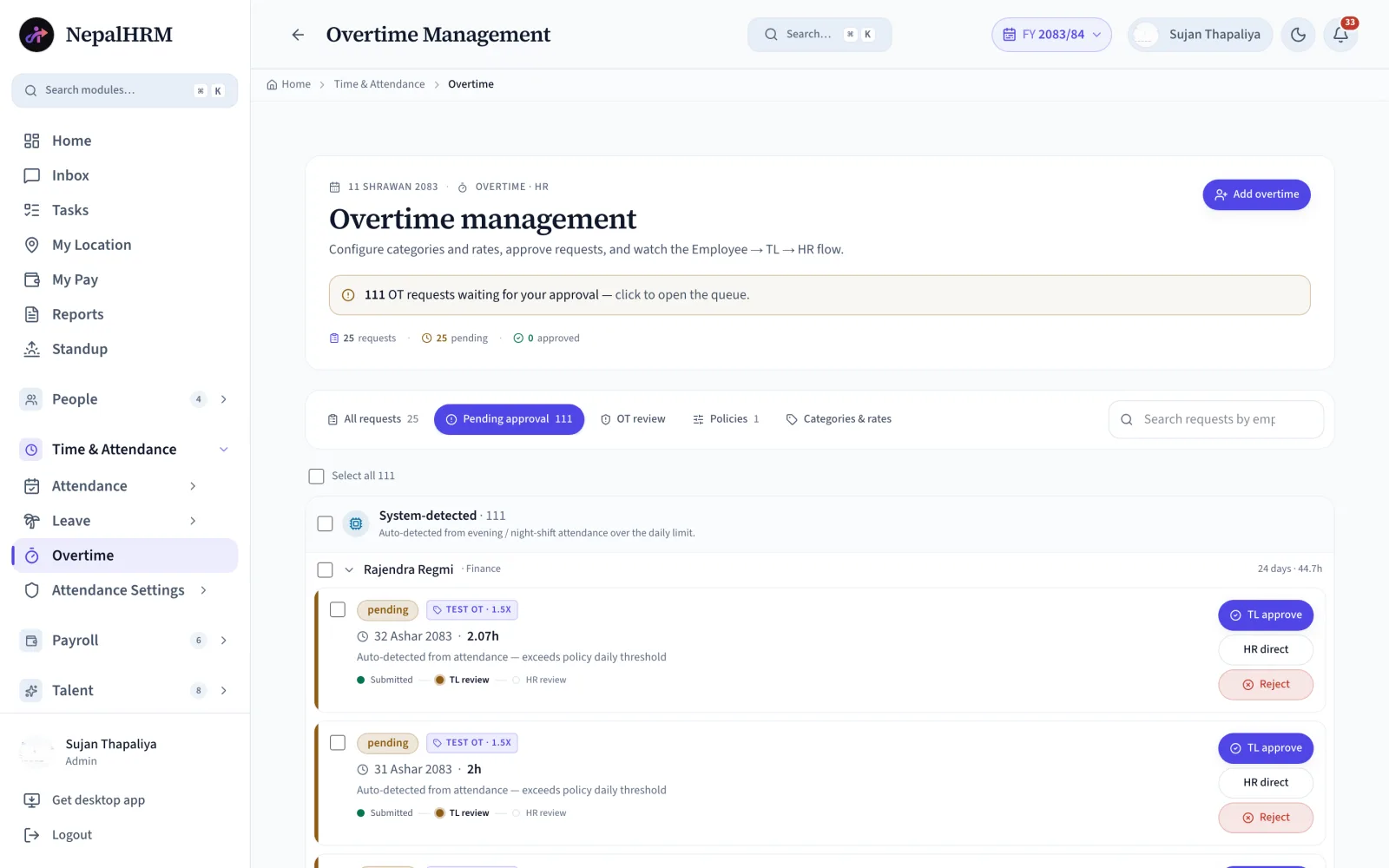
This page prices a week you type in. NepalHRM raises the overtime from the day's punches once worked minutes cross the attendance policy threshold, then routes it for approval before it reaches payroll.
- Overtime is raised by the employee or from the day's punches, and carries a rate tier through team-leader and HR review.
- Rate tiers are configurable, seeded at 1.5x regular, 2.0x weekend, 2.5x holiday, 1.75x night and 2.0x emergency.
- Approved hours price into the payroll run at the tier chosen, so the payslip and the timesheet agree.
- The daily and weekly ceilings stay a supervisor decision. NepalHRM reports the hours; it does not refuse them.
Nepal Overtime Rules, Answered
Section 31(1) of the Labour Act 2074 pays overtime at 1.5 times the basic remuneration receivable during regular hours. Derive an hourly rate from monthly basic, multiply by 1.5, then by the overtime hours. Basic is the base, not gross, so allowances are excluded from the hourly figure.
Section 30(1) allows overtime of no more than 4 hours a day and 24 hours a week, on top of the standard 8-hour day and 48-hour week in Section 28(1). Section 29 also prevents an employer compelling overtime, except where not doing the work would endanger life, safety or health, or cause serious loss.
On basic. Section 31(1) names the basic remuneration receivable during regular hours of work. Rating overtime on gross is the most common overtime error in Nepali payroll and overpays every hour, in a salary structure where basic is 60 percent of gross, by two thirds.
It can. Section 30(2) deems work performed without the substitute leave that Section 42 requires to be overtime work. Substitute leave has to be given within twenty-one days of the day worked, so a holiday shift that is never compensated with a day off becomes payable overtime.
Yes. The ceiling in Section 30(1) limits how much overtime an employer may cause a worker to perform. It does not authorise withholding pay for hours actually worked. Hours beyond the ceiling remain payable at the statutory rate, and the breach is the scheduling, not the payment.
This tool prices one week from figures you type. Raising overtime from real punches, routing it for approval and pricing it into payroll at the right rate tier is what the NepalHRM shift and overtime module does. Companies with up to 10 employees use it free.
While You're Here, Try These Too
Every NepalHRM tool is free, runs in your browser and needs no account. See all of the free Nepal payroll and tax calculators.
Price Overtime From the Timesheet, Every Month
This calculator settles one week. Inside NepalHRM overtime is raised from punched time, approved on a trail, and priced into the run at the tier you configured.
- 1.5x on basic, per the Act
- Configurable rate tiers
- Approval trail to payroll
- Free onboarding