Nepal Offer Letter Format, Built From the Act
Fill in the appointment and get a letter that states what Section 11(3) of the Labour Act 2074 requires it to state, with the salary broken down on the current tax slabs rather than left as one gross figure.
- Labour Act 2074 sections cited
- SSF or PF and CIT
- Prints as a PDF
- Nothing leaves your browser
What the Act requires of the letter
- Section 11(3) requires
- 3 things
- Of employment, Section 10
- 5 types
- Maximum probation, Section 13
- 6 months
- Notice after a year, Section 144
- 30 days
The appointment
Salary and terms
Against the Labour Act 2074
5 of 5 clear- Remuneration is stated, and broken down
Gross NPR 60,000 a month, of which basic is NPR 36,000. Basic is the base every statutory figure is computed on, so a letter that gives only a gross figure leaves overtime, festival expense and gratuity undefined.
- Benefits are stated
The letter carries festival expense at 1 month of basic (Section 37), medical insurance of at least NPR 100,000 and accident insurance of at least NPR 700,000 (Sections 54 and 55), and enrolment in the Social Security Fund.
- Conditions of employment are stated
Regular employment under Section 10(1), Kathmandu office, Sunday to Friday, 10:00 to 18:00. The Act's ceiling is 8 hours a day and 48 a week (Section 28(1)).
- Probation is within 6 months
3 months. Section 13 allows up to 6, and once it passes without the contract being ended the employment relation is confirmed automatically.
- Notice is at least 30 days after a year
30 days. Section 144(1) sets the floor by length of service: 1 day up to four weeks, 7 days four weeks to one year, 30 days more than one year.
These five are the checks a letter can be tested against mechanically. They are not a legal review, and the Labour Rules 2075 prescribe further matters for the contract that this tool does not model.
Letter of Appointment
Dear Candidate,
Following your interview with us, we are pleased to appoint you to the position of Senior Accountant in the Finance department, on the terms set out below. This letter, once accepted, is the employment contract required by Section 11(1) of the Labour Act 2074.
- Type of employment. Your employment is regular employment within the meaning of Section 10(1) of the Labour Act 2074.
- Commencement and workplace. You will join on 2083-05-01 BS at Kathmandu office, reporting to the Finance Manager.
- Working hours. Sunday to Friday, 10:00 to 18:00, within the limit of 8 hours a day and 48 hours a week set by Section 28(1). Overtime, where required, is paid at 1.5 times basic remuneration under Section 31(1).
- Remuneration. A monthly gross of NPR 60,000, made up of a basic remuneration of NPR 36,000 and an allowance of NPR 24,000. The breakdown below shows the deductions that apply. Tax is deducted at source and deposited with the Inland Revenue Department.
- Annual grade. You will receive an annual increment in remuneration for each completed year of service, of not less than half a day's basic remuneration, under Section 36.
- Festival expense. An amount equal to 1 month's basic remuneration each year under Section 37, paid at Dashain unless you ask in writing for the festival you celebrate. In your first year it is paid in proportion to the service completed.
- Social Security Fund. You will be enrolled in the Social Security Fund. NPR 3,960 a month is deducted from your remuneration and the company contributes its own share on top of your salary.
- Insurance. Medical insurance of at least NPR 100,000 a year, with the premium shared between us on a pro rata basis (Section 54), and accident insurance of at least NPR 700,000 with the premium borne entirely by the company (Section 55).
- Leave. Public leave of 13 days a year, and 14 days for a female employee, on the days the company publishes (Section 41). Home leave accrues at one day for every twenty days worked (Section 43) and sick leave is 12 days a year (Section 44). Maternity, paternity and mourning leave apply as the Act provides.
- Probation. The first 3 months are a probation period under Section 13. If your work is not found satisfactory the contract may be ended during it. Once the period passes without that happening, the employment relation is confirmed automatically.
- Notice. Either of us may end this employment on 30 days' written notice, subject to the minimum set by Section 144(1) for your length of service. Notice may be paid or deducted in lieu under Sections 144(2) and 144(3). Nothing here limits action taken for misconduct under the Act.
- Company rules. You will observe the company's bye-laws, code of conduct and any collective agreement in force, together with the obligations placed on a labour by the Labour Act 2074 and the Labour Rules 2075.
| Monthly remuneration | NPR |
|---|---|
| Basic remuneration | 36,000 |
| Allowance | 24,000 |
| Gross monthly | 60,000 |
| Less: SSF employee contribution (11% of basic) | -3,960 |
| Less: tax deducted at source | -0 |
| Indicative net pay | 56,040 |
Please sign and return a copy of this letter to confirm your acceptance. We look forward to working with you.
A draft, not legal advice. Have a letter reviewed before it is issued, and check it against any collective agreement or bye-law that binds your enterprise.
Four Fields, Then the Letter
The order matters more than it looks. Employment type decides how the rest of the Act reads, and the salary split decides every statutory figure underneath it, so both come before the wording.
- 1
Name the type of employment
Section 10(1) recognises 5: regular, work-based, time-based, casual and part-time. Most Nepali letters name none, which leaves the single fact that decides how every other clause is read undefined. Section 10(2) settles a dispute about it on the nature of the work, whatever the contract says.
- 2
Split the salary before you quote it
Basic is the base for SSF, provident fund, gratuity, overtime and festival expense. A letter that gives only a gross figure has fixed none of them, and the generator computes each from the split so the letter and the first payslip agree.
- 3
Set probation and notice inside the limits
Probation may run to 6 months under Section 13 and no further. Notice is 1 day, 7 days or 30 days by length of service under Section 144(1). A contract may be more generous than either. It cannot be less.
- 4
Check it, then print it
The panel beside the letter reports it against the 3 matters Section 11(3) requires and the two limits above. Print to PDF, sign, and keep the accepted copy: Section 12(4) treats an employer who cannot produce the record as having the employment relation established against them anyway.
Last updated · Reviewed by Rajendra Regmi, Co-founder
The Same Letter, Three Jurisdictions
These are the three sources a Nepali HR team actually pulls a letter from, and the first two are wrong in ways that only surface at the first payslip or the first exit.
| Indian template | Global builder | Labour Act 2074 | |
|---|---|---|---|
| Contract in writing | Practice, by state | Optional, at-will | Compulsory, Section 11(1) |
| Provident fund | 12% of basic | Not modelled | 10% of basic, matched (Section 52(1)) |
| Gratuity | After 5 years | Not modelled | 8.33% of basic a month (Section 53(1)) |
| Notice to end employment | Contractual, often 60 to 90 days | None, at-will | 1, 7 or 30 days by service (Section 144(1)) |
| Festival payment | Bonus Act, on profit | Not modelled | 1 month of basic, every year (Section 37) |
| Insurance | ESI, by wage ceiling | Not modelled | NPR 100,000 medical, NPR 700,000 accident (Sections 54, 55) |
The at-will clause is the one worth pointing at. It appears in most free international offer letter templates, it is the single clause a Nepali labour officer will not accept, and it survives because nobody rereads the boilerplate once it is in the company's file.
Six Lines Worth Getting Right
Each of these settles a question that otherwise gets settled a year later, with less goodwill on both sides.
Basic, not just gross
Overtime is 1.5 times basic (Section 31(1)). Festival expense is one month of basic (Section 37). Gratuity is 8.33% of basic (Section 53(1)). SSF is assessed on basic. A letter that states only a gross salary has left all four undefined, and the employer who set basic low to reduce them has also reduced the number the employee sees on the first payslip.
Probation stops at 6 months
Section 13 permits a probation of up to 6 months and allows the contract to be ended within it if the work is not satisfactory. The clause that matters is the next one: once that period ends without the contract being terminated, the employment relation is confirmed automatically. A letter writing a longer probation has not extended anything.
Notice runs both ways
Section 144(1) binds the employer and the labour equally: 1 day up to four weeks of service, 7 days from four weeks to a year, 30 days after a year. Either side may pay or deduct in lieu (144(2), 144(3)). The obligation drops away only where employment ends on action taken for misconduct.
Insurance is not a perk
Sections 54 and 55 require annual medical insurance of at least NPR 100,000 with the premium shared pro rata, and accident insurance of at least NPR 700,000 with the premium borne entirely by the employer. Listing them as benefits the company generously provides is a common and harmless error; leaving them out of the letter entirely is the one to avoid.
The type is not decoration
Time-based employment is what most Nepali employers mean by a contract, and casual employment is the only type Section 11(2) lets you engage without a written contract at all, at seven days or less of work in a month. Section 10(2) then decides a dispute about regularity on the nature of the work, notwithstanding anything in the contract, so a regular job labelled otherwise stays regular.
The exit clause you write on day one
Section 148(1) gives the employer 15 days from the end of employment to pay everything owed, however the employment ended. Section 148(3) is the enforcement: miss it and remuneration keeps accruing as though the person were still in service until the money is paid. Saying so in the appointment letter costs nothing and settles the final settlement conversation before it starts.
Write the Letter Once, Send It a Hundred Times
A generator is the right tool for one letter. The second and third are a template problem, and the fiftieth is a version-control problem.
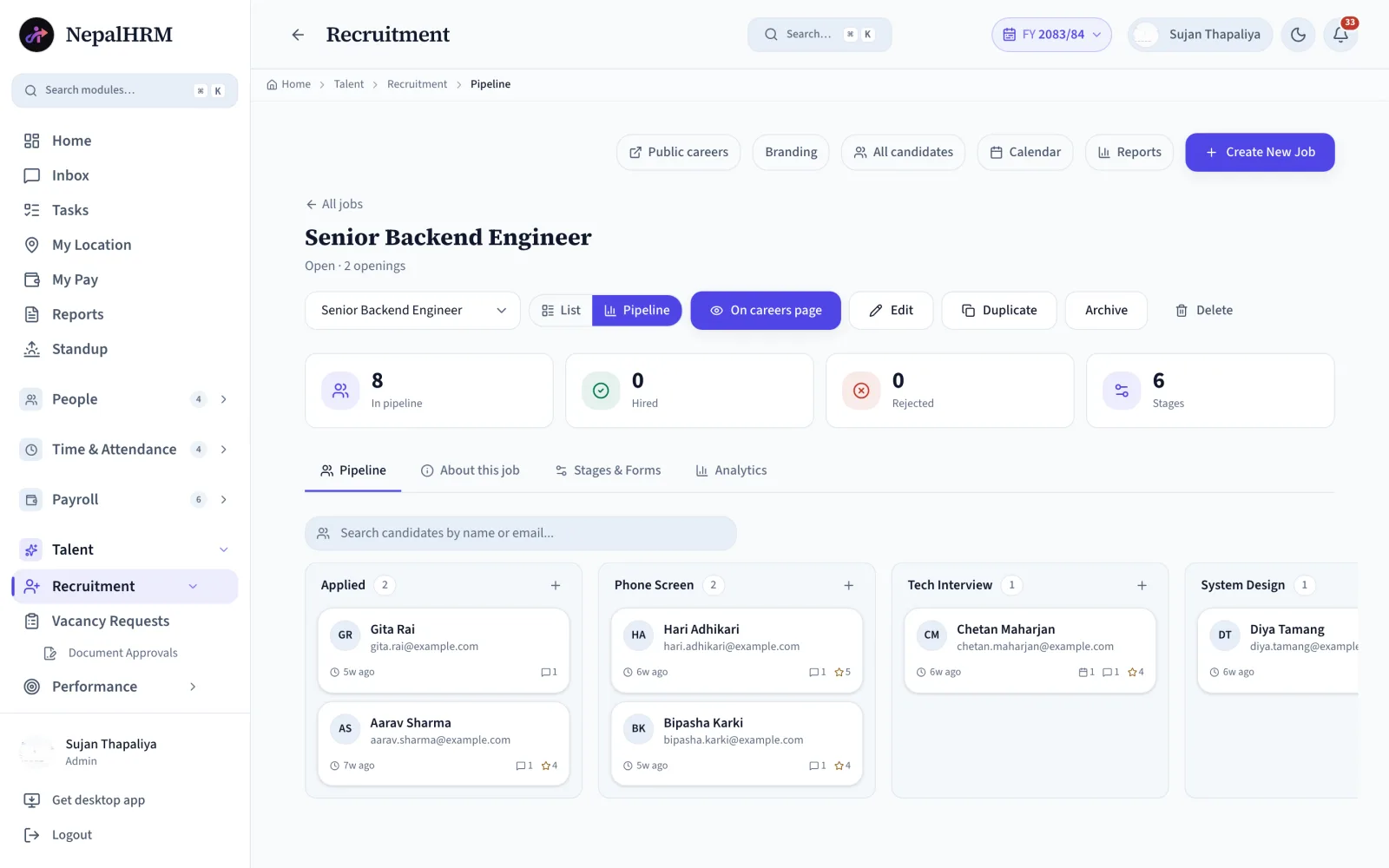
- The letter body is authored once per company with merge fields for the candidate, job title, salary, joining date and probation, then rendered to PDF per offer.
- Your own letterhead, signature and stamp images are printed into the PDF, so it matches the paper the company already hands out.
- The offer carries its salary breakdown, an expiry date and a single-use acceptance link, and only one active offer can exist per candidate.
- Editing a sent offer returns it to draft and the resend bumps its revision count, so what was sent when is recoverable.
Offer Letters in Nepal, Answered
A written employment contract is. Section 11(1) of the Labour Act 2074 says no employer shall employ a person without entering into an employment contract, and Section 11(2) exempts only casual employment from having it in writing. In Nepali practice the appointment letter, signed and returned, is that contract, which is why what it contains matters more than what it is called.
Section 11(3) requires the contract to set out the remuneration the labour receives, the benefits, the conditions of employment, and the other matters prescribed by the Labour Rules 2075. In practice that means naming the type of employment under Section 10, breaking the salary into basic and allowance, stating the statutory benefits, and setting working hours, probation and notice within the limits the Act fixes.
Up to 6 months, under Section 13. During it the employer may end the contract if the work is not found satisfactory. Once the 6 months pass without that happening, the employment relation is confirmed automatically, so a longer probation written into a letter has no effect after the sixth month.
Section 144(1) sets the floor by length of service: 1 day for employment up to four weeks, 7 days from four weeks to a year, and 30 days after a year. It binds both sides. A letter may promise more than the Act, and often does for senior roles, but a clause below the statutory minimum is not enforceable against the employee.
Both, and the split is the important half. Basic remuneration is the base for overtime at 1.5 times (Section 31(1)), festival expense of one month (Section 37), gratuity at 8.33% a month (Section 53(1)) and the SSF or provident fund deduction. A letter quoting only a gross figure leaves every one of those undetermined, which is why this generator asks for the split before it writes anything.
Not without rewriting the substance. The rates differ (provident fund is 10% of basic here, not 12%), the entitlements differ (festival expense is a yearly month of basic under Section 37, not a profit-linked bonus), and the notice rules come from a different statute. The layout travels; the clauses do not.
The Act does not require a language, and English letters are normal in Nepali private companies. What matters is that the employee understands the terms they are accepting, so where English is not the working language of the role, issuing the letter in Nepali or in both is the safer practice.
The employment relation still exists. Section 12(1) establishes it from the date the labour was engaged, in writing or verbally. Section 12(4) then lets the Labour Office order the employer to produce the records, and where the employer does not, the relation is deemed established. The written letter protects the employer at least as much as the employee, and Section 148 gives you 15 days to settle everything owed when it ends.
While You're Here, Try These Too
Every NepalHRM tool is free, runs in your browser and needs no account. See all of the free Nepal payroll and tax calculators.
Stop Retyping the Same Letter
NepalHRM authors the appointment letter once, fills it per candidate, and files the accepted copy against the employee record. The 8-hour day and 48-hour week you promised in it are the same ones attendance measures against.
- Letter template with merge fields
- Your letterhead and signature
- Candidate accepts online
- Free onboarding