Employee Training Software That Proves Who Is Actually Certified
Build the course, grade the quiz, issue the certificate, and know on any given day which of your people hold current occupational-safety and anti-harassment training. Attendance sheets cannot answer that; this can.
- No credit card
- Quick set up
- Free onboarding
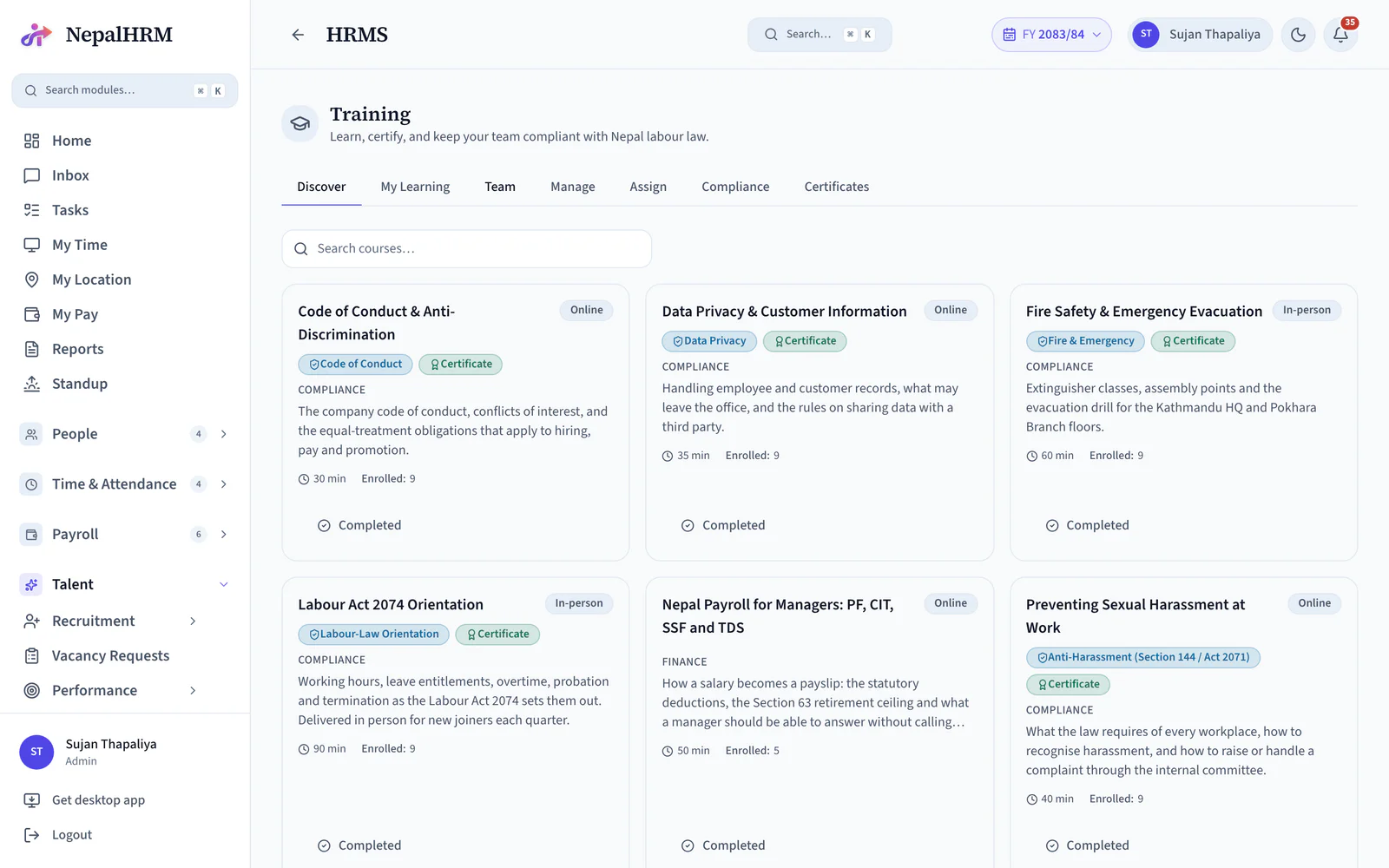
What is an HR training and LMS module for?
A training module answers one question an auditor will eventually ask: who is certified today, and can you prove it. NepalHRM builds courses from modules and lessons, adds a graded assessment where one is needed, and records each completion against the employee with a score and a certificate number. That dated, numbered record is what turns a training session into evidence rather than a recollection.
- Seven categories are tracked separately, so statutory obligations do not blend into optional training.
- Certificates are numbered per company against the fiscal year, in the form TRN-2083/84.
- Three delivery formats are supported: online, in-person, and external courses.
- Certificates expire, and the recurrence rule reopens the requirement automatically when they do.
- Coverage is reported by category with the gap named employee by employee, so a compliance question has a list behind it.
- Assessment scores are stored with the completion, so a pass is a record rather than an assertion.
Last updated · Reviewed by Rajendra Regmi, Co-founder
A training register an auditor can actually read
- 7 Categories
- Statutory obligations tracked separately
- TRN-2083/84
- Certificate numbering, per company
- 3 Formats
- Online, in-person and external courses
- 1 Question
- Who is covered today, answered instantly
The Training Happened. Proving It Is the Problem
Most Nepali organisations do run their safety and orientation sessions. What they cannot do is produce evidence twelve months later.
- Attendance captured on a paper sheet that lives in somebody's drawer
- No record of which employees hold current certification, only who once attended
- Certifications lapse silently, because nothing tracks an expiry date
- A Labour Audit asks for the safety-training register and the answer takes a week
A Course, a Score, a Certificate, an Expiry
Every completion becomes a dated, numbered record tied to a statutory category, which is what turns training into evidence.
What NepalHRM gives you
- Courses built from modules and lessons, with a graded assessment where one is needed
- Completion recorded per employee with a score and a certificate number
- Certificates expire, and the recurrence rule reopens the requirement automatically
- Coverage by category, with the gap named employee by employee
A Real Course Platform, Wired to Nepali Statute
Authoring, delivery, assessment and the compliance register, in the same system that already holds the employee record.
Course Builder
A course holds ordered modules, each holding ordered lessons. Lessons carry rich text, a video, an uploaded file or an external link.
Graded Assessments
One quiz per course with a pass mark, an attempt limit and a time limit. Grading runs on the server, so a client cannot report its own score.
Numbered Certificates
Completion issues a PDF certificate numbered per company in the form TRN-2083/84-000014, with an issue date, an expiry and HR revocation.
Statutory Compliance Register
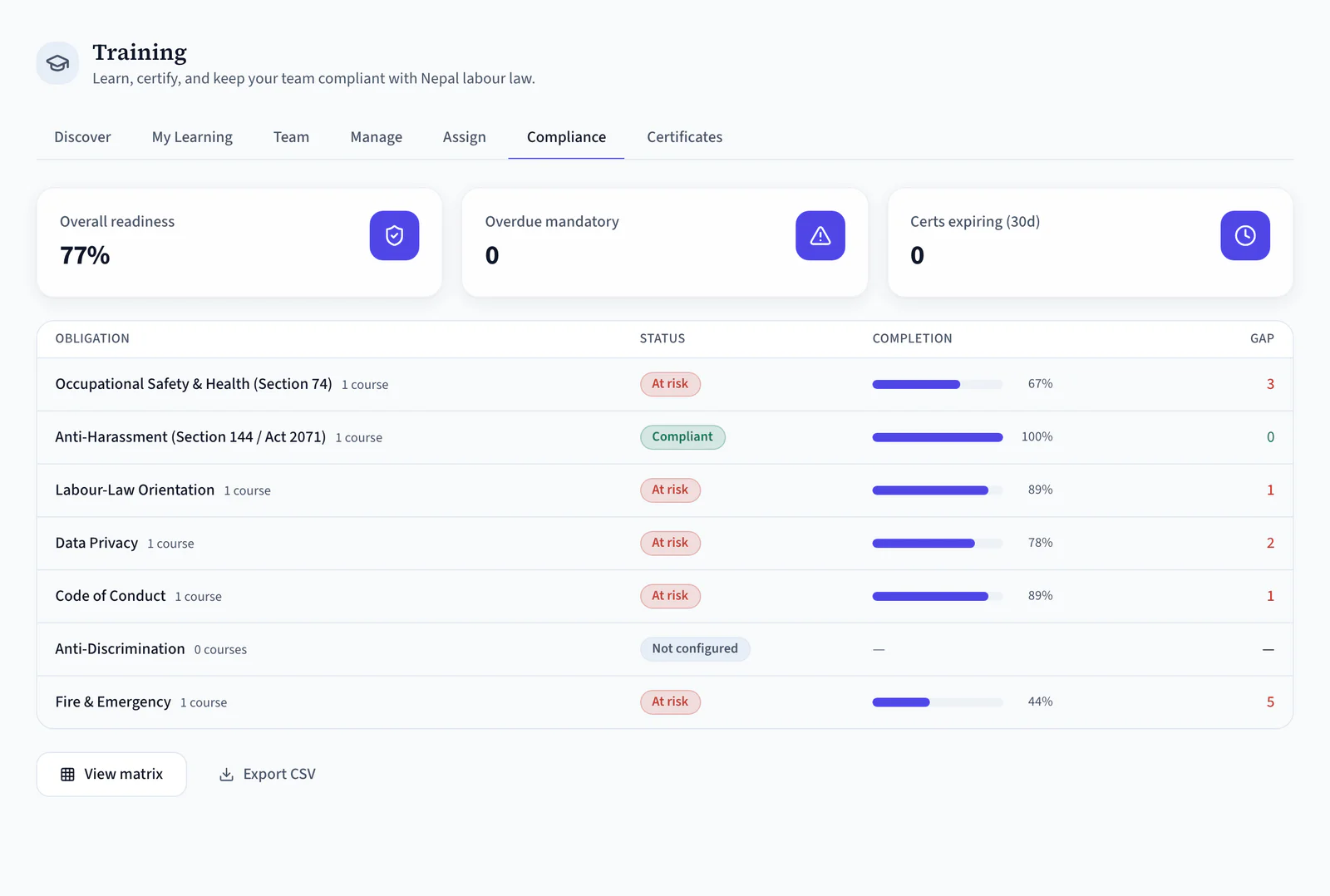
Seven tracked categories including Occupational Safety and Health (Section 74) and Anti-Harassment (Section 144 / Act 2071), each with its own coverage figure.
The Gap, by Name
For any category the register returns completion percent, who is covered and who is not, so the follow-up list writes itself.
Expiry and Recurrence
A recurrence in months reopens the requirement as a new enrollment when a completion lapses, leaving the original completion and its evidence on file.
Assign to a Department
A mandate rule fans out into enrollments across a department or the whole company, instead of nominating people one at a time.
Three Delivery Formats
Online courses the employee completes alone, instructor-led in-person sessions, and external courses at a vendor that HR still records here.
The Learner's View
Discover the catalogue, self-enrol where it is open, work through the player lesson by lesson, and keep a personal training history.
Department-Owned Courses
A course belongs to the department that authored it, or to HR when it is company-wide. Only the owner can change it.
Course Materials
Slide decks, handbooks and recordings attach to the course, up to 25 MB each across PDF, Office, image, MP4 and WebM formats.
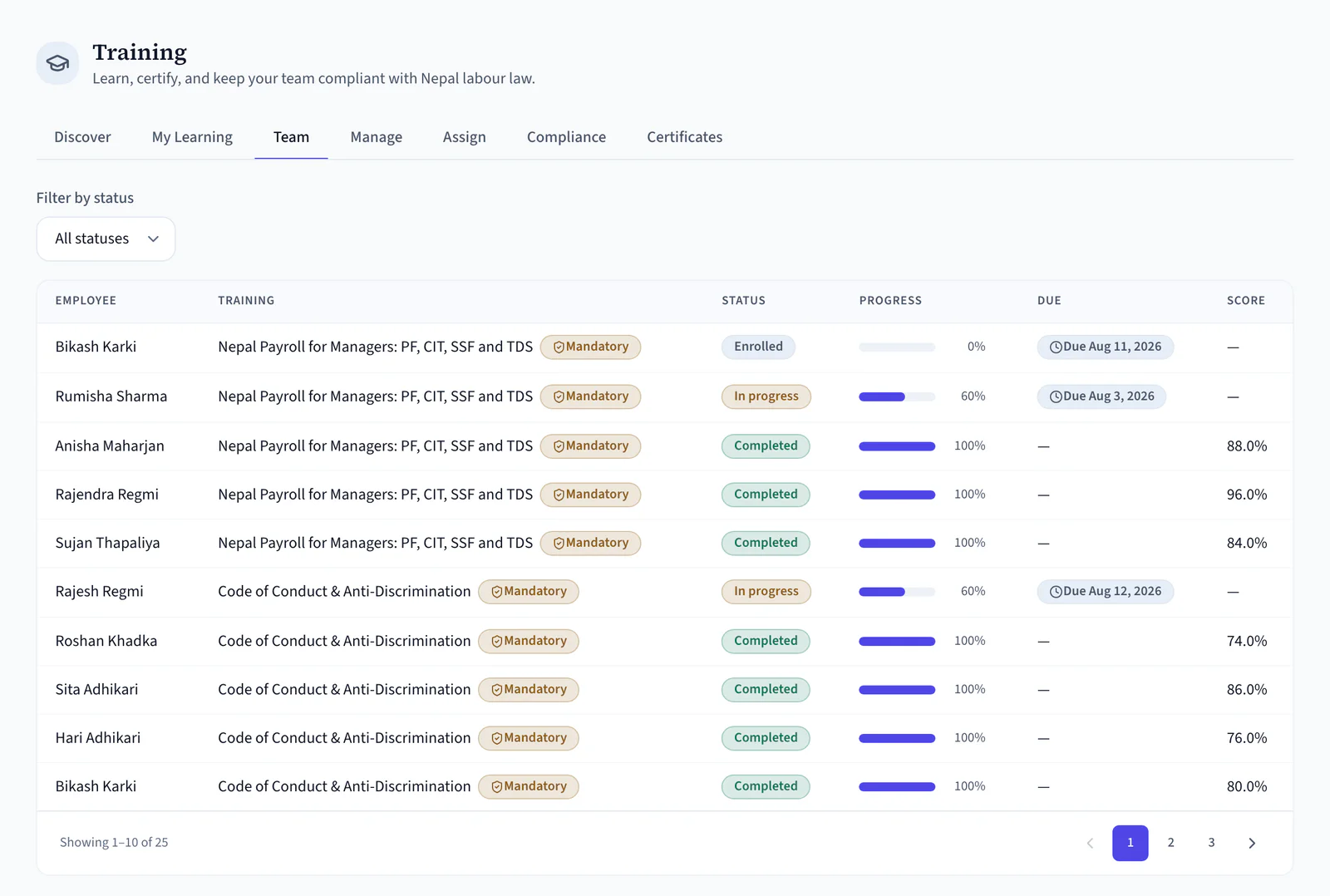
Team Progress
A manager sees their own team's enrolments, progress percentage and completions without opening the company-wide register.
From an Obligation to an Auditable Completion
Six states, each one a row somebody can point at when the question is asked twelve months later.
- Draft
Authored
The course is built from modules and lessons, tagged to a statutory category and given its pass mark.
- Published
Assigned
A mandate rule enrols a department or the whole company. Self-enrolment covers the rest of the catalogue.
- In progress
Delivered
The employee works through the lessons and the progress percentage moves with them.
- Completed
Certified
The assessment is graded server-side. A pass issues a numbered certificate with an expiry date.
- Covered
Counted
The completion counts toward its category until it expires. Only current completions count as coverage.
- Expired
Reopened
The recurrence rule opens a fresh enrollment. The lapsed completion stays on file as history.
An LMS That Knows What Nepali Law Asks For
A global LMS will host your video perfectly well. It has no idea that Section 74 exists, which is the part an auditor asks about.
Attendance Sheets and a Shared Drive
- A signed sheet proves attendance, not competence or currency
- Nothing links a session to the obligation it was meant to satisfy
- Expiries pass unnoticed until somebody checks the folder
- The register is rebuilt by hand every time it is asked for
Build It Once, Prove It Every Year
One track to author, one to deliver, one to keep the register true.
- A mandate rule fans out into an enrollment for every employee in scope, marked mandatory, rather than nominating people one at a time.
- The course player moves lesson by lesson and the progress percentage follows. My Trainings holds everything assigned and everything finished.
- The quiz opens once the lessons are done. The server grades it against the pass mark, and a fail can be retaken up to the attempt limit.
- A pass writes a numbered certificate with an issue date and an expiry, downloadable as a PDF and attached to the employee record.
- For each statutory category the register gives completion percent across active employees, counting only completions that are current, not expired and not revoked.
- The same query names who is not covered, so the follow-up is a list of people rather than a reconciliation exercise.
- Certificates expiring inside a window surface ahead of time, and the recurrence rule opens the new enrollment when one lapses.
- The register returns the trail an audit asks for: employee, course, completion date, expiry date and certificate number.
The Course Shell
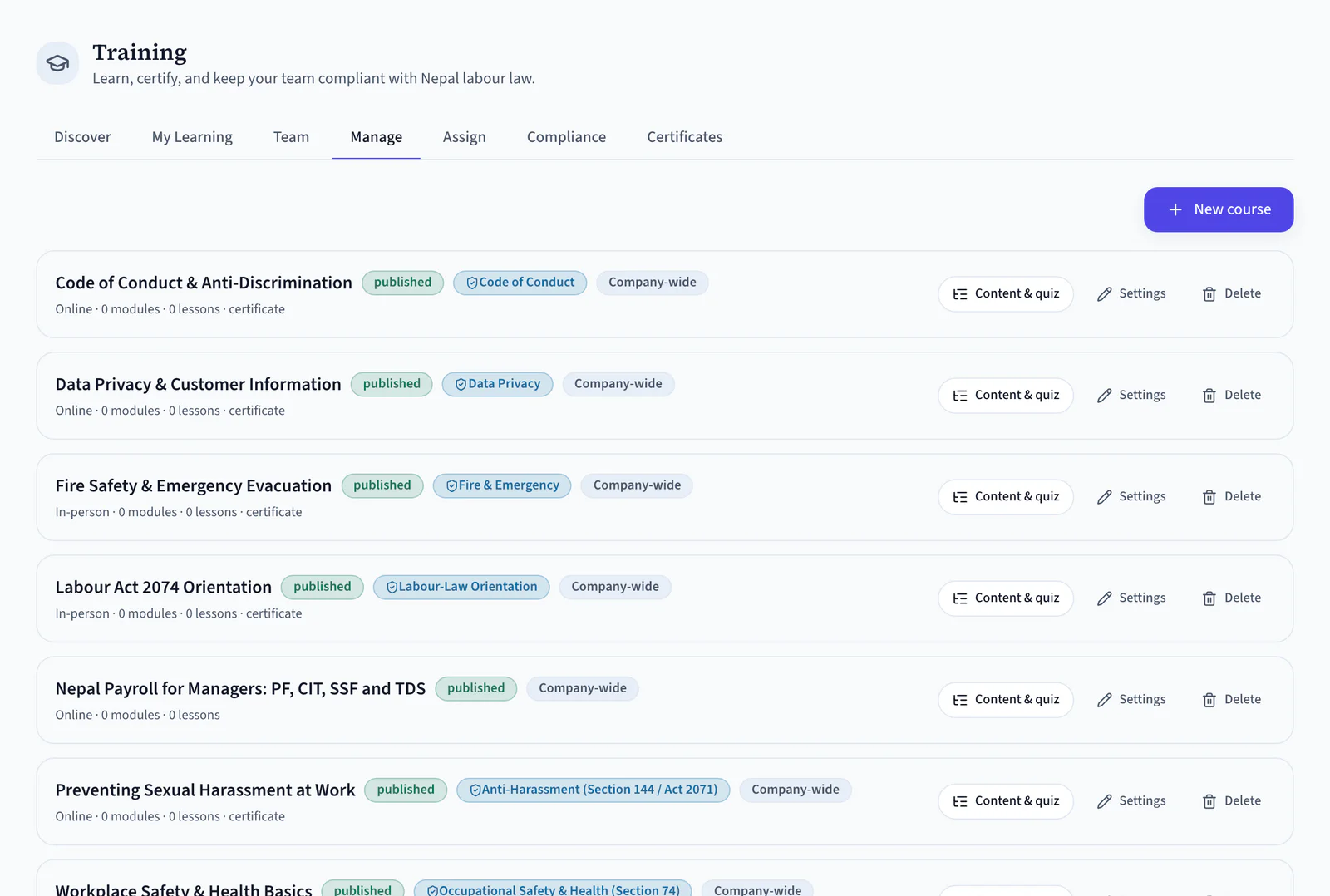
Assign, Do Not Nominate
Coverage, Not Attendance
One Register, Four Ways to Use It
L&D builds it, managers chase their own team, employees keep their record, and an auditor gets an answer instead of a folder.
For HR & L&D
Author once, assign to everyone
- Build the course, set the pass mark, tag the obligation
- Assign to a department as a mandate instead of naming people
- See coverage and the gap for every statutory category
For Managers
Your team's progress, not the company's
- Enrolments, progress percentage and completions for direct reports
- Who has an assessment still to sit before the due date
- Which of your people carry a certificate about to expire
For Employees
One place, one history
- The catalogue to browse and, where it is open, self-enrol
- The player, the assessment and the retake in the same screen
- Every certificate ever earned, downloadable as a PDF
For an Auditor
Evidence, not an assurance
- Coverage per statutory category across active employees
- Completion and expiry dates per employee, per course
- A certificate number against every current completion
Training Records for Nepal's Regulated Workplaces
Manufacturing, construction, hospitals, banks and INGOs carry statutory training obligations and get asked to prove them. The heavier the obligation, the more the register is worth.
Training Connects to the Rest of the Record
A completion is worth more attached to the employee it belongs to than sitting in a separate learning tool.
Performance Management
A development objective set in a review can point at the course that closes it, in the same system.
Onboarding & Offboarding
Orientation and safety courses become part of the joining checklist, so day one includes the training the law expects.
Employee Management
Completions, scores and certificates sit on the employee record beside the contract and the documents.
Employee Self Service
Employees find the catalogue, sit assessments and download their own certificates without asking HR.
Employee Engagement
Announce a new mandatory course to the exact group it applies to, and see who has not started it yet.
Task Management
A course with a deadline is a task: it belongs in the same board as everything else the employee owes.
Training & LMS is one module of the all-in-one HR software for Nepal, so an employee is created once and every module above reads the same record.
Simple, Transparent Pricing
No Hidden Fees
NepalHRM gives you enterprise-grade HR software at a price built for Nepali businesses of every size.
- All core HR modules
- Nepal payroll compliance
- PF, SSF, CIT & eTDS
- Biometric integration
- Free onboarding support
- Regular feature updates
- Multi-company support
- BS + AD calendar
Free trial available, no card required · No setup fees · Cancel anytime
Learn on the Web, Android and iOS
A lesson finished on the commute, an assessment sat at the site office, a certificate downloaded the morning the auditor arrives.
Frequently Asked Questions
Everything you need to know about training & lms in NepalHRM before you get started.
Yes, and they are two different records here. Enrolment moves from enrolled to in progress to completed as the employee works through the lessons, and the progress percentage tracks it. For in-person and external courses HR records the completion directly, so a classroom session lands in the same register as an online one.
Yes. A pass issues a certificate numbered per company in the form TRN-2083/84-000014, with an issue date and an expiry, stored as a downloadable PDF on the employee's record. HR can revoke one, which removes it from coverage without deleting the history.
That is what the compliance register is for. Seven statutory categories are tracked separately, including Occupational Safety and Health under Section 74 and Anti-Harassment under Section 144 and the Act of 2071, and each course carries a statute reference. Coverage counts only current completions.
Yes. Certificates expiring inside a window surface before they lapse, and each course carries a recurrence in months. When a completion expires the requirement reopens as a fresh enrolment, and the original completion stays on file as evidence for the period it covered.
Yes. My Trainings holds everything assigned and everything finished, with the score, the certificate and the expiry date for each. Employees can browse the catalogue and self-enrol on courses that are open, without going through HR.
Yes. Orientation, safety and code-of-conduct courses are assigned as mandates, so a new joiner is enrolled the moment their record exists rather than after somebody remembers. The completion then counts toward the statutory category like any other.
Yes. A course can be marked external, meaning a vendor workshop or a third-party platform the employee attends elsewhere, and HR still records the completion and issues the internal certificate. That keeps one register rather than one per training provider.
It includes quizzes. Each course can carry one assessment with a pass mark, an attempt limit and a time limit, and questions carry their own point values. Grading happens on the server, never from a score the browser reports, so a pass is a real result.
Run the Training. Then Be Able to Prove It
Join hundreds of Nepali businesses that have already moved from manual HR to NepalHRM. The session is the easy part; the register is what an audit asks for.
- No credit card
- Free onboarding
- Set up in one day
- Cancel anytime