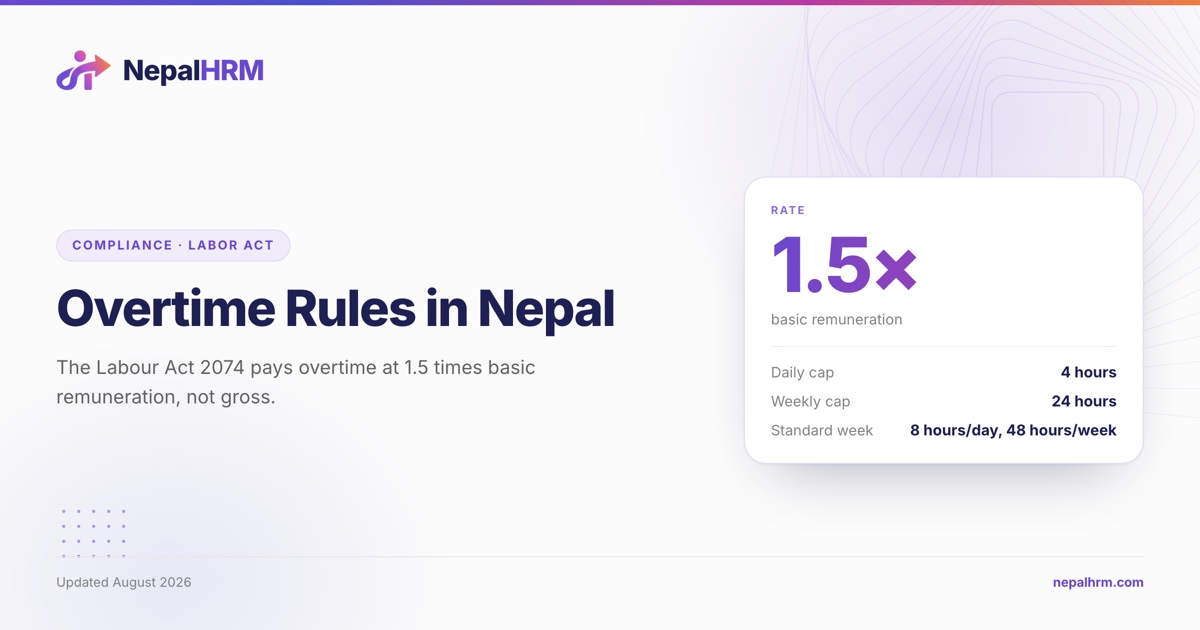
Nepal's Labour Act 2074 pays overtime at one and a half times basic remuneration, capped at four hours a day and twenty-four hours a week. The word that decides whether your payroll is correct is basic. Section 31(1) does not say gross, and it does not say "regular wage". Companies that calculate overtime on gross salary overpay by exactly the ratio of gross to basic, which in a typical Nepali salary structure means paying about 50% more than the law requires.
This guide walks through the four sections that govern overtime, shows the calculation with real numbers, and covers the two situations most employers miss: work on a holiday that becomes overtime by operation of law, and the narrow managerial exception.
Table of Contents
- What the Labour Act 2074 actually says
- The rate is on basic remuneration, not gross
- What the difference costs
- How to calculate overtime pay, step by step
- The divisor the Act does not give you
- The 4-hour and 24-hour caps are ceilings, not budgets
- The overtime you did not plan: holiday work
- You cannot compel overtime
- The managerial exception
- What to check in your payroll this month
- Frequently asked questions
- What is the overtime rate in Nepal?
- How many overtime hours are allowed in Nepal?
- Is overtime calculated on gross or basic salary in Nepal?
- Can an employer force an employee to work overtime in Nepal?
- What happens if we work someone on a public holiday?
- Does the Labour Act say how to convert monthly salary to an hourly rate?
- Sources
What the Labour Act 2074 actually says
Four sections in Chapter 7 do the work. It is worth knowing which is which, because the wrong section number is quoted constantly in Nepali HR content.
| Section | What it governs | The rule |
|---|---|---|
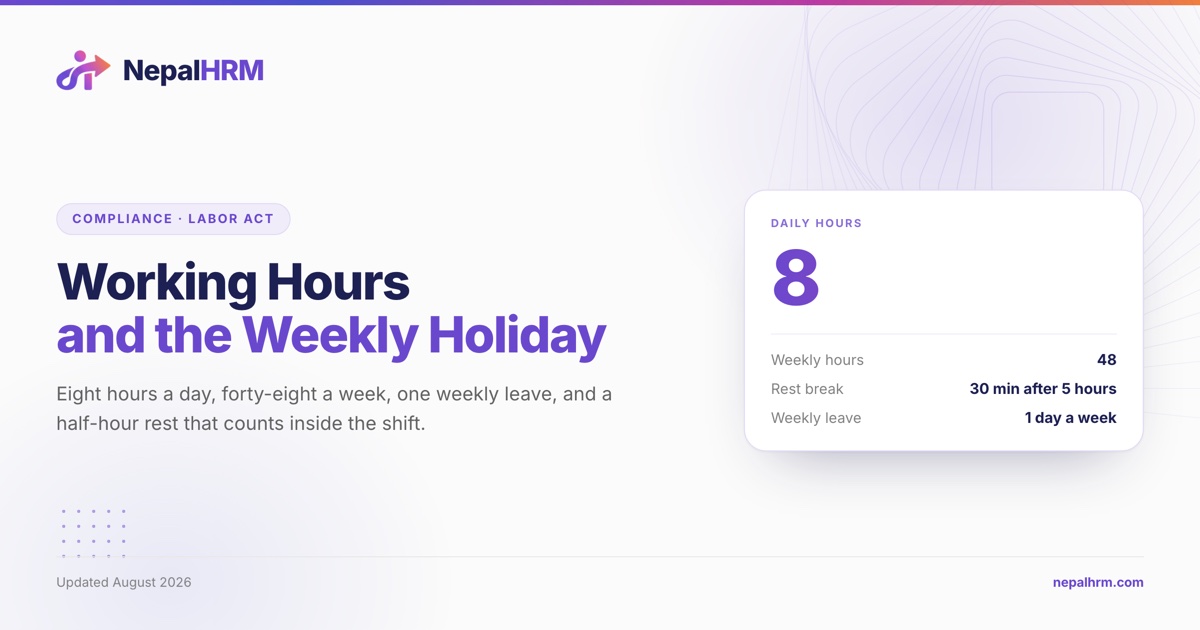
| 28(1) | Working hours | No more than 8 hours a day and 48 hours a week |
| 28(2), 28(4) | Rest interval | Half an hour after 5 hours of continuous work, counted within the working hours above |
| 29(1) | Compulsion | No employer shall compel a labour to work beyond Section 28(1) hours |
| 30(1) | Overtime limit | Not exceeding 4 hours a day and 24 hours a week |
| 30(2) | Deemed overtime | Work performed without substitute leave under Section 42 is deemed overtime |
| 31(1) | Overtime rate | 1.5 times the basic remuneration receivable during regular hours of work |
| 31(2) | Exception | Benefits in lieu, for managerial-level labour, via collective agreement or employment contract |
Section 32 is Fixation of working hours, which says the employment contract sets start and finish times. It has nothing to do with the overtime rate or the caps, and any source that cites "Section 32" for the 1.5× multiplier is citing the wrong provision.
For the wider picture, see our complete guide to the Nepal Labour Act 2074, which covers employment types, leave, termination and the annual compliance checklist.
The rate is on basic remuneration, not gross
Here is Section 31(1) in full, from the Nepal Law Commission's English translation:
"While employing any labour to work overtime pursuant to Section 30, the employer shall pay to the labour remuneration at a rate of 1.5 times of the basic remuneration receivable during regular hours of work."
The Act is not casual about this word. Section 2 defines the two terms separately:
- "Basic remuneration" means the basic remuneration to be received by a labour for employment, and this term also includes the amount of increment in remuneration after completion of one year of the employment period (Section 2(a)).
- "Remuneration" means the basic remuneration to which a labour is entitled, and this term also includes an allowance (Section 2(i)).
So the Act had a word available that included allowances, and Section 31 deliberately did not use it. Overtime is priced on basic plus accrued increments, and excludes the allowance layer.
That definition of basic remuneration carries a second consequence most payrolls miss. Because it explicitly includes the annual increment, an employee's overtime base moves every year with their grade increment. A payroll that froze the overtime base at the hiring basic is underpaying, and it will be underpaying more each year.
What the difference costs
Take a common structure: NPR 30,000 basic, NPR 15,000 in allowances, NPR 45,000 gross. The employee works 10 overtime hours in a month.
| Method | Hourly base | Overtime rate | 10 hours |
|---|---|---|---|
| Correct (1.5× basic) | 30,000 ÷ 208 = 144.23 | 216.35 | NPR 2,163 |
| Wrong (1.5× gross) | 45,000 ÷ 208 = 216.35 | 324.52 | NPR 3,245 |
Calculating on gross costs an extra NPR 1,082 on ten hours for one employee, a 50% overpayment. Across a factory floor of 200 workers on regular overtime, that is a material and entirely voluntary cost. The error runs the other way too: employers who invent a low nominal hourly rate rather than deriving it from basic underpay, and that is the version a labour inspection writes up.
Both mistakes come from the same root, which is not reading basic salary and gross salary as the distinct legal terms they are.
How to calculate overtime pay, step by step
- Start from basic remuneration, including any increment the employee has earned since joining. Not gross, not net, not a contractual "OT rate".
- Derive the hourly figure by dividing monthly basic by your standard monthly hours (see the divisor problem below).
- Multiply by 1.5.
- Multiply by approved overtime hours, counted against the assigned shift rather than against raw punch times.
- Show it as its own line on the payslip. Overtime folded into a lump "allowance" is invisible to the employee and unverifiable to an inspector.
The divisor the Act does not give you
Section 31 fixes the multiplier. It does not say how to convert a monthly salary into an hourly one, and neither does Section 28. Two conventions are in common use in Nepal:
| Convention | Working | Hourly on NPR 30,000 basic | 10 OT hours |
|---|---|---|---|
| 208 hours/month (48 hrs × 52 weeks ÷ 12) | 30,000 ÷ 208 | NPR 144.23 | NPR 2,163 |
| 240 hours/month (30 days × 8 hours) | 30,000 ÷ 240 | NPR 125.00 | NPR 1,875 |
The gap is NPR 288 on ten hours, about 15%. Neither is unlawful on the face of the Act, but running one convention in the payroll while the employment contract implies the other is how overtime disputes start.
Pick one, write it into the employment contract or the staff bye-laws, and apply it consistently. The 208-hour convention has the better claim to being derived from the Act, since it follows arithmetically from the 48-hour week in Section 28(1) rather than from an assumed 30-day month that ignores the weekly rest day.
The 4-hour and 24-hour caps are ceilings, not budgets
Section 30(1) allows overtime "not exceeding four hours a day and twenty-four hours a week". Read together with the 48-hour standard week, the absolute statutory maximum is 72 hours a week.
Two practical points.
The caps are limits, not entitlements. A team sitting at the ceiling every week is not a payroll problem, it is a headcount problem, and the overtime report is usually the first place it becomes visible. Twenty-four hours of weekly overtime at 1.5× costs more than 36 hours of a new hire's basic time.
Nothing automatically enforces the ceiling for you. This is worth saying plainly because HR software is often assumed to block it. Most systems, ours included, price overtime rather than refuse it; a supervisor can still approve a fifth hour in a day. The ceiling has to be a supervisor rule and an exception report, not an assumed feature. If a vendor tells you their system enforces the statutory cap, ask them to demonstrate it by trying to approve five hours.
The overtime you did not plan: holiday work
Section 30(2) is the provision employers most often discover after the fact:
"The work which any labour has been caused by the employer to perform without giving the substitute leave pursuant to Section 42 shall be deemed to be an overtime work."
Section 42 gives a worker engaged on a weekly or public holiday a substitute leave, to be provided within twenty-one days of the date they worked. Miss that 21-day window and the law reclassifies the day as overtime, payable at 1.5× basic, regardless of what your roster called it.
This matters most for continuous operations: hospitals, hotels, manufacturing lines, security, anything that cannot stop for public holidays. The compliance control is not the payroll run, it is the substitute-leave tracker. If nobody is watching the 21-day clock, the liability accrues silently and surfaces in an audit.
You cannot compel overtime
Section 29(1) is unambiguous: no employer shall compel a labour to work beyond the Section 28(1) hours. Section 29(2) creates one narrow exception, where not performing the work is likely to cause an adverse effect on the life, safety or health of any person, or serious loss or damage to the employer, and even then it remains subject to the Section 30(1) caps.
In practice this means overtime should be requested and approved before the hours are worked, not reconciled afterwards. Approval after the fact is not a control, it is bookkeeping, and it puts the employer in the position of having already accepted work it never authorised.
The managerial exception
Section 31(2) allows something in place of overtime pay, but the conditions are narrow. Benefits may be provided in lieu of overtime remuneration for labour of managerial level, and only where a collective agreement or the employment contract provides for them.
Three things follow. The substitution has to be written down, in the contract or the collective agreement. It applies to managerial-level staff, not to anyone an employer chooses to label a manager. And it must be an actual benefit, not silence. An employment contract that says "the salary is inclusive of all overtime" without identifying the benefit provided is not obviously within Section 31(2).
What to check in your payroll this month
- Is the overtime base basic remuneration, or has gross crept in?
- Does the base move with annual increments, per Section 2(a)?
- Is the hourly divisor written down anywhere an employee could read it?
- Does the payslip show overtime as its own line, with hours and rate?
- Is anyone watching the 21-day substitute-leave window for holiday work?
- Does anything flag employees approaching 24 hours in a week, before they cross it?
- Is overtime approved before the hours are worked?
If the answer to the first question is uncertain, check one payslip by hand against Section 31(1). That single reconciliation finds the error faster than any policy review.
Getting the number right every month is a data problem before it is a legal one. NepalHRM computes overtime from biometric punches against each employee's assigned shift, prices it through configurable rate tiers, and carries approved hours into the same month's salary sheet with PF and eTDS intact. See how shift and overtime management works, or book a walkthrough with your own shift pattern.
Frequently asked questions
What is the overtime rate in Nepal?
One and a half times basic remuneration receivable during regular hours of work, under Section 31(1) of the Labour Act 2074. The multiplier applies to basic, which the Act defines separately from "remuneration" (basic plus allowance) in Section 2.
How many overtime hours are allowed in Nepal?
Not more than four hours a day and twenty-four hours a week, under Section 30(1). Combined with the 48-hour standard week in Section 28(1), the statutory maximum is 72 hours a week.
Is overtime calculated on gross or basic salary in Nepal?
Basic. Section 31(1) says "basic remuneration", and Section 2 shows the Act had a broader term available, "remuneration", which includes allowances, and did not use it in Section 31. Calculating on gross overpays by the ratio of gross to basic.
Can an employer force an employee to work overtime in Nepal?
No. Section 29(1) prohibits compelling work beyond the Section 28(1) hours. Section 29(2) allows it only where non-performance would adversely affect life, safety or health, or cause serious loss or damage to the employer, and the Section 30(1) caps still apply.
What happens if we work someone on a public holiday?
They are entitled to substitute leave within twenty-one days under Section 42. If that substitute leave is not given, Section 30(2) deems the work to be overtime, payable at 1.5× basic.
Does the Labour Act say how to convert monthly salary to an hourly rate?
No. The Act fixes the 1.5 multiplier but not the divisor. The 208-hour convention follows from the 48-hour week in Section 28(1); a 240-hour convention is also used. Record whichever you apply in the employment contract, because the two differ by roughly 15%.
Sources
- Labour Act, 2074 (2017), official English translation, Nepal Law Commission: lawcommission.gov.np. Sections 2, 28, 29, 30, 31, 42 quoted above were read from the Commission's English text, retrieved 2026-08-06.
Related reading: Nepal Labour Act 2074: the complete guide · Working hours and weekly holiday rules in Nepal · Leave types under the Labour Act 2074