Most Nepali leave policies fail in the same place. They copy an entitlement table off another company's handbook, then discover at year end that the balances do not reconcile, that a resignation has produced an overpayment argument, or that a leave the Act calls a right has been refused by a manager who thought it was a facility.
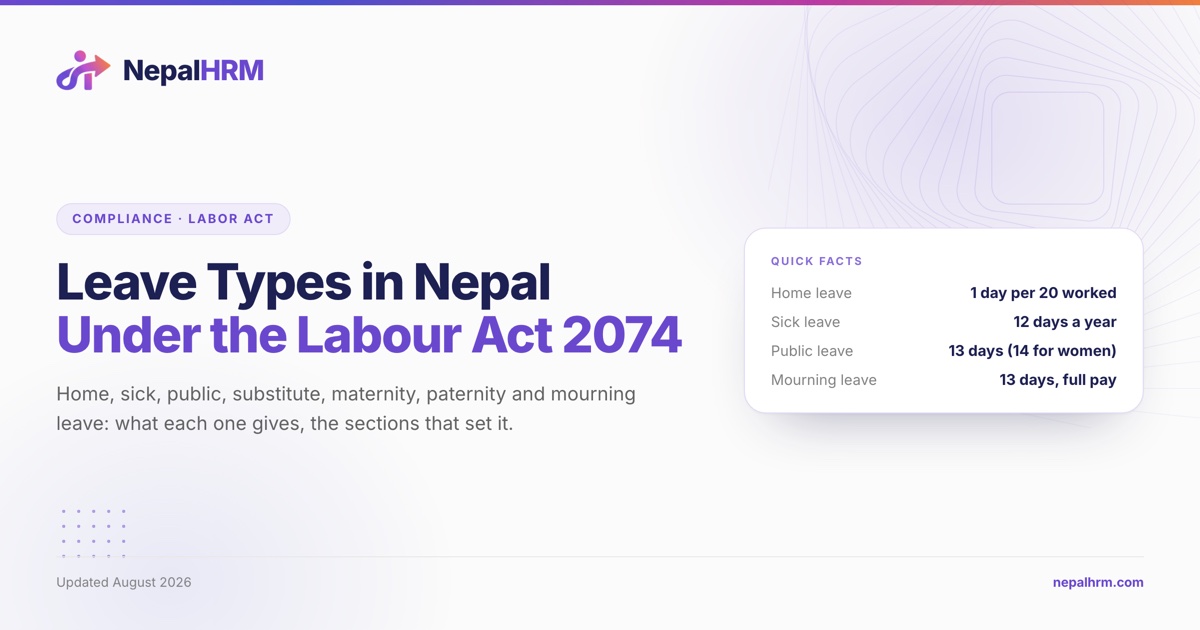
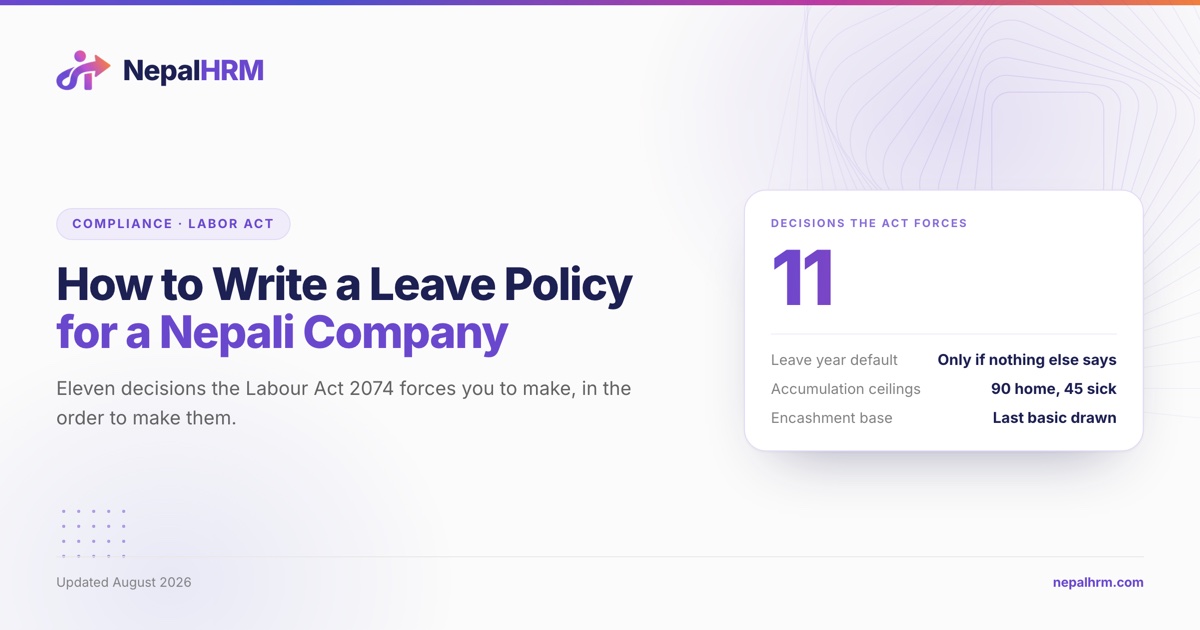
The Labour Act 2074 forces eleven decisions. Nine of them have a default in the Act that applies whether or not you write it down, and two of them are yours to make and are only enforceable if you do. This guide takes them in the order that avoids rework. It sits under our guide to leave types under the Labour Act, which covers the entitlements themselves.
Table of Contents
- 1. Which leave year applies?
- 2. Which leaves are rights and which are facilities?
- 3. Does home leave accrue or is it granted?
- 4. What are the accumulation ceilings?
- 5. What happens above the ceiling?
- 6. What is leave worth, and on what base?
- 7. Which public holidays, and how many?
- 8. Who is watching the substitute-leave clock?
- 9. What documents can you actually require?
- 10. What are you adding on top of the Act?
- 11. Where does the policy actually live?
- The eleven decisions, as a checklist
- Frequently asked questions
- What should a leave policy in Nepal include?
- Does the leave year in Nepal have to be the fiscal year?
- Can a Nepali company give more leave than the Labour Act requires?
- Is casual leave required by law in Nepal?
- Can a leave policy say unused leave lapses at the end of the year?
- Sources
1. Which leave year applies?
Do this first, because every accrual, ceiling and payout in the policy is measured against it.
Section 50 answers it in a strict order, and the answer is not automatically the fiscal year:
- As fixed by law, if law fixes it.
- Otherwise, as fixed by the regulatory body.
- Otherwise, as stated in the employment contract.
- Only where none of those apply, the Government of Nepal's fiscal year.
A company whose employment contracts set the leave year from the joining date is on solid ground. A company that has never said anything is on the Shrawan-to-Ashad year by default. Either is workable. Having half the workforce on one and half on the other, which is what happens when contracts were changed at some point and the policy never was, is what causes the reconciliation to fail every Ashad.
Write the answer into the policy explicitly, and make sure it matches what the employment contracts actually say.
2. Which leaves are rights and which are facilities?
This is the structural decision, and it determines the shape of every approval workflow that follows.
Section 51(1) makes sick leave, mourning leave and maternity leave rights. Every other leave in Chapter 9 is a facility that "cannot be claimed as a matter of right". Section 51(2) lets the employer refuse, postpone, deduct or change the timing of a facility leave according to the needs of the work at the workplace, stating the reason.
So the policy needs two processes, not one:
| Rights | Facilities | |
|---|---|---|
| Which | Sick, mourning, maternity | Home, substitute, and any leave you add |
| Employee action | Notify | Request |
| Employer discretion | None | Refuse, postpone, deduct, reschedule |
| What the file must show | The evidence the Act specifies | The recorded reason |
Two failure modes follow directly. A policy that routes sick leave through discretionary approval claims a power the employer does not have. And a refusal of home leave with no recorded reason is the version that loses at the Labour Office, because "stating the reason" in Section 51(2) is a condition, not decoration.
3. Does home leave accrue or is it granted?
Section 43(1) grants home leave "at the rate of one day for every twenty days of the period worked". That ratio is the entitlement. The Act states no annual total.
Twenty worked days to one day of leave means a full year of six-day weeks earns roughly eighteen days, and a joiner in Magh earns proportionally fewer. A policy that opens the year by crediting everyone a flat eighteen days has granted leave nobody has earned yet, and it turns every mid-year resignation into a clawback conversation.
Accrue it. If you want employees to be able to take leave before they have earned it, allow a negative balance up to a stated limit and say so, which is a very different thing from granting the year up front.
Section 43(2) carves out one group: workers at teaching institutions and anyone who already receives summer or winter vacations do not get home leave. The proviso softens it, so where that vacation is shorter than the home leave that would have been earned, the difference is still owed. See home leave for the term.
4. What are the accumulation ceilings?
Section 49(1) sets two, and they are not the same number: ninety days of home leave, forty-five days of sick leave.
This is the single most-copied error in Nepali HR writing. The widely republished summaries of this Act state one flat ninety covering both, which overstates a sick-leave payout by up to forty-five days of basic pay per employee.
5. What happens above the ceiling?
Section 49(3): leave accumulated above the ceiling is paid out at the end of each year at the worker's basic rate.
It is not lost and it is not carried. A "use it or lose it" clause above ninety days is not what the Act says, and a policy containing one is accruing an unrecorded liability rather than avoiding one. Whatever runs your payroll needs a year-end step that finds balances above the cap and pays the excess.
6. What is leave worth, and on what base?
Section 49(2) is precise: the lump sum on separation or death is calculated at the last basic remuneration drawn, and covers accumulated home and sick leave.
Three consequences for the policy wording:
- Basic, not gross. Allowances do not enter the calculation. See basic salary.
- The last rate drawn, not the rate when the leave was earned. A recent increment raises the value of leave accrued years earlier.
- Sick leave is encashable. Many Nepali policies say it is not.
The tax treatment is a separate question with a clear answer, and it is not the one most people assume. Our guide to leave encashment and its tax treatment covers it. To price a specific balance, use our leave calculator.
7. Which public holidays, and how many?
Section 41(1) sets thirteen paid public leave days a year, fourteen for a female worker. Section 41(2) leaves the choice of days to the regulator for your class of enterprise, or to you where there is none.
The policy has to name the days, because the Act does not. The Government's annual notice runs to considerably more than thirteen days and binds government offices rather than private employers, so anything you grant above thirteen should be labelled as company benefit rather than as legal entitlement. Our guide to public holiday rules for private companies works through how to choose, and our holiday calendar lists the dated days.
Say explicitly what happens when a public holiday falls on a weekly off day. The Act does not answer it, which makes it yours, and it is one of the most common leave-balance disputes.
8. Who is watching the substitute-leave clock?
Section 42(1) gives substitute leave to a worker engaged on a weekly or public holiday in work that cannot be stopped. Section 42(2) requires that substitute leave to be given within twenty-one days of the day worked.
Miss the window and Section 30(2) deems the day to be overtime, payable at 1.5 times basic under Section 31(1). The liability accrues quietly, because nothing in the salary sheet marks the twenty-first day. Our guide to overtime rules in Nepal covers the rates and ceilings.
The policy should name who tracks it and what triggers the reminder. A rule with no owner is the same as no rule.
9. What documents can you actually require?
The Act specifies evidence for two leaves, and only those two:
- Section 44(2): a certificate from a recognised physician for more than three consecutive days of sick leave. Consecutive days, not a cumulative annual count.
- Section 46: a copy of the prescribed birth registration certificate from a worker who has taken maternity leave, except where the newborn has died.
- Section 44(3): for sudden illness, notification to the employer or a designated person by the fastest available means. Name that person in the policy, or the duty is unenforceable.
Requiring more than this for a right-tier leave is where a policy starts to look like an obstacle rather than a process. Our guide to sick, maternity and paternity leave covers the pay mechanics for each.
10. What are you adding on top of the Act?
The Act contains no casual leave, no annual leave by that name, no bereavement leave beyond kriya bidaa, no unpaid personal leave and no compassionate leave. Companies that run those buckets are running contractual leave above the statutory floor. That is entirely lawful and often sensible.
Label them. A single sentence in the policy, marking which entitlements come from the Act and which the company grants, is what makes the second kind revisable later without it reading as a breach.
11. Where does the policy actually live?
A leave policy that exists as a PDF and a leave system that was configured separately will disagree within one year, and the employee is the only person who notices.
Before the policy is published, confirm that whatever runs leave holds: the leave year from step 1, the accrual ratio from step 3, both ceilings from step 4, the year-end excess payout from step 5, the encashment base from step 6, the holiday list from step 7, and the substitute-leave deadline from step 8.
The eleven decisions, as a checklist
| # | Decision | Where the default comes from |
|---|---|---|
| 1 | Leave year | §50, in strict order |
| 2 | Rights vs facilities | §51(1) and 51(2) |
| 3 | Home leave accrual | §43(1), 1 per 20 worked |
| 4 | Accumulation ceilings | §49(1), 90 and 45 |
| 5 | Excess above ceiling | §49(3), annual payout |
| 6 | Encashment base | §49(2), last basic drawn |
| 7 | Public holidays | §41(1) count, §41(2) days |
| 8 | Substitute leave clock | §42(2), 21 days |
| 9 | Required documents | §44(2), §44(3), §46 |
| 10 | Contractual add-ons | Not in the Act. Yours. |
| 11 | System configuration | Not in the Act. Yours. |
A leave policy is only as good as the balances underneath it. NepalHRM holds each leave type with its own accrual rule and its own ceiling, applies the leave year you actually run on, updates balances the moment a request is approved, excludes company holidays falling inside a request from the charged balance, and decides at year end whether unused days lapse, carry forward or encash. See how leave management works, or book a walkthrough with your own policy loaded.
Frequently asked questions
What should a leave policy in Nepal include?
At minimum: the leave year under Section 50, which leaves are rights and which are facilities under Section 51, the home leave accrual ratio from Section 43(1), both accumulation ceilings from Section 49(1), the treatment of leave above those ceilings under Section 49(3), the encashment base from Section 49(2), the public holidays chosen under Section 41(2), the substitute-leave deadline in Section 42(2), and the documents Sections 44 and 46 allow you to require.
Does the leave year in Nepal have to be the fiscal year?
No. Section 50 applies the Government of Nepal's fiscal year only where law, the regulatory body and the employment contract have all failed to fix one. A contract that sets the leave year from the joining date takes precedence over the fiscal year.
Can a Nepali company give more leave than the Labour Act requires?
Yes. The Act sets a floor, and a contract, collective agreement or company policy may be more generous. The distinction worth preserving in writing is which entitlements are statutory and which the company has granted, because only the second can be revised without breaching a contract.
Is casual leave required by law in Nepal?
No. The Labour Act 2074 contains no casual leave and no annual leave under that name. Home leave under Section 43 is Nepal's annual leave. A casual leave bucket is a contractual entitlement the company has chosen to add.
Can a leave policy say unused leave lapses at the end of the year?
Not above the accumulation ceilings. Section 49(3) requires leave accumulated beyond the Section 49(1) ceilings to be paid out at the end of each year at the basic rate. Below the ceilings, leave accumulates rather than lapsing.
Sources
- Labour Act, 2074 (2017), consolidated Nepali text as amended through 2082, Nepal Law Commission: lawcommission.gov.np. Sections 30, 41 to 51 read section by section from that text, retrieved 2026-08-07.
Related reading: Leave types under the Labour Act 2074 · Sick, maternity and paternity leave in Nepal · Public holiday rules for private companies