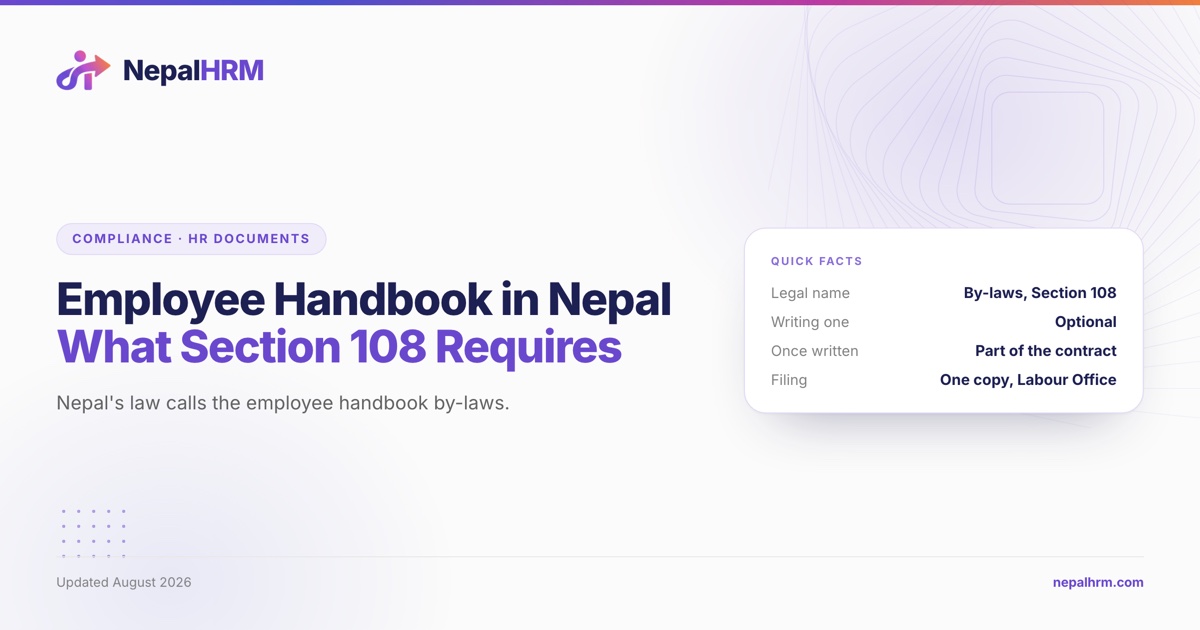
Nepal has no legal instrument called an employee handbook. What the Labour Act 2074 recognises is the विनियमावली, the establishment's own by-laws, under Section 108. Section 108(1) says every establishment may make them. That single word is why most Nepali companies never do, and it is the most expensive word in the Act: five ordinary management decisions are lawful only if your by-laws say so.
This is the pillar page for our HR documents cluster. It sits under the complete guide to the Nepal Labour Act 2074, and it covers what Section 108 obliges, what has to be inside the document, what may never be, and how to register it.
Table of Contents
- What Nepali law actually calls it
- Section 108, sub-section by sub-section
- Five things you cannot do without by-laws
- The handbook is part of the contract, and that cuts both ways
- What to put in it: a twelve-chapter outline
- The documents the handbook sits on top of
- What must never be in it
- Adopting and registering one
- What a labour audit looks for
- Where it usually goes wrong
- Frequently asked questions
- Is an employee handbook mandatory in Nepal?
- Is a company handbook legally binding on employees in Nepal?
- Where do I register company by-laws in Nepal?
- Can our handbook give less than the Labour Act?
- Do we need union approval for the handbook?
- Can we dismiss someone for misconduct that only our handbook lists?
- What is an employee handbook called in Nepali?
- Sources
What Nepali law actually calls it
Three documents are easy to confuse, and only one of them is yours to write.
| Document | Who makes it | What it does |
|---|---|---|
| Labour Act 2074 | Parliament | The floor. Section 3(1) says the Act is a minimum standard. |
| Labour Rules 2075 (नियमावली) | Government, under Section 182 | Fills in what the Act leaves "as prescribed". |
| By-laws (विनियमावली) | Your establishment, under Section 108 | Your service conditions, your discipline, your appraisal. |
An employee handbook, staff manual, HR policy or service rulebook is the same object in every case: the by-laws. Calling the file Employee Handbook on the cover changes nothing about how Section 108 treats it.
Section 108, sub-section by sub-section
| What it says | What it costs you | |
|---|---|---|
| 108(1) | Every establishment may make by-laws for its internal management, as required. | Optional. |
| 108(2) | By-laws on service, terms and facilities must not run against the Act's minimum standards or a collective agreement. The approving body must apply the same test. | Your ceiling is the Act's floor. |
| 108(3) | The Ministry may issue a model set of by-laws. Nepal Rastra Bank does so for banks and financial institutions, and the sector regulator for others. | A regulated employer starts from the regulator's template, not a blank page. |
| 108(4) | One copy must be registered at the Office, and must be provided to a worker who wants to see it. | A handbook nobody filed and nobody can read is not a defence. |
| 108(5) | Making or amending them requires consultation with the authorised trade union, or with an active union if there is no authorised one. | You cannot rewrite the rules over a weekend. |
| 108(6) | A provision conflicting with the Act, prevailing law or a collective agreement can be voided by a court. | The bad clause dies, the rest survives. |
Two of those six are duties, not options: registration under 108(4) and union consultation under 108(5). They attach the moment you decide to have by-laws at all.
Five things you cannot do without by-laws
This is the part that changes the decision. Each of these is a normal management action, and each one the Act routes through the by-laws.
1. Terminate on a ground the Act does not itself list. Section 139(1) is categorical: employment shall not be terminated except in accordance with this Act, the Rules made under it, or the by-laws. Section 139(2) adds that a proper and adequate reason must be stated. With no by-laws you are limited to the Act's own grounds, and everything else is an unlawful termination waiting for a Labour Office complaint. Our guide to termination and notice periods works through those grounds.
2. Let anyone below the chief executive decide a disciplinary case. Section 136(1) puts the power to punish misconduct in the hands of the establishment's chief executive. Section 136(2) allows a managerial-grade worker to investigate and take the final decision only where the by-laws confer that power. A company of two hundred people whose CEO must personally sign every warning letter is a company that never wrote its by-laws.
3. Define your own grave misconduct as dismissible. Section 133(2) permits a provision in the by-laws for removal from service for grave misconduct, either through a collective agreement or with the Department's permission. Section 133(1) lets a regulated establishment (bank or financial institution, school, telecom provider, hospital, airline, insurance company, or an establishment of a particular nature) carry its regulator's specific penalties into the by-laws.
4. Retire anyone before sixty. Section 147 sets compulsory retirement from regular employment at sixty years of age. The proviso allows a lower age for work of a particular nature, but only on permission obtained from the Council as prescribed and a provision in the by-laws. Both, not either. Note that the Rules still speak of fifty-eight in Rule 73; the Act's sixty came later, through the Good Governance amendment of 2081, and the Act governs.
5. Run a performance appraisal at all. Rule 63(1) of the Labour Rules 2075 says the employer shall evaluate a worker's performance on the basis and by the procedure prescribed in the establishment's by-laws. Rule 63(2) requires the employer to supply the form. Rule 63(3) requires the previous fiscal year's form to be filled at the start of each fiscal year and kept for at least three years. An appraisal with no by-law behind it has no prescribed basis, which is precisely the argument raised when an appraisal score is used to justify anything.
The handbook is part of the contract, and that cuts both ways
Rule 4 of the Labour Rules 2075 lists what an employment contract must disclose beyond Section 11(3), and item (c) is this: that the by-laws made under Section 108 of the Act are an integral part of the contract.
So the by-laws are not internal guidance. They are contract terms, delivered to every worker at once, amended through Section 108(5) rather than through 200 individual signatures. That is the upside.
The downside is symmetrical. Section 3(2) says an employment contract that gives less than the Act or the Rules prescribe, or that runs against the Act's terms, is deemed contrary to the Act and is void to that extent. Section 34(3) says remuneration and facilities a worker has been receiving cannot be reduced except as recorded in a collective agreement. Put those together and a generous handbook clause is a promise you have made in every contract in the building, while a stingy one is simply void. See our page on the Labour Act 2074 for how the minimum-standard rule works elsewhere in the Act.
What to put in it: a twelve-chapter outline
Each chapter below settles something the Act leaves to you, and names the provision it has to respect.
| Chapter | What it settles | Respects |
|---|---|---|
| 1. Scope and definitions | Which workers, which locations, from what date | §2, §10 |
| 2. Employment types and recruitment | Which of the five types you use and for what | §10, §11 |
| 3. Probation and confirmation | Length up to six months, how confirmation is recorded | §13 |
| 4. Working hours, shifts and overtime | Daily and weekly limits, shift rotation, the overtime rate | §28, §29, §31 |
| 5. Attendance and absence | Punching, late marks, absence without approved leave | Rule 81, §131(1)(a) |
| 6. Leave | Your calendar of the leave the Act guarantees, plus anything extra | §40–§49 |
| 7. Public holidays | Which days you close on, since the Act fixes only the count | §41 |
| 8. Remuneration and increments | Pay date, structure, the annual grade, festival expense | §34–§37 |
| 9. Social security and retirement benefits | SSF enrolment and what it covers | §52, §53, §57 |
| 10. Conduct, discipline and penalties | Your misconduct list, the enquiry, who decides | §130–§138 |
| 11. Performance evaluation | The basis, the procedure, the form, the cycle | Rule 63 |
| 12. Separation and settlement | Notice, retirement age, final payment, experience certificate | §139–§150 |
Chapters 10 and 11 are the two that most Nepali handbooks skip and the two the Act most clearly hands to you.
For chapters 4 to 7, the underlying entitlements are covered in working hours and weekly holiday rules and every leave type under the Act.
The documents the handbook sits on top of
Four chapters above are big enough to be their own document, and one duty at the end of employment is not in the handbook at all. Each has its own guide.
| Chapter | The document | Guide |
|---|---|---|
| 2. Recruitment | The offer, before any contract exists | Offer letter rules in Nepal |
| 2. Recruitment | The appointment letter, which is the contract | What an appointment letter must say |
| 2 and 3 | The contract regime itself, §11 and Rule 4 | Employment contracts in Nepal |
| 5, 6 and 7 | Attendance, leave and the holiday calendar | Writing an attendance and leave policy |
| 12. Separation | The §150 certificate and the relieving letter | Experience and relieving letters |
| 8. Remuneration | The letter a bank or embassy asks for | Salary certificate in Nepal |
Rule 4(c) is the thread running through all of them: whatever the handbook says, the contract has to say the handbook is part of it.
What must never be in it
- Anything below the floor. Fewer than 13 paid public holidays (14 for women) under Section 41(1). Less than 12 days of paid sick leave under Section 44(1). Home leave at worse than one day per 20 worked under Section 43(1). Probation over six months under Section 13.
- At-will language. Employment at the employer's pleasure does not exist in Nepal. Section 139 requires a lawful ground and an adequate stated reason.
- A shorter enquiry than Section 135. Seven days to show cause, with the alleged facts and the possible penalty spelled out. A handbook cannot compress it.
- Time limits longer than Section 137. Proceedings begin within two months of the misconduct coming to notice and conclude within three months of starting.
- Forfeiture of accrued entitlements on resignation. Festival expense is pro-rated under Section 37(3), accumulated leave is encashed, and Section 148(1) puts a 15-day clock on all of it.
- A retirement age below sixty without the Council's permission under the Section 147 proviso.
- A copy of an Indian handbook. Provident fund at 12%, gratuity after five years and a Shops and Establishments notice period describe a different country's law. Nepal's numbers are 10% plus a matching 10% under Section 52(1) and gratuity at 8.33% a month from day one.
Adopting and registering one
- Draft against the Act, not against a template. Every clause needs the section it sits on.
- Consult the union. Section 108(5): the authorised trade union if there is one, otherwise an active one. Record that you did.
- Get regulator approval where it applies. Section 108(3): Nepal Rastra Bank for banks and financial institutions, the sector regulator elsewhere. Section 108(2) binds the approving body to the same minimum-standard test.
- Register one copy at the Labour Office under Section 108(4).
- Publish it internally. Section 108(4) again: a worker who wants to see it must be given it. An intranet link that works for everyone satisfies this in a way a locked HR cupboard does not.
- Reference it in the contract. Rule 4(c) requires the contract to state that the by-laws form an integral part of it. Our guide to what an employment contract must contain covers the rest of that list.
- Amend it the same way. Section 108(5) applies to amendments, not just to the first version.
What a labour audit looks for
Rule 56 requires an establishment to conduct a labour audit of whether things were done under the Act and the Rules, reported in the Schedule 10 format. The by-laws are where an auditor goes first, because every downstream question (was the penalty within the published scale, was the appraisal on the prescribed basis, was the retirement age lawful) is answered by that document or is not answered at all. Our labour audit compliance checklist walks the rest of it.
Where it usually goes wrong
- The handbook exists but was never registered, so Section 108(4) is unmet and the document is easy to attack.
- The handbook was never shown to the union, breaching Section 108(5) at the moment of adoption.
- It was amended by email and nobody consulted anyone.
- It contradicts the signed contract on notice or on leave, and Rule 4(c) means both are contract terms saying different things.
- It quotes the repealed Labour Act 2048, most visibly on gratuity.
- It says fifty-eight for retirement, copied from Rule 73 rather than from the amended Section 147.
A handbook is only as good as the system that enforces it. NepalHRM holds leave balances, attendance records and the payroll rules in one place, so the policy your by-laws describe is the policy that actually runs each month. See how leave management works, or look at employee records.
Frequently asked questions
Is an employee handbook mandatory in Nepal?
No. Section 108(1) of the Labour Act 2074 says an establishment may make by-laws for its internal management. It is optional. What is not optional are the duties that attach once you have them: registering a copy at the Labour Office under Section 108(4) and consulting the trade union under Section 108(5).
Is a company handbook legally binding on employees in Nepal?
Yes, once adopted. Rule 4(c) of the Labour Rules 2075 requires the employment contract to state that the by-laws made under Section 108 form an integral part of the contract. Section 130 makes compliance with the discipline and duties set out in the by-laws a duty of every worker.
Where do I register company by-laws in Nepal?
At the Labour Office. Section 108(4) requires one copy of the by-laws made by the establishment to be registered there, and requires the establishment to provide the document to any worker who wants to read it.
Can our handbook give less than the Labour Act?
No. Section 3(1) makes the Act a minimum standard, and Section 3(2) makes any term giving less than the Act or the Rules void to that extent. Section 108(2) applies the same test to the by-laws and to whoever approves them, and Section 108(6) lets a court void a conflicting provision.
Do we need union approval for the handbook?
Consultation, not approval. Section 108(5) requires the establishment to consult the authorised trade union when making or amending by-laws, or an active trade union where there is no authorised one.
Can we dismiss someone for misconduct that only our handbook lists?
Only if the by-laws provide for it under Section 133(2), which requires either a collective agreement or the Department's permission. And Section 135 still applies: seven days to show cause, with the facts and the possible penalty stated in writing.
What is an employee handbook called in Nepali?
विनियमावली, the establishment's by-laws, under Section 108 of the Labour Act 2074. It is a different document from the नियमावली, the Labour Rules 2075 made by government under Section 182.
Sources
- Labour Act, 2074 (2017), consolidated Nepali text as amended through 2082, Nepal Law Commission: lawcommission.gov.np. Sections 3, 10, 11, 13, 34, 37, 41, 43, 44, 108, 130, 133, 135, 136, 137, 139, 147 and 148 were read from that text, retrieved 2026-08-07.
- Labour Rules, 2075 (2018), Nepali text, Nepal Law Commission. Rules 4, 56, 63, 73 and 81 were read from that text, retrieved 2026-08-07.
Related reading: Nepal Labour Act 2074: the complete guide · What an employment contract must contain · Writing an attendance and leave policy