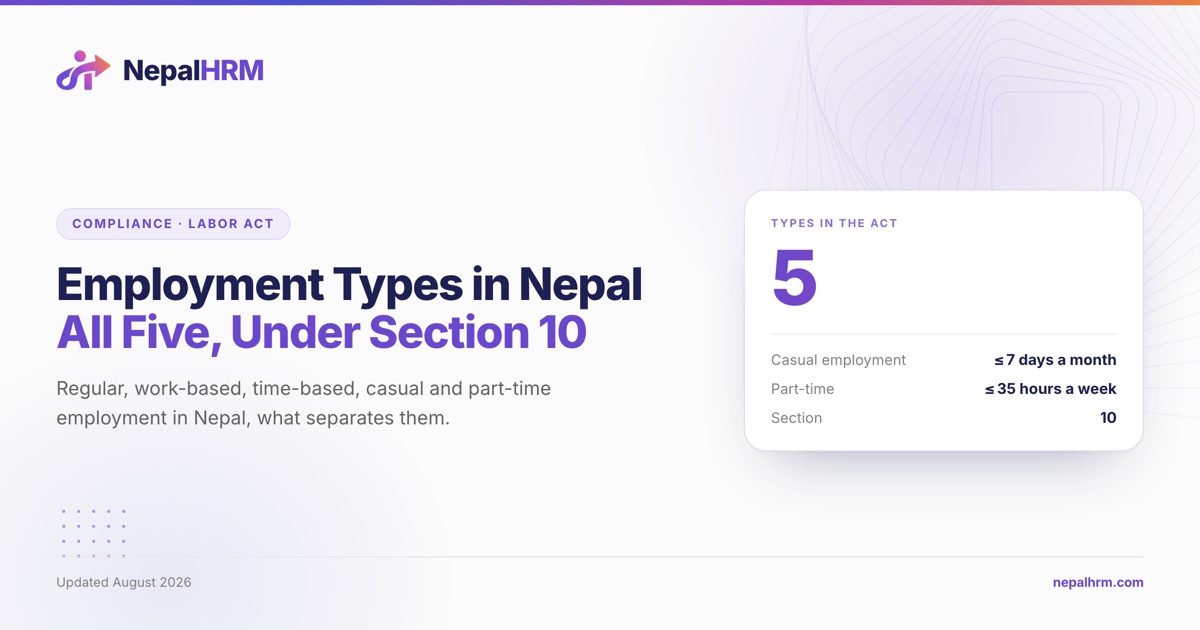
Section 10 of Nepal's Labour Act 2074 recognises exactly five kinds of employment: regular, work-based, time-based, casual and part-time. Two of them are defined by a hard number, one is defined as whatever is left over, and none of them is defined by what your employment contract calls it.
That last point is Section 10(2), and it is the most consequential sentence in the chapter. This guide sets out all five, the thresholds that separate them, and what does and does not change between them. It sits under our complete guide to the Nepal Labour Act 2074.
Table of Contents
- The five types, and what defines each
- Section 10(2): the label does not decide
- What genuinely differs between the types
- 1. How the employment ends
- 2. Whether a written contract is needed
- 3. How the basic salary is set
- What does not differ
- Part-time employment has its own chapter
- Trainees are not a sixth type
- Foreign workers and supplied workers
- The transitional rule that made many staff regular
- What to check in your contracts
- Frequently asked questions
- How many types of employment are there in Nepal?
- What is casual employment in Nepal?
- What counts as part-time work in Nepal?
- Is contract employment a separate type in Nepal?
- Can an employer decide the employment type in the contract?
- Do contract employees get PF and gratuity in Nepal?
- How long can a foreign worker's contract be in Nepal?
- Sources
The five types, and what defines each
| Type | Nepali | The defining test | Section 10 explanation |
|---|---|---|---|
| Regular | नियमित रोजगारी | Everything that is not one of the three below | (1) |
| Work-based | कार्यगत रोजगारी | Given to complete a specified work or service | (2) |
| Time-based | समयगत रोजगारी | Given for a fixed period, to provide a service or complete work within it | (3) |
| Casual | आकस्मिक रोजगारी | Seven days or fewer in a one-month period | (4) |
| Part-time | आंशिक रोजगारी | Thirty-five hours a week or fewer | (5) |
Notice the structure. Regular employment is not defined by any positive characteristic at all: the explanation says it means any employment other than work-based, time-based and casual. It is the default, and everything else has to earn its way out of it.
That drafting choice is why "we hired them on contract" is not, on its own, an answer. There is no employment type called "contract" in the Act. A person hired on a contract is in time-based employment if the contract states a period, in work-based employment if it specifies a piece of work, and in regular employment if it does neither.
Section 10(2): the label does not decide
The second sub-section is short and blunt:
Where a question arises as to whether any employment is regular or not, it shall be determined as prescribed on the basis of the nature of the work, notwithstanding anything mentioned in the employment contract.
Three practical consequences.
A renewed fixed-term contract is a risk. Where the same person on the same work has been rolled over on nine-month contracts for four years, the nature of the work is continuous, and the contract's label is expressly not conclusive.
A "consultant" doing the operational job of an employee is at risk. Same test: the nature of the work, not the title on the paper.
Documents still matter, in the other direction. Section 12(4) lets the Labour Office order an employer to produce employment records, and where the employer does not produce them, the employment relation is presumed to exist. The nature of the work decides the type; the absence of records decides the relationship.
What genuinely differs between the types
Not as much as most Nepali handbooks assume. The differences are concentrated in three places.
1. How the employment ends
Section 140 is the only section that ends employment automatically, and it covers just three of the five:
- Time-based: ends when the period stated in the contract expires. The proviso: in project-based employment, if the period is extended, or the work needs longer given its nature, employment does not end until then.
- Work-based: ends when the work stated in the contract is completed, with the same project extension proviso.
- Casual: ends at the will of either the employer or the worker.
Regular and part-time employment have no such trigger. They end only through one of the routes in our guide to termination and notice periods in Nepal.
2. Whether a written contract is needed
Section 11(1) prohibits engaging anyone in work without an employment contract. Section 11(2) then carves out casual employment only: a written contract is not required for it. Section 11(3) requires every other contract to state the remuneration, benefits, terms of employment and the other prescribed particulars.
3. How the basic salary is set
Section 170(1) says the basic remuneration of a worker in work-based employment is fixed as prescribed, and, where it has not been prescribed, the minimum remuneration fixed for workers is deemed to be the basic remuneration. Section 170(2) deals with work paid by the unit produced, where the rate per unit is derived from the minimum remuneration as prescribed. See minimum wage for how that figure is set and revised.
What does not differ
This is the part worth pinning to the wall, because it is where most cost assumptions about "contract staff" go wrong.
| Entitlement | Applies to | Section |
|---|---|---|
| Provident fund, 10% + 10% of basic | Every worker, from day one | 52 |
| Gratuity, 8.33% of basic monthly | Every worker, from day one | 53 |
| Home leave, sick leave, public leave | Every worker | 43, 44, 41 |
| Medical insurance, at least NPR 100,000 a year | Every worker | 54 |
| Accident insurance, at least NPR 700,000 | Every worker | 55 |
| Overtime at 1.5× basic | Every worker | 31 |
| Equal pay for equal work | Every worker | 7 |
| Reasonable and sufficient cause on termination | Every worker | 139(2) |
Neither Section 52 nor Section 53 is qualified by employment type. Both say "every labour", and both apply "from the very day the concerned labour commenced the work". Our guide to gratuity in Nepal covers what that monthly 8.33% actually is.
Part-time employment has its own chapter
Chapter 5, Sections 19 to 21, gives part-time work rules that no other type has.
- 19(1): an employer may engage a worker part-time. The proviso is one-way: a full-time worker cannot be moved to part-time without their consent.
- 19(2): part-time remuneration is generally fixed on an hourly basis, or as the employment contract between the two sides provides.
- 19(3): and it must be fixed taking as the base at least the monthly remuneration of a full-time worker doing the same nature of work at the same level. Part-time is a shorter week, not a cheaper hour.
- 19(4): a part-time worker engaged beyond their agreed hours is paid at 1.5 times the rate under 19(2).
- 20: a part-time worker cannot be barred from working elsewhere. An exclusivity clause in a part-time contract is unenforceable on its face.
- 21: where a worker works part-time for more than one employer, each employer contributes gratuity, provident fund and other social security on the basic remuneration that employer pays.
Section 21 is the one that surprises finance teams. Two part-time employers means two contributing employers, each on their own share, not one nominated employer covering the whole.
Trainees are not a sixth type
Sections 16 to 18 sit beside Section 10 rather than inside it.
Section 16 allows an enterprise to take trainees under an agreement with an educational institution, and Section 17 applies the worker provisions to them.
Section 18 covers trainee workers taken on to learn a job while working. The training period may not exceed one year, unless prevailing law prescribes a period for a particular trade or a specific period is genuinely needed. Section 18(3) is emphatic on cost: the employer must give at least the minimum remuneration, sick leave, gratuity, provident fund and insurance, without any reduction in social security. Section 18(4) does not force the employer to retain the trainee afterwards, but its proviso is worth knowing: if the same employer does retain them, no probation period applies.
Foreign workers and supplied workers
Two more categories sit outside Section 10 and are often mistaken for employment types.
Foreign workers. Chapter 6 requires a labour permit from the Department, and Section 27 caps a foreign worker's employment contract at three years. The rules on remuneration, service conditions and repatriation of pay are in Sections 25 to 27.
Workers supplied by a manpower company. Chapter 11 licenses labour suppliers and puts a chain of liability on the main employer. Section 64 makes the main employer responsible for the supplied workers' entitlements, and Section 66 treats supplied workers as the main employer's own workers in the circumstances that section sets out. Outsourcing the payroll does not outsource the obligation.
The transitional rule that made many staff regular
Section 178(1) deserves a mention because it settled a whole generation of employment status questions in one line: a worker who was in permanent service when the Act was issued is automatically deemed to be in regular employment under it.
Section 178(2) required everyone else, however they had been engaged, whether on contract, on job-work terms, or in any other manner, to be given an employment contract under Chapter 3, and allowed existing remuneration and benefits to be adjusted against the Act's provident fund and other requirements within three months. Section 178(3) protects anyone who was already receiving more than the Act provides.
What to check in your contracts
- Does every worker have an employment contract, except genuine casual engagements?
- Does each contract state a period or a specified work, if you intend it not to be regular?
- Would the nature of the work support that classification if Section 10(2) were applied?
- Are rolled-over fixed-term contracts on continuous work being re-papered indefinitely?
- Are part-time rates benchmarked to a full-timer at the same level?
- Do part-time contracts contain an exclusivity clause that Section 20 makes unenforceable?
- Do you contribute PF or SSF for part-timers on your share of their basic?
- Are trainees getting minimum remuneration, sick leave, gratuity, PF and insurance?
A contract type is only real if something enforces its end date. In NepalHRM, a fixed-term contract carries its end date on the employee record and flips to Expired automatically when it passes, so a time-based engagement does not quietly become a regular one. See how employee management works, or book a walkthrough.
Frequently asked questions
How many types of employment are there in Nepal?
Five, under Section 10(1) of the Labour Act 2074: regular, work-based, time-based, casual and part-time employment.
What is casual employment in Nepal?
Employment given to provide a service or complete work for seven days or fewer within a one-month period, per the explanation to Section 10. It is the only category exempt from the written employment contract requirement in Section 11(2), and Section 140(c) lets either party end it at will.
What counts as part-time work in Nepal?
Work performed in thirty-five hours a week or fewer, per the explanation to Section 10. Sections 19 to 21 then set the rules: hourly pay benchmarked to a full-timer at the same level, 1.5× for extra hours, no bar on working elsewhere, and social security contributions from each employer.
Is contract employment a separate type in Nepal?
No. There is no employment type called "contract" in the Act. A fixed-period engagement is time-based employment, an engagement for a defined piece of work is work-based, and an engagement that is neither is regular, regardless of the word on the document.
Can an employer decide the employment type in the contract?
Only within limits. Section 10(2) says that where a question arises whether employment is regular, it is determined on the basis of the nature of the work as prescribed, notwithstanding anything mentioned in the employment contract.
Do contract employees get PF and gratuity in Nepal?
Yes. Sections 52 and 53 apply to every worker from the very day work commences, and neither is qualified by employment type. So do leave accrual under Sections 43 and 44, and both insurances under Sections 54 and 55.
How long can a foreign worker's contract be in Nepal?
Up to three years. Section 27 provides that an employment contract with a foreign worker remains in force for up to three years, and Chapter 6 requires a labour permit from the Department before engaging one.
Sources
- Labour Act, 2074 (2017), consolidated Nepali text as amended through 2082, Nepal Law Commission: lawcommission.gov.np. Sections 7, 10 to 21, 27, 43, 44, 52 to 55, 64, 66, 139, 140, 170 and 178 were read from that text, retrieved 2026-08-06.
Related reading: Nepal Labour Act 2074: the complete guide · Probation period in Nepal · Termination and notice period in Nepal