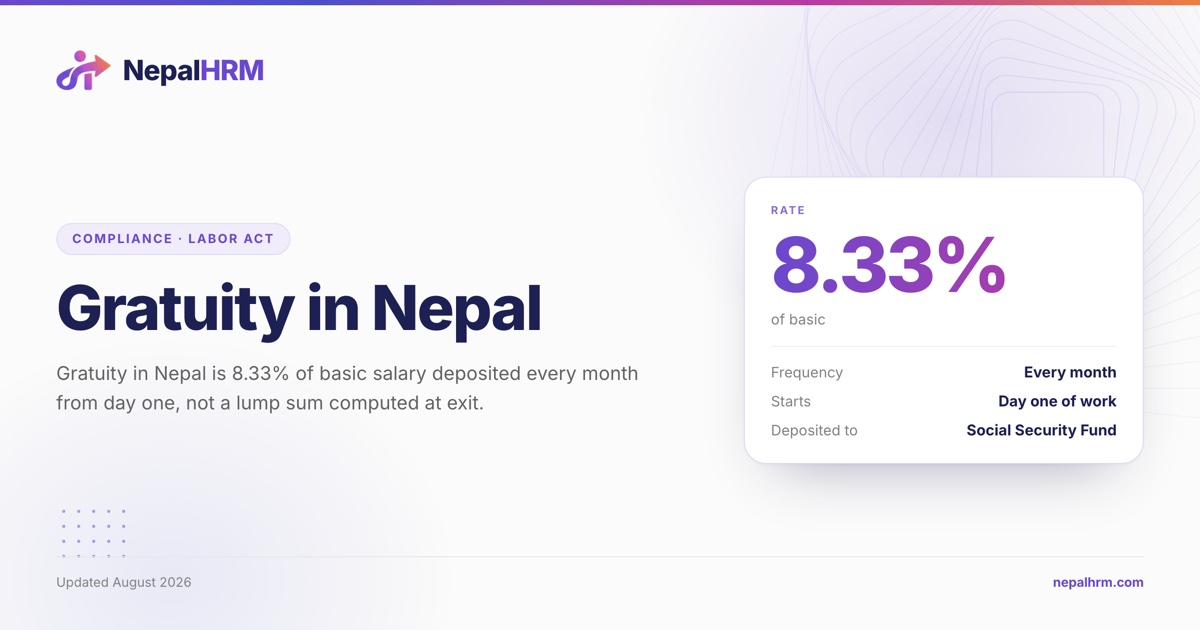
Gratuity in Nepal is 8.33% of basic remuneration, deposited every month, from the day the employee starts work. It is not a lump sum calculated at exit from years of service, and there is no three-year qualifying period. Section 53 of the Labour Act 2074 replaced the old arrangement completely, and most gratuity content still published for Nepal describes the repealed one.
This guide covers what Section 53 requires, where the money goes, how gratuity fits inside the SSF contribution, and what an employer who is still holding gratuity on its own balance sheet has to do. It sits under our complete guide to the Nepal Labour Act 2074.
Table of Contents
- What Section 53 says
- What changed, and why the old formula is still everywhere
- The arithmetic: why 8.33%
- Where gratuity sits inside the SSF contribution
- Who qualifies
- What an employer who is not yet in the SSF must do
- Gratuity in the final settlement
- What to check this month
- Frequently asked questions
- What is the gratuity rate in Nepal?
- How is gratuity calculated in Nepal?
- How many years of service are needed for gratuity in Nepal?
- Is gratuity calculated on basic or gross salary in Nepal?
- Is gratuity included in the SSF contribution?
- Does an employer still pay gratuity separately if it is in the SSF?
- What is gratuity called in Nepali?
- Sources
What Section 53 says
Section 53(1) is one sentence: the employer shall deposit an amount equal to eight point three three percent of the basic remuneration of every worker, every month, as gratuity.
Section 53(2) says where it goes and when it starts: into the Social Security Fund, in that worker's name, applying from the very day the concerned worker commenced the work.
Section 53(3) is the narrow exception. The employer deposits it as otherwise prescribed only in two cases: until the Social Security Fund has been established and brought into operation, or until the social security law applies to that particular employer.
Section 53(6) is the backstop. Where the gratuity amount cannot be deposited under 53(2) or 53(3) for any reason, the employer must pay the worker 8.33% of basic remuneration in addition. The obligation does not evaporate because the deposit route is unavailable; it converts into cash in the employee's hand.
What changed, and why the old formula is still everywhere
Section 183(1) repealed three acts outright: the Labour Act 2048, the Industrial Trainee Training Act 2039, and the Retirement Fund Act 2042.
The gratuity formula almost every Nepali HR article still quotes came from the 2048 Act: half a month's salary per year for the first seven years, one month for the next seven, and so on, payable to a worker with at least three years of continuous service. That act no longer exists. The rule that replaced it is a flat monthly accrual with no service threshold.
| Repealed Labour Act 2048 | Labour Act 2074, §53 | |
|---|---|---|
| Form | Lump sum computed at exit | Monthly contribution |
| Rate | Banded by years of service | Flat 8.33% of basic |
| Minimum service | Three years | None |
| Held by | The employer | The Social Security Fund, in the worker's name |
| Paid on | Separation | Per the social security scheme's own rules |
The practical consequence for an employee is large. Under the old rule, leaving in year two meant leaving with nothing. Under Section 53, twenty-two months of employment means twenty-two months of 8.33% sitting in the worker's own name.
The arithmetic: why 8.33%
8.33% is 1 ÷ 12, expressed as a percentage. Twelve monthly deposits of 8.33% of basic add up to one month's basic per year of service.
On a basic salary of NPR 30,000:
| Amount | |
|---|---|
| Monthly gratuity contribution (8.33% of 30,000) | NPR 2,499 |
| Twelve months | NPR 29,988 |
| One month's basic, for comparison | NPR 30,000 |
The twelve-rupee gap is rounding, because 8.33% is a rounded 1/12. That equivalence is worth holding on to: gratuity accrues at one month of basic per year, paid a twelfth at a time.
Note also that "basic remuneration" is a defined term. Section 2(a) says it includes the amount of the increment in remuneration after one year of employment, so a worker's gratuity base rises with their annual grade increment under Section 36. A payroll that froze the gratuity base at the joining basic is under-contributing, and it under-contributes more each year. See basic salary and gross salary for why the distinction decides the number.
Where gratuity sits inside the SSF contribution
This is the part that makes the whole design click, and it is pure arithmetic.
An employee enrolled in the Social Security Fund contributes 11% of basic and the employer contributes 20%, for 31% in total. The Fund publishes how that 31% is allocated across its protection schemes:
| Scheme | Share of basic |
|---|---|
| Medical treatment, health and maternity protection | 1.20% |
| Accident and disability protection | 0.80% |
| Dependent family protection | 0.67% |
| Old-age protection | 28.33% |
| Total | 31.00% |
Now put the pre-SSF statutory obligations beside it. Section 52(1) requires 10% of basic deducted from the worker plus a 100% employer match, so 20%. Section 53(1) requires 8.33% for gratuity. Add them: 10 + 10 + 8.33 = 28.33%.
The old-age protection bucket is, to the decimal place, the provident fund plus the gratuity. The remaining 2.67% (1.20 + 0.80 + 0.67) buys the medical, accident and dependent-family cover that an employer would otherwise have had to arrange separately under Sections 54 and 55.
That is why Section 57 works the way it does: an employer contributing to the social security scheme need not make a further contribution or arrange separate insurance under that chapter, to the extent the scheme covers provident fund, gratuity and medical treatment insurance. Nothing was taken away, and nothing was added twice. See gratuity, provident fund and the Social Security Fund.
Who qualifies
Every worker with whom an employment relation is established, from day one. Section 53(2) leaves no room: "from the very day the concerned labour commenced the work".
That includes probationers, because Section 13 makes probation a term of the employment contract rather than a suspension of the Act. It includes workers in work-based, time-based and part-time employment, because Section 10 makes them all employment. Our guide to employment types in Nepal sets out how the five categories differ and what does not differ between them.
Casual employment is the edge case. Section 10's explanation defines casual employment as work of seven days or fewer in a month, and Section 11(2) exempts it from a written contract. The contribution mechanics for someone engaged for three days are a question for the Fund's own enlistment rules rather than for a payroll policy.
What an employer who is not yet in the SSF must do
Section 53(3) permits depositing as prescribed only while the social security law has not been applied to that employer. Two duties follow.
Section 53(5): transfer the historic balance. Amounts accumulated for gratuity in a retirement fund established under the then-prevailing law, or held by the employer, must be transferred to the Social Security Fund after the Act commenced, as prescribed. The Retirement Fund Act 2042 was repealed at the same time.
Section 53(6): if it cannot be deposited, pay it. The 8.33% is the worker's, wherever it ends up.
An employer still accruing gratuity as a provision on its own books, planning to compute a lump sum on exit, is running the repealed regime. Our employer's guide to migrating from PF and gratuity to the SSF covers what the switch involves month by month.
Gratuity in the final settlement
Because gratuity is deposited monthly into the Fund in the worker's name, it is generally not a line the employer computes and pays at exit. What the employer owes at exit under Section 148(1) is everything still unpaid: salary to the last day, accumulated leave encashed at the last basic drawn under Section 49(2), pro-rated festival expense, and any gratuity month not yet deposited.
Section 148(2) then adds the duty most settlements forget: the employer must give the worker the assistance needed to obtain the amounts payable from the Social Security Fund, an insurer or another body. Handing over a settlement sheet is not the whole obligation. Our guide to termination and notice periods covers the fifteen-day deadline and what happens when it is missed.
What to check this month
- Is gratuity 8.33% of basic, monthly, or a year-end provision?
- Does the base move with the annual increment, per Section 2(a)?
- Is it running from the joining date, including for probationers?
- Is it going to the Fund in the worker's name, or sitting on your balance sheet?
- If you are pre-SSF, is the historic balance scheduled for transfer under Section 53(5)?
- Does your staff handbook still quote the repealed 2048 formula?
Gratuity is now a payroll line, not a year-end calculation. NepalHRM computes SSF at 11% employee and 20% employer of basic on every payroll run, shows both sides on the payslip, and prepares the deposit figures. See how payroll works, or put a number on it with the SSF contribution calculator.
Frequently asked questions
What is the gratuity rate in Nepal?
8.33% of basic remuneration a month, under Section 53(1) of the Labour Act 2074. Over twelve months that is equivalent to one month's basic salary per year of service.
How is gratuity calculated in Nepal?
It is not calculated at exit. Section 53(1) requires the employer to deposit 8.33% of the worker's basic remuneration every month, and Section 53(2) requires it to go into the Social Security Fund in that worker's name from the day they started work.
How many years of service are needed for gratuity in Nepal?
None under the current Act. The three-year qualifying period came from the Labour Act 2048, which Section 183(1) of the Labour Act 2074 repealed. Gratuity now accrues monthly from the first day of employment.
Is gratuity calculated on basic or gross salary in Nepal?
Basic. Section 53(1) says "basic remuneration", which Section 2(a) defines separately from "remuneration" and which includes the annual increment amount once a year of employment is complete. Allowances are excluded.
Is gratuity included in the SSF contribution?
Yes. The Fund's old-age protection allocation is 28.33% of basic, which is exactly the 10% employee plus 10% employer provident fund under Section 52(1) plus the 8.33% gratuity under Section 53(1). Section 57 relieves an employer contributing to the scheme from making the same contributions again.
Does an employer still pay gratuity separately if it is in the SSF?
No, to the extent the scheme covers it. Section 57 says an employer or worker contributing to a social security plan that provides provident fund, gratuity and medical treatment insurance need not make a further contribution or arrange separate insurance under that chapter.
What is gratuity called in Nepali?
Upadan (उपदान). Section 53 of the Labour Act 2074 is headed upadan paaune, the entitlement to gratuity.
Sources
- Labour Act, 2074 (2017), consolidated Nepali text as amended through 2082, Nepal Law Commission: lawcommission.gov.np. Sections 2, 36, 49, 52, 53, 54, 55, 57, 148 and 183 were read from that text, retrieved 2026-08-06.
- Social Security Scheme Operation Procedure, 2075, including the fifth amendment: ssf.gov.np. Section 25 sets the 11% employee and 20% employer split and the four-way allocation of the 31%; it was read from that text, retrieved 2026-08-06.
Related reading: Nepal Labour Act 2074: the complete guide · Provident fund calculation in Nepal · Termination and notice period in Nepal