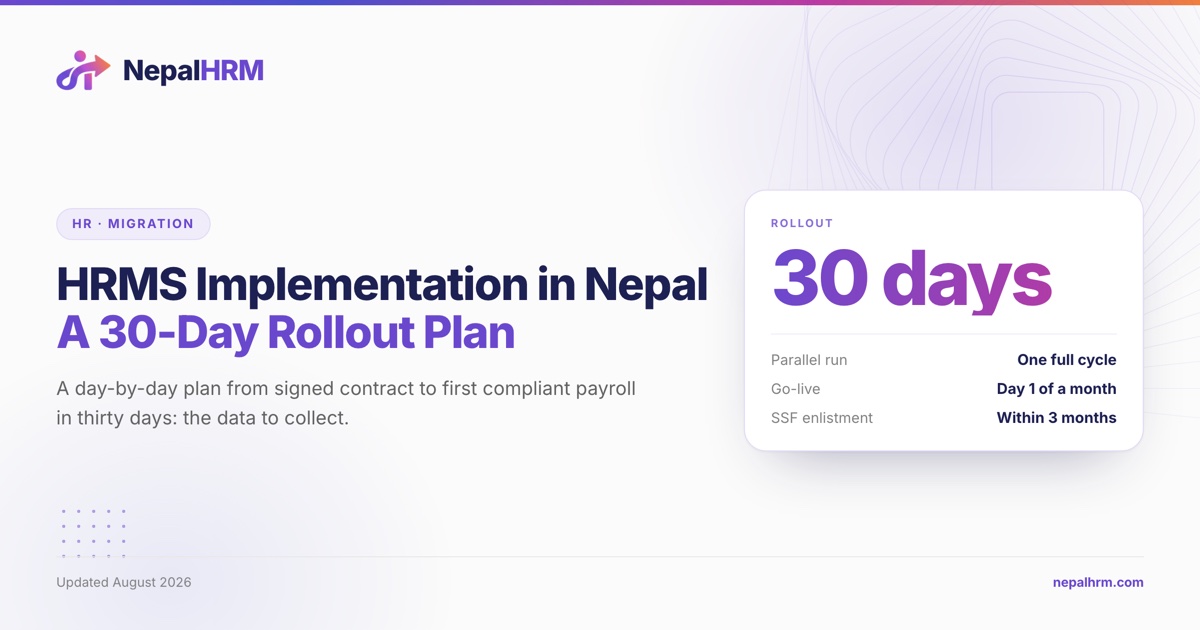
Thirty days is enough to put an HRMS into a Nepali company of under two hundred people, and the reason is not that the software is quick to configure. It is that almost all of the work is collecting data you already own, and the only genuinely slow parts are statutory: a Social Security Fund number, a personal PAN per employee, and the opening balances the tax projection has to start from.
The plan below assumes you have already chosen a vendor. If you have not, the HRMS buying checklist is the question set to run first, and our guide to switching HR and payroll software at the fiscal-year boundary covers when to do this. This one covers how, in any month of the year.
Table of Contents
- Why thirty days is the right box
- Before day 1: the six things you need
- Week 1 (days 1–7): decide, then collect
- Week 2 (days 8–14): configure Nepal, not "HR"
- Week 3 (days 15–21): the parallel run
- Week 4 (days 22–30): go live and clear the first statutory cycle
- Who owns what
- Five ways a 30-day rollout fails
- Frequently asked questions
- How long does an HRMS implementation take in Nepal?
- When should a Nepali company go live on a new HRMS?
- What data do you need before starting an HRMS implementation?
- What is a parallel run in a payroll implementation?
- Can you implement an HRMS in the middle of a fiscal year?
- Who should own an HRMS rollout inside the company?
- What happens if payroll deadlines fall during the go-live month?
- Sources
Why thirty days is the right box
Shorter than a month and you cannot fit a parallel run, which is the only step that actually proves the configuration. Longer than a month and the project loses the two people whose attention it needs, because HR and finance both have a month-end that does not pause for an implementation.
Thirty days also aligns the rollout with the cycle it has to survive. Nepali payroll is monthly by law: Section 35 of the Labour Act 2074 requires that the gap between remuneration payments does not exceed one month, and Schedule 10 of the Labour Rules 2075 asks the enterprise to state a reason where it does. A rollout that spans exactly one cycle gets tested once before it is trusted.
| Week | Days | What it produces |
|---|---|---|
| 1 | 1–7 | Decisions made, data collected, one owner named |
| 2 | 8–14 | The system configured for Nepal, employees loaded |
| 3 | 15–21 | One real month run in parallel and reconciled |
| 4 | 22–30 | Go-live, then the first statutory cycle cleared |
Before day 1: the six things you need
None of these is software. All six are the reason rollouts stall, and five of them are requests to somebody outside the project.
| # | What | Where it comes from | Typical wait |
|---|---|---|---|
| 1 | Employer PAN and company registration details | Your own records | Same day |
| 2 | Social Security Fund registration number, if you are enrolled | SSF, from your registration | Already held, or weeks |
| 3 | Personal PAN for every employee | Each employee | The long pole |
| 4 | Bank account number and branch for every employee | Each employee, verified against the bank | Days |
| 5 | Signed employment contracts or appointment letters | Your files | Reveals gaps |
| 6 | Last three months of processed payroll | Your existing workbook or system | Same day |
Item 3 is the one to start on day 1 rather than day 10. The monthly withholding return, which the IRD publishes in the eTDS format, reports tax withheld employee by employee against each individual's personal PAN, so an employee with no PAN is an employee that return cannot account for. Collecting forty PANs takes a fortnight of chasing, and it can run in the background of everything else.
Item 5 is the one that produces an uncomfortable discovery. Section 11(1) of the Labour Act prohibits engaging anyone except casual workers without a contract, and Section 163(1)(d) prices the omission at NPR 10,000 per worker, up to NPR 500,000. An implementation is the first time most companies list every employee in one place, which is why it is also the first time the gap is visible. Fix it during the rollout, not during a labour inspection.
Week 1 (days 1–7): decide, then collect
Six decisions have to be made before any data is loaded, because each one changes the shape of the employee record.
- Retirement system per employee. Social Security Fund, or provident fund plus gratuity under Sections 52 and 53 of the Labour Act. Section 57 relieves an employer contributing to a covering social security plan from making those contributions separately, so the two are alternatives rather than a stack. Our PF and gratuity to SSF migration guide covers the transfer if you are moving.
- Salary structure. The basic-to-allowance split, because basic salary is the base for SSF, PF and gratuity, and gross salary is not.
- Pay calendar. Which BS date payroll closes on, which date it pays on, and how those map to the statutory deadlines later in this plan.
- Leave year and opening balances. Which leave types you grant, at what accrual, and each employee's balance on the cutover date.
- Attendance source. Biometric device, mobile clock-in, or a monthly ledger imported from whatever the device already exports.
- Approval chains. Who approves leave, attendance corrections and overtime, and what happens when that person is on leave.
Then collect. One spreadsheet, one row per employee, the columns the vendor's import expects, filled by HR rather than by the vendor. The company that hands over a half-filled sheet and asks the vendor to "figure out the rest" is the company whose payroll is wrong in month two.
Name one owner. Not a committee. An HRMS rollout needs one person who can decide that the sales team's allowance is a fixed component and not a variable one, and decide it in an afternoon.
Week 2 (days 8–14): configure Nepal, not "HR"
Every HRMS configures departments, designations and approval chains. Those take a morning. The settings that decide whether your payroll is correct are the Nepal-specific ones, and a generic implementation checklist does not list them.
Fiscal year and calendar. The Nepali fiscal year runs Shrawan 1 to the end of Ashad, and tax is projected across that year, not the calendar one. Confirm the system's year boundary before loading anything.
Tax slabs and the SSF waiver. FY 2083/84 merged the single and couple schedules into one table for all resident natural persons, raised the 1% first band to NPR 1,000,000, and cut the top marginal rate to 29%. That first band is the social security tax, and an SSF contributor is exempt from it. If the system charges it to an enrolled employee, the payslip is wrong from the first run. Check one employee against the salary tax calculator.
Retirement deduction ceiling. Contributions reduce taxable income only up to the lowest of the actual contribution, NPR 500,000, or one third of assessable income. A senior employee on a large basic hits that ceiling, and a system that ignores it under-withholds all year.
Contribution rates. SSF is 11% from the employee and 20% from the employer, both on basic. Verify the base is reading the basic column and not the gross one, on one payslip, by hand. The SSF contribution calculator gives you the number to check against.
Leave types from the Act, not from a template. Weekly, public, home, sick, maternity, maternity-care, mourning and substitute leave each have their own rules. Our guide to every leave type under the Labour Act sets them out.
The holiday list. Company-scoped, loaded once, and it drives leave charging as well as attendance. A holiday that is missing from the calendar is a day of leave charged to somebody who did not take it.
Overtime rules. Section 28 fixes eight hours a day and forty-eight a week, and Section 31 requires the additional rate beyond that. Configure the rate before the first attendance import, not after somebody queries a payslip.
Festival expense. Section 37 provides for it, and its timing sits inside the fiscal year rather than at its end. Decide the month now so it does not arrive as a surprise adjustment.
Week 3 (days 15–21): the parallel run
This is the week the implementation is actually validated, and it is the week most often skipped.
Take a month you have already processed and paid, load its inputs into the new system, run it, and compare. Not a sample of five employees. The whole payroll, because the errors live in the exceptions: the joiner on day 12, the employee whose allowance changed, the one with a loan deduction.
Five totals have to tie, and "close enough" is not one of the options:
| What must match | Sample company, five employees |
|---|---|
| Total gross | NPR 405,000 |
| Employee SSF, 11% of basic | NPR 26,730 |
| Employer SSF, 20% of basic | NPR 48,600 |
| Total tax withheld for the month | NPR 10,062 |
| Net pay, which is the bank transfer file total | NPR 368,208 |
Those figures are generated from lib/nepal-payroll.ts, the module behind this site's calculators, on FY 2083/84 slabs with a 60% basic structure and every employee enrolled in the SSF. The arithmetic that has to hold on your own run is the same: gross, less employee contributions, less tax withheld, equals the bank transfer file total.
When they do not match, the difference is information. A gap equal to one employee's contribution is a missing enrolment. A gap that is a round percentage of basic is a rate set wrong. A gap that changes when you re-run is a date problem, usually a joining date recorded in the wrong calendar. Our guide to moving payroll from Excel works through the ones that recur.
Reconcile until the difference is zero. Then have finance, not the project owner, sign the reconciliation.
Week 4 (days 22–30): go live and clear the first statutory cycle
The go-live gate. Five conditions, checked on day 22. Any "no" means you slip to the next month rather than going live and fixing it afterwards, because a wrong first payroll costs more trust than a delayed one.
- The parallel run reconciled to zero and finance signed it.
- Every employee has a personal PAN, a bank account with its branch, and a signed contract on file.
- Opening balances are loaded: leave, year-to-date gross, year-to-date tax withheld, loan outstanding.
- Employees can log in and see their own payslip. If self-service is not working on day 22, it will not be working in month three.
- The old system, or the workbook, is frozen and read only, with one named person able to unfreeze it.
Go live on day 1 of a month. A mid-month cutover splits one employee's projection across two systems, which means neither one holds the year-to-date figure the withholding return needs.
Then clear the cycle, which is where the rollout actually ends. Statutory deadlines do not grant a grace period for new software:
| Obligation | Deadline | Source |
|---|---|---|
| Deposit SSF contributions | Within 25 days of the month ending | Contribution Based Social Security Act 2074, §4(4), as amended 2082 |
| Deposit withheld tax with the withholding return | Within 25 days of the month ending | Income Tax Act 2058, withholding provisions |
| Enlist a new joiner with the Fund | Within 3 months of the employment relation | Same Act, §20(1) |
| Inform the Fund when a contributor leaves | Within 1 month | Same Act, §24 |
Late SSF is not a flat fine. Section 9(1) recovers the contribution with ten percent interest, and Section 9(2) allows an application for relief only within thirty days, stating the reason. Our guide to monthly SSF filing covers the full cycle, and to six SSF mistakes covers what the errors cost.
Between day 25 and day 30, run the checks that only a live system can answer: does every payslip open, did the bank accept the transfer file without a rejected row, and can you produce the headcount split by employment type that Schedule 10 of the Labour Rules will ask for at the labour audit.
Who owns what
A rollout with no named owners becomes the vendor's project, and the vendor does not know that the sales team's allowance is negotiated per person.
| Role | Owns | Cannot be delegated |
|---|---|---|
| Project owner (HR lead) | Every configuration decision, the schedule | Deciding the salary structure |
| Finance | The parallel-run reconciliation, sign-off | Approving that the numbers tie |
| IT or admin | Device connectivity, accounts, network access | Nothing, if the vendor is remote |
| Department heads | Confirming their own team's data | Confirming their reports' grades and allowances |
| Vendor | Configuration support, import, training | Owning your data quality |
The line that matters is the last one. A vendor can load a file. It cannot know that two rows are the same person spelled two ways.
Five ways a 30-day rollout fails
Data collection starts in week 2. The PAN chase is a fortnight of somebody else's time. Start it on day 1 and it finishes on schedule; start it on day 8 and it is the reason you slip.
The parallel run is a sample. Five employees always reconcile. The joiner, the leaver and the person with a mid-month grade change do not, and they are the whole point of the exercise.
Go-live is mid-month. The projection splits, the withholding return has no single source for the year to date, and the fix is a manual adjustment that has to be remembered every month until Ashad.
Nobody freezes the old system. Two systems running in parallel after go-live is not a safety net. It is two versions of the truth, and within a month nobody can say which payslip is the real one.
Training is one session for everybody. Managers approving leave and employees viewing a payslip need ten minutes each. HR and finance need an hour, twice, with their own data on screen.
Where this becomes concrete. NepalHRM applies the FY 2083/84 slabs and the SSF split of 11% employee and 20% employer on basic automatically on every run, produces the bank transfer file and the IRD eTDS file for upload, and holds the headcount and leave records the labour audit asks for. Integration is file-based: CSV and Excel import and export, saved import profiles so a device's own monthly export loads the same way each month, and bank transfer file export. Free onboarding and data migration come with every plan, and the Free plan covers up to 10 employees. See how payroll works, or book a walkthrough with one of your own payslips.
Frequently asked questions
How long does an HRMS implementation take in Nepal?
Thirty days is realistic for a company of under two hundred employees, split as one week of decisions and data collection, one week of configuration, one week of parallel running against an already-processed month, and one week of go-live plus the first statutory cycle. The schedule is set by data collection and by the monthly payroll cycle, not by how long the software takes to configure.
When should a Nepali company go live on a new HRMS?
On day 1 of a month, so that no employee's annual tax projection is split across two systems. The fiscal-year boundary from Ashad to Shrawan is cleaner still, because opening balances start at zero, but any month start works if year-to-date figures are carried across correctly.
What data do you need before starting an HRMS implementation?
Employer PAN and registration details, the Social Security Fund registration number if enrolled, a personal PAN for every employee, each employee's bank account number and branch, signed employment contracts or appointment letters, and the last three months of processed payroll to reconcile against.
What is a parallel run in a payroll implementation?
Processing a month you have already paid in both the old and the new system, then reconciling the two. Five totals have to match exactly: gross, employee contributions, employer contributions, tax withheld, and net pay, which is the bank transfer file total. A parallel run on a sample of employees proves nothing, because the errors sit in joiners, leavers and mid-month changes.
Can you implement an HRMS in the middle of a fiscal year?
Yes, provided year-to-date gross and year-to-date tax withheld are loaded as opening balances. Without them the new system projects annual tax from the remaining months only, which under-withholds for the rest of the year and leaves a shortfall the employee pays at year end.
Who should own an HRMS rollout inside the company?
One named person, usually the HR lead, with authority to make configuration decisions without convening a committee. Finance owns the parallel-run reconciliation and signs it off. The vendor owns configuration support and training, but cannot own data quality, because only the company knows which two rows are the same person.
What happens if payroll deadlines fall during the go-live month?
They still apply. SSF contributions are due within twenty-five days of the month ending under Section 4(4) of the Contribution Based Social Security Act 2074, and withheld tax is due within twenty-five days with its return. Late SSF is recovered with ten percent interest under Section 9(1), and relief must be applied for within thirty days under Section 9(2).
Sources
- Labour Act, 2074 (2017), consolidated Nepali text as amended through 2082, Nepal Law Commission: lawcommission.gov.np. Sections 11, 28, 31, 35, 37, 52, 53, 57 and 163 were read from that text, retrieved 2026-08-07.
- Labour Rules, 2075 (2018), Nepali text published by the Social Security Fund at ssf.gov.np. Rule 56 and Schedule 10, retrieved 2026-08-07.
- Contribution Based Social Security Act, 2074 (2017), consolidated Nepali text as amended through 2082: ssf.gov.np. Sections 4, 9, 20 and 24, retrieved 2026-08-07.
- Social Security Scheme Operation Procedure, 2075, including the fifth amendment: ssf.gov.np. Section 25 for the 11% and 20% contribution rates, retrieved 2026-08-07.
- The FY 2083/84 slab table, the NPR 500,000 retirement deduction ceiling and every rupee figure in the reconciliation table are generated from
lib/nepal-payroll.ts, the module behind this site's salary tax, payslip and SSF calculators.
Related reading: Moving payroll from Excel to an HRMS · HRMS buying checklist for Nepal · Switching HR and payroll software at the new fiscal year