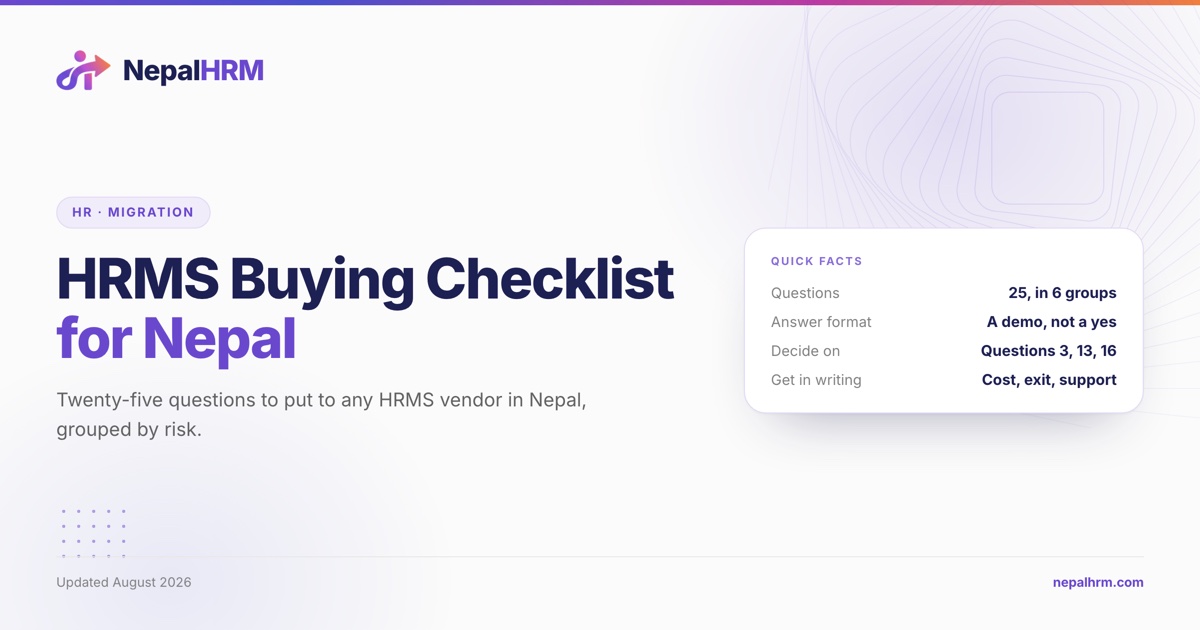
Most HRMS evaluations in Nepal are run on a feature list, and a feature list cannot lose. Every vendor ticks every box, because "payroll", "attendance" and "leave" are true of all of them. The questions below are written so that a wrong answer is visible, which mostly means asking to see something run rather than asking whether something exists.
This is a procurement instrument, not a vendor ranking. For a ranked look at who is actually selling in this market, see our comparison of the best HRMS software in Nepal. Once you have chosen, the 30-day rollout plan is the schedule to hold the vendor to.
Table of Contents
- Group 1 · Nepal statutory fit (questions 1–7)
- Group 2 · Payroll mechanics (questions 8–12)
- Group 3 · Data, migration and exit (questions 13–16)
- Group 4 · Attendance and devices (questions 17–19)
- Group 5 · Security and continuity (questions 20–22)
- Group 6 · Commercials and support (questions 23–25)
- The four answers to walk away from
- Questions that sound rigorous and tell you nothing
- How to score it
- Frequently asked questions
- What should you ask an HRMS vendor in Nepal?
- How do you choose an HRMS in Nepal?
- What is the most overlooked question when buying HR software?
- Should you buy a Nepali HRMS or an international one?
- How much should an HRMS cost in Nepal?
- What is a red flag when evaluating an HRMS vendor?
- Sources
Group 1 · Nepal statutory fit (questions 1–7)
This group is why a global HRMS with a Nepal reseller and a Nepali HRMS are not the same purchase. Ask all seven, and ask for a screen rather than a sentence.
| # | Ask | A good answer contains |
|---|---|---|
| 1 | Which fiscal year does the system run on, and can it issue a payslip dated in BS? | Shrawan to Ashad as the tax year, and both calendars visible in the product |
| 2 | Show me the current income tax slab table inside the product, and show me where it changes when the budget changes | A settings screen with FY 2083/84 rates, and a named person who updates it |
| 3 | Run one payroll containing both an SSF contributor and a provident-fund-plus-gratuity employee, and show me both payslips | Two correct payslips from a single run, not two separate companies |
| 4 | Which figure is SSF calculated on in your system, and where do I see that setting? | Basic, explicitly, with the setting on screen |
| 5 | How is the 1% social security tax handled for an SSF contributor? | It is waived for them, and charged for everyone else |
| 6 | Show the retirement deduction ceiling being applied to a high earner | The lowest of the actual contribution, NPR 500,000, or one third of assessable income |
| 7 | What does the system produce for the monthly withholding return, and who uploads it? | A file produced by the system, uploaded by a person, stated plainly |
Question 3 is the single most useful question in this list. Nepali companies routinely run both retirement systems at once, because Section 57 of the Labour Act 2074 relieves an employer contributing to a covering social security plan from the separate provident fund and gratuity obligations under Sections 52 and 53, but enrolment happens employee by employee. A system that models only one of the two forces a spreadsheet back into your process on day one.
Question 5 catches a specific error. The first income band under FY 2083/84 is the social security tax, and an SSF contributor is exempt from it because the contribution already funds what it pays for. Leaving that band switched on over-withholds from every enrolled employee, which is one of the six SSF mistakes that cost Nepali employers money.
Group 2 · Payroll mechanics (questions 8–12)
Everything here is an ordinary month in a Nepali company, and each one is a place where a demo tenant with five tidy employees will not have been tested.
| # | Ask | A good answer contains |
|---|---|---|
| 8 | Run a mid-month joiner and a mid-month leaver, live | Pro-rated gross, contributions and tax, computed not typed |
| 9 | How is festival expense handled, and in which month? | A configurable month, and it appears on the payslip |
| 10 | Show me the bank transfer file for my bank | A real file, and a list of banks in production today |
| 11 | How are arrears and back-dated changes handled? | A named mechanism, not "we adjust it manually" |
| 12 | What happens if an error is found after a payroll is released? | A defined correction path, with an audit trail |
Question 9 is a Nepal question, not a nicety: Section 37 of the Labour Act provides for festival expense, and its timing sits inside the fiscal year. Question 10 is the one that stops a go-live, because a transfer file the bank rejects on payday is not a support ticket, it is unpaid staff.
Group 3 · Data, migration and exit (questions 13–16)
Four questions, and the last one is the one nobody asks during a sales conversation.
| # | Ask | A good answer contains |
|---|---|---|
| 13 | Which fields must my import file contain? Show me the template today | An actual file, sent while you are still on the call |
| 14 | How does the system know whether a date in my file is BS or AD? | A per-column setting, saved and reusable |
| 15 | What opening balances can be loaded for a mid-year cutover? | Year-to-date gross, tax withheld, contributions, leave, loan outstanding |
| 16 | If we leave in two years, what do we get back, in what format, how long does it take, and what does it cost? | A format, a timescale and a number, in the contract |
Question 14 is a better test than it looks. A vendor who has actually run Nepali migrations answers it immediately, because a BS joining date read as an AD date is the error that silently corrupts gratuity, service length and probation dates all at once. Our guide to moving payroll from Excel works through that failure and the opening balances in question 15.
Question 16 is the one to get in writing. Ask it early, ask it in the room, and put the answer in the contract rather than in an email. A vendor who cannot describe how you leave is describing how you cannot.
Group 4 · Attendance and devices (questions 17–19)
| # | Ask | A good answer contains |
|---|---|---|
| 17 | Which device makes and models do you have in production today, and can I speak to a customer running that exact model? | Named makes and models, and a reference call |
| 18 | What happens to attendance when the internet drops at a branch? | Punches held locally and synced when the link returns |
| 19 | If you do not support my device, what is the fallback and how much manual work is it each month? | A saved column mapping for the device's own export, not re-mapping monthly |
Question 17 has a specific trap. Device support is the easiest thing in this market to over-claim, because "supports biometric devices" is true of any system that can accept a spreadsheet. Ask for makes and models in production, and treat a list longer than you expected as a reason to ask for the reference call. Our biometric attendance setup guide covers what integration actually involves.
Group 5 · Security and continuity (questions 20–22)
Three questions, deliberately blunt. The answers belong in the contract, not the pitch deck.
| # | Ask | A good answer contains |
|---|---|---|
| 20 | Where is our data hosted, in which country, and who inside your company can read our payroll? | A location, a named access policy, and logging |
| 21 | What login protection is available beyond a password, and on which plan? | A specific mechanism, and whether it costs extra |
| 22 | What availability commitment is in the contract, how often are backups taken, how long are they kept, and how are we told about an incident? | Four separate answers, all of them written down |
Payroll data is the most sensitive data most Nepali companies hold, and it is the reason question 20 asks who inside the vendor can read it. "Nobody" is not a credible answer for any system that has a support team. "These roles, logged, and here is how you see the log" is.
Group 6 · Commercials and support (questions 23–25)
| # | Ask | A good answer contains |
|---|---|---|
| 23 | What is the total first-year cost, itemised, including anything one-off? | Subscription, hardware, setup, training, add-ons, as separate lines |
| 24 | Is the price per employee or per user account, and what happens when headcount changes? | Which of the two, and how a change mid-month is billed |
| 25 | Who supports us, in which time zone and which language, and what is the escalation path on payday? | A named channel, hours that cover your payroll day, and an escalation |
Question 24 separates two pricing models that look identical on a quote and diverge as you grow. Per active employee tracks your headcount; per user account charges for every login, including managers who approve two leave requests a month. Ask which, and ask what happens in a month when ten people join.
Question 25 has one answer that matters more than the rest: what happens when payroll is stuck at 4pm on payday. Support hours in another time zone are not support.
The four answers to walk away from
"We can build that for you." Offered in response to a statutory question, this means the statutory feature does not exist. Custom work for one customer is also the work that does not get maintained when the next budget changes the slabs.
"It is on the roadmap." Fine for a nicety, disqualifying for anything in Group 1. Ask for a date and a contractual consequence if it slips, and watch what happens.
"Nobody else has asked for that." For a question about Nepali statutory payroll, this says the vendor's other customers are not running Nepali statutory payroll.
"We will send the details after the call." Once, about a detail, is normal. Three times, about the import template, the bank file and the exit terms, is a pattern: those three are the answers that are hard to give and easy to defer.
Questions that sound rigorous and tell you nothing
Cut these from your evaluation. Every vendor passes them, so they add length without adding information.
- Is it customisable? Yes, from everyone. Ask instead which specific thing you need changed, and who changes it.
- How many customers do you have? Unverifiable and irrelevant to whether your payroll is right. Ask for one reference at your headcount, in your sector.
- Is it cloud-based? Almost universally yes. Question 20 asks the part that matters.
- Does it have reports? Ask for the three reports you actually run each month, produced live in the demo.
- Does it support our industry? Ask for the one thing your industry does that a generic payroll does not, and have it demonstrated.
How to score it
Twenty-five questions is too many to hold in your head across three vendor calls, so score as you go.
- 2 points where the vendor showed it working on your data or handed over the artefact.
- 1 point where they described it credibly but did not show it.
- 0 points for a yes with nothing behind it.
Weight Group 1 double. Statutory correctness is the only category where a wrong answer produces a legal exposure rather than an inconvenience, and it is the category a demo can settle in minutes. Then check that the totals agree with your instinct after the calls. Where they disagree, the checklist is usually right and the demo was charming.
Our own answers. NepalHRM applies the FY 2083/84 slabs, the SSF split of 11% employee and 20% employer on basic, and the NPR 500,000 retirement deduction ceiling automatically, runs SSF and provident-fund employees in the same payroll, and produces the bank transfer file and the IRD eTDS file for upload. Integration is file-based: CSV and Excel import and export, saved import profiles, and bank transfer file export. Pricing is per active employee in NPR and published in full on pricing, the Free plan covers up to 10 employees, and free onboarding and data migration come with every plan. Book a walkthrough and run this list at us.
Frequently asked questions
What should you ask an HRMS vendor in Nepal?
Ask to see things run rather than asking whether they exist. The highest-value three are: run one payroll containing both an SSF contributor and a provident-fund-plus-gratuity employee, show the import template today, and state what you get back if you leave, in what format and how long it takes. Those three separate a working Nepali payroll product from a feature list faster than anything else on a checklist.
How do you choose an HRMS in Nepal?
Score vendors on demonstrated behaviour, not claimed features, and weight statutory correctness double. Nepal-specific fit is where products actually diverge: the Shrawan-to-Ashad tax year, the FY 2083/84 slabs, SSF assessed on basic, the waiver of the 1% first band for SSF contributors, the NPR 500,000 retirement deduction ceiling, and a bank transfer file your own bank accepts.
What is the most overlooked question when buying HR software?
What happens when you leave. Ask what data you get back, in what format, how long it takes and what it costs, and put the answer in the contract rather than an email. It is the one question a vendor has no commercial incentive to answer well, which is exactly why it belongs in the room rather than in a follow-up.
Should you buy a Nepali HRMS or an international one?
The deciding factor is question 3: whether one payroll run can contain both an SSF contributor and a provident-fund-plus-gratuity employee, correctly. Nepali statutory payroll is not a localisation layer over a global product, because the slab table, the contribution base, the fiscal year and the withholding return are all different. An international product with a strong Nepal implementation can pass; ask it to prove that it does.
How much should an HRMS cost in Nepal?
Ask for the total first year, itemised, rather than a monthly rate. The lines that move the total are hardware, one-off setup, per-module charges and training. Also establish whether the price is per active employee or per user account, because the two look identical on a quote for twenty people and diverge sharply at a hundred.
What is a red flag when evaluating an HRMS vendor?
"We can build that for you," offered in response to a statutory question. It means the statutory capability does not exist today, and bespoke work for one customer is also the work least likely to be maintained when the next budget changes the tax slabs.
Sources
- Labour Act, 2074 (2017), consolidated Nepali text as amended through 2082, Nepal Law Commission: lawcommission.gov.np. Sections 37, 52, 53 and 57, retrieved 2026-08-07.
- Social Security Scheme Operation Procedure, 2075, including the fifth amendment: ssf.gov.np. Section 25 for the 11% employee and 20% employer contribution on basic, retrieved 2026-08-07.
- The FY 2083/84 slab structure, the waiver of the first band for SSF contributors and the NPR 500,000 retirement deduction ceiling are as implemented in
lib/nepal-payroll.ts, the module behind this site's salary tax, payslip and SSF calculators.
Related reading: HRMS implementation in Nepal: a 30-day rollout plan · Moving payroll from Excel to an HRMS · The best HRMS software in Nepal