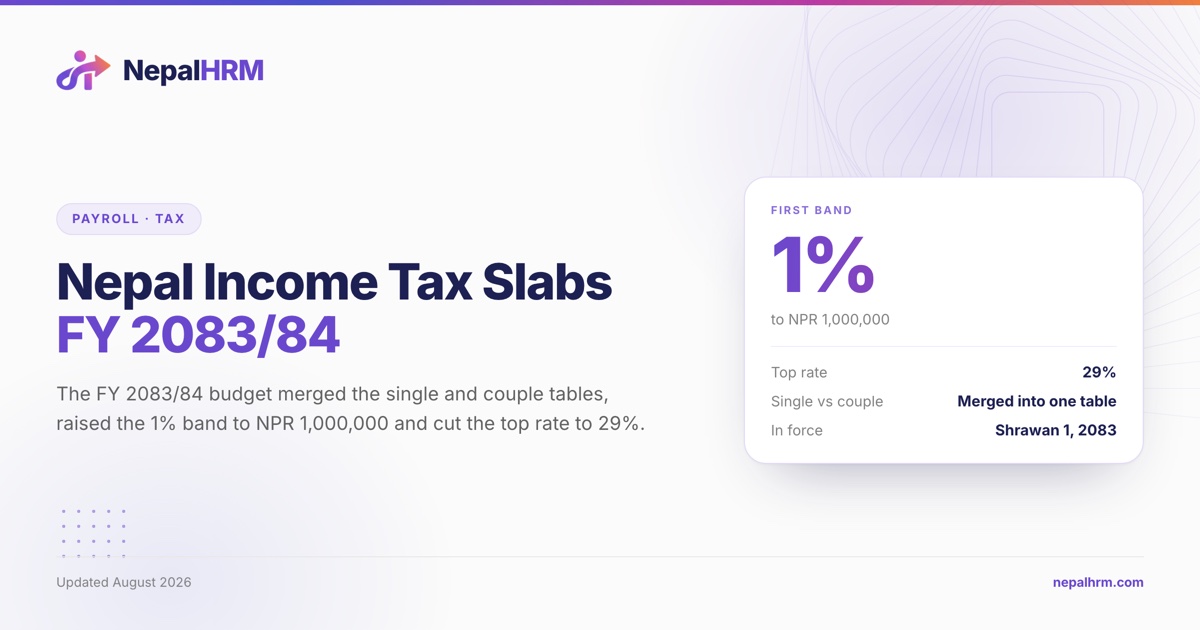
For FY 2083/84, a resident natural person in Nepal pays 1% on annual taxable income up to NPR 1,000,000, then 10%, 20% and 27% on the bands above it, and 29% on everything above NPR 4,000,000. The separate schedules for a single person and for a couple are gone: there is now one table for everyone.
This is the table your payroll withholds against every month under Section 87 of the Income Tax Act 2058. If you are working out a whole payslip rather than just the tax, start with our guide to calculating employee salary in Nepal, and use the salary tax calculator for the arithmetic.
Table of Contents
- The FY 2083/84 table
- What actually changed, and what did not
- How a marginal band actually works
- The 1% band is a tax, not an exemption
- Getting from gross salary to taxable income
- Where these numbers come from
- Frequently asked questions
- What are the income tax slabs in Nepal for FY 2083/84?
- Is there still a separate tax slab for married couples in Nepal?
- What is the highest income tax rate in Nepal now?
- Who does not pay the 1% social security tax?
- How much can I deduct for PF, CIT and SSF contributions?
- Does a raise into a higher band tax my whole salary at that rate?
- When did the new slabs take effect?
- Sources
The FY 2083/84 table
Rates apply to annual taxable income, which is assessable income after the retirement deduction below. Each rate applies only to the slice of income inside its own band.
| Annual taxable income (NPR) | Rate | Tax on a full band | Cumulative at the top |
|---|---|---|---|
| Up to 1,000,000 | 1% | 10,000 | 10,000 |
| 1,000,001 to 1,500,000 | 10% | 50,000 | 60,000 |
| 1,500,001 to 2,500,000 | 20% | 200,000 | 260,000 |
| 2,500,001 to 4,000,000 | 27% | 405,000 | 665,000 |
| Above 4,000,000 | 29% |
Two things about the top row are worth stating plainly. The Finance Act presents it as 27% plus a 2% surcharge rather than as a flat 29, and the budget's own summary describes the change as the maximum rate of personal income tax being reduced by ten percentage points. Ten points off the old 39% is 29%, which is the effective top marginal rate and the figure our calculators apply.
What actually changed, and what did not
| FY 2082/83 | FY 2083/84 | |
|---|---|---|
| Tables | Separate for single and couple | One table for all |
| First band | 500,000 at 1% | 1,000,000 at 1% |
| Bands | Six rates, to 39% | Five rates, to 29% |
| Top rate | 39% (30% plus 30% surcharge) | 29% |
| Retirement deduction ceiling | min(actual, 500,000, one third) | Unchanged |
The ceiling is the one people get wrong, because a rate cut in the same year makes it look as though every limit moved. It did not. The Finance Act 2083 touched Schedule 1 in three places (the slab table, vehicle tax and building insurance) and left Section 63 alone, so the retirement deduction still caps at the lowest of the actual contribution, NPR 500,000, or one third of assessable income.
How a marginal band actually works
A raise that pushes you into the 20% band does not tax your whole salary at 20%. Only the rupees inside that band are taxed at that rate.
Annual taxable income of NPR 1,200,000:
| Band | Rate | Income in band | Tax |
|---|---|---|---|
| 0 to 1,000,000 | 1% | 1,000,000 | 10,000 |
| 1,000,000 to 1,500,000 | 10% | 200,000 | 20,000 |
| 30,000 |
Annual taxable income of NPR 2,000,000:
| Band | Rate | Income in band | Tax |
|---|---|---|---|
| 0 to 1,000,000 | 1% | 1,000,000 | 10,000 |
| 1,000,000 to 1,500,000 | 10% | 500,000 | 50,000 |
| 1,500,000 to 2,500,000 | 20% | 500,000 | 100,000 |
| 160,000 |
An effective rate of 2.5% on the first and 8% on the second, against headline rates of 10% and 20%. Quoting the band rate as though it were the rate on the whole salary is the most common error in Nepali salary negotiations.
The 1% band is a tax, not an exemption
The first band is the social security tax, not a zero-rated allowance. It is charged at 1% and it is a separate deposit head from income tax, which matters when your accountant reconciles the year.
It is not levied on:
- a person contributing to the Social Security Fund,
- a person contributing to a pension fund,
- pension income, and
- income of a sole proprietorship firm.
That exemption is worth real money on a mid salary, because it removes the whole first band rather than reducing a rate. Take a monthly gross of NPR 100,000 on a 60% basic structure:
| PF and CIT | SSF | |
|---|---|---|
| Annual taxable income | 1,128,000 | 1,120,800 |
| Annual tax | 22,800 | 12,080 |
| Monthly withholding | 1,900 | 1,007 |
Almost the same taxable income, and close to half the tax, because the SSF contributor pays nothing on the first NPR 1,000,000 instead of 1% of it. Our comparison of CIT, PF and SSF works through which system leaves an employee better off overall.
Getting from gross salary to taxable income
The table above takes taxable income, and a salary is not taxable income until three things happen to it.
- Add everything the Act counts as remuneration. Section 8(2) includes wages, salary, leave pay, overtime, fees, commission, prizes, gifts, bonus, personal allowances including dearness, subsistence, entertainment and transport, payments for accepting terms of employment, payments for termination or compulsory retirement, and the employer's own retirement contribution.
- Take out what Section 8(3) excludes, notably food and tiffin provided at the work site on the same terms to all employees, and reimbursement of expenses that serve the employer's business purpose.
- Subtract the allowed retirement contribution, capped as above.
Employees who are not resident in Nepal for the income year sit outside this table entirely, and that treatment is a question for the organisation's tax advisor rather than for a payroll setting.
Where these numbers come from
Nepal's tax year runs Shrawan to Ashad, so FY 2083/84 began on Shrawan 1, 2083 and the table above applies to remuneration paid from that date. The Economic Act 2083 was published in the Nepal Gazette on 2083/03/30, and its Section 1(2) commences the substantive provisions on Shrawan 1, 2083.
Our salary tax calculator and payslip generator both compute from this one table, so a figure quoted here and a figure produced there cannot drift apart.
Slabs change most years, and a stale table is a stale payroll. NepalHRM keeps one tax engine for every employee, applies the current bands with the SSF exemption resolved per person, and shows the band breakdown behind each month's withholding. See how payroll works, or book a walkthrough.
Frequently asked questions
What are the income tax slabs in Nepal for FY 2083/84?
For a resident natural person: 1% up to NPR 1,000,000, 10% from 1,000,001 to 1,500,000, 20% from 1,500,001 to 2,500,000, 27% from 2,500,001 to 4,000,000, and 29% above 4,000,000. One table now covers everyone.
Is there still a separate tax slab for married couples in Nepal?
No. The Finance Act for FY 2083/84 removed the separate individual and couple schedules and replaced them with a single table, so marital status no longer affects the rate.
What is the highest income tax rate in Nepal now?
29% on annual taxable income above NPR 4,000,000. The budget describes this as a ten percentage point reduction from the previous top rate of 39%.
Who does not pay the 1% social security tax?
A person contributing to the Social Security Fund or a pension fund, a person receiving pension income, and a sole proprietorship firm. The 1% is not charged on the first band in those cases.
How much can I deduct for PF, CIT and SSF contributions?
The lowest of three figures: your actual contribution, NPR 500,000, or one third of your assessable income. That ceiling did not change for FY 2083/84.
Does a raise into a higher band tax my whole salary at that rate?
No. Nepal's bands are marginal. Only the income inside a band is taxed at that band's rate, which is why NPR 1,200,000 of taxable income attracts NPR 30,000 of tax rather than NPR 120,000.
When did the new slabs take effect?
Shrawan 1, 2083, the first day of FY 2083/84. Remuneration paid from that date is withheld against the new table.
Sources
- Economic Act, 2083 (आर्थिक ऐन, २०८३), published in the Nepal Gazette, Part 2, Volume 76, Extraordinary Issue 29, dated 2083/03/30, as published by the Inland Revenue Department: ird.gov.np. Section 1(1) and 1(2) read from the gazette text, retrieved 2026-08-07.
- Institute of Chartered Accountants of Nepal, Highlights of Federal Budget of Nepal for FY 2083/84: en.ican.org.np. The Schedule 1, Section 1(1) amendment table and the major-highlights note that the maximum personal rate was reduced by ten percentage points, retrieved 2026-08-07.
- Income Tax Act, 2058 (2002), Nepal Law Commission text: Sections 8 (computation of income from employment), 63 (approval of retirement fund and the deduction claim) and 87 (withholding by the employer), retrieved 2026-08-07.
- Band arithmetic and the worked examples on this page are generated from
lib/nepal-payroll.ts, the single source used by our salary tax calculator, SSF calculator and payslip generator.
Related reading: TDS on salary in Nepal · CIT vs PF vs SSF · Salary tax calculator