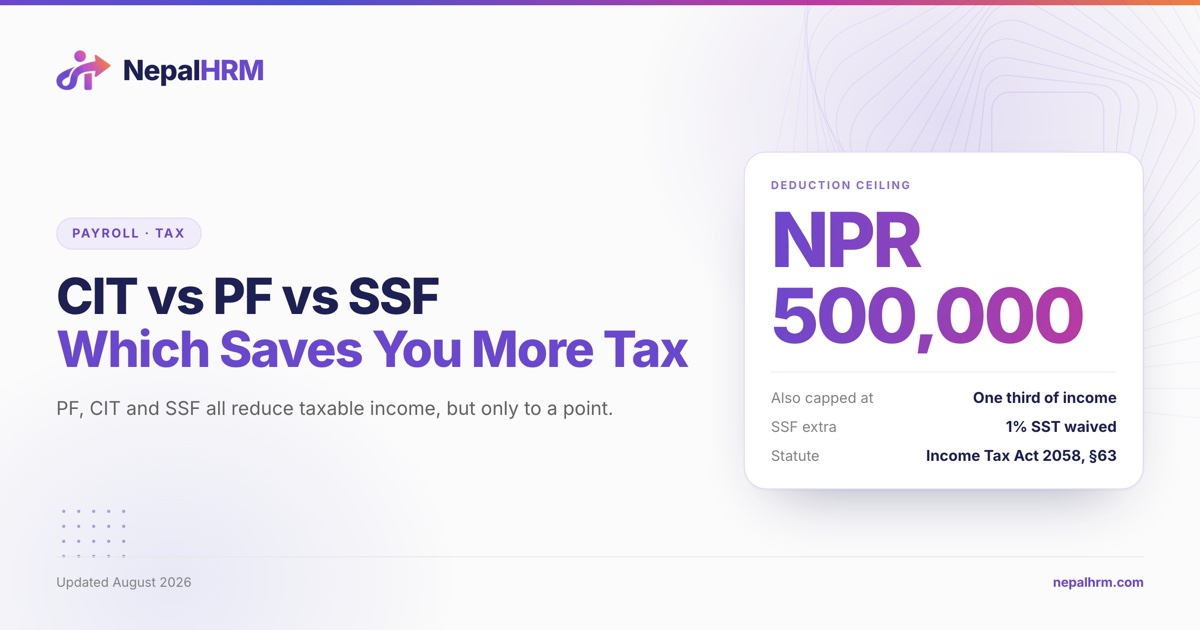
All three reduce your taxable income, and all three stop at the same ceiling. Section 63(3) of the Income Tax Act 2058 caps the retirement contribution you can deduct at the lowest of your actual contribution, NPR 500,000, or one third of assessable income. Past that point, another rupee of contribution saves nothing in tax.
Inside the ceiling the three are not equal, and the difference is not where most comparisons put it. This guide runs the arithmetic. For the underlying deduction mechanics see our provident fund calculation guide, and for the bands the saving is measured against, the FY 2083/84 income tax slabs.
Table of Contents
- What each one is
- The ceiling is the whole game
- What an extra rupee of CIT actually saves
- PF and gratuity against SSF, side by side
- So which one should you be on?
- Frequently asked questions
- Is CIT better than PF for saving tax in Nepal?
- How much retirement contribution can I deduct in Nepal?
- Does SSF reduce tax more than PF and CIT?
- How much tax does an extra rupee of CIT save?
- Is PF plus gratuity cheaper for the employer than SSF?
- Can I contribute to both CIT and SSF?
- Is a lump sum from a retirement fund taxed in Nepal?
- Sources
What each one is
| Provident Fund | Citizen Investment Trust | Social Security Fund | |
|---|---|---|---|
| Nature | Retirement savings | Retirement savings, elective top-up | Statutory social security |
| Employee share | 10% of basic | Employee's election | 11% of basic |
| Employer share | 10% of basic | None | 20% of basic |
| Gratuity | Separate, 8.33% of basic | Not applicable | Inside the 20% |
| Deductible under §63 | Yes | Yes | Yes |
| Effect on the 1% band | None | None | Waived |
| Covers | Retirement pot only | Retirement pot only | Medical, accident, dependant, old-age |
PF and CIT are savings instruments. The SSF is a contributory scheme with four benefit heads, which is why its employer rate is double the PF rate. Our post on the four SSF schemes covers what that buys.
The ceiling is the whole game
Section 63(2) lets a beneficiary claim the year's retirement contribution against taxable income. Section 63(3) then limits the claim to the prescribed limit, which is the lowest of:
- the actual contribution made in the year,
- NPR 500,000, and
- one third of assessable income.
Two consequences people miss. First, on a modest salary the binding limit is usually one third of income, not the NPR 500,000 figure everyone quotes. Second, the ceiling counts all retirement contributions together. PF plus CIT plus SSF are one pool, so contributing more to CIT once you are already at the cap buys nothing at all in tax.
The Finance Act for FY 2083/84 amended Schedule 1 in three places and left Section 63 untouched, so the NPR 500,000 figure stands for this year.
What an extra rupee of CIT actually saves
CIT is the only one of the three where the employee chooses the rate, so it is the one worth modelling. Monthly gross NPR 150,000, basic at 60% of gross, employee on PF and CIT.
| CIT election | Monthly CIT | Annual deduction | Annual taxable | Annual tax | Monthly TDS | Monthly take-home |
|---|---|---|---|---|---|---|
| 0% | 0 | 108,000 | 1,692,000 | 98,400 | 8,200 | 132,800 |
| 5% | 4,500 | 162,000 | 1,638,000 | 87,600 | 7,300 | 129,200 |
| 10% | 9,000 | 216,000 | 1,584,000 | 76,800 | 6,400 | 125,600 |
| 15% | 13,500 | 270,000 | 1,530,000 | 66,000 | 5,500 | 122,000 |
| 20% | 18,000 | 324,000 | 1,476,000 | 57,600 | 4,800 | 118,200 |
Every 5% step adds NPR 54,000 a year of contribution and removes NPR 10,800 a year of tax. That ratio is exactly 20%, this employee's marginal band. The pattern generalises: a rupee into CIT saves tax at your top band rate and nothing more.
So CIT is not a discount, it is a deferral with a rate attached. Take-home falls by more than the tax saved, because the difference has moved into a retirement account rather than disappeared. Whether that is a good trade depends on whether you want the money now, not on the tax. The genuine benefit arrives at withdrawal, where Section 65(1)(b) treats a lump sum from an approved retirement fund as taxable only after deducting the higher of 50% of the payment or NPR 500,000, and Section 88(1) withholds on provident fund and gratuity from an approved fund at 6% rather than the usual 15%.
Our posts on how CIT saves tax and CIT interest rates go further into the instrument itself.
PF and gratuity against SSF, side by side
The comparison that actually decides things is not CIT, it is whether the enterprise runs PF plus gratuity or is listed with the SSF. Monthly gross NPR 150,000, basic at 60%, no CIT election on the PF side so the two are comparable.
| PF and gratuity | SSF | |
|---|---|---|
| Employee deduction | 9,000 (PF 10%) | 9,900 (SSF 11%) |
| Monthly TDS | 8,200 | 7,187 |
| Monthly take-home | 132,800 | 132,913 |
| Employer share | 9,000 (PF 10%) | 18,000 (SSF 20%) |
| Gratuity accrual at 8.33% | 7,497 | inside the 20% |
| Monthly employer cost | 166,497 | 168,000 |
Take-home differs by NPR 113 a month. Employer cost differs by NPR 1,503. On a 60% basic structure the two arrangements are, in cash terms, nearly the same thing. That is not a coincidence: the SSF's 20% employer rate is close to PF 10% plus gratuity 8.33%, which is 18.33%, and the extra 1.67 points buy the medical, accident and dependant cover.
The real divergence is lower down the scale, where the 1% waiver bites hardest. At a monthly gross of NPR 75,000 with a 60% basic:
- PF and CIT: monthly TDS of NPR 705.
- SSF: monthly TDS of zero, because annual taxable income of NPR 840,600 sits entirely in a band that is zero-rated for an SSF contributor.
So which one should you be on?
For most people this is not a free choice, and honest advice starts there.
- If the enterprise is listed with the SSF, contributions go to the SSF. That is the arrangement, and PF and gratuity are replaced by it. See our PF and gratuity to SSF migration guide.
- If it is not, the employee is on PF plus gratuity, and CIT is the only lever they control.
- The lever is worth pulling up to the ceiling and not beyond. Work out where min(NPR 500,000, one third of assessable income) lands, subtract what PF already contributes, and that gap is the CIT room that still carries a tax effect.
- Below roughly NPR 1,000,000 of taxable income the tax argument is weak either way, because the marginal band is 1% (or zero on the SSF). Contribute for the retirement pot at that level, not for the deduction.
Use the salary tax calculator to test a specific salary and CIT rate, and the SSF contribution calculator for the SSF side.
The CIT room worth using changes every time salary changes. NepalHRM ships a tax planner in payroll that cites Section 63, shows the current annual tax against the optimal annual tax, and the saving still capturable at a raised CIT, before the run closes. See how payroll works, or book a walkthrough.
Frequently asked questions
Is CIT better than PF for saving tax in Nepal?
Neither is better in itself. Both are deductible under Section 63 and both count against the same ceiling. CIT is the one an employee can raise voluntarily, so it is the lever available once PF is fixed at 10% of basic.
How much retirement contribution can I deduct in Nepal?
The lowest of your actual contribution, NPR 500,000, or one third of your assessable income, under Section 63(3). All contributions count together, so PF, CIT and SSF share that one ceiling.
Does SSF reduce tax more than PF and CIT?
For most salaries, yes, because the 1% social security tax on the first NPR 1,000,000 is not levied on an SSF contributor. On a monthly gross of NPR 75,000 with a 60% basic, that removes the withholding entirely.
How much tax does an extra rupee of CIT save?
Tax at your marginal band rate. In the 20% band, contributing NPR 54,000 more in a year cuts tax by NPR 10,800. It is a deferral into a retirement account, not money returned.
Is PF plus gratuity cheaper for the employer than SSF?
Barely. At a 60% basic structure, PF at 10% plus gratuity at 8.33% comes to 18.33% of basic against the SSF's 20%, so the SSF costs about 1.67 points of basic more and covers medical, accident and dependant benefits with it.
Can I contribute to both CIT and SSF?
The deduction is what matters, and it is one shared ceiling. Contributions beyond the lowest of the actual amount, NPR 500,000 and one third of assessable income produce no further reduction in taxable income.
Is a lump sum from a retirement fund taxed in Nepal?
Partly. Section 65(1)(b) subtracts the higher of 50% of the payment or NPR 500,000 before treating the balance as a gain, and Section 88(1) withholds at 6% on provident fund and gratuity paid by an approved retirement fund.
Sources
- Income Tax Act, 2058 (2002), Nepal Law Commission text as published by the Institute of Chartered Accountants of Nepal: en.ican.org.np. Sections 63, 65, 87 and 88 read from that text, retrieved 2026-08-07.
- Institute of Chartered Accountants of Nepal, Highlights of Federal Budget of Nepal for FY 2083/84: en.ican.org.np. The section-by-section amendment list records changes to Schedule 1 Section 1(1), 1(13) and 1(16Ka) only; Section 63 is absent, so the ceiling is unchanged. Retrieved 2026-08-07.
- Contribution rates: Social Security Scheme Operation Procedure, 2075, Section 25 (11% employee, 20% employer, on basic), ssf.gov.np.
- Gratuity at 8.33% of basic and every tax figure on this page are generated from
lib/nepal-labour.tsandlib/nepal-payroll.ts, the single sources behind our calculators.
Related reading: Nepal income tax slabs FY 2083/84 · PF and gratuity to SSF migration · SSF contribution calculator