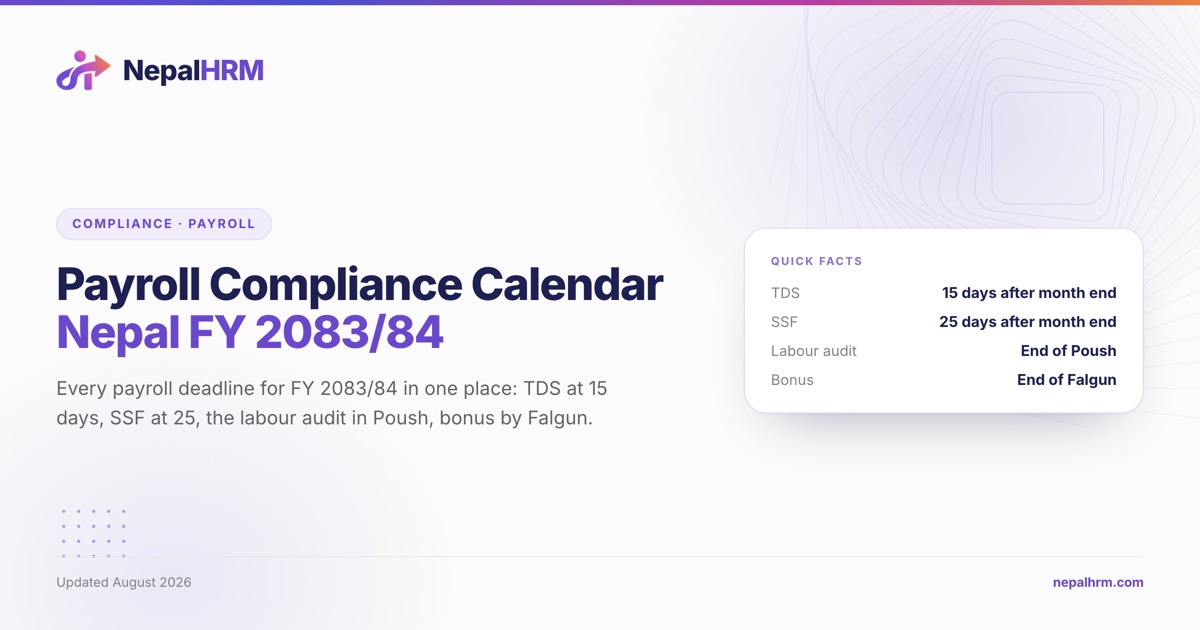
Two deadlines repeat every month in Nepali payroll, and they are not the same date. TDS is due within fifteen days of the month ending, under Section 90 of the Income Tax Act 2058. SSF contributions are due within twenty-five days, under Section 4(4) of the Contribution Based Social Security Act 2074 as amended in 2082. Everything else in the year hangs off those two.
FY 2083/84 runs from Shrawan 1, 2083 to the end of Ashad 2084. This is the whole calendar, with the provision behind each entry. If you are setting up the run itself, start with how to calculate employee salary in Nepal.
Table of Contents
- Every month, without exception
- The FY 2083/84 year, month by month
- The three that are not on the calendar
- What lateness costs, by obligation
- A monthly routine that keeps this true
- Frequently asked questions
- What are the monthly payroll deadlines in Nepal?
- When is the income tax return due in Nepal?
- When are advance tax installments due in Nepal?
- When must bonus be distributed in Nepal?
- When is the labour audit due in Nepal?
- What is the deadline to pay a departing employee in Nepal?
- When does the fiscal year start in Nepal?
- Sources
Every month, without exception
| Obligation | Due | Provision |
|---|---|---|
| Deposit tax withheld | Within 15 days of month end | Income Tax Act §90(2) |
| Lodge the monthly TDS statement | Within 15 days of month end | Income Tax Act §90(1) |
| Deposit SSF contributions (11% employee, 20% employer, on basic) | Within 25 days of month end | Social Security Act §4(4), as amended 2082 |
Shrawan's TDS is therefore due about halfway through Bhadra, and Shrawan's SSF about ten days after that. Sources still publishing fifteen days for SSF are describing the pre-2082 provision. Our guides to eTDS and monthly SSF filing cover each in detail.
The FY 2083/84 year, month by month
| Nepali month | What falls due |
|---|---|
| Shrawan 2083 | New fiscal year begins. New slab table applies from Shrawan 1. Monthly TDS and SSF for Ashad 2083. Withholding certificates for FY 2082/83 due within 30 days of year end (§91(3)). |
| Bhadra 2083 | Monthly TDS and SSF. |
| Ashoj 2083 | Income return for FY 2082/83, by month end (§96(1), three months after year end). Extension of up to three months available on written application inside the window (§98). Dashain usually falls here or in Kartik: festival expense of one month's basic (Labour Act §37). |
| Kartik 2083 | Monthly TDS and SSF. Festival expense if Dashain falls in Kartik. |
| Mangsir 2083 | Economic Act 2083 §49 waiver window closes at month end. Outstanding tax, fees or duties filed and paid with an additional 1% by this date carry a waiver of the fines, interest, additional charges and fees otherwise due. |
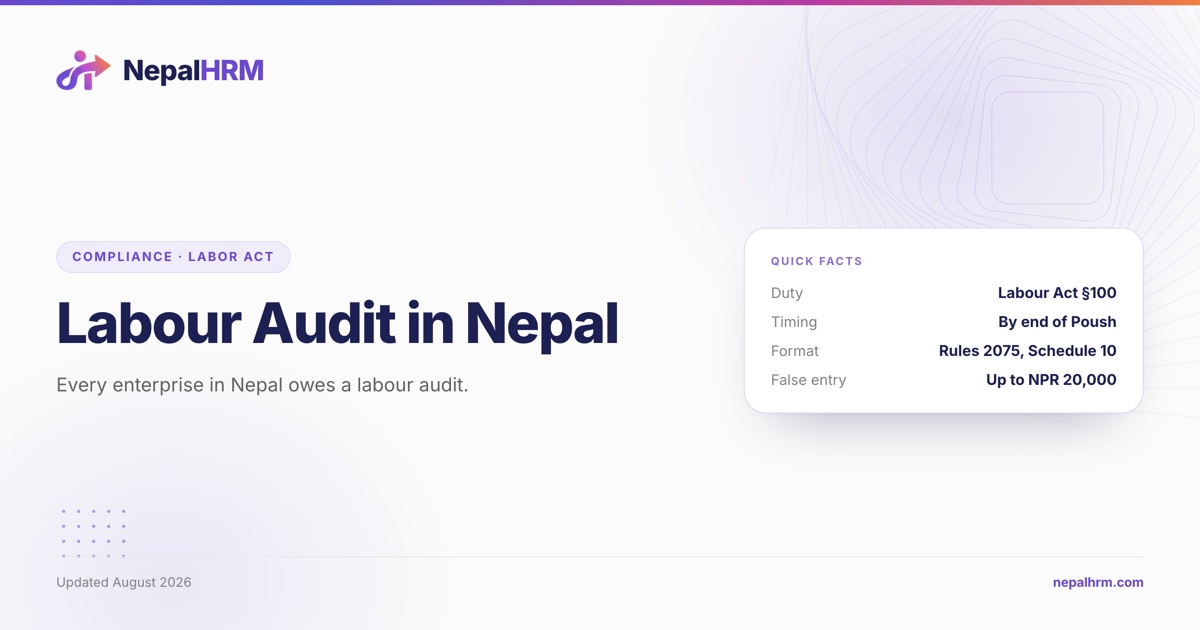
| Poush 2083 | First advance tax installment, 40% of estimated tax, by month end (§94(1)). Annual labour audit due by month end, on Schedule 10, with copies to the labour relations committee and the sector regulator (Labour Act §100, Labour Rules 2075 Rule 56). Bonus Act balance sheet and profit and loss statement to the Labour Office, six months after year end (Bonus Act §4(1)). |
| Magh 2083 | Monthly TDS and SSF. |
| Falgun 2083 | Bonus for FY 2082/83 must be distributed by month end, eight months after the year closed (Bonus Act §9(2)). The Labour Office may extend by up to three months on a reasoned application (§9(3)). |
| Chaitra 2083 | Second advance tax installment, 70% of estimated tax, by month end (§94(1)). |
| Baishakh 2084 | Monthly TDS and SSF. |
| Jestha 2084 | Monthly TDS and SSF. Salary revision and increment cycles commonly land here, ahead of year end. |
| Ashad 2084 | Third advance tax installment, 100% of estimated tax, by month end (§94(1)). Fiscal year closes. Year-end payroll reconciliation. |
The three that are not on the calendar
These are triggered by an event, so a calendar will never remind you. They are also the ones that produce the most expensive surprises.
| Trigger | Obligation | Deadline | Provision |
|---|---|---|---|
| Someone joins | Enlist them with the SSF | Within 3 months of the employment relation being established | Social Security Act §20(1) |
| Someone leaves | Inform the SSF | Within 1 month | Social Security Act §24 |
| Employment ends, for any reason | Pay all remuneration, benefits and amounts due | Within 15 days | Labour Act §148(1) |
Labour Act Section 148(3) is the one to know before you need it: if the dues are not paid inside those fifteen days, the employer must keep paying remuneration as though the worker were still in service until they are. Our full and final settlement guide walks the whole exit.
What lateness costs, by obligation
| Missed | Consequence |
|---|---|
| TDS statement | 1.5% a year of the tax that should have been withheld, per month and part month, from the due date until lodged (Income Tax Act §117(3)) |
| Tax payment | Interest at the normal rate, per month and part month, on the outstanding amount (§119(1)). It cannot be recovered from the employee (§119(3)) |
| Income return | 1.5% a year of assessable income computed without deductions, per month and part month, or NPR 1,000 per month, whichever is higher (§117(1)) |
| Advance tax underpaid | Interest at the normal rate from the first installment date until the tax is assessed (§118) |
| SSF contribution | Recovery with 10% interest (Social Security Act §9(1)); accounts and property may be frozen and a passport withheld (§9(4)); under the Labour Act, recovery plus double as damages (§163(2)(d)) |
| Final dues | Remuneration continues as if the worker were still employed (Labour Act §148(3)) |
| Labour audit false entry | Fine up to NPR 20,000, each time (Labour Act §163(2)(b)) |
| Bonus not distributed | Fine up to NPR 5,000 imposed by the Department of Labour (Bonus Act §20) |
A monthly routine that keeps this true
- Close the payroll run and freeze it before anything is filed.
- Reconcile the TDS control account to the statement you are about to lodge. Our payroll accounting guide sets out the entries that make this a two-minute check.
- Deposit the tax and lodge the statement inside fifteen days. Keep the voucher reference.
- Reconcile the SSF contributor list against headcount, then deposit inside twenty-five days.
- Clear the event queue: joiners past two months without enlistment, leavers not yet reported, exits approaching day fifteen.
- Check the quarter markers in Poush, Chaitra and Ashad before the month closes rather than after.
A calendar only helps if the underlying run is already right. NepalHRM computes TDS and SSF from one engine, produces the IRD eTDS file and the SSF deposit figures from the closed run, and keeps the joiner and leaver dates that drive the event deadlines in the same record. Your team does the depositing and uploading. See how payroll works, or book a walkthrough.
Frequently asked questions
What are the monthly payroll deadlines in Nepal?
Two. Tax withheld must be deposited and the TDS statement lodged within fifteen days of the month ending, under Section 90 of the Income Tax Act 2058. SSF contributions must reach the Fund within twenty-five days of the month ending, under Section 4(4) of the Social Security Act as amended in 2082.
When is the income tax return due in Nepal?
Within three months of the income year ending, under Section 96(1), which puts the ordinary deadline at the end of Ashoj. Section 98 allows the Department to extend it by up to three months on a written application made inside the original window.
When are advance tax installments due in Nepal?
Three times a year under Section 94(1): 40% of estimated tax by the end of Poush, 70% by the end of Chaitra, and 100% by the end of Ashad, each measured against tax already paid.
When must bonus be distributed in Nepal?
Within eight months of the close of the fiscal year, under Section 9(2) of the Bonus Act 2030, which means the end of Falgun. The Labour Office may extend that by up to three months where the reasons are found genuine.
When is the labour audit due in Nepal?
By the end of Poush each year, on Schedule 10, under Section 100 of the Labour Act 2074 and Rule 56 of the Labour Rules 2075, with copies to the labour relations committee and the sector regulator.
What is the deadline to pay a departing employee in Nepal?
Fifteen days from the employment ending, under Section 148(1) of the Labour Act 2074, whatever the reason for the ending. Section 148(3) requires remuneration to continue as if the worker were still in service until payment is made.
When does the fiscal year start in Nepal?
Shrawan 1. FY 2083/84 began on Shrawan 1, 2083 and closes at the end of Ashad 2084.
Sources
- Income Tax Act, 2058 (2002), Nepal Law Commission text as published by the Institute of Chartered Accountants of Nepal: en.ican.org.np. Sections 90, 91, 94, 96, 98, 117, 118 and 119 read from that text, retrieved 2026-08-07.
- Economic Act, 2083, Nepal Gazette Part 2, Volume 76, Extraordinary Issue 29, dated 2083/03/30, as published by the Inland Revenue Department: ird.gov.np. Section 1(2) commencement and Section 49 waiver window read from the gazette text, retrieved 2026-08-07.
- Labour Act, 2074 (2017), consolidated Nepali text, Nepal Law Commission: lawcommission.gov.np. Sections 37, 100, 148 and 163 read from that text, retrieved 2026-08-07.
- Contribution Based Social Security Act, 2074, consolidated Nepali text as amended through 2082: ssf.gov.np. Sections 4, 9, 20 and 24.
- Bonus Act, 2030 (1974), Nepal Law Commission text. Sections 4, 9 and 20.
Related reading: eTDS in Nepal · Monthly SSF filing in Nepal · Labour audit compliance checklist