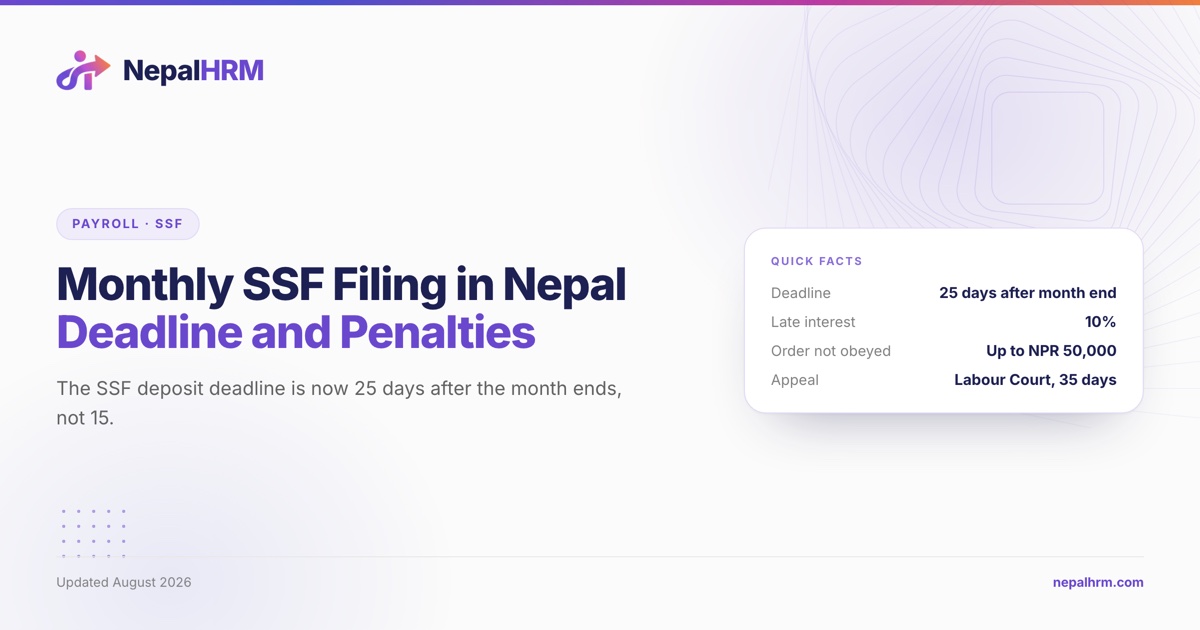
The deadline for depositing SSF contributions in Nepal is within twenty-five days of the end of the month the contributable income relates to. Section 4(4) of the Contribution Based Social Security Act 2074 was amended by the Some Nepal Acts (Amendment) Act 2082, and the consolidated text now reads twenty-five days. Sources still publishing fifteen are not describing the current provision.
This guide covers the monthly cycle: what is deposited, when, what happens on a no-pay month, and precisely what late payment costs. For the amounts, our SSF contribution calculator works from a basic salary.
Table of Contents
- What gets deposited each month
- The cycle, month by month
- What late payment actually costs
- Under the Social Security Act
- Under the Labour Act
- As an offence
- Where filing happens
- A monthly checklist
- Frequently asked questions
- What is the SSF deposit deadline in Nepal?
- Is the SSF deadline 15 days or 25 days?
- What is the penalty for late SSF payment in Nepal?
- Can the SSF freeze a company's bank account?
- What happens if an employee has an accident while contributions are unpaid?
- Does an employer pay SSF for a month when an employee had no salary?
- Is SSF calculated on basic or gross salary?
- Sources
What gets deposited each month
Section 25 of the Social Security Scheme Operation Procedure 2075 sets the mechanics in one sentence: the employer deducts 11 percent from the worker's basic remuneration, adds 20 percent of the same basic from its own side, and deposits 31 percent in total.
| Rate | Base | Who bears it | |
|---|---|---|---|
| Employee share | 11% | Basic salary | Deducted from pay |
| Employer share | 20% | Basic salary | A cost of employment |
| Deposited | 31% | Basic salary |
Two things go wrong here more than anywhere else. The base is basic, not gross: on a 60% basic structure, contributing on gross overstates the deposit by two-thirds. And the employer's 20% is not deducted from anyone's pay; only the 11% is a payslip line. See the Social Security Fund and basic salary.
The rate itself is not in the Act. Section 7(1) leaves it to the Ministry, on the Committee's recommendation, by notice in the Nepal Gazette, and Section 7(2) allows it to be revised on the basis of participant numbers, inflation, the Fund's financial position and the number of schemes running. So it is a Gazette figure, not a statutory constant, and it is worth re-checking annually.
The cycle, month by month
Contributions run by the day, not by the month. Section 4(2): the deposit is made for the period from the day the worker was listed with the Fund to the last day they remain in employment.
They are monthly and pro-rated. Section 4(3): contributions are deposited monthly unless the Fund specifies otherwise, and where a full month is not due, they are made proportionately. A joiner on the 20th and a leaver on the 8th both produce part-month contributions by design.
The deadline is twenty-five days after month end. Section 4(4), as amended in 2082: the contribution must be deposited so as to reach the Fund within twenty-five days of the end of the month in which the contributable income was payable. Shrawan's contribution is due most of the way through Bhadra.
A no-pay month still contributes. Section 8(1): where a worker for any reason receives no remuneration and so cannot make the contribution they are required to deposit regularly, the employer deposits the worker's share for up to three months. Section 8(2) lets the employer recover it later, as prescribed, from that worker's remuneration, allowance or other benefits. Unpaid leave does not silently break a contribution record; it moves the cash flow to the employer for up to a quarter.
Leavers get reported. Section 24: when a contributor ceases to be in employment for any reason, the listed employer informs the Fund within one month, as prescribed. Skipping this is how a contributor list drifts away from headcount, and once it drifts, every subsequent reconciliation fails for a reason nobody can locate.
What late payment actually costs
The consequences are stacked, and they come from two different statutes.
Under the Social Security Act
| Provision | Consequence |
|---|---|
| §9(1) | The Fund recovers the contribution with ten percent interest |
| §9(2) | The employer may apply within thirty days, stating the reason and grounds, where circumstances beyond control prevented the deposit |
| §9(3) | The Fund may then waive the interest wholly or partly and allow the deposit |
| §9(4) | The Executive Director may write to the relevant authorities to freeze bank accounts, freeze movable and immovable property, suspend concessions available under prevailing law, suspend licences and permits, and withhold the person's passport |
| §9(5) | The authority written to must begin the necessary process within fifteen days |
| §9(6) | Where contributions were not deposited and an accident or death occurs during that period, the employer must itself provide the worker the equivalent of the benefit the Act would have given |
| §56 | Amounts recoverable by the Fund are recovered as government dues |
Section 9(2) is the provision to know before you need it. The relief for a genuine cash-flow failure is not automatic and it is not indefinite: it is an application, with reasons, within thirty days.
Under the Labour Act
Section 163(2)(d) gives the Labour Office an independent power. Where an employer does not deposit gratuity, provident fund or the amount payable to the Social Security Fund, does not provide medical treatment expense, or does not take out the compensation insurance, the Office may order recovery of that amount plus double as damages.
As an offence
Section 47(1) of the Social Security Act makes it an offence to misappropriate an amount payable to the Fund by not depositing it within the period the Act sets, to submit wrong or false particulars to obtain a benefit, to take more benefit than is due, or to commit irregularity in any social security programme.
Section 47(2) sets the penalty: where the amount is established, a fine equal to that amount; where it is not, a fine of up to NPR 100,000, or imprisonment up to one year, or both. Section 47(3) gives an accomplice or abettor half the principal's penalty.
Section 48 gives the investigating officer the powers of a police officer for arrest, search, seizure of documents, recording statements and preparing a muchulka, and Section 48(3) permits detention in custody for up to twenty-five days, in stretches of no more than seven days at a time, with the adjudicating authority's permission. Section 50 makes the Government of Nepal the plaintiff.
Separately, Section 51 fines a person who does not obey an order of the Fund up to NPR 50,000, and Section 52, as amended in 2082, allows an appeal to the Labour Court within thirty-five days of learning of the order or decision.
Where filing happens
The employer files through the Fund's system at sosys.ssf.gov.np, using the Employer Login that ssf.gov.np links from its front page. The contributor login beside it is the employee's view; our guide to checking an SSF balance covers that side.
The Fund publishes separate desks for the parts of this that usually go wrong:
| Need | Channel |
|---|---|
| Deposit and collection | collection@ssf.gov.np, and the collection branch line published on ssf.gov.np |
| Account reconciliation (hisab milan) | reconcsupport@ssf.gov.np |
| Enlistment support | reg@ssf.gov.np |
| Tax statement | tax@ssf.gov.np |
| System access | itsupport@ssf.gov.np |
| General | 1116, toll free on NTC and Ncell |
The Fund also publishes a submission-number tracking page on ssf.gov.np, which is the right way to confirm a deposit landed rather than assuming a bank transfer reached the correct contributor list.
A monthly checklist
- Compute on basic salary, never gross.
- Deduct 11% from the employee and add 20% from the company.
- Pro-rate joiners and leavers, per Section 4(3).
- Where a worker had no pay, deposit their share yourself for up to three months, per Section 8(1), and record it for later recovery.
- Deposit so it reaches the Fund within twenty-five days of month end.
- Keep the submission reference, and verify it landed.
- Enlist any joiner within three months of the employment relation starting.
- Report any leaver within one month, per Section 24.
- Reconcile the Fund's contributor list against your headcount every month.
- If a month is going to be late, apply under Section 9(2) within thirty days, in writing.
Our SSF registration guide covers the enlistment side, and our six SSF mistakes that cost Nepali employers money covers the errors that survive a correct filing routine.
A filing routine is only as reliable as the number it starts from. NepalHRM calculates SSF at 11% employee and 20% employer of basic automatically on every payroll run, resolves the base through the employee's basic rather than gross, shows both sides on the payslip, and prepares the deposit figures. See how payroll works, or book a walkthrough.
Frequently asked questions
What is the SSF deposit deadline in Nepal?
Within twenty-five days of the end of the month in which the contributable income was payable, under Section 4(4) of the Contribution Based Social Security Act 2074 as amended by the Some Nepal Acts (Amendment) Act 2082.
Is the SSF deadline 15 days or 25 days?
Twenty-five. The consolidated text of Section 4(4) carries a footnote recording that the sub-section was amended by the Some Nepal Acts (Amendment) Act 2082, and it now reads twenty-five days. Content still stating fifteen days does not reflect the current provision.
What is the penalty for late SSF payment in Nepal?
The Fund recovers the contribution with ten percent interest under Section 9(1). Section 9(2) allows the employer to apply within thirty days where circumstances beyond its control caused the delay, and Section 9(3) lets the Fund waive the interest wholly or partly.
Can the SSF freeze a company's bank account?
Yes. Section 9(4) lets the Executive Director write to the relevant authorities to freeze bank accounts, freeze movable and immovable property, suspend concessions available under prevailing law, suspend licences and permits, and withhold a passport. Section 9(5) requires the authority to begin the process within fifteen days.
What happens if an employee has an accident while contributions are unpaid?
Section 9(6) makes the employer provide the worker the equivalent of the benefit the Act would have given. Not depositing does not transfer the risk to the Fund; it keeps the risk with the employer.
Does an employer pay SSF for a month when an employee had no salary?
Yes, for up to three months. Section 8(1) requires the employer to deposit the worker's own share where the worker received no remuneration and so could not contribute. Section 8(2) lets the employer recover it later from that worker's remuneration, allowance or other benefits, as prescribed.
Is SSF calculated on basic or gross salary?
Basic. Section 25 of the Social Security Scheme Operation Procedure 2075 sets the deduction at 11 percent of the worker's basic remuneration and the employer's addition at 20 percent of the same basic, deposited as 31 percent in total.
Sources
- Contribution Based Social Security Act, 2074 (2017), consolidated Nepali text as amended through 2082, published by the Social Security Fund: ssf.gov.np. Sections 4, 7, 8, 9, 17, 24, 47 to 52 and 56 were read from that text, retrieved 2026-08-06. Section 4(4) and Section 52 carry footnotes recording amendment by the Some Nepal Acts (Amendment) Act, 2082, authenticated 2082.04.14.
- Social Security Scheme Operation Procedure, 2075, including the fifth amendment: ssf.gov.np. Section 25, retrieved 2026-08-06.
- Labour Act, 2074 (2017), Nepal Law Commission: lawcommission.gov.np. Section 163, retrieved 2026-08-06.
- Employer portal, support desks and the toll-free line as published on ssf.gov.np, checked 2026-08-06.
Related reading: SSF registration in Nepal: an employer's step-by-step · Six SSF mistakes that cost Nepali employers money · SSF contribution calculator