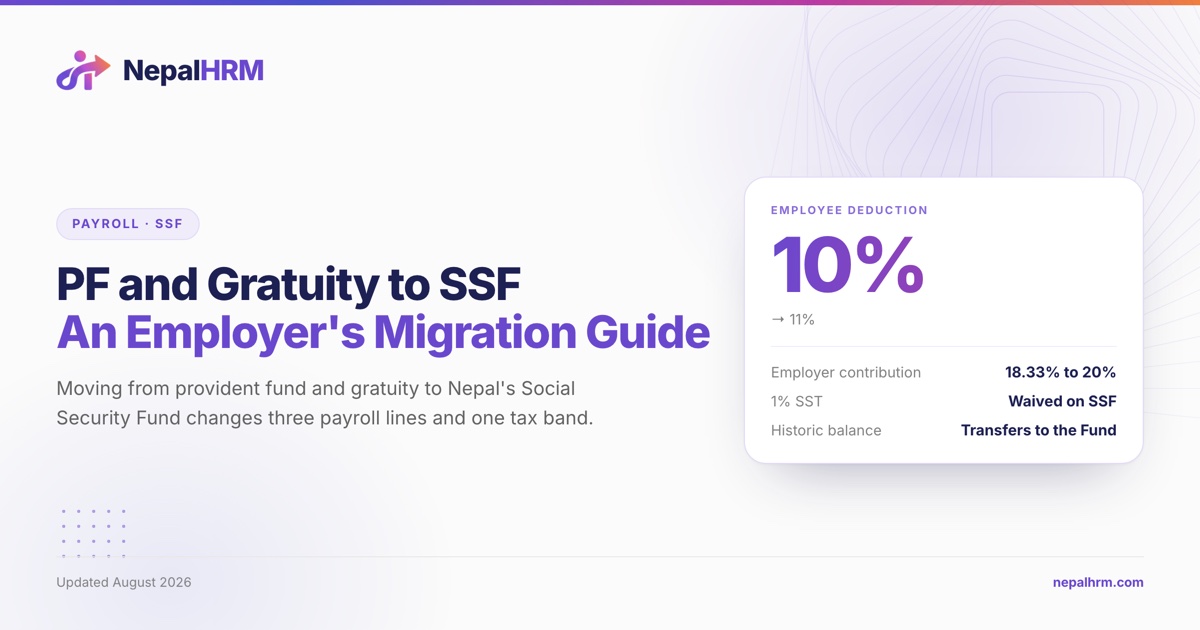
Moving a Nepali payroll from provident fund and gratuity onto the Social Security Fund changes three lines and one tax band. The employee deduction goes from 10% to 11% of basic. The employer's contribution goes from 18.33% to 20%. And the 1% social security tax on the first income band stops applying.
On a typical structure the employee's take-home actually goes up, because the tax band that disappears is worth more than the extra one percent deducted. This guide works the numbers, then covers what happens to the money already sitting in your old fund. For the ongoing figure, our SSF contribution calculator takes any basic salary.
Table of Contents
- What the two regimes actually are
- What it costs, worked out
- The tax side, precisely
- What happens to the money already in your old fund
- The migration, month by month
- Three things that go wrong
- Frequently asked questions
- Should a company in Nepal run PF or SSF?
- How much more does SSF cost an employer than PF?
- Does SSF reduce an employee's take-home pay?
- What happens to existing provident fund and gratuity balances when a company joins the SSF?
- Is gratuity still payable separately after joining the SSF?
- Do we still need medical and accident insurance after joining the SSF?
- Does joining the SSF change the retirement tax deduction ceiling?
- Sources
What the two regimes actually are
| Outside the SSF | Inside the SSF | |
|---|---|---|
| Employee deduction | Provident fund 10% of basic, §52(1) | SSF 11% of basic |
| Employer contribution | PF 10% + gratuity 8.33% = 18.33% | SSF 20% of basic |
| Combined | 28.33% of basic | 31% of basic |
| Medical insurance | Arranged separately, min NPR 100,000/yr, §54 | Covered to that extent, §57 |
| Accident insurance | Arranged separately, min NPR 700,000, §55 | Covered to that extent, §57 |
| 1% social security tax | Charged on the first income band | Waived |
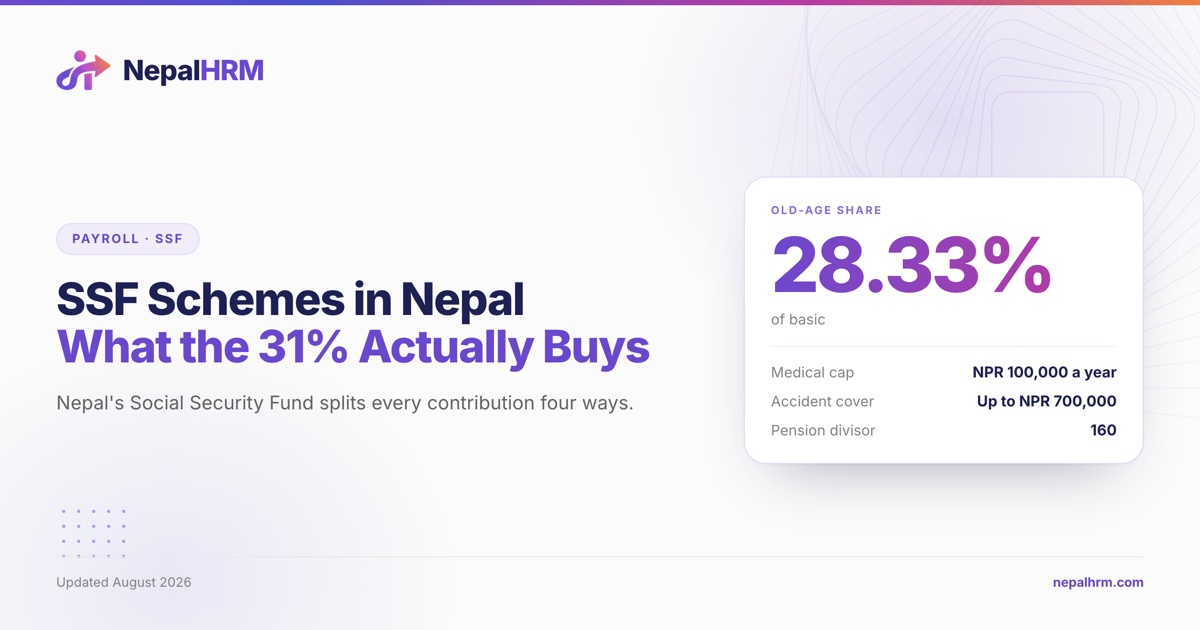
The arithmetic in the third row is the whole point. Section 25 of the Social Security Scheme Operation Procedure 2075 allocates the 31% across four schemes: 1.20% for medical, health and maternity protection, 0.80% for accident and disability, 0.67% for dependent family, and 28.33% for old-age protection. That 28.33% is exactly the provident fund plus the gratuity your payroll was already paying. Our guide to gratuity in Nepal works through the identity in detail.
So the honest framing of the change is not "31% instead of 20%". It is: the same retirement money, plus 2.67% that buys the insurance cover Sections 54 and 55 obliged you to arrange anyway.
What it costs, worked out
The figures below are generated from lib/nepal-payroll.ts, the same module this site's salary tax and SSF calculators run on, using FY 2083/84 slabs and a 60% basic structure. Gratuity at 8.33% is added to the employer column separately, because it is a real pre-SSF cost.
On a gross of NPR 50,000, basic NPR 30,000:
| Before (PF + gratuity) | After (SSF) | Change | |
|---|---|---|---|
| Employee deduction | 3,000 | 3,300 | +300 |
| Monthly TDS | 470 | 0 | −470 |
| Employee take-home | 46,530 | 46,700 | +170 |
| Employer contribution | 3,000 + 2,499 = 5,499 | 6,000 | +501 |
| Total employer cost | 55,499 | 56,000 | +501 |
Across four salary levels, monthly:
| Basic | Employer cost before | Employer cost after | Employer change | Employee take-home change |
|---|---|---|---|---|
| 20,000 | 36,999 | 37,333 | +334 | +113 |
| 30,000 | 55,499 | 56,000 | +501 | +170 |
| 50,000 | 92,498 | 93,333 | +835 | +283 |
| 100,000 | 184,997 | 186,667 | +1,670 | +33 |
Two things stand out.
The employee is not worse off. At every level in the table, take-home rises. The extra 1% deducted is smaller than the 1% social security tax that stops being charged, because the tax applies to total income while the contribution applies only to basic. Under FY 2083/84 slabs the first band runs to NPR 1,000,000, so the waived band is worth up to NPR 10,000 a year to an SSF contributor.
The employer's increase is smaller than the headline. The gap between 18.33% and 20% is 1.67% of basic, not 11 percentage points. And it comes with the Section 54 and 55 insurance premiums falling away, to the extent the scheme covers them, which for many employers more than closes it.
These are estimates on a clean structure, not a quotation. Run your own numbers in the salary tax calculator.
The tax side, precisely
Two distinct effects, and they are often merged into one wrong sentence.
The 1% band is waived, not the tax. The first income-tax band in Nepal is a 1% social security tax. An SSF contributor is exempt from it because the SSF contribution already funds what it pays for. Every band above the first is charged exactly as it is for anybody else. See social security tax.
The contribution is deductible, within a ceiling. Retirement contributions reduce taxable income by the lowest of the actual contribution, NPR 500,000 a year, or one third of assessable income. That ceiling applies whether the contribution is PF plus CIT or SSF, so switching does not change the ceiling, only what fills it.
One consequence worth flagging to employees who use Citizen Investment Trust as a tax-planning lever: at 11%, SSF fills less of that ceiling than a 10% PF plus a voluntary CIT contribution could. High earners who were using CIT to reach the cap will see their deductible total fall unless something replaces it.
What happens to the money already in your old fund
This is the step most migration plans forget, and both sections say the same thing.
Section 52(5), Labour Act: amounts accumulated for provident fund in a retirement fund established under the then-prevailing law, or held in the employer's custody, must be transferred to the Social Security Fund after this Act commenced, as prescribed.
Section 53(5): the same duty for gratuity balances.
Section 183(1): the Retirement Fund Act 2042 was repealed outright, along with the Labour Act 2048 and the Industrial Trainee Training Act 2039. The statute a legacy retirement fund was constituted under no longer exists.
Section 22(2), Social Security Act: a worker who was already depositing to a social security fund under prevailing law when the Act commenced is deemed listed with the Fund from the date that amount was deposited. Prior contribution history is not thrown away.
And the backstop, in both sections: where the amount cannot be deposited for any reason, Section 52(6) requires the employer to pay the worker an additional 10% of basic, and Section 53(6) an additional 8.33%. The obligation converts to cash rather than lapsing.
The migration, month by month
Before the switch
- Confirm the Gazette notice under Section 19 of the Social Security Act covers your industry and area.
- Register the company and record the registration number. Our SSF registration guide walks the steps.
- Enlist every employee and record each social security number on their file.
- Take stock of the old fund: balance per employee, custodian, and the transfer route under Sections 52(5) and 53(5).
- Check what your medical and accident insurance policies cost today, so the offset is a number rather than a hope.
- Tell employees what changes on their payslip before it changes, including that the SSF line will be larger and the TDS line smaller.
The first SSF payroll run
- Switch the deduction from PF 10% to SSF 11% of basic.
- Switch the employer contribution from PF 10% plus gratuity 8.33% to SSF 20% of basic.
- Stop the separate PF deduction. One retirement scheme, not two.
- Turn off the 1% social security tax band for enrolled employees.
- Verify the base is basic, not gross, on both sides.
- Pro-rate a part month, per Section 4(3).
Every month afterwards
- Deposit within twenty-five days of the month ending, per Section 4(4) as amended in 2082. Our monthly SSF filing guide covers the process and the penalties.
- Enlist joiners within three months of the employment relation starting, Section 20(1).
- Report leavers within one month, Section 24.
- Reconcile the Fund's contributor list against your headcount.
Three things that go wrong
Deducting twice. The commonest and most expensive error: SSF at 11% alongside a surviving PF line at 10%. Section 57 makes the separate contribution unnecessary, and the employee is out 10% of basic every month until someone notices.
Contributing on gross. SSF is assessed on basic. On a 60% basic structure, contributing on gross overstates the deposit by two-thirds.
Leaving the old fund open. A legacy fund that is neither transferred nor closed leaves balances the employee cannot claim and the auditor cannot place. Sections 52(5) and 53(5) require the transfer; nothing permits parking it indefinitely.
Our six SSF mistakes that cost Nepali employers money covers the rest.
The switch is a settings change followed by a habit change. NepalHRM calculates SSF at 11% employee and 20% employer of basic automatically on every payroll run, resolves the base through the employee's basic rather than gross, shows both sides on the payslip, and prepares the deposit figures. See how payroll works, or book a walkthrough with your own salary structure.
Frequently asked questions
Should a company in Nepal run PF or SSF?
One or the other, never both. Section 57 of the Labour Act 2074 relieves an employer contributing to a social security scheme covering provident fund, gratuity and medical treatment insurance from making those contributions again. A company enrolled in the SSF deducts 11% and contributes 20%, with no separate provident fund line.
How much more does SSF cost an employer than PF?
1.67% of basic salary. Before the SSF, the employer paid 10% provident fund plus 8.33% gratuity, which is 18.33%. Inside the SSF it pays 20%. The increase also displaces the separate medical and accident insurance required by Sections 54 and 55, to the extent the scheme covers them.
Does SSF reduce an employee's take-home pay?
The deduction rises from 10% to 11% of basic, but SSF contributors are exempt from the 1% social security tax on the first income band, which is worth up to NPR 10,000 a year under FY 2083/84 slabs. At common Nepali salary levels the second effect is larger, so take-home usually goes up slightly.
What happens to existing provident fund and gratuity balances when a company joins the SSF?
Sections 52(5) and 53(5) of the Labour Act 2074 require amounts accumulated in a retirement fund established under the then-prevailing law, or held by the employer, to be transferred to the Social Security Fund as prescribed. Section 22(2) of the Social Security Act treats a worker already depositing under prevailing law as listed from the date that deposit was made.
Is gratuity still payable separately after joining the SSF?
No. The Fund's old-age protection allocation of 28.33% of basic is precisely the 10% + 10% provident fund under Section 52(1) plus the 8.33% gratuity under Section 53(1). Section 57 relieves the employer of contributing the same amounts twice.
Do we still need medical and accident insurance after joining the SSF?
Only to the extent the scheme does not cover them. Section 57 removes the obligation under Sections 54 and 55 to the extent a social security plan provides provident fund, gratuity and medical treatment insurance. Check what the Fund's schemes actually pay before cancelling a policy.
Does joining the SSF change the retirement tax deduction ceiling?
No. Retirement contributions reduce taxable income by the lowest of the actual contribution, NPR 500,000 a year, or one third of assessable income, whichever regime funds them. What changes is what fills the ceiling: SSF at 11% of basic may fill less of it than 10% PF plus a voluntary CIT contribution did.
Sources
- Labour Act, 2074 (2017), consolidated Nepali text as amended through 2082, Nepal Law Commission: lawcommission.gov.np. Sections 52 to 57 and 183 were read from that text, retrieved 2026-08-06.
- Contribution Based Social Security Act, 2074 (2017), consolidated Nepali text as amended through 2082: ssf.gov.np. Sections 4, 19, 20, 22 and 24, retrieved 2026-08-06.
- Social Security Scheme Operation Procedure, 2075, including the fifth amendment: ssf.gov.np. Section 25, which sets the 11% and 20% split and the four-way allocation of the 31%, was read from that text, retrieved 2026-08-06.
- Every figure in the comparison tables is generated from
lib/nepal-payroll.ts, the module behind this site's salary tax, payslip and SSF calculators, on FY 2083/84 slabs with a 60% basic structure. Gratuity at 8.33% of basic is added to the pre-SSF employer column separately.
Related reading: SSF registration in Nepal: an employer's step-by-step · Gratuity in Nepal · Provident fund calculation in Nepal