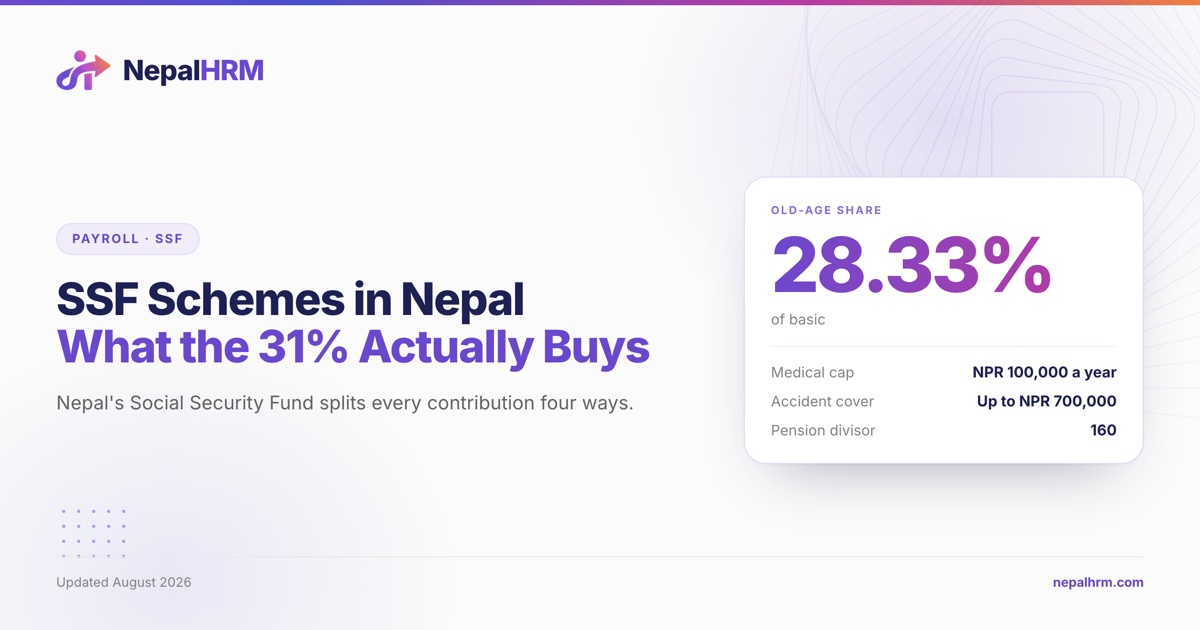
Every month, 31% of an enrolled employee's basic salary reaches Nepal's Social Security Fund, and the Fund splits it four ways before it lands. Section 25 of the Social Security Scheme Operation Procedure 2075 sets the split: 1.20% to medical, health and maternity protection, 0.80% to accident and disability, 0.67% to dependent family, and 28.33% to old-age protection.
Almost every English explanation of the SSF stops at the 11 and the 20. This one goes to what each share buys, with the caps, the qualifying periods and the pension formula from the Fund's own operating procedure. For what the contribution costs, our SSF contribution calculator takes any basic salary.
Table of Contents
- Seven scheme heads, four contribution shares
- 1. Medical, health and maternity protection · 1.20%
- 2. Accident and disability protection · 0.80%
- 3. Dependent family protection · 0.67%
- 4. Old-age protection · 28.33%
- Claiming: which form, which desk
- What this means for an employer
- Frequently asked questions
- How many schemes does the SSF run in Nepal?
- How is the SSF contribution divided between schemes?
- How much medical cost does the SSF cover in Nepal?
- How is the SSF pension calculated in Nepal?
- How much does the SSF pay for an accident?
- How long must you contribute before SSF benefits start?
- What happens to SSF money if a contributor dies before retirement?
- Sources
Seven scheme heads, four contribution shares
Section 10(1) of the Contribution Based Social Security Act 2074 names the plans the Fund shall operate:
- Medical treatment and health protection
- Maternity protection
- Accident protection
- Disability protection
- Old-age protection
- Dependent family protection
- Unemployment assistance
- Other social security plans the Fund specifies
Section 10(3) then lets the Fund operate them in phases, which is why the contribution split does not have seven lines. Section 25 of the operating procedure groups the live schemes into four:
| Scheme | Share of basic | What it does |
|---|---|---|
| Medical treatment, health and maternity protection | 1.20% | Reimburses treatment, delivery, fatal disease |
| Accident and disability protection | 0.80% | Treatment cost and income replacement |
| Dependent family protection | 0.67% | Pension, education grant, funeral expense |
| Old-age protection | 28.33% | Pension plan and retirement benefit plan |
| Total | 31.00% |
Section 12(1) requires a separate account for each plan, which is why a contributor statement shows several lines rather than one balance. Our guide to checking your SSF balance covers how to read it.
Note what is not yet a contribution line: unemployment assistance, scheme head seven. It matters, because Section 145(8) of the Labour Act removes a retrenched worker's right to retrenchment compensation where they are entitled to an unemployment benefit under the social security law. Our guide to termination and notice periods covers that interaction.
1. Medical, health and maternity protection · 1.20%
What it covers. Section 5 of the operating procedure lists: physician consultation fees; hospital admission and surgery charges; disease testing and treatment costs; medicine bills; regular antenatal check-ups for a female contributor or a male contributor's wife; hospital admission and delivery-related surgery or treatment; delivery costs; treatment related to the delivery for up to six weeks afterwards; treatment of the infant for up to three months; and consultation fees where a health worker visits the home because the patient cannot travel to hospital. The fifth amendment added accident treatment for the contributor's spouse or children under 18, up to NPR 100,000.
Who qualifies, and when. Section 4(1): the contributor must have contributed regularly for at least three of the preceding six months. Cover extends to the spouse and to children under 18. Benefits begin after the first three months of regular contribution, and continue for three months after the employment relation ends.
The caps. Section 6 is precise, and the numbers are worth knowing before a claim, not after:
| Situation | Limit |
|---|---|
| Hospital admission, contributor + spouse + children under 18 | NPR 100,000 a year |
| Outpatient, on a physician's prescription | NPR 20,000 a year, deducted from the above |
| Total treatment benefit in one fiscal year | NPR 100,000 |
| The contributor's own share of any claim | 20% |
| Fatal disease, over the whole service period | NPR 1,000,000 |
Section 6(1क), added by the fifth amendment, adds a genuine long-service benefit: a contributor with at least 60 months of regular contribution who is admitted to a hospital connected to the Fund's online system has 50% of treatment costs between NPR 100,000 and NPR 1,000,000 paid by the Fund directly to the hospital.
Fatal disease. Section 2 defines it as coronary artery bypass or open-heart surgery, stroke, kidney disease, cancer, Parkinson's, Alzheimer's, spinal injury, head injury, sickle cell anaemia, haemophilia or thalassaemia, plus anything the Government of Nepal designates. Section 4(2) sets a much longer qualifying period: at least 24 of the preceding 28 months of regular contribution, with the benefit continuing for 24 months after contributions stop, and for seven years from the start of pension for a contributor already drawing one. Within the NPR 1,000,000, Section 6(4क) sets sub-limits: up to NPR 100,000 for the diagnosis once the disease is proven; up to NPR 700,000 for treatment abroad, where a government-constituted medical board certifies it cannot be treated in Nepal; and up to NPR 200,000 for post-discharge re-examination.
What it will not pay. Section 8: plastic surgery and dental treatment, except where an accident requires it; bariatric surgery; costs during a nationwide epidemic where the Fund has suspended the plan because it cannot bear the cost; abortion other than as prevailing law permits; and anything already received under the accident and disability scheme.
A lifetime option at retirement. Section 8क(3): a contributor who has completed 60 years and contributed for at least 180 months on not less than the minimum basic remuneration may, on taking their pension, elect to contribute 1% of the pension each month and keep medical treatment cover for life.
2. Accident and disability protection · 0.80%
When it starts. Section 10: from the date the Fund began taking contributions after enlistment, and it stops when contributions stop. Occupational disease treatment is the exception: Section 10(3) requires at least two years of contribution, and the cover then persists for two years after contributions cease.
What is covered. Section 11(1): where the contributor suffers an employment-related accident, or is treated for an occupational disease, all costs.
Seven days. Section 11(1क) puts a reporting duty on the employer, the contributor or a family member: inform the Fund within seven days of an employment accident. It can be done through the Fund's system, by phone, or by message or email quoting the social security number. Section 11(1ख) supplies the sanction: where the Fund was not informed and treatment was at a hospital with no agreement with the Fund, costs above NPR 700,000 are not borne.
Non-employment accidents. Section 11(2): the Fund bears treatment costs up to NPR 700,000. Where other insurance pays NPR 700,000 or more, the Fund pays nothing; where it pays less, the Fund covers the balance up to the limit.
Income replacement. Section 11(3): temporary total incapacity from an employment accident or occupational disease pays 60% of the minimum basic remuneration monthly until the contributor returns to work, of which 2.67% is redeposited into the medical, accident and dependent-family schemes. Beyond three months, the health-check committee under Section 30 must recommend continuation.
This is the scheme that replaces the accident insurance Section 55 of the Labour Act would otherwise require an employer to buy, at a minimum sum of NPR 700,000 with the whole premium on the employer. Section 57 of the Labour Act is what permits that substitution.
3. Dependent family protection · 0.67%
Payable on a contributor's death, and the entitlements are specific.
| Beneficiary | Benefit |
|---|---|
| Spouse | A pension, per Section 15 |
| Up to two children under 18 | An education grant of 40% of the contributor's last basic remuneration, divided between them, monthly, until 18 |
| Dependent parents, where there is no spouse and no children | 60% of basic remuneration, pro rata, monthly, for life |
| Any contributor | Funeral expense, per Section 18 |
Section 14क sets the qualifying rule, and it distinguishes by cause of death. The benefit runs from the date contributions started and stops when they stop; but where death is from a cause other than an employment-related accident, at least twelve months of regular contribution is required first.
Section 24ग covers death after retirement: where a contributor dies before completing seven years of pension, the spouse receives the same monthly pension for the remainder of that period, and 50% of the pension monthly for life thereafter. Where there is no spouse, children under 18 receive 50% of the pension pro rata as an education grant until they turn 18.
4. Old-age protection · 28.33%
This is where the money is, and where the arithmetic is most worth understanding.
It is your provident fund and gratuity. Section 19(1) states it in terms: the scheme is run from the employer's 10% for provident fund plus 8.33% for gratuity, being 18.33%, and the worker's 10% provident fund contribution, totalling 28.33%. That is the Labour Act's Sections 52(1) and 53(1) rewritten as a contribution. Our guide to gratuity in Nepal covers what that changed.
It splits again, into two plans. Section 19(2):
| Plan | Share of basic | Section |
|---|---|---|
| Pension plan (nivrittabharan) | 20% | 19(2क) |
| Retirement benefit plan (awakash suvidha) | 8.33% | 19(2ख) |
Who is in the pension plan. Section 20(1): every contributor who began contributing on or after Shrawan 1, 2078 is included. Section 20(2) allowed earlier contributors to opt in by written application up to the end of Ashad 2078.
Eligibility. Section 22(1): the contributor must have completed sixty years of age and contributed for at least 180 months.
The formula. Section 21(a) is a single sentence and it is the answer to the most-asked SSF question in Nepal:
On completing retirement age, the total of the amount accumulated in the pension plan under Section 19(2क) together with the return earned on it from the Fund's investment, divided by 160, is received every month as pension for life.
A divisor of 160 is roughly thirteen and a third years of monthly payments before the accumulated balance itself is exhausted, after which the pension continues for life out of the pool. That is the insurance in the arrangement, and it is what distinguishes a pension from a savings withdrawal.
Dying before retirement. Section 21(b): the heir receives the whole thing as a lump sum, the contributor's contributions, the employer's contributions and the investment return.
Working past sixty. Section 24ङ: a worker who is already a contributor may continue after sixty if the employment relation continues, and the 20% that would go to the pension plan goes to the retirement benefit plan instead. Someone who starts contributing only after sixty has the whole amount go to the retirement benefit plan.
Very high salaries. Section 23क: where a contributor contributes on more than five times the government's minimum remuneration, the amount up to the minimum remuneration goes monthly into the pension plan and everything above it into the retirement benefit plan.
Claiming: which form, which desk
Section 26 of the operating procedure ties each scheme to a numbered claim form, filed at the Fund's office or with an authorised representative:
| Claim | Form |
|---|---|
| Medical treatment and health protection, by the worker | Schedule 1 |
| The same, claimed directly by the hospital | Schedule 2 |
| Maternity protection | Schedule 3 |
| Accident and disability protection | Schedule 4 |
| Accident protection, occupational disease | Schedule 5 |
| Dependent family protection | Schedule 6 |
| Funeral expense | Schedule 7 |
| Pension claim | Schedule 8, then Schedules 9 and 10 |
| Dependent family pension | Schedule 11, then Schedule 12 |
The Fund publishes claim forms and the withdrawal-claim process on ssf.gov.np, along with desks for each: claim@ssf.gov.np for benefit payment, retirement@ssf.gov.np for retirement claims, and the toll-free 1116.
What this means for an employer
Three practical consequences.
Your accident-reporting duty has a seven-day clock. Section 11(1क) names the employer first. Missing it can cost the employee NPR 700,000 of cover, and Section 148(2) of the Labour Act separately requires an employer to help a departing worker obtain what the Fund owes them.
Enlistment gaps become benefit gaps. Every qualifying period in this document counts months of regular contribution: three of the last six for medical, twelve for non-accidental death cover, twenty-four of twenty-eight for fatal disease, sixty for the enhanced hospital benefit, one hundred and eighty for pension. A three-month enlistment delay is not an administrative lapse; it moves someone's eligibility date. Our SSF registration guide covers the deadlines.
The employee usually does not know any of this. The contribution is visible on the payslip and the entitlements are not. Publishing the caps in your handbook costs nothing and is the cheapest benefit communication available to a Nepali employer.
Contribute accurately and the entitlements follow; contribute late and they move. NepalHRM calculates SSF at 11% employee and 20% employer of basic on every payroll run, shows both sides on the payslip, and prepares the deposit figures. See how payroll works, or book a walkthrough.
Frequently asked questions
How many schemes does the SSF run in Nepal?
Section 10(1) of the Contribution Based Social Security Act 2074 names seven scheme heads plus a residual: medical treatment and health, maternity, accident, disability, old-age, dependent family, and unemployment assistance. Section 10(3) allows them to run in phases, and Section 25 of the operating procedure currently splits the contribution four ways.
How is the SSF contribution divided between schemes?
Section 25 of the Social Security Scheme Operation Procedure 2075 allocates the 31% of basic salary as 1.20% to medical, health and maternity protection, 0.80% to accident and disability protection, 0.67% to dependent family protection, and 28.33% to old-age protection.
How much medical cost does the SSF cover in Nepal?
Up to NPR 100,000 a fiscal year for the contributor, spouse and children under 18, of which outpatient treatment on a physician's prescription is capped at NPR 20,000. The contributor bears 20% of every claim. A contributor with at least 60 months of contribution also gets 50% of costs between NPR 100,000 and NPR 1,000,000 paid to a hospital connected to the Fund's online system.
How is the SSF pension calculated in Nepal?
Section 21(a) of the operating procedure: the amount accumulated in the pension plan, plus the return the Fund earned on it, divided by 160, is paid every month for life. Eligibility under Section 22(1) requires completing sixty years of age and at least 180 months of contribution.
How much does the SSF pay for an accident?
An employment-related accident is covered in full, under Section 11(1). A non-employment accident is covered up to NPR 700,000, and where other insurance pays that much or more, the Fund pays nothing. The Fund must be informed within seven days of an employment accident.
How long must you contribute before SSF benefits start?
It depends on the scheme. Medical, health and maternity protection needs at least three of the previous six months. Dependent family protection for a non-accidental death needs twelve months. Fatal-disease treatment needs twenty-four of the previous twenty-eight months. The enhanced hospital benefit needs sixty months, and the pension needs one hundred and eighty.
What happens to SSF money if a contributor dies before retirement?
Section 21(b) of the operating procedure gives the heir the whole amount as a lump sum: the contributor's contributions, the employer's contributions and the investment return. The dependent family protection scheme benefits under Sections 14 to 18 are separate from that.
Sources
- Contribution Based Social Security Act, 2074 (2017), consolidated Nepali text as amended through 2082, published by the Social Security Fund: ssf.gov.np. Sections 10, 12 and 14 were read from that text, retrieved 2026-08-06.
- Social Security Scheme Operation Procedure, 2075, including the fifth amendment: ssf.gov.np. Sections 2 to 6, 8, 8क, 9 to 11, 14 to 19, 21 to 26 and 23क, 24ग, 24ङ were read from that text, retrieved 2026-08-06. The fourth amendment applies from Baishakh 1, 2082, and the fifth from the same date.
- Labour Act, 2074 (2017), Nepal Law Commission: lawcommission.gov.np. Sections 52, 53, 55, 57, 145 and 148, retrieved 2026-08-06.
Related reading: How to check your SSF balance in Nepal · PF and gratuity to SSF: a migration guide · Gratuity in Nepal