Nepal's Labour Act 2074 does not let an employer end an employment relation at will. Section 139(1) says no worker's employment shall be terminated except in the circumstances the Act, its Rules or the enterprise bye-laws provide, and Section 139(2) requires a reasonable and sufficient cause to be disclosed when it is.
There are seven lawful routes, each with its own trigger, its own process and, in one case, its own compensation formula. This guide walks all seven, plus the notice ladder in Section 144 and the fifteen-day settlement deadline in Section 148. It sits under our complete guide to the Nepal Labour Act 2074.
Table of Contents
- The seven routes out
- The notice ladder, Section 144
- Resignation has a fifteen-day clock, on the employer
- Poor performance is a three-strike route
- Health-related termination, and the protections around it
- Retrenchment: notice, order, and one month per year
- Compulsory retirement is sixty, not fifty-eight
- Fifteen days to pay everything, Section 148
- The misconduct route, in one paragraph
- An offboarding checklist that matches the Act
- Frequently asked questions
- What is the notice period in Nepal under the Labour Act?
- Is the notice period in Nepal three months?
- Can an employer terminate an employee without notice in Nepal?
- How long does an employer have to accept a resignation in Nepal?
- How much compensation is payable on retrenchment in Nepal?
- When must final settlement be paid in Nepal?
- What is the retirement age in Nepal?
- Is an experience letter compulsory in Nepal?
- Sources
The seven routes out
| Route | Section | Trigger | Notice under §144 |
|---|---|---|---|
| Contract expiry | 140 | The stated period ends, or the specified work is completed | Yes |
| Resignation | 141 | The worker's written resignation | Yes, by the worker |
| Poor performance | 142 | Three consecutive unsatisfactory evaluations | Yes |
| Health | 143 | Medically unfit, on a physician's recommendation | Yes |
| Misconduct | 131 to 138 | Proven misconduct, after due process | No |
| Retrenchment | 145 | Financial difficulty, merger, or closure | Yes, plus 30 days to the Office |
| Retirement | 147 | Completing sixty years of age | Not applicable |
Anything that is not on that list is not a route. "Restructuring", "the contract was not renewed" on a regular employee, and "we asked them to leave" all have to resolve into one of these seven, and the one they resolve into decides what is owed.
The notice ladder, Section 144
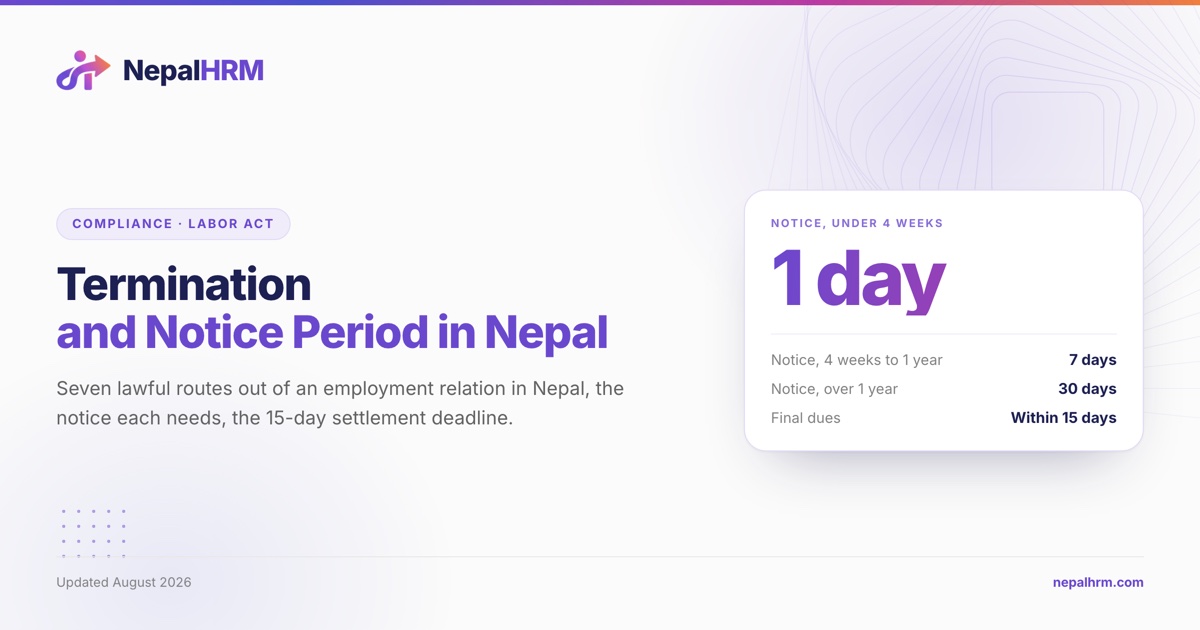
Section 144(1) sets notice by length of service, and it binds both parties:
| Length of employment | Notice owed |
|---|---|
| Up to four weeks | At least 1 day |
| Four weeks to one year | At least 7 days |
| More than one year | At least 30 days |
Section 144(2): an employer who terminates without giving that notice must pay the worker the remuneration for the notice period. Section 144(3): a worker who leaves without giving it can have the equivalent deducted from what they are owed.
That symmetry is the answer to the most-asked question about Nepali employment. There is no ninety-day notice period in the Labour Act. A three-month notice clause in a contract is a contractual term, not a statutory one, and it is a term the employee agreed to. The Act's floor is thirty days.
The opening words of Section 144(1) carry the whole exception: the notice duty applies "except where employment is terminated after action on misconduct". Dismissal for proven misconduct needs no notice, because the misconduct chapter has already supplied a process. See notice period for the term.
Resignation has a fifteen-day clock, on the employer
Section 141 is short and asymmetric in a way employers often miss.
- 141(1): a worker may resign by submitting a written resignation to the employer.
- 141(2): the employer must approve it within fifteen days and inform the worker.
- 141(3): if the employer does not approve it within that period, the resignation is deemed automatically approved from the next day.
- 141(4): it can be cancelled by mutual agreement of both parties.
- 141(5): if the worker keeps working at the same enterprise after the resignation took effect, the resignation is deemed cancelled.
Sitting on a resignation therefore does not keep an employee. It approves the resignation by default on day sixteen. And letting a resigned employee carry on working past their last day cancels the resignation entirely, which is a real problem when the handover slips by a fortnight and nobody re-papers it.
Poor performance is a three-strike route
Section 142(1) permits termination where a performance evaluation carried out under the Act, the Rules or the bye-laws finds a worker's performance unsatisfactory or below standard three consecutive times or more.
Two conditions attach. Section 142(2): the evaluation must actually have been carried out as the Rules or bye-laws provide, so a company with no written appraisal process has no access to this route. Section 142(3): where ten or more workers are employed, the worker gets at least seven days to defend themselves before the termination.
This is the route that fails most often in practice, and it fails for a documentary reason. Three consecutive evaluations means three, on the record, against a standard the employee could have read.
Health-related termination, and the protections around it
Section 143(1) permits termination where a worker is physically or mentally incapable, disabled or injured such that they cannot work, or needs treatment long enough to affect the work, on a physician's recommendation.
Section 143(2) then puts a hard shield around work-related harm. Where the worker had an accident performing work assigned by the employer, or contracted an occupational disease:
- while receiving hospital treatment, employment cannot be terminated; and
- where treatment is at home, it cannot be terminated for one year from the date treatment started;
- and full remuneration is payable for that period.
The proviso adds the same offset that runs through the Act: where the remuneration for the treatment period is receivable from the Social Security Fund, the employer need not pay it. That is one of the clearest reasons for an employer to be enrolled, and our guide to the SSF schemes covers what the accident scheme actually pays.
Section 143(3): in every other health case, employment cannot be terminated for six months, unless a physician clearly certifies the worker cannot return to work. Section 143(4): where a disabled or injured worker can be given work suited to their condition, the employer must give it.
Retrenchment: notice, order, and one month per year
Section 145 is the route for financial difficulty, a merger producing surplus headcount, or a partial or complete closure.
Process. At least thirty days before the retrenchment date, the employer notifies the Labour Office and the enterprise-level authorised trade union, or, failing that, the active union or the labour relations committee, stating the reason, the likely date and the likely number affected. The employer then discusses alternatives and selection criteria with them, and may retrench as agreed. If the union declines to discuss or no agreement is reached, the employer informs the Office and may proceed.
Order of selection, under Section 145(5), generally: foreign workers first, then workers with comparatively more misconduct penalties, then weaker performers, then, among workers doing the same kind of work, the most recently appointed. Departing from that order requires a stated reason. Under 145(6), officials of the collective bargaining committee or the authorised union go last unless the union agrees otherwise.
Compensation, under Section 145(7): a lump sum of one month's basic remuneration for each year of service, for workers with at least one year completed, and pro rata for less than a year.
Two carve-outs decide whether the section applies at all:
- Section 145(8): a worker entitled to an unemployment benefit under the social security law does not get this compensation. The Act assumes the Fund covers it.
- Section 145(10): the whole section does not apply to an employer with ten or fewer workers.
Section 146 adds a re-hiring duty. If the enterprise restarts or needs more workers within two years, retrenched workers get priority. A worker who is not notified or not taken back may apply to the Labour Court within thirty-five days.
Compulsory retirement is sixty, not fifty-eight
Section 147 provides for compulsory retirement from employment on completing sixty years of age for a worker in regular employment. The proviso lets a lower age be set for work of a particular nature, through the bye-laws, with the Council's permission as prescribed.
The number matters because the widely republished figure is fifty-eight, which was the original text. Section 147 was amended by the Good Governance Promotion and Public Service Delivery (Amendment of Some Nepal Acts) Act, 2081, and the consolidated text now reads sixty. If your bye-laws still say fifty-eight, they are retiring people two years early on a rule that no longer exists.
Fifteen days to pay everything, Section 148
This is the deadline that catches employers who get every other step right.
Section 148(1): whether employment ends for misconduct or in any other manner whatsoever, the employer must pay the worker all remuneration, benefits and every amount due within fifteen days of the employment ending.
Section 148(2): the employer must also give the assistance the worker needs to obtain the amounts or benefits payable from the Social Security Fund, an insurer or any other body.
Section 148(3) is the enforcement, and it is unusually direct. Where the employer does not pay within that period, or does not give that assistance, the worker must be paid remuneration as if still in service until the amount is paid. The clock does not stop because the employee has left.
Section 148(4) and (5) cover the case where the worker does not come to collect: the employer may pay directly into the worker's account or deposit it with the Office.
What is in the settlement is the sum of everything already accrued: unpaid salary to the last day, accumulated home and sick leave encashed at the last basic drawn under Section 49(2), pro-rated festival expense under Section 37(3), gratuity, and provident fund or the SSF balance. Our guide to leave types and encashment covers the leave arithmetic, and full and final settlement covers the term.
Two more duties survive the exit. Section 149 gives the worker's unpaid remuneration and benefits first priority when an enterprise is closed or liquidated, subject to insolvency law. Section 150 requires an experience certificate stating the period of employment and the post, whenever a departed worker asks for one.
The misconduct route, in one paragraph
Sections 130 to 138 are a separate chapter and a separate discipline. In outline: Section 131 grades misconduct and its penalties; Section 135 requires a written charge stating the facts and the possible penalty with seven days to defend; Section 136 puts the power to punish with the chief executive of the enterprise unless the bye-laws delegate it; and Section 137 puts two deadlines on the employer, starting action within two months of the misconduct coming to knowledge and deciding within three months of starting. Miss either deadline and the route is closed.
An offboarding checklist that matches the Act
- Identify which of the seven routes this exit is, before writing anything.
- State a reasonable and sufficient cause, per Section 139(2).
- Serve Section 144 notice at the right band, or budget the pay in lieu.
- On a resignation, approve or refuse within fifteen days, and confirm the last working day in writing.
- Stop the employee working after the effective date, or the resignation is deemed cancelled.
- Compute leave encashment at the last basic drawn, not the joining basic.
- Pay everything within fifteen days, and keep the proof.
- Help the leaver claim from the SSF or the insurer, per Section 148(2).
- Issue the experience certificate when asked, per Section 150.
- Notify the SSF within one month that the contributor has left employment.
An exit is a deadline, not a form. NepalHRM holds the joining and leaving dates, carries accrued leave into the encashment figure at the last basic drawn, and produces the final payslip in the same run as everyone else's. See how onboarding and offboarding works, or book a walkthrough.
Frequently asked questions
What is the notice period in Nepal under the Labour Act?
One day for employment up to four weeks, seven days from four weeks to one year, and thirty days beyond one year, under Section 144(1). It binds both the employer and the worker, and either side may pay the notice period's remuneration instead of serving it.
Is the notice period in Nepal three months?
Not under the Act. Section 144 caps the statutory notice at thirty days. A ninety-day notice clause is contractual, agreed between the parties, and it is not what the Labour Act requires.
Can an employer terminate an employee without notice in Nepal?
Only where the employment is terminated after action on misconduct. Section 144(1) excludes that case expressly. In every other case, notice is owed, and Section 144(2) makes the employer liable for the notice period's remuneration if it is skipped.
How long does an employer have to accept a resignation in Nepal?
Fifteen days. Section 141(2) requires the employer to approve the resignation within fifteen days and inform the worker; Section 141(3) deems it automatically approved from the day after that period ends.
How much compensation is payable on retrenchment in Nepal?
One month's basic remuneration for each year of service, as a lump sum, for a worker who has completed at least one year, and pro rata below that, under Section 145(7). It is not payable to a worker entitled to an unemployment benefit under the social security law, and the section does not apply to employers with ten or fewer workers.
When must final settlement be paid in Nepal?
Within fifteen days of the employment ending, under Section 148(1). Section 148(3) requires the employer to keep paying remuneration as though the worker were still in service until the amount is actually paid.
What is the retirement age in Nepal?
Sixty. Section 147 provides for compulsory retirement on completing sixty years of age for a worker in regular employment, following the amendment made by the Good Governance Promotion and Public Service Delivery (Amendment of Some Nepal Acts) Act, 2081. Bye-laws may set a lower age for work of a particular nature, as prescribed.
Is an experience letter compulsory in Nepal?
On request, yes. Section 150 requires the employer to give a work-experience certificate stating the period of employment and the post, when a worker whose employment has ended asks for one.
Sources
- Labour Act, 2074 (2017), consolidated Nepali text as amended through 2082, Nepal Law Commission: lawcommission.gov.np. Sections 49, 131 to 150 were read from that text, retrieved 2026-08-06. The Section 147 retirement age is the text as amended by the Good Governance Promotion and Public Service Delivery (Amendment of Some Nepal Acts) Act, 2081, which the consolidated version footnotes on that page.
Related reading: Nepal Labour Act 2074: the complete guide · Probation period in Nepal · Gratuity in Nepal