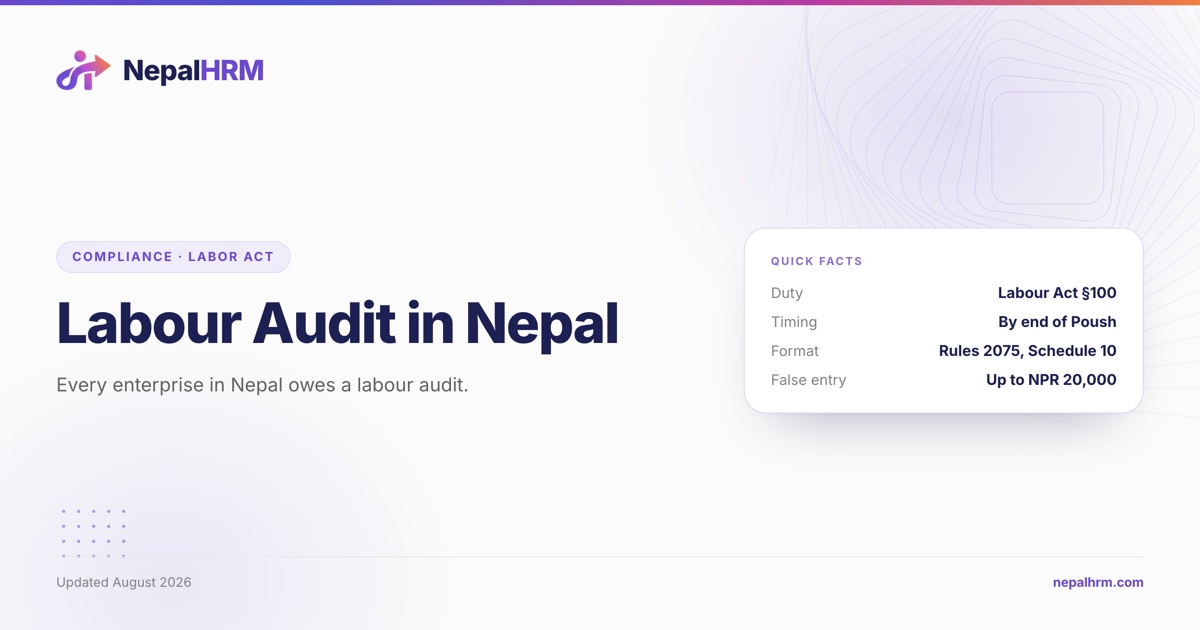
Every enterprise in Nepal owes a labour audit. Section 100(1) of the Labour Act 2074 requires each one to audit whether it is operating in accordance with the Act, the Rules and prevailing law, prepare a report, and hand that report to the Labour Office or an inspector on inspection or on demand.
Rule 56 of the Labour Rules 2075 then supplies the timing and the form: by the end of Poush each year, in the format of Schedule 10. What follows is that schedule, rendered in English, question by question. It sits under our complete guide to the Nepal Labour Act 2074.
Table of Contents
- What the law actually requires
- The headcount block
- Schedule 10, question by question
- Reading the form as a to-do list
- What the answers cost when they are "no"
- How to run the audit without it eating a week
- Frequently asked questions
- Is a labour audit compulsory in Nepal?
- When is the labour audit due in Nepal?
- Who can conduct a labour audit in Nepal?
- What format does the labour audit report take?
- Who gets a copy of the labour audit report?
- What is the penalty for a false labour audit report?
- Does the labour audit cover the Social Security Fund?
- Sources
What the law actually requires
Section 100(1), Labour Act 2074. Every enterprise shall carry out a labour audit, as prescribed, on whether work and activities in the enterprise have been carried out in accordance with this Act, the Rules and prevailing law, and prepare a report of it.
Section 100(2). The report must be made available to the Labour Office or an inspector when they inspect under this chapter, or when they ask for it.
Rule 56(1), Labour Rules 2075. The enterprise gets the audit done within the end of Poush each year, per the standard fixed by the Ministry, through either its own managerial-level worker or another person or institution connected with the labour sector.
Rule 56(2). The report is kept in the format of Schedule 10, and must be provided to the inspector inspecting the enterprise under Section 98.
Rule 56(3). Where a person carrying out the labour audit is found to have stated wrong particulars, the Labour Office may fine that person and the enterprise's manager, each time, under Section 163(2)(b).
Rule 56(4). A copy of the report must also be given to the labour relations committee and to the regulator for the sector: banks and financial institutions to Nepal Rastra Bank, insurance companies to the insurance regulator, and so on for other regulated industries.
Two points worth reading twice. The audit is not filed like a tax return, it is held and produced on demand, so the failure mode is not a late filing but an empty drawer during an inspection. And the report is not confidential to management: the labour relations committee, which under Section 111 exists in any enterprise with ten or more workers, gets a copy.
The headcount block
Schedule 10 opens with a numeric picture of the workforce, and it is more granular than most Nepali HR reporting:
| Count required | |
|---|---|
| Workers in regular employment | Female workers |
| Workers in work-based employment | Male workers |
| Workers in time-based employment | Other workers |
| Workers in part-time employment | Foreign workers |
| Total workers engaged | Managerial-level workers |
| Estimated casual workers engaged this year | Trainee workers |
| Apprentices | |
| Workers engaged through a labour supplier |
If your HR system cannot produce that split on demand, the audit starts as a spreadsheet exercise. Our guide to employment types in Nepal explains the five categories the first column asks for.
Schedule 10, question by question
The form asks for each row: complied yes or no, write "not applicable" where it does not relate to the enterprise, plus remarks.
| # | What the form asks | Act reference |
|---|---|---|
| 1 | Has an employment contract or appointment letter been given to workers in every type of employment? If not, how many and why | §11 |
| 2 | If foreign nationals are engaged, has a labour permit been taken? If not why; if yes, for how many | Ch. 6 |
| 3 | Is any child under 18 engaged? If so, how and on what work | §5 |
| 4 | If apprentices are engaged, are Sections 16 and 17 complied with | §§16, 17 |
| 5 | Are trainees engaged, and given remuneration and facilities on a par with other workers | §18 |
| 6 | Are workers engaged in part-time employment, and on what terms | §§19–21 |
| 7 | Is anyone engaged beyond eight hours a day and forty-eight a week | §28 |
| 8 | Is the half-hour rest after five hours given, and is work beyond hours paid at the additional rate | §§28, 31 |
| 9 | Where women are engaged after sunset or before sunrise, is transport and security arranged | §33 |
| 10 | Is anyone paid below the minimum remuneration | §106 |
| 11 | What is the enterprise's average monthly remuneration rate, including basic, allowances and benefits | |
| 12 | Is the annual grade increment given | §36 |
| 13 | Does the gap between remuneration payments exceed one month? If so, state the reason | §35 |
| 14 | Is festival expense provided | §37 |
| 15 | How many days of each leave are actually given: weekly, public, home, sick, maternity, maternity-care, mourning, substitute | Ch. 9 |
| 16 | Is provident fund deposited for every worker in each of the five employment types, to the fund or the SSF? If not, where has that money been used | §52 |
| 17 | Is gratuity deposited for every worker in each of the five employment types, to the SSF? If not, where has that money been used | §53 |
| 18 | Is medical treatment insurance in place | §54 |
| 19 | Is accident insurance covering any kind of accident in place | §55 |
| 20 | Are workers engaged through a labour supplier? Is that supplier licensed under Section 59, with the licence number and date? Do those workers get minimum remuneration and the Act's minimum standards, and is that monitored regularly | §§59, 64 |
| 21 | Is a safety and health policy formulated and implemented | §68 |
| 22 | Is a safety and health committee formed, and does it meet and decide regularly | §74 |
| 23 | Has the enterprise made bye-laws for internal management | §108 |
| 24 | Are the bye-laws registered at the Labour Office and distributed to workers? State the registration date and number | §108 |
| 25 | Is a labour relations committee formed and meeting regularly? State the last meeting date this fiscal year | §111 |
| 26 | Is a performance evaluation system in place | §112 |
| 27 | Were any individual claims submitted? How many were resolved by discussion with management | §113 |
| 28 | Were collective claims submitted this fiscal year | §116 |
| 29 | If a charter of demands was submitted, when? Is negotiation continuing or is an agreement signed, and on what date? Was there a strike or lock-out | §§116–124 |
| 30 | Is any agreement, decision or award under the Labour Act still to be implemented? By when will it be | §166 |
Then three separate blocks for other statutes:
Contribution Based Social Security Act 2074: is the enterprise registered with the Social Security Fund, and are contributions being deposited?
Bonus Act 2030: must the enterprise distribute bonus? If so, has it been distributed? Is last fiscal year's bonus still outstanding?
Trade Union Act 2049: is there an enterprise-level trade union? Has the authorised trade union been elected?
And a final open block: other matters the enterprise may add, including whether a separate arrangement exists for auditing the occupational safety and health policy, and a space for recommendations on what needs to improve. The form closes with the names, designations, signatures and dates of the person who filled it in and the person who approved it.
Reading the form as a to-do list
Six rows account for most of the "no" answers we see in Nepali enterprises, and each has a specific fix.
Row 1, employment contracts. Section 11(1) prohibits engaging anyone without a contract, and only casual employment is exempt. The penalty is not nominal: Section 163(1)(d) allows NPR 10,000 per worker, up to NPR 500,000, plus an order to issue the contracts.
Row 15, leave days actually given. The form does not ask whether your policy grants the leave; it asks how many days are being given. That is an attendance-record question, not a handbook question. Our guide to leave types under the Labour Act covers all eight, and to working hours and weekly holidays covers rows 7 to 9.
Rows 16 and 17, provident fund and gratuity. The follow-up question is unusually pointed: if not deposited, disclose where that money has been used. There is no comfortable answer. Section 163(2)(d) lets the Office recover the amount plus double as damages.
Rows 23 and 24, bye-laws. Making bye-laws is not enough. They must be registered at the Labour Office and distributed to workers, with the registration number and date stated on the form.
Row 20, labour suppliers. The main employer is on the hook for supplied workers' entitlements under Section 64, and the audit asks whether that is monitored regularly, not whether it was checked once.
The SSF block. Registration and contribution are two separate questions, because an enterprise can be registered and still not depositing. Our employer's guide to SSF registration and to monthly SSF filing cover both sides.
What the answers cost when they are "no"
| Failure | Penalty | Section |
|---|---|---|
| Engaging without an appointment letter or employment contract | NPR 10,000 per worker, up to NPR 500,000, plus an order to issue them | 163(1)(d) |
| Supplying workers without a licence, or using such a supplier | Up to NPR 200,000, plus orders | 163(1)(a) |
| Engaging a foreigner without a labour permit | Up to NPR 200,000 by number of workers, then NPR 5,000 per person per month if it continues | 163(1)(b) |
| Discrimination contrary to Chapter 2 | Up to NPR 100,000, plus an order to restore equality | 163(1)(c) |
| Paying below minimum remuneration, or unlawful deductions | The amount deducted plus up to double as damages, recovered for the worker | 163(2)(a) |
| False particulars, including in the audit report | Up to NPR 20,000 | 163(2)(b) |
| Engaging someone as a trainee or apprentice contrary to the Act | NPR 10,000 per head, plus an order to place them in regular employment with the pay and benefits due | 163(2)(c) |
| Not depositing gratuity, provident fund or SSF contributions; not giving medical treatment expense; not taking the compensation insurance | Recovery of the amount plus double as damages | 163(2)(d) |
One more provision is worth knowing. Section 164(3): where an offence punishable under the Act is committed by an organised institution, the institution is fined, and where the offence also carries imprisonment, the chief executive of that institution is imprisoned.
How to run the audit without it eating a week
- Pick the owner now. Rule 56(1) allows an internal managerial-level person; naming one in Ashwin beats scrambling in Poush.
- Pull the headcount split first. It is the hardest number to reconstruct late, and it drives half the rows.
- Answer from records, not from policy documents. Row 15 asks for days actually given.
- Write "not applicable" where a row genuinely does not apply. The form invites it, and a blank reads as a gap.
- Where the answer is no, put the remedy and the date in the remarks column. An audit that names its own gaps and dates the fixes is a stronger document than one that claims perfection.
- Distribute the copies: inspector on demand, labour relations committee, sector regulator.
- Keep the previous year's report. Row 30 asks what is still to be implemented, and last year's remarks are the answer.
Most of the audit is a data-extraction problem. NepalHRM holds the headcount by employment type, the leave actually taken by leave type, the PF or SSF deposited per employee per month, and the attendance behind rows 7 and 8, so the form is a report to run rather than a fortnight of reconstruction. See how NepalHRM handles payroll and compliance, or book a walkthrough.
Frequently asked questions
Is a labour audit compulsory in Nepal?
Yes. Section 100(1) of the Labour Act 2074 requires every enterprise to carry out a labour audit as prescribed, on whether it is operating in accordance with the Act, the Rules and prevailing law, and to prepare a report of it.
When is the labour audit due in Nepal?
Rule 56(1) of the Labour Rules 2075 sets it within the end of Poush each year, which falls in mid-January. The report is then produced to the Labour Office or an inspector on inspection or on demand, under Section 100(2).
Who can conduct a labour audit in Nepal?
Rule 56(1) allows the enterprise's own managerial-level worker, or another person or institution connected with the labour sector, to conduct it, per the standard fixed by the Ministry.
What format does the labour audit report take?
Schedule 10 of the Labour Rules 2075. It comprises a numeric workforce block, roughly thirty compliance rows referenced to sections of the Labour Act, and separate blocks for the Contribution Based Social Security Act 2074, the Bonus Act 2030 and the Trade Union Act 2049.
Who gets a copy of the labour audit report?
The inspector inspecting the enterprise under Section 98, plus, under Rule 56(4), the labour relations committee and the enterprise's sector regulator, such as Nepal Rastra Bank for banks and financial institutions.
What is the penalty for a false labour audit report?
Rule 56(3) points to Section 163(2)(b), under which the Labour Office may impose a fine of up to NPR 20,000 for submitting false particulars, on the person who gave them and on the enterprise's manager, each time.
Does the labour audit cover the Social Security Fund?
Yes. Schedule 10 carries a separate block for the Contribution Based Social Security Act 2074, asking whether the enterprise is registered with the Social Security Fund and whether contributions are being deposited.
Sources
- Labour Act, 2074 (2017), consolidated Nepali text as amended through 2082, Nepal Law Commission: lawcommission.gov.np. Sections 11, 98, 100, 108, 111, 163 and 164 were read from that text, retrieved 2026-08-06.
- Labour Rules, 2075 (2018), Nepali text published by the Social Security Fund at ssf.gov.np. Rule 56 and Schedule 10 were read from that text, retrieved 2026-08-06. The question list above is our English rendering of Schedule 10; the Nepali form is the operative one.
Related reading: Nepal Labour Act 2074: the complete guide · Working hours and weekly holiday rules in Nepal · Worker protection beyond the Labour Act