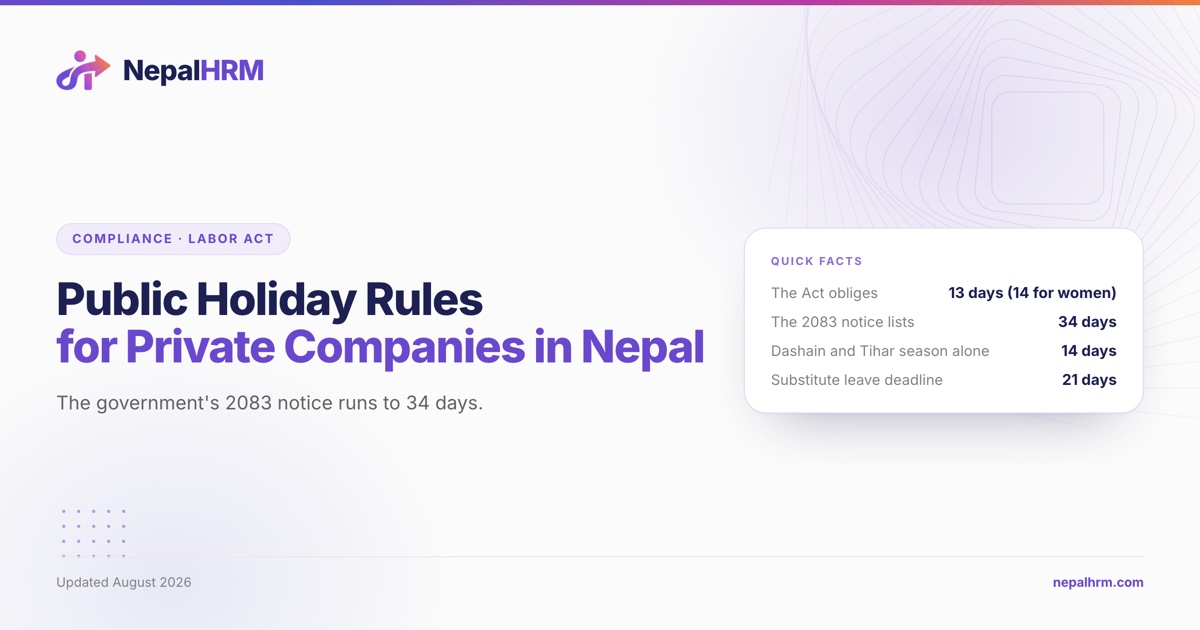
The Government of Nepal's public holiday notice for 2083 grants a general employee 34 days. Nepal's Labour Act 2074 obliges a private employer to give 13. Both numbers are correct, they are set by different instruments, and the twenty-one day gap between them is about four working weeks of payroll.
Almost every Nepali holiday article prints the government list and calls it your entitlement. It is not. This guide covers which instrument binds you, how to choose your thirteen days, what you owe when someone works one of them, and what has to be published before the year starts. It sits under our guide to leave types under the Labour Act, which covers the other seven leaves.
Table of Contents
- Which instrument actually binds a private company?
- What the 2083 notice actually contains
- The festival season eats the whole statutory year
- How to choose your thirteen days
- What you owe when someone works a public holiday
- Publish before the year starts, not during it
- Frequently asked questions
- How many public holidays must a private company give in Nepal?
- Does the government holiday list apply to private companies?
- How many days is Dashain holiday in Nepal?
- Do employees get extra pay for working on a public holiday in Nepal?
- Is Teej a public holiday for private companies in Nepal?
- What happens if a public holiday falls on a weekly off day?
- Sources
Which instrument actually binds a private company?
The Labour Act binds you. The Home Ministry notice does not, and conflating the two is the single most expensive error in Nepali holiday planning.
Section 41(1) grants every worker thirteen days of paid public leave a year including May Day, and fourteen days for a female worker, the fourteenth being International Women Labour Day. That is a count. The Act names no festival and fixes no date.
Section 41(2) then hands the calendar over. Where a regulatory body sets public holidays for a class of enterprise, that body's list applies. Everywhere else, the employer determines the days. A bank follows Nepal Rastra Bank; a private trading company follows itself.
The annual notice published by the Ministry of Home Affairs is a different document with a different audience. It sets holidays for government offices and public bodies. A private company that adopts it in full has not complied harder, it has granted about twenty-one extra paid days by contract, and once granted through practice those days are difficult to withdraw.
See public holidays for the term itself, and our 2083/84 holiday calendar for every dated day in the notice with its AD date beside it.
What the 2083 notice actually contains
Read as data rather than as an entitlement, the notice is genuinely useful: it is the menu you choose your thirteen days from, and it tells you which days your customers, banks and government counterparties will be closed.
| Days | |
|---|---|
| Distinct days a general employee gets under the full notice | 34 |
| Days the Labour Act obliges a private employer to give | 13 (14 for women) |
| Difference | ≈ 21 days |
| Extra days a province may add on its own | up to 6 |
The notice also lists days restricted to a group rather than granted to everyone: Teej and Jitiya for female employees, Indra Jatra and Ghode Jatra inside the Kathmandu Valley, Gai Jatra for the Newar community, Basanta Panchami for educational institutions, and faith-specific days for Kirat, Muslim and Sikh employees. Those are grants to a group, not to your whole workforce.
Three national days in the notice are observances on which offices stay open: the National Day against Racial Discrimination and Untouchability, Civil Service Day, and Gen Z Martyrs' Day. Companies close for these every year and do not owe them.
The festival season eats the whole statutory year
This is the arithmetic that decides a Nepali leave calendar, and it is rarely written down.
| Holiday | 2083 dates | Days |
|---|---|---|
| Ghatasthapana | Ashoj 25 · Sun 11 Oct 2026 | 1 |
| Dashain | Ashoj 31 to Kartik 6 · Sat 17 to Fri 23 Oct 2026 | 7 |
| Tihar | Kartik 22 to Kartik 26 · Sun 8 to Thu 12 Nov 2026 | 5 |
| Chhath | Kartik 29 · Sun 15 Nov 2026 | 1 |
| 14 |
Fourteen days, inside a thirty-six day window, against an annual statutory entitlement of thirteen.
A company that closes for the full Dashain-to-Chhath run has spent its entire year's public leave obligation between mid-Ashoj and mid-Kartik, and every other day it grants (New Year, Constitution Day, Maha Shivaratri, Christmas, the Lhosars, Holi) sits above the statutory floor as a contractual benefit.
That is not an argument for closing less. Most Nepali companies cannot trade through Dashain regardless of what the Act says, and Section 41(2) lets you grant more. It is an argument for knowing which of your holidays are law and which are your own policy, because only the second kind can be revised, and only the first kind is what you are actually audited against.
Two structural notes on the same season. Dashain and Tihar are consecutive blocks, not single days, so a holiday calendar modelled as individual dates will misprice them. And Fagu Purnima splits by geography: Chaitra 7 in the fifty-six hill and mountain districts, Chaitra 8 in the Tarai districts from Jhapa to Kanchanpur. A company with a Kathmandu head office and a Birgunj branch needs two calendars for that one day.
How to choose your thirteen days
The Act gives you the discretion. Use it deliberately, in this order.
- Check whether a regulator has already chosen. Banks, financial institutions, insurers and schools frequently have a list set for them under Section 41(2). If one exists, the choice is made and the rest of this section does not apply.
- Start from what the business cannot trade through. In practice Dashain and Tihar are decided by the market, not by HR. That is twelve of the thirteen days before you have chosen anything.
- Spend the remainder where your workforce actually is. One day left over goes further on Maghe Sankranti in a Tarai operation than on a day nobody in the office observes.
- Decide the group-restricted days as policy, in writing. Teej for female employees, the Valley jatras for a Valley office, faith-specific days for the staff who observe them. Grant them or do not, but decide once rather than case by case, because case by case is how a discrimination complaint starts.
- Handle the two undated days explicitly. Eid ul-Fitr and Bakar Eid carry no date in the notice because they follow a lunar sighting. Your policy should name them and say the date is confirmed each year, otherwise your calendar silently omits them.
- Write down anything above thirteen as a company benefit, not as a legal entitlement. That sentence is the difference between revising a policy and breaching a contract.
What you owe when someone works a public holiday
Nothing about the day being a holiday makes it premium-rated on its own. Nepal's Act routes it through substitute leave first.
Section 42(1) gives substitute leave to a worker engaged on a weekly or public holiday in work that cannot be stopped or must run continuously. Section 42(2) puts a deadline on it: that substitute leave must be given within twenty-one days of the day worked.
Miss the window and the consequence is a reclassification rather than a policy failure. Section 30(2) deems work performed without the substitute leave under Section 42 to be overtime, payable under Section 31(1) at 1.5 times basic remuneration. Our guide to overtime rules in Nepal works through what that costs and where the daily and weekly ceilings sit.
The practical control is a countdown, not a payroll rule. Nothing in the salary sheet will tell you the twenty-first day has passed; the liability accrues silently and surfaces in a labour audit or a final settlement.
Publish before the year starts, not during it
Section 41(2) makes the calendar an employer decision, and an employer decision that was never published is indistinguishable from no decision at all.
Publish before Shrawan 1, or at the latest before Ashoj, covering:
- the thirteen (or fourteen) days you are treating as the statutory public leave;
- any further days granted as company benefit, labelled as such;
- the group-restricted days and who is eligible;
- the branch differences, where Holi or a jatra splits by district;
- how a holiday falling on a weekly off is treated;
- who confirms the undated Eid dates and by when.
Then load it into whatever runs leave, before Ghatasthapana rather than after it. A holiday that exists on a notice board but not in the leave system will be deducted from somebody's home leave balance, and that error is only ever found by the employee.
A holiday calendar is only worth what your leave balances do with it. NepalHRM holds a company holiday list where a multi-day block like Dashain is a single entry with a start and end date, and leave approved across those days is not charged to the employee's balance. See how leave management works, or book a walkthrough with your own calendar loaded.
Frequently asked questions
How many public holidays must a private company give in Nepal?
Thirteen paid days a year, and fourteen for a female worker, under Section 41(1) of the Labour Act 2074. The Act fixes that count but not the dates: Section 41(2) leaves the choice of days to the regulatory body for that class of enterprise, or to the employer where no regulator has set one.
Does the government holiday list apply to private companies?
No. The Ministry of Home Affairs notice sets holidays for government offices and public bodies. A private employer's obligation is the thirteen-day count in Section 41(1), normally chosen from that list. Adopting the full notice grants roughly twenty-one days a year beyond what the Act requires.
How many days is Dashain holiday in Nepal?
In the 2083 notice, Dashain is a seven-day block from Ashoj 31 to Kartik 6, with Ghatasthapana granted separately six days earlier. Together with Tihar's five days and Chhath, the festival season runs to fourteen days, which is more than the Labour Act's entire annual public leave entitlement.
Do employees get extra pay for working on a public holiday in Nepal?
Not automatically. Section 42 requires substitute leave within twenty-one days of the day worked. Only where that substitute leave is not given does Section 30(2) treat the day as overtime, payable at 1.5 times basic under Section 31(1).
Is Teej a public holiday for private companies in Nepal?
The 2083 notice grants Teej to female employees, not to everyone. The Labour Act's fourteenth day for a female worker is International Women Labour Day rather than Teej, so an employer following the Act and an employer following the notice grant different days. Whichever you choose, record it in the policy.
What happens if a public holiday falls on a weekly off day?
The Act does not merge them or automatically grant a day in lieu, so this is a policy decision under Section 41(2). Whatever you decide, state it in writing, because it is one of the most common sources of leave-balance disputes at year end.
Sources
- Labour Act, 2074 (2017), consolidated Nepali text as amended through 2082, Nepal Law Commission: lawcommission.gov.np. Sections 30, 41 and 42 read from that text, retrieved 2026-08-07.
- Public holiday notice for 2083, Nepal Rajpatra, Khanda 75, Sankhya 67, Bhag 5, published Falgun 18 2082, Ministry of Home Affairs: moha.gov.np. Day counts on this page are computed from that notice.
Related reading: Leave types under the Labour Act 2074 · Working hours and weekly holiday rules · How to write a leave policy for a Nepali company