Chapter 9 of Nepal's Labour Act 2074 sets out eight leaves, and only three of them are a right an employee can insist on. That distinction is in Section 51, it is rarely quoted, and it decides whether "leave rejected" is a lawful decision or a dispute.
This guide covers each leave in Sections 40 to 48: what it gives, how it accrues, what it is paid at, and the two provisions that trip up most Nepali leave policies. It sits under our complete guide to the Nepal Labour Act 2074, which covers the wider Act.
Table of Contents
- The eight leaves at a glance
- Home leave is annual leave, and it accrues by days worked
- Sick leave: twelve days, and a certificate after three
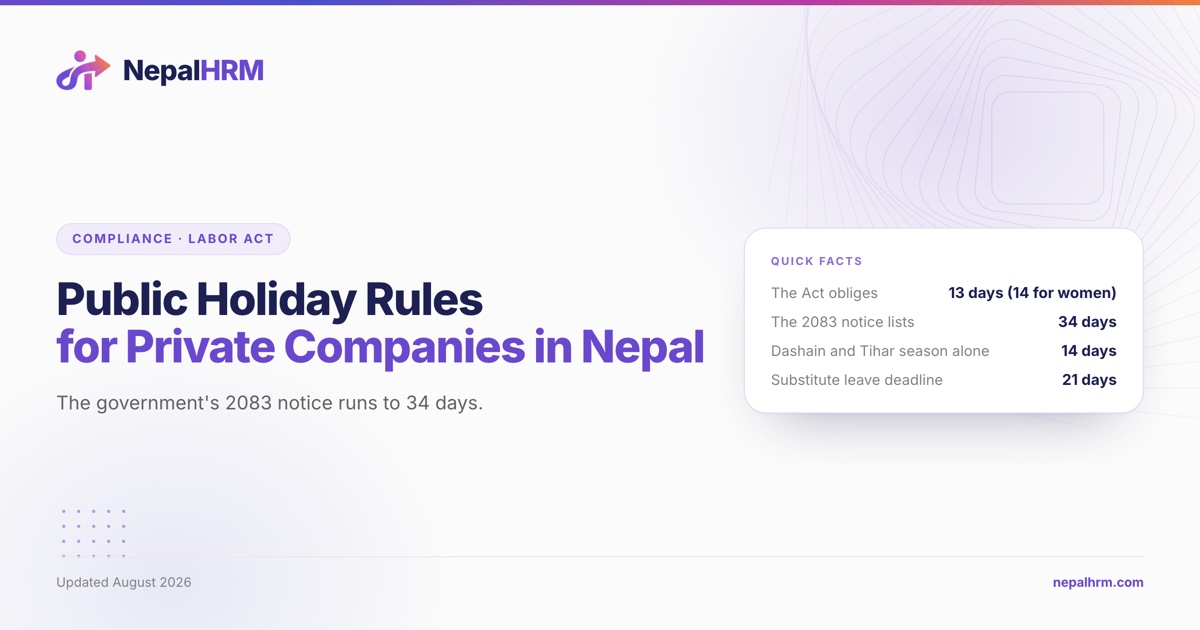
- Public leave: thirteen days, fourteen for a female worker
- Substitute leave and the twenty-one day clock
- Maternity, paternity and the SSF offset
- Mourning leave is narrower than it sounds
- Section 51: most leave is a facility, not a right
- Accumulation, encashment, and the two different caps
- Which year is your leave year?
- What to check in your leave policy this month
- Frequently asked questions
- How many leaves are there in Nepal's Labour Act 2074?
- How many days of annual leave does an employee get in Nepal?
- Can an employer refuse leave in Nepal?
- How much leave can be accumulated in Nepal?
- How is leave encashment calculated in Nepal?
- How many days of paternity leave are there in Nepal?
- Does the employer pay for maternity leave if the company is in the SSF?
- Sources
The eight leaves at a glance
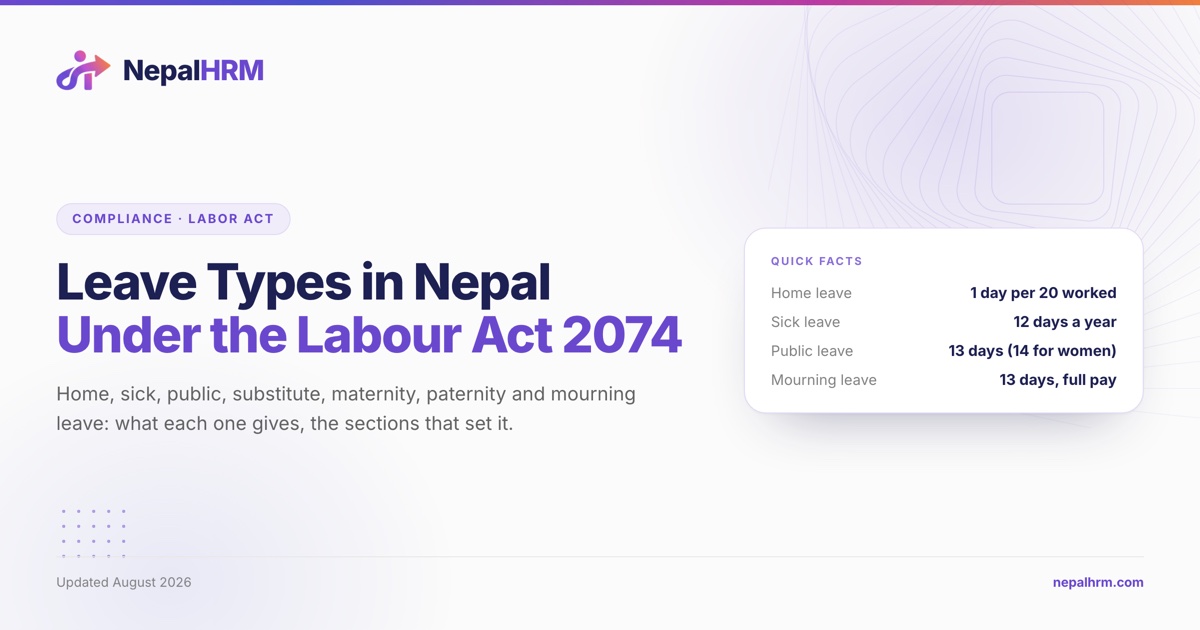
| Leave | What the Act gives | Section |
|---|---|---|
| Weekly leave | One day a week | 40 |
| Public leave | 13 days a year including May Day; 14 for a female worker, the extra day being International Working Women's Day | 41(1) |
| Substitute leave | One day for each weekly or public holiday worked, to be given within 21 days | 42 |
| Home leave | One day of paid leave for every 20 days worked | 43(1) |
| Sick leave | 12 days a year, paid, pro-rated below a year of service | 44(1) |
| Maternity leave | 14 weeks, of which 60 days are on full remuneration | 45(1), 45(3) |
| Maternity-care leave | 15 paid days for a male worker whose wife gives birth | 45(7) |
| Mourning leave | 13 days on full remuneration | 48 |
Two things are missing from that table on purpose. There is no casual leave and no annual leave in the Act: Nepali companies that run a "casual leave" bucket are running a contractual leave on top of the statutory floor, which is allowed but is not the Act speaking. And there is no bereavement leave separate from kriya bidaa under Section 48, which is narrower than the English word "bereavement" suggests.
Home leave is annual leave, and it accrues by days worked
Section 43(1) grants home leave "at the rate of one day for every twenty days of the period worked". That ratio, not a headline number, is the entitlement.
Twenty worked days to one day of leave means a worker who puts in a full year of six-day weeks earns roughly eighteen days, and a worker who joins in Magh earns proportionally fewer. A leave policy that opens the year by crediting everyone a flat eighteen days is granting leave the Act has not yet created, and it turns every mid-year resignation into an overpayment argument.
Section 43(2) carves out one group: workers at teaching institutions, and anyone who already gets summer or winter vacations, do not get home leave. The proviso softens it, so where that vacation runs shorter than the home leave earned, the difference is still owed.
Home leave is paid leave, which for basic salary purposes means the day is paid, not that the day is priced on gross. See home leave for the term on its own.
Sick leave: twelve days, and a certificate after three
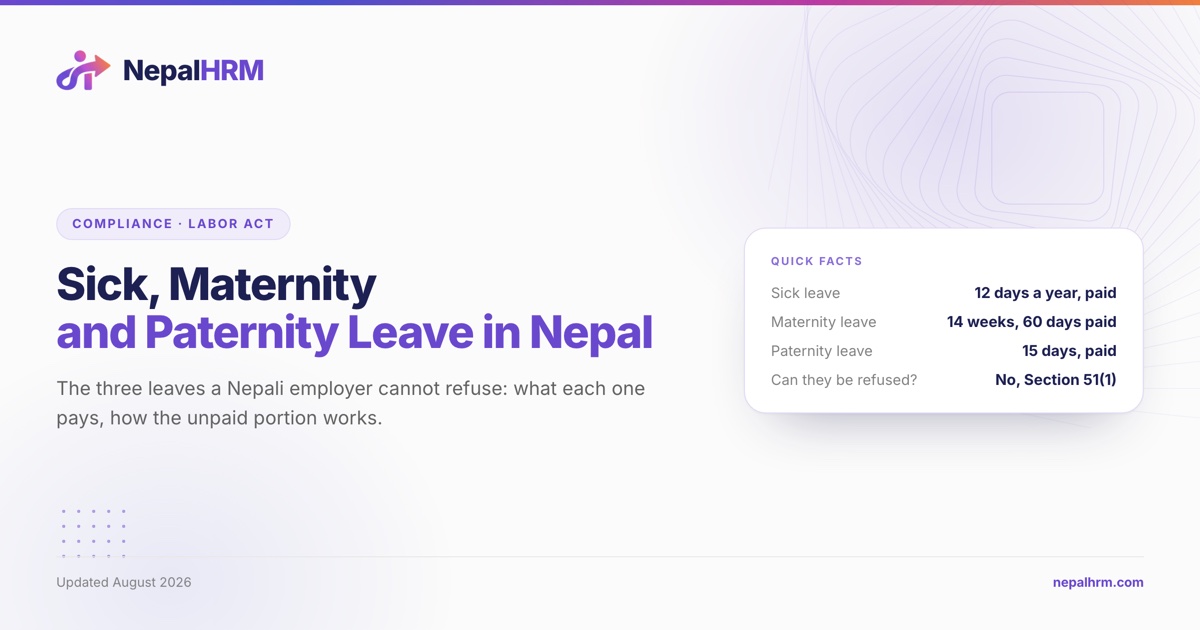
Section 44(1) gives twelve days of paid sick leave a year, with a proviso pro-rating it for a worker who has served a year or less.
Two procedural rules sit underneath it. Section 44(2): a worker asking for more than three consecutive days of sick leave must produce a certificate from a recognised physician. Section 44(3): sudden illness must be reported to the employer, or the person the employer names, by the fastest available means.
Both are worth writing into the policy verbatim, because both are commonly enforced as if they said something else. "Three days" is consecutive days, not a running annual total, and the notification duty is immediate rather than on return. See sick leave for the definition.
Public leave: thirteen days, fourteen for a female worker
Section 41(1) sets thirteen days of paid public leave a year including May Day, and fourteen days for a female worker, the fourteenth being International Working Women's Day.
Section 41(2) is the part that surprises employers: the Act fixes the count, not the calendar. Where a regulator sets public holidays for a type of enterprise, that regulator's list applies; otherwise the employer decides which days those thirteen fall on. Nepal's public holiday notice may run to more days than thirteen, and a private employer is not obliged to observe every one of them.
Practically, that means a company calendar published before the fiscal year starts is not a nicety. It is how you show which thirteen days you chose. See public holidays for how the count works.
Substitute leave and the twenty-one day clock
Section 42(1) gives substitute leave to a worker engaged on a weekly or public holiday in work that cannot be stopped or must run continuously. Section 42(2) puts a deadline on it: the substitute leave must be given within twenty-one days of the date worked.
Miss that window and the consequence is not a policy failure, it is a reclassification. Section 30(2) deems work performed without the substitute leave under Section 42 to be overtime, payable at 1.5 times basic under Section 31(1). The liability accrues quietly and surfaces in an audit or a final settlement. Our guide to overtime rules in Nepal works through what that costs.
The control here is a tracker, not a payroll rule. If nobody is watching the twenty-first day, nothing in the salary sheet will tell you.
Maternity, paternity and the SSF offset
Section 45 is the longest leave provision in the Act and the most often summarised wrongly.
- 45(1): fourteen weeks of maternity leave, before or after delivery.
- 45(2): at least two weeks before the expected date and at least six weeks after delivery are compulsory, not optional.
- 45(3): sixty days of that leave carry full remuneration. The balance of the fourteen weeks is unpaid.
- 45(4): where a recognised physician recommends further rest for mother or infant, the employer approves up to one further month, unpaid or adjusted against other leave, running continuously with the maternity leave.
- 45(5): a stillbirth or a miscarriage at seven months or more is treated as a delivery for leave purposes.
- 45(6): if the mother dies before the child is sixty days old, the surviving worker takes the remaining leave, with remuneration, to care for the infant.
- 45(7): a male worker whose wife gives birth gets fifteen days of paid maternity-care leave.
Then Section 47 does something no summary mentions. Where the maternity-leave remuneration is payable from the Social Security Fund, the employer does not have to pay it again to that extent. If your company contributes to the SSF, the paid portion of maternity leave is a fund claim, not only a payroll cost, and treating it as a payroll cost means paying twice. Our guide to the SSF schemes covers what the maternity protection scheme actually pays and who qualifies.
See maternity leave and paternity leave for the terms.
Mourning leave is narrower than it sounds
Section 48(1) gives thirteen days of kriya bidaa on full remuneration in three situations: the death of a husband or wife; where the worker must personally observe mourning rites under the customs of their lineage; and, for a married female worker, the death of her own parents or her parents-in-law.
It is not a general bereavement leave, and Section 48(2) confirms it is on full remuneration. See mourning leave.
Section 51: most leave is a facility, not a right
This is the provision that decides how a leave policy is actually enforced, and it is almost never quoted.
Section 51(1): the leaves other than sick leave, mourning leave and maternity leave receivable by a labour under this Chapter are only facilities and cannot be claimed as a matter of right.
Section 51(2) spells out what that means in practice. For any leave outside those three, the employer may, stating the reason, refuse it, postpone it, deduct it, or change the timing of leave already approved, according to the needs of the work at the workplace.
Three consequences follow.
Home leave can be refused. A worker with an accrued balance is not entitled to take it on a chosen date. That is a management decision the Act expressly permits, so long as a reason is recorded.
The reason has to exist. "Stating the reason" is not decoration. A refusal with no recorded reason is the version that loses at the Labour Office.
Sick, mourning and maternity cannot be refused. They are outside Section 51(1). A policy that requires prior approval for sick leave in the same way it requires prior approval for home leave has quietly mixed a right with a facility.
Accumulation, encashment, and the two different caps
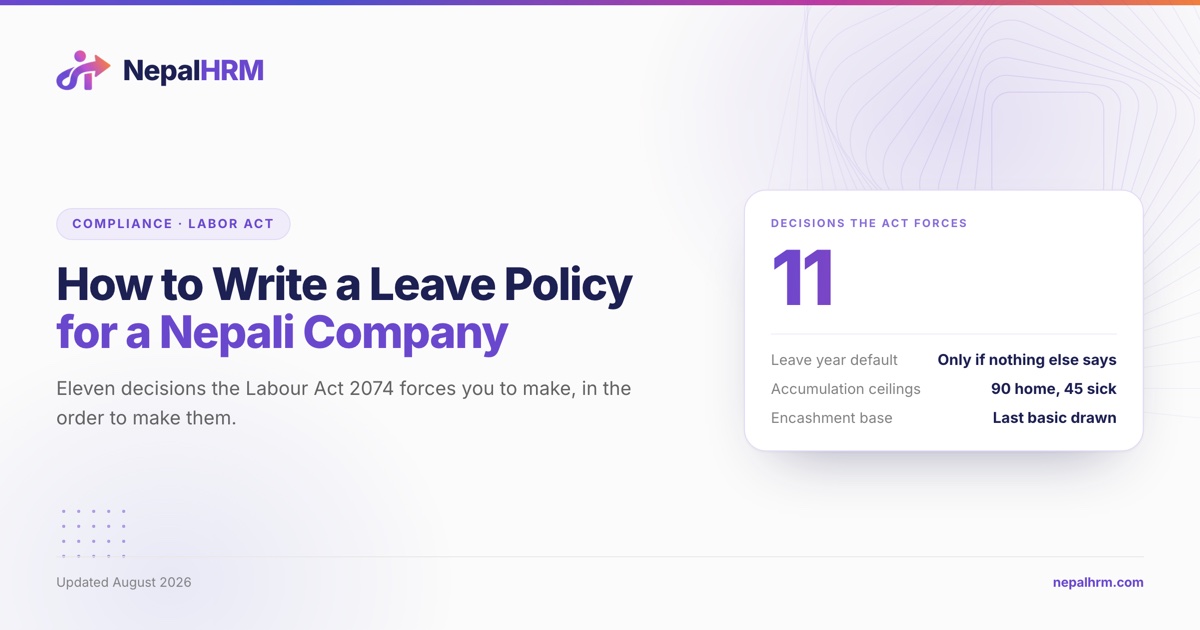
Section 49(1) sets two ceilings that are not the same number: home leave accumulates up to ninety days, sick leave up to forty-five. The widely republished summaries of this Act state a single flat ninety, which overstates a sick-leave payout by up to forty-five days of basic pay.
| Home leave | Sick leave | |
|---|---|---|
| Accrual | 1 day per 20 worked, §43(1) | 12 days a year, §44(1) |
| Accumulation cap | 90 days | 45 days |
| Above the cap | Paid out at year end, §49(3) | Paid out at year end, §49(3) |
| On leaving or death | Lump sum at last basic, §49(2) | Lump sum at last basic, §49(2) |
Section 49(2) is precise about the rate: the lump sum is calculated at the last basic remuneration drawn, and it is paid to the worker, or to their prescribed family member on death. A recent increment therefore raises the value of leave earned years earlier.
Section 49(3) is the one most policies ignore. Leave accumulated above the ceiling is not lost and is not carried: it is paid out at the end of each year at the basic rate. A "use it or lose it" clause above ninety days is not what the Act says. See leave encashment for the mechanics.
Which year is your leave year?
Section 50 answers this in a strict order, and the answer is not automatically the fiscal year:
- As fixed by law, if law fixes it.
- Otherwise, as fixed by the regulatory body.
- Otherwise, as stated in the employment contract.
- Only where none of those apply, the Government of Nepal's fiscal year.
So a company whose employment contracts say the leave year runs from the joining date is on solid ground, and a company that has never said anything is on the Shrawan-to-Ashad year by default. Either is fine. Having half the workforce on each is what causes the reconciliation to fail every Ashad.
What to check in your leave policy this month
- Does home leave accrue by days worked, or is it granted flat in Shrawan?
- Are the accumulation ceilings 90 and 45, or one number for both?
- Is encashment priced at the last basic drawn, and on basic rather than gross?
- Does anything pay out the excess above the cap at year end, per Section 49(3)?
- Is sick leave treated as a right, with no discretionary rejection path?
- Is somebody watching the 21-day substitute-leave clock for holiday work?
- Does the contract or the bye-laws say which leave year applies?
- If you contribute to the SSF, is paid maternity leave claimed from the Fund rather than absorbed by payroll?
Leave goes wrong in the arithmetic long before it goes wrong in the policy. NepalHRM holds each leave type with its own accrual rule, updates balances the moment a request is approved, resolves holiday and weekend overlaps by rule rather than by hand, and decides at year end whether unused days lapse, carry forward or encash. See how leave management works, or book a walkthrough with your own leave types.
Frequently asked questions
How many leaves are there in Nepal's Labour Act 2074?
Eight, in Sections 40 to 48: weekly leave, public leave, substitute leave, home leave, sick leave, maternity leave, maternity-care leave for a male worker, and mourning leave. There is no separate casual leave or annual leave in the Act. Home leave is Nepal's annual leave.
How many days of annual leave does an employee get in Nepal?
The Act sets a ratio rather than a total. Section 43(1) gives one day of paid home leave for every twenty days worked, so a full year of work earns roughly eighteen days, and a partial year earns proportionally less.
Can an employer refuse leave in Nepal?
For most leave, yes. Section 51(1) makes every leave except sick, mourning and maternity leave a facility rather than a right, and Section 51(2) lets the employer refuse, postpone, deduct or reschedule it according to the needs of the work, stating the reason. Sick, mourning and maternity leave are outside that provision.
How much leave can be accumulated in Nepal?
Ninety days of home leave and forty-five days of sick leave, under Section 49(1). They are two different ceilings. Anything above them is paid out at the end of the year at the basic rate under Section 49(3).
How is leave encashment calculated in Nepal?
At the last basic remuneration drawn, under Section 49(2), for accumulated home and sick leave when the worker leaves service or dies. Basic, not gross, and the "last" drawn rate rather than the rate in force when the leave was earned.
How many days of paternity leave are there in Nepal?
Fifteen days, paid. Section 45(7) grants a male worker whose wife gives birth fifteen days of maternity-care leave with remuneration.
Does the employer pay for maternity leave if the company is in the SSF?
Not to the extent the Fund pays it. Section 47 relieves the employer of paying maternity-leave remuneration where that remuneration is receivable from the Social Security Fund. The compulsory leave still applies; the funding source changes.
Sources
- Labour Act, 2074 (2017), consolidated Nepali text as amended through 2082, Nepal Law Commission: lawcommission.gov.np. Sections 30, 40 to 51 were read section by section from that text, retrieved 2026-08-06.
Related reading: Nepal Labour Act 2074: the complete guide · Overtime rules in Nepal · Working hours and weekly holiday rules