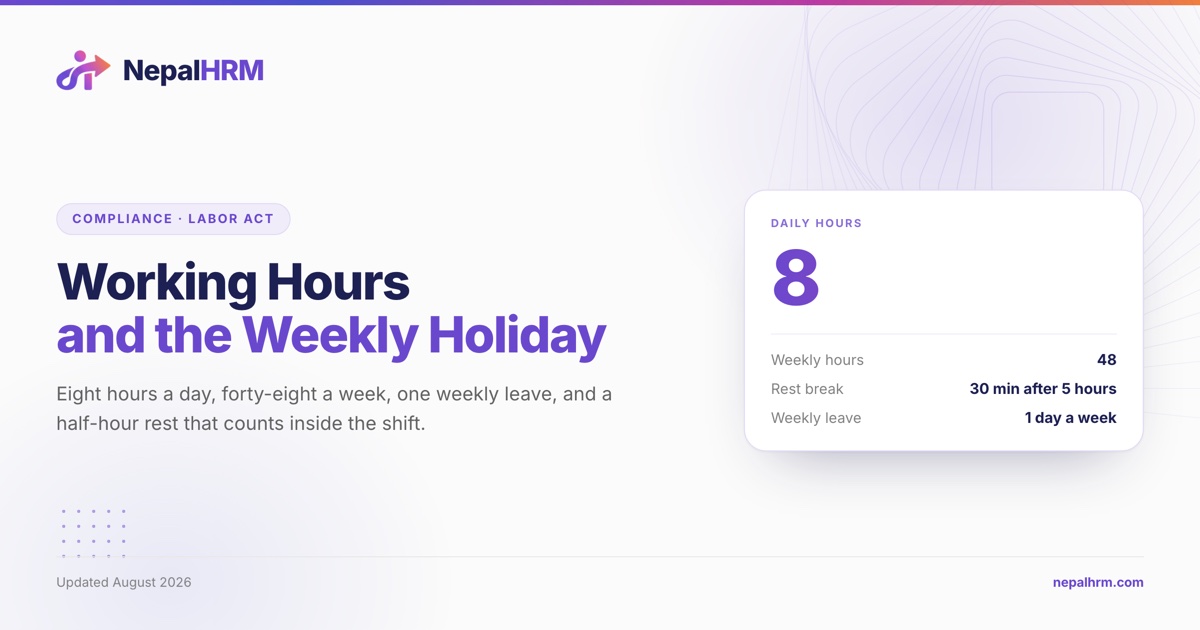
Nepal's standard working week is eight hours a day and forty-eight hours a week, with one day of weekly leave, and a half-hour rest after five continuous hours that is counted inside those hours rather than added to them. That last clause is Section 28(4), and getting it wrong lengthens every shift in the company by thirty minutes.
This guide covers Sections 28 to 33 on working time and Sections 40 to 42 on weekly and public holidays, including the transport duty in Section 33 that almost no Nepali handbook carries. It sits under our complete guide to the Nepal Labour Act 2074.
Table of Contents
- The statutory week
- The rest break is inside the day, not on top of it
- No one can be compelled to work longer
- Start and finish times belong to the contract
- Weekly leave: one day, and the Act does not say which
- Working a holiday: the twenty-one day clock
- Section 33: transport for night shifts, for female workers
- Hours, attendance, and what an inspection asks for
- What to check in your schedule
- Frequently asked questions
- What are the working hours in Nepal under the Labour Act?
- Is the lunch break included in working hours in Nepal?
- Can a company in Nepal run a five-day, 48-hour week?
- How many weekly holidays are there in Nepal?
- What happens if an employee works on a public holiday in Nepal?
- Can an employer force an employee to work overtime in Nepal?
- Does an employer have to provide transport for night shifts in Nepal?
- Sources
The statutory week
| Rule | The number | Section |
|---|---|---|
| Maximum hours a day | 8 | 28(1) |
| Maximum hours a week | 48 | 28(1) |
| Rest after continuous work | 30 minutes after 5 hours | 28(2) |
| Is the rest inside the hours? | Yes | 28(4) |
| Weekly leave | 1 day a week | 40 |
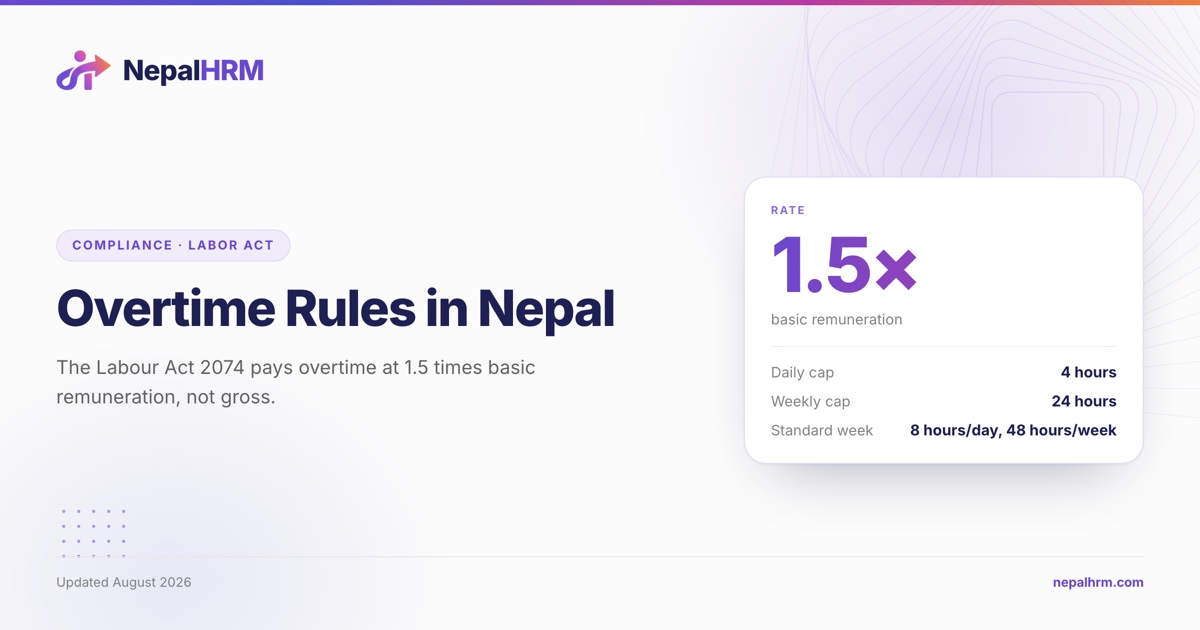
| Maximum overtime | 4 a day, 24 a week | 30(1) |
| Overtime rate | 1.5× basic remuneration | 31(1) |
Forty-eight hours across six days is eight hours a day. Across five days it is 9.6 hours a day, which breaches the daily eight-hour limit in the same sub-section. A five-day week in Nepal therefore has to run at forty hours, or the extra hours have to be treated and paid as overtime. This is the single most common structural error in Nepali office scheduling.
The rest break is inside the day, not on top of it
Section 28(2) requires a half-hour rest after five hours of continuous work. Section 28(3) allows it to be given on rotation where work cannot be stopped or must be run continuously. Section 28(4) then says the rest time given under 28(2) and 28(3) shall be counted within the working hours under 28(1).
Read together: a worker who starts at 9:00, takes a half-hour lunch at 13:00 and finishes at 17:00 has worked their eight hours. If the same employer expects them at 17:30 to "make up" the lunch, the last thirty minutes are hours beyond Section 28(1) and are overtime under Sections 30 and 31, payable at 1.5 times basic. Our guide to overtime rules in Nepal works through the rate and the caps.
Section 28(3) matters for hospitals, hotels, manufacturing lines and security work, where nobody can simply stop for thirty minutes. The Act does not remove the rest; it requires it to be rotated.
No one can be compelled to work longer
Section 29(1) is unambiguous: the employer shall not compel a worker to work beyond the hours in Section 28(1).
Section 29(2) is the only exception, and it is narrow. Where not completing the work would adversely affect the life, safety or health of any person, or cause serious loss or damage to the employer, the worker may be engaged in additional hours, and even then subject to Section 30(1), so the four-hour daily and twenty-four-hour weekly overtime ceilings still bind.
In practice this means overtime is requested and approved before the hours are worked, not reconciled afterwards. Approval after the fact is bookkeeping, not a control.
Start and finish times belong to the contract
Section 32(1) allocates the decision: the time at which a worker's work begins and ends is as stated in the employment contract, and where the contract is silent, as determined by the employer. Section 32(2) leaves other working-time matters to be prescribed by the Rules.
Two things follow. An employment contract that states nothing about hours hands the employer the decision, which is convenient until a dispute over an unpaid evening. And Section 32 has nothing to do with the overtime rate: any source citing "Section 32" for the 1.5 multiplier is citing the wrong provision, which is Section 31(1).
See working hours and shift roster for the terms.
Weekly leave: one day, and the Act does not say which
Section 40 is a single line: a worker shall get one day of weekly leave every week.
It does not name Saturday, and it does not require the same day for everyone. A roster that gives shop staff their weekly leave on Tuesday is entirely compliant. What is not compliant is a week with no weekly leave at all, or a rotation that lets one worker go three weeks without one.
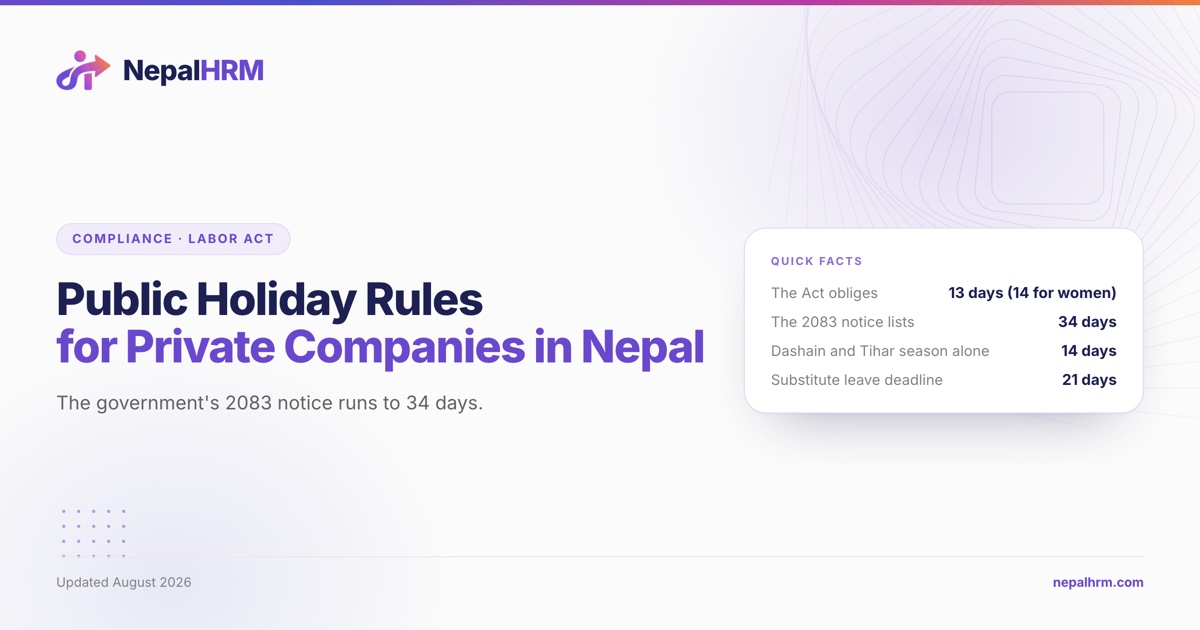
Public leave sits beside it in Section 41: thirteen paid days a year including May Day, and fourteen for a female worker, the fourteenth being International Working Women's Day. Section 41(2) leaves the choice of days to the regulator, where one regulates that class of enterprise, and otherwise to the employer. Our guide to leave types under the Labour Act covers all eight leaves.
Working a holiday: the twenty-one day clock
Section 42(1) gives substitute leave to a worker engaged on a weekly or public holiday in work that cannot be stopped or must run continuously. Section 42(2) sets the deadline: the substitute leave must be given within twenty-one days of the date the worker worked.
Section 30(2) supplies the consequence. Work performed without giving the substitute leave under Section 42 is deemed to be overtime work, payable at 1.5 times basic under Section 31(1), whether or not anyone called it overtime.
So holiday working has two lawful settlements and no third: a substitute day inside twenty-one days, or overtime pay. Silence resolves to overtime by operation of law, and it does so silently, which is why the control has to be a substitute-leave tracker rather than a payroll rule.
Section 33: transport for night shifts, for female workers
This provision is short, specific, and almost never quoted in Nepali HR content.
Where a female worker is engaged such that her working time begins before sunrise or ends after sunset, the employer must arrange the necessary transport for her to come to the workplace and to return from it.
It is not conditional on the shift being a formally designated night shift, and it is not satisfied by a transport allowance where no transport is arranged. If your BPO, hotel, hospital or factory runs an early or late shift with women on it, this is a standing operational obligation, not a policy statement.
Two related duties sit nearby. Section 81 requires a pregnant worker who has had a health check to be given lighter work where the medical advice supports it. Section 74 requires a safety and health committee at any workplace with twenty or more workers.
Hours, attendance, and what an inspection asks for
Section 100 requires every enterprise to carry out a labour audit on whether it is operating in accordance with the Act, the Rules and prevailing law, prepare a report, and produce it to the Labour Office or an inspector when inspecting or on demand. Working time is one of the first things that audit touches, and the evidence it needs is not a policy document but a record:
- daily in and out times per worker, against an assigned shift;
- the rest break, shown as taken inside the working hours;
- weekly leave actually taken, week by week;
- holiday working, with the substitute-leave date or the overtime payment beside it;
- overtime hours approved before they were worked, and priced at 1.5× basic.
Our labour audit compliance checklist goes through the whole exercise. Attendance regularisation covers what to do about the days that do not reconcile.
What to check in your schedule
- Is the week 48 hours across six days, or 48 across five, which breaches the daily eight?
- Is the rest break counted inside the shift, per Section 28(4)?
- Does everyone actually take one weekly leave every week, including on rotation?
- Is your public holiday list published, and does it total the thirteen or fourteen days the Act sets?
- Is holiday work resolved by a substitute day inside 21 days or by overtime pay?
- Is overtime approved before it is worked, per Section 29?
- Do the contracts state start and finish times, per Section 32(1)?
- Is transport arranged for female workers on shifts that start before sunrise or end after sunset?
Working time is a record-keeping problem before it is a legal one. NepalHRM builds each day from real punches against the employee's assigned shift, separates ordinary hours from approved overtime, and carries both into the same month's salary sheet. It prices overtime rather than blocking it, so the four-hour and twenty-four-hour ceilings still need a supervisor rule and an exception report behind them. See how attendance works, or book a walkthrough with your own shift pattern.
Frequently asked questions
What are the working hours in Nepal under the Labour Act?
Not more than eight hours a day and forty-eight hours a week, under Section 28(1) of the Labour Act 2074. Section 30(1) allows overtime beyond that of up to four hours a day and twenty-four hours a week.
Is the lunch break included in working hours in Nepal?
Yes. Section 28(2) requires a half-hour rest after five hours of continuous work, and Section 28(4) counts that rest within the working hours under Section 28(1). It does not extend the working day.
Can a company in Nepal run a five-day, 48-hour week?
Not without overtime. Forty-eight hours across five days is 9.6 hours a day, which exceeds the eight-hour daily ceiling in Section 28(1). A lawful five-day week runs at forty hours, or the hours above eight a day are overtime under Sections 30 and 31.
How many weekly holidays are there in Nepal?
One day of weekly leave every week, under Section 40. The Act does not specify which day, so an employer may set it, and it may differ between workers on a roster.
What happens if an employee works on a public holiday in Nepal?
They are entitled to substitute leave within twenty-one days of that date, under Section 42. If it is not given, Section 30(2) deems the work to be overtime, payable at 1.5 times basic remuneration under Section 31(1).
Can an employer force an employee to work overtime in Nepal?
No. Section 29(1) prohibits compelling work beyond the Section 28(1) hours. Section 29(2) permits it only where non-performance would adversely affect life, safety or health, or cause serious loss or damage to the employer, and the Section 30(1) caps still apply.
Does an employer have to provide transport for night shifts in Nepal?
For female workers, yes. Section 33 requires the employer to arrange the necessary transport to and from the workplace where a female worker is engaged such that her working time begins before sunrise or ends after sunset.
Sources
- Labour Act, 2074 (2017), consolidated Nepali text as amended through 2082, Nepal Law Commission: lawcommission.gov.np. Sections 28 to 33, 40 to 42, 74, 81 and 100 were read from that text, retrieved 2026-08-06.
Related reading: Nepal Labour Act 2074: the complete guide · Overtime rules in Nepal · Leave types under the Labour Act 2074