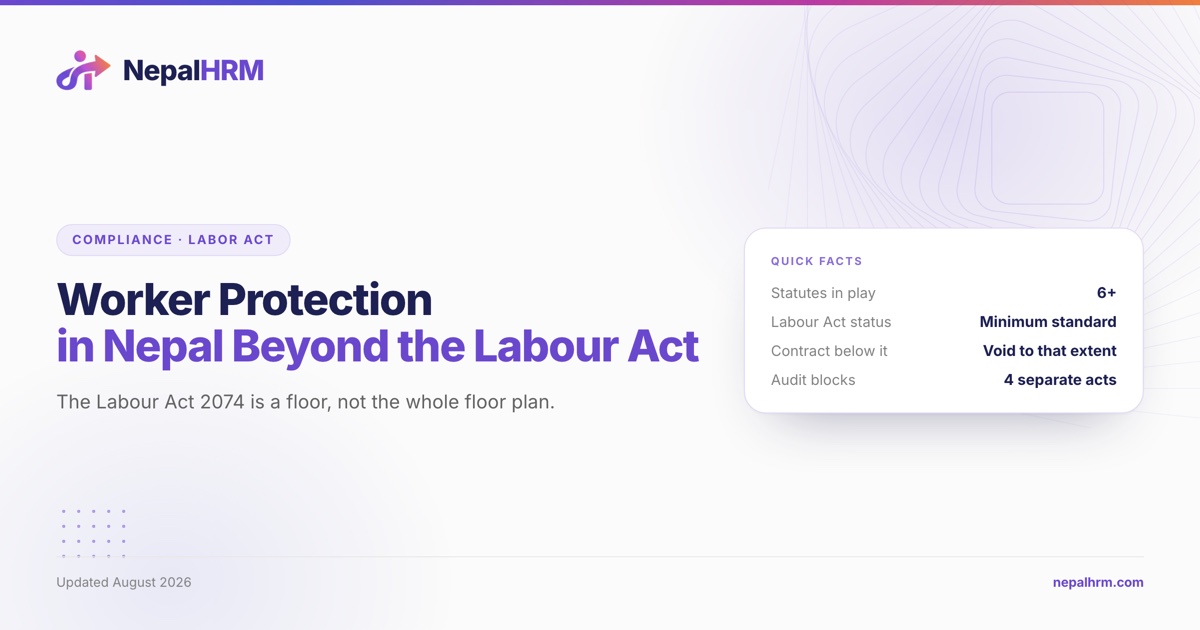
Section 3(1) of Nepal's Labour Act 2074 describes itself in five words: it stands as a minimum standard. Section 3(2) adds the enforcement: where an employment contract gives less remuneration or fewer benefits than the Act and its Rules provide, or runs contrary to its conditions, that contract is void to that extent.
A floor is not a floor plan. At least six statutes govern the ordinary Nepali employment relationship, and the government's own labour audit form asks about four of them by name. This piece maps the ones a Nepali employer actually has to satisfy, and sits under our complete guide to the Nepal Labour Act 2074.
Table of Contents
- The map, as the state draws it
- 1. Contribution Based Social Security Act 2074
- 2. Bonus Act 2030
- 3. Trade Union Act 2049
- 4. Occupational safety and health
- 5. Two insurances, and what replaces them
- 6. Prohibitions that are not about pay
- Where the Labour Act does not reach, and what fills the gap
- The obligations most Nepali employers have not documented
- Frequently asked questions
- Which laws govern employment in Nepal besides the Labour Act?
- Is the Labour Act 2074 a minimum standard?
- Who is excluded from the Labour Act 2074?
- Is insurance compulsory for employees in Nepal?
- When is a safety and health committee required in Nepal?
- What is the difference between bonus and festival expense in Nepal?
- Can an employment contract in Nepal give less than the Labour Act?
- Sources
The map, as the state draws it
The clearest evidence of what a Nepali employer is answerable for is not a commentary. It is Schedule 10 of the Labour Rules 2075, the labour audit report every enterprise must prepare under Section 100. After thirty rows on the Labour Act, the form opens three more blocks:
| Block on the form | What it asks |
|---|---|
| Contribution Based Social Security Act 2074 and its Rules | Is the enterprise registered with the Social Security Fund? Are contributions being deposited? |
| Bonus Act 2030 and Bonus Rules 2039 | Must the enterprise distribute bonus? Has it been distributed? Is last year's still outstanding? |
| Trade Union Act 2049 and Rules 2050 | Is there an enterprise-level trade union? Has the authorised trade union been elected? |
| Other matters | Is there a separate arrangement to audit whether the occupational safety and health policy is implemented? |
Our labour audit compliance checklist walks the whole form. What matters here is the framing: the compliance question is never only "does this satisfy the Labour Act".
1. Contribution Based Social Security Act 2074
The most consequential of the four, because it takes over duties the Labour Act itself imposes.
Section 57 of the Labour Act says an employer or worker contributing to a social security scheme that provides provident fund, gratuity and medical treatment insurance need not make a further contribution or arrange separate insurance under that chapter, to the extent the scheme covers it. Sections 52(2) and 53(2) already send the provident fund and gratuity into the Social Security Fund in the worker's own name.
The Social Security Act adds duties the Labour Act does not have:
- Enlistment. Section 20(1) requires a listed employer to enlist a person they appoint, or with whom an employment relation is established, within three months of that relation.
- A deposit deadline. Section 4(4), as amended in 2082, requires the contribution to reach the Fund within twenty-five days of the end of the month the contributable income relates to.
- A leaving notification. Section 24 requires the employer to inform the Fund within one month when a contributor leaves employment.
- Consequences. Section 9(1) recovers unpaid contributions with ten percent interest, and Section 9(4) lets the Fund ask other authorities to freeze bank accounts, freeze property, suspend licences and even withhold a passport.
Our employer's guide to SSF registration and guide to monthly SSF filing cover both processes.
2. Bonus Act 2030
Bonus is a share of profit, not a discretionary gift, and it is governed by its own Act rather than by the Labour Act. Ten percent of net profit is set aside for the bonus pool, eligibility turns on having worked at least half the year, individual entitlement is capped as a multiple of monthly salary, and the residual after distribution goes to welfare funds. Our annual bonus glossary entry sets out the mechanics.
Do not confuse it with festival expense under Section 37 of the Labour Act, which is one month's basic remuneration a year, paid at the worker's main festival or, absent a written request, at Bada Dashain, and pro-rated for anyone short of a year's service. Festival expense is owed whether or not the business made a profit. Bonus is not. See festival expense.
One cross-reference is easy to miss. Section 178(6) of the Labour Act keeps the welfare fund set up under Section 37 of the repealed Labour Act 2048 and Section 13 of the Bonus Act 2030 running as before, until separate social security law provides otherwise.
3. Trade Union Act 2049
Section 8 of the Labour Act gives every worker the right to form and join a trade union, subject to that Act and other law. The Trade Union Act 2049 supplies the machinery, and the labour audit asks two questions about it: whether an enterprise-level union exists, and whether the authorised union has been elected.
The Labour Act then builds on it in ways that bind employers regardless of union politics. Section 111 requires a labour relations committee in any enterprise with ten or more workers. Section 116 lets ten or more workers submit a collective claim. Section 145(2) requires notice of retrenchment to the authorised union, or failing that to the active union or the labour relations committee. And Section 171(2) excludes managerial-level staff from collective bargaining and strikes.
4. Occupational safety and health
Chapter 12 of the Labour Act is a statute inside a statute, and it is where most Nepali enterprises have the largest documented gap.
- Section 68: the employer must make and implement a safety and health policy. The audit asks about it, and asks separately whether it is itself audited.
- Section 69: the employer's duties to workers on occupational safety and health.
- Section 70: duties toward non-workers who come and go from the workplace.
- Section 74: a safety and health committee at any workplace with twenty or more workers, which the audit asks must meet and decide regularly.
- Section 75: protection from action for a worker who raised a safety concern.
- Section 76: the right to stop work in the face of imminent danger.
- Section 79: notify accidents at the workplace.
- Section 80: arrangements to control infectious disease.
- Section 81: lighter work for a pregnant worker on medical advice.
- Section 82: special provision for treating occupational disease.
Section 164(2) is the reason to take this chapter seriously. Where a wilful or negligent breach of an occupational safety and health provision causes death, dismemberment or lasting harm, the Labour Court may impose up to two years' imprisonment plus compensation, where prevailing law does not already provide a penalty. Section 164(3) adds that where an organised institution commits an offence carrying imprisonment, it is the chief executive who serves it.
5. Two insurances, and what replaces them
The Labour Act carries its own insurance mandate, and the figures are specific:
| Cover | Minimum | Who pays the premium | Section |
|---|---|---|---|
| Medical treatment insurance | NPR 100,000 a year | Half employer, half worker | 54 |
| Accident insurance, any kind of accident | NPR 700,000 | Entirely the employer | 55 |
Section 55(3): death or total physical or mental incapacity from an accident pays one hundred percent of the sum insured to the worker or their legal heir. Section 55(4) prorates it by the percentage of disability for partial incapacity. Section 56 is the sting: where the worker or their dependants cannot get the insurance money because the employer did not insure, or was negligent or in error in insuring, the employer pays the equivalent.
Section 173 lets the Ministry raise both figures by notice in the Gazette on the Council's recommendation, so these are floors that can move without the Act changing.
6. Prohibitions that are not about pay
Three provisions apply from the first day of employment and have no contribution, no threshold and no exemption.
Bonded labour. Section 4(1) prohibits engaging any worker in bonded labour, directly or indirectly, and the section's explanation defines it as making someone work against their will by showing fear of economic, physical or mental action. Section 164(1) lets the Labour Court impose up to two years' imprisonment or a fine up to NPR 500,000 or both, plus recovery of the worker's remuneration and double that as damages.
Child labour. Section 5 prohibits engaging children in any work contrary to law, and the Child Labour (Prohibition and Regularisation) Act 2056 supplies the detail. The labour audit asks directly whether anyone under eighteen is engaged and, if so, how and on what work.
Discrimination and equal pay. Section 6 prohibits discrimination on grounds including religion, colour, sex, caste, ethnicity, origin and language. Section 7 prohibits pay discrimination between workers on the ground of sex. Section 163(1)(c) fines discrimination up to NPR 100,000 and lets the Office order equality restored.
Sexual harassment. Section 132 of the Labour Act prohibits improper sexual conduct at the workplace or in the course of work, and the Sexual Harassment at Workplace (Prevention) Act 2071 sets out the wider framework and the complaint mechanism. Section 133 lets banks, financial institutions and certain other enterprises define misconduct further in their bye-laws.
Where the Labour Act does not reach, and what fills the gap
Section 180 is the boundary, and its structure is worth knowing because it answers "does this apply to us" more often than any other provision.
- 180(1)(a): the Act does not apply to the Nepali Army, Nepal Police, the Armed Police Force, or National Investigation.
- 180(1)(b): the civil service is governed by prevailing civil service law.
- 180(2): services constituted by special law, and special economic zones, follow that law where it states service terms and benefits.
- 180(3): where prevailing Nepal law says nothing about a worker's remuneration, service conditions or benefits, this Act applies automatically.
- 180(4): a decision, order or judgment holding that the Act does not apply must also state under which law the worker's rights and facilities are provided instead.
- 180(5): enterprises under the Working Journalists Act 2051 may bring themselves within this Act by contract.
Section 179 states the same principle generally: matters written in this Act and its Rules are governed by them, and everything else by prevailing law. Subsection 180(3) is the one to remember. The default is coverage, and the exclusions are specific.
The obligations most Nepali employers have not documented
Ranked by how often we see the row answered "no" on a first labour audit:
- A written occupational safety and health policy under Section 68.
- A safety and health committee under Section 74, at twenty or more workers, that actually meets.
- Bye-laws under Section 108, registered at the Labour Office and distributed to workers.
- A labour relations committee under Section 111, at ten or more workers.
- A performance evaluation system under Section 112, without which the Section 142 route to performance termination is unavailable.
- A sexual harassment complaint mechanism.
- Transport for female workers on shifts that begin before sunrise or end after sunset, under Section 33.
- SSF enlistment within three months of the employment relation starting.
None of these needs a lawyer to start. Each needs a document, an owner and a date.
Compliance is mostly evidence. NepalHRM keeps the employment record, the attendance behind the working-time rows, the leave actually taken, and the SSF or PF deposited per employee per month, so the answers to the audit exist before anyone asks for them. See how NepalHRM handles payroll and compliance, or book a walkthrough.
Frequently asked questions
Which laws govern employment in Nepal besides the Labour Act?
At least the Contribution Based Social Security Act 2074, the Bonus Act 2030, the Trade Union Act 2049, the Sexual Harassment at Workplace (Prevention) Act 2071, the Child Labour (Prohibition and Regularisation) Act 2056, and the Income Tax Act 2058 for withholding on salary. Schedule 10 of the Labour Rules 2075 asks about the first three by name.
Is the Labour Act 2074 a minimum standard?
Yes, expressly. Section 3(1) says the Act stands as a minimum standard on workers and matters relating to workers, and Section 3(2) makes an employment contract that provides less, or runs contrary to the Act's conditions, void to that extent.
Who is excluded from the Labour Act 2074?
Section 180(1) excludes the Nepali Army, Nepal Police, the Armed Police Force and National Investigation, and puts the civil service under civil service law. Section 180(3) then applies the Labour Act automatically wherever no other prevailing law addresses a worker's remuneration, service conditions or benefits.
Is insurance compulsory for employees in Nepal?
Yes. Section 54 requires medical treatment insurance of at least NPR 100,000 a year, with the premium split equally between employer and worker. Section 55 requires accident insurance of at least NPR 700,000 covering any kind of accident, with the employer paying the entire premium. Section 57 relieves an employer of these to the extent a social security scheme covers them.
When is a safety and health committee required in Nepal?
At any workplace where twenty or more workers work, under Section 74 of the Labour Act 2074. The labour audit form asks not only whether it is formed but whether it meets and takes decisions regularly.
What is the difference between bonus and festival expense in Nepal?
Festival expense is one month's basic remuneration a year under Section 37 of the Labour Act, owed regardless of profit and pro-rated for service under a year. Bonus is a share of net profit under the Bonus Act 2030, and it exists only where there is a profit to share.
Can an employment contract in Nepal give less than the Labour Act?
No. Section 3(2) deems a contract that provides less remuneration or fewer benefits than the Act and Rules, or that runs contrary to the Act's conditions, to be contrary to the Act, and it is void to that extent.
Sources
- Labour Act, 2074 (2017), consolidated Nepali text as amended through 2082, Nepal Law Commission: lawcommission.gov.np. Sections 3 to 8, 33, 37, 52 to 57, 68 to 82, 100, 108, 111, 112, 132, 133, 163, 164, 171, 173, 178, 179 and 180 were read from that text, retrieved 2026-08-06.
- Labour Rules, 2075 (2018), Nepali text: ssf.gov.np. Rule 56 and Schedule 10 were read from that text, retrieved 2026-08-06.
- Contribution Based Social Security Act, 2074 (2017), consolidated Nepali text as amended through 2082, published by the Social Security Fund: ssf.gov.np. Sections 4, 9, 20 and 24 were read from that text, retrieved 2026-08-06.
Related reading: Nepal Labour Act 2074: the complete guide · Labour audit compliance checklist · Employment types in Nepal