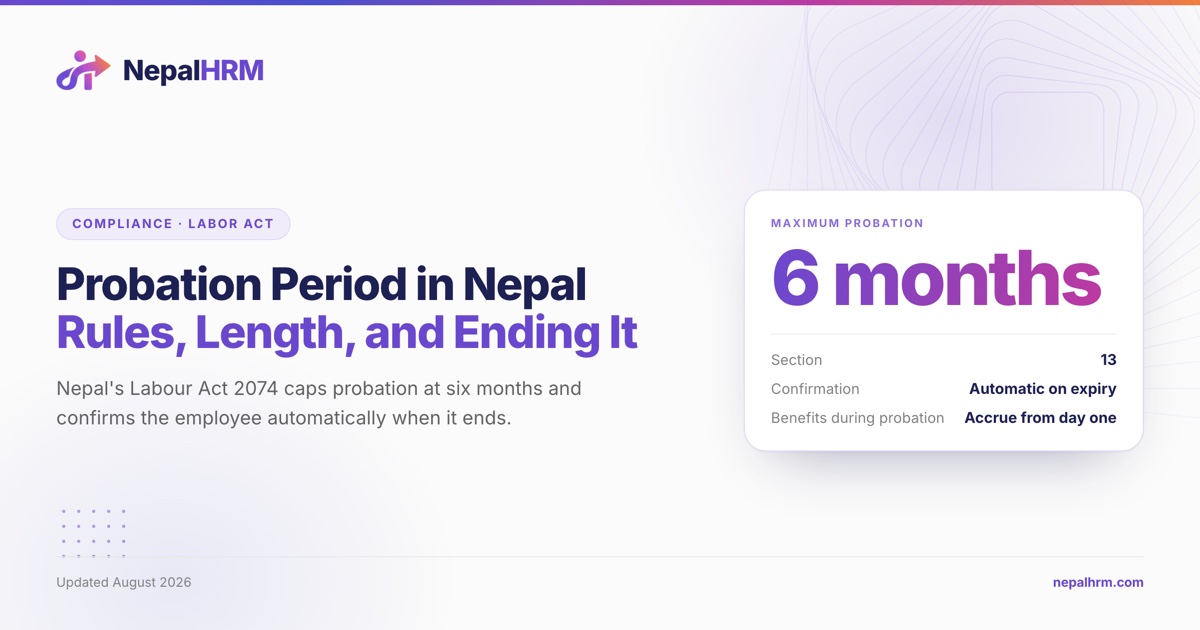
Nepal's Labour Act 2074 allows a probation period of up to six months, and when it ends without the contract being terminated, the employment relation is automatically confirmed. No confirmation letter is needed for that to happen, which means an employer who forgets to send one has still confirmed the employee.
Section 13, parikshyankaal sambandhi vyavastha (परीक्षणकाल सम्बन्धी व्यवस्था), is one short paragraph. Most of what Nepali HR practice believes about probation is not in it. This guide separates the two, and sits under our complete guide to the Nepal Labour Act 2074.
Table of Contents
- What Section 13 actually says
- The date probation runs from
- What a probationer is entitled to
- Ending a contract during probation
- What probation does not suspend
- Probation and the type of employment
- A probation policy that holds up
- Frequently asked questions
- What is the maximum probation period in Nepal?
- Can a probation period be extended in Nepal?
- Does an employee need a confirmation letter after probation?
- Do employees get PF and leave during probation in Nepal?
- Can an employer terminate an employee during probation in Nepal?
- What notice is required to end employment during probation?
- What is probation period called in Nepali?
- Sources
What Section 13 actually says
The whole provision reads, in substance: while making an employment contract with a worker, the employer may make it so the worker remains on probation for six months; if the worker's work is not found satisfactory during probation, the employer may terminate that employment contract; and where the contract is not so terminated, the employment relation is deemed automatically confirmed on the expiry of the probation period.
Four rules come out of that one sentence.
Probation belongs in the contract. It is created "while making an employment contract". A probation clause announced after joining, in an appointment letter that follows the start date, or in an internal policy the employee never signed, is on weak ground. Section 11(1) already prohibits engaging anyone without an employment contract, and Section 11(3) requires the contract to state remuneration, benefits and the terms of employment.
Six months is a maximum, not a default. Nothing in the Act obliges an employer to use six. A one-month or three-month probation is perfectly lawful and is often the better commercial choice.
There is no extension. The Act contains no mechanism for extending probation, and none for a second probation on the same employment. An "extended probation" letter in month seven is asking an employee to give up a confirmation the Act has already given them.
Confirmation happens by silence. The words are swatah sadar (स्वतः सदर), automatically confirmed. Confirmation is the default outcome, and termination is the exception you have to actively exercise inside the window.
The date probation runs from
Section 12(1) fixes when the employment relation starts, and it is not always the date on the letter. The relation is established from whichever comes first: the employer making an employment contract with the worker, giving employment orally, or, in casual employment, the date or time the worker started work or provided the service.
That matters because probation is counted from the establishment of the relation, not from the date HR processed the paperwork. A worker who started on the floor two weeks before the contract was signed has two weeks of probation already spent.
Section 12(4) sharpens it further. Where a dispute arises about whether an employment relation exists, the Labour Office may order the employer to produce records, and failure to produce them means the relation is presumed to exist. The burden sits with the employer, and it is discharged with documents.
What a probationer is entitled to
The common belief that probationers get "no benefits until confirmation" does not survive a read of the Act.
| Entitlement | From when | Section |
|---|---|---|
| Provident fund, 10% deducted and matched | The day work starts | 52(2) |
| Gratuity, 8.33% of basic a month | The day work starts | 53(2) |
| Home leave, 1 day per 20 worked | Immediately, by accrual | 43(1) |
| Sick leave, 12 days a year | Pro-rated below a year | 44(1) |
| Weekly and public leave | Immediately | 40, 41 |
| Medical insurance, at least NPR 100,000 a year | On employment | 54(1) |
| Accident insurance, at least NPR 700,000 | On employment | 55(1) |
| Remuneration and benefits | The date work is commenced | 34(1) |
Sections 52(2) and 53(2) are explicit that the contribution applies "from the very day the concerned labour commenced the work". Where the employer contributes to the Social Security Fund instead, Section 57 says the same amounts go there and no separate arrangement is needed. Either way there is no waiting period.
Two things genuinely are tied to service length rather than to confirmation, and both are worth knowing because they are often confused with probation:
- Annual grade increment under Section 36 arrives on completing one year of service, at not less than half a day's basic remuneration.
- Festival expense under Section 37 is one month's basic a year, pro-rated for anyone who has not completed a year by the payment date. See festival expense.
Neither turns on whether the worker is confirmed. Both turn on time served.
Ending a contract during probation
Section 13 permits termination where the work "is not found satisfactory during the probation period". That is a genuinely lower bar than the one for a confirmed employee, and the contrast is the whole commercial value of probation:
| Probationer, §13 | Confirmed employee, §142 | |
|---|---|---|
| Ground | Work not found satisfactory | Performance unsatisfactory or below standard |
| Evidence needed | The employer's assessment | Three consecutive unsatisfactory performance evaluations |
| Process | Terminate the contract inside the window | Evaluation must have been carried out per the rules or bye-laws first |
| Show-cause | Not required by §13 | At least 7 days where 10 or more workers are employed, §142(3) |
Section 139(2) still applies across both: where employment is terminated, "reasonable and sufficient cause" must be disclosed. A probation termination that states no reason is a termination with no recorded cause, whatever section it cites.
And Section 144 notice applies to a probationer exactly as it applies to anyone else, because that section excludes only terminations that follow action for misconduct:
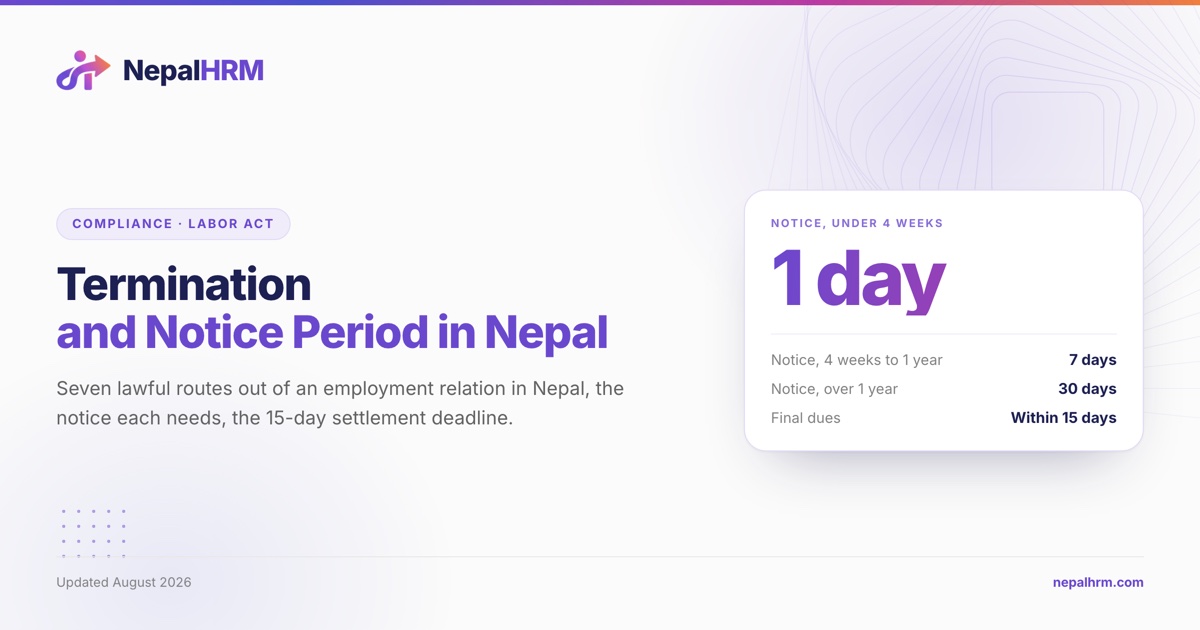
- Up to four weeks of employment: at least one day before.
- Four weeks to one year: at least seven days before.
- More than one year: at least thirty days before.
Under Section 144(2), an employer who terminates without that notice owes remuneration for the notice period. So terminating a five-month probationer with no notice costs seven days' pay, not nothing. Our guide to termination and notice periods in Nepal covers the full set of routes.
What probation does not suspend
Misconduct. A probationer who commits misconduct is dealt with under Sections 130 to 138 like anyone else: an opportunity to defend with a seven-day deadline under Section 135, action started within two months of the conduct coming to knowledge and decided within three months under Section 137.
Discrimination and equal pay. Sections 6 and 7 apply from the first day.
Occupational safety and health. Chapter 12 duties do not have a probation carve-out.
Working hours and overtime. Sections 28 to 31 apply in full. A probationer working ten hours is working two hours of overtime at 1.5 times basic, the same as a confirmed colleague. See overtime rules in Nepal.
Probation and the type of employment
Probation makes sense for regular employment, where the relation is open-ended and confirmation means something. It makes much less sense on a four-month time-based contract, where Section 140(a) already ends the employment when the stated period expires.
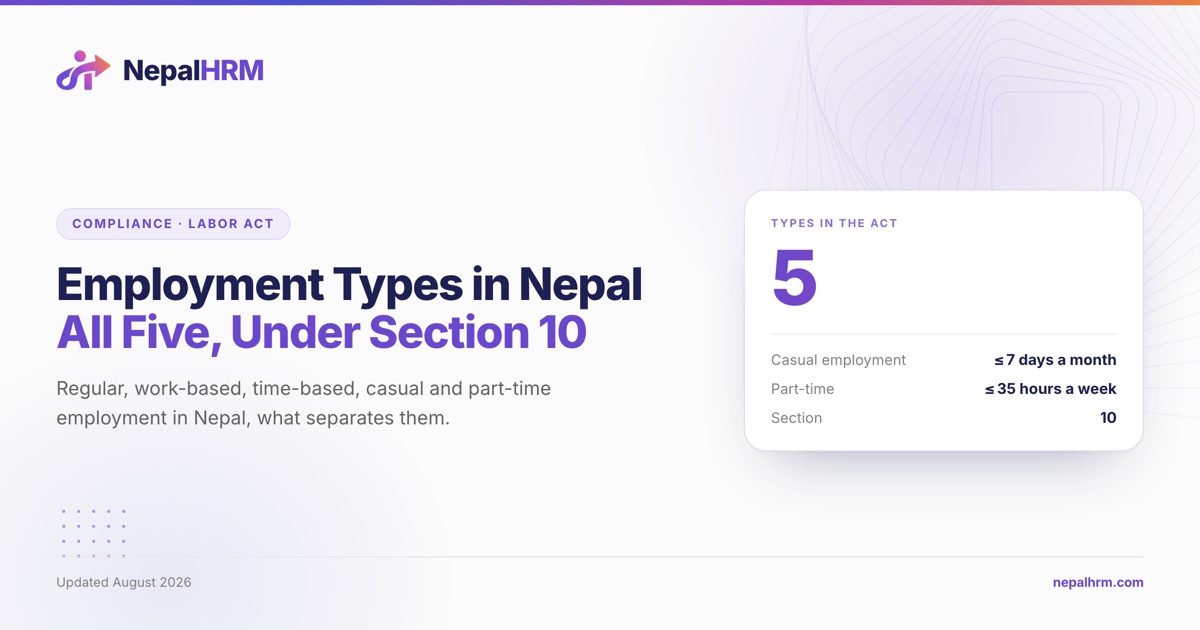
Putting a six-month probation on a three-month contract creates a probation that outlives the job. Our guide to employment types in Nepal sets out all five categories in Section 10 and which one to use when.
A probation policy that holds up
- Put the probation period in the employment contract, signed before or on the start date.
- Set a realistic length. Six months is the ceiling, not the recommendation.
- Diarise the expiry date, because confirmation happens with or without you.
- Assess before the window closes, not after. There is no lawful extension.
- Give Section 144 notice even during probation, or pay for it.
- State a reason on any termination, per Section 139(2).
- Run PF or SSF, leave accrual and both insurances from day one.
- Do not use probation as a discipline route. Misconduct has its own chapter.
Most probation disputes are date disputes. NepalHRM holds the joining date, the probation end date and the confirmation on the employee record, applies leave policies that can differ for probation staff, and starts statutory deductions from the first payroll rather than from confirmation. See how employee management works, or book a walkthrough.
Frequently asked questions
What is the maximum probation period in Nepal?
Six months. Section 13 of the Labour Act 2074 allows an employer, when making the employment contract, to place the worker on probation for six months. A shorter period is lawful; a longer one is not.
Can a probation period be extended in Nepal?
The Act provides no mechanism for it. Section 13 says the employment relation is deemed automatically confirmed once the probation period expires without the contract being terminated, so an extension offered after that point asks the employee to surrender a confirmation the law has already made.
Does an employee need a confirmation letter after probation?
No. Confirmation under Section 13 is automatic on expiry of the probation period. A letter is good practice and good record-keeping, but the employment relation is confirmed whether or not one is issued.
Do employees get PF and leave during probation in Nepal?
Yes. Sections 52(2) and 53(2) apply the provident fund and gratuity contributions from the very day the worker commences work, and leave accrues under Sections 43 and 44 from the start of service. There is no waiting period tied to confirmation.
Can an employer terminate an employee during probation in Nepal?
Yes, where the work is not found satisfactory during probation, under Section 13. Section 139(2) still requires reasonable and sufficient cause to be disclosed, and Section 144 notice still applies: one day up to four weeks of service, seven days from four weeks to a year.
What notice is required to end employment during probation?
One day for the first four weeks of employment and seven days after that, under Section 144(1). Section 144(2) makes an employer who skips the notice liable for the remuneration of the notice period.
What is probation period called in Nepali?
Parikshyankaal (परीक्षणकाल). Section 13 of the Labour Act 2074 is headed parikshyankaal sambandhi vyavastha, the provision relating to the probation period.
Sources
- Labour Act, 2074 (2017), consolidated Nepali text as amended through 2082, Nepal Law Commission: lawcommission.gov.np. Sections 11, 12, 13, 34, 36, 37, 43, 44, 52, 53, 54, 55, 135, 137, 139, 142 and 144 were read from that text, retrieved 2026-08-06.
Related reading: Nepal Labour Act 2074: the complete guide · Employment types in Nepal · Termination and notice period in Nepal