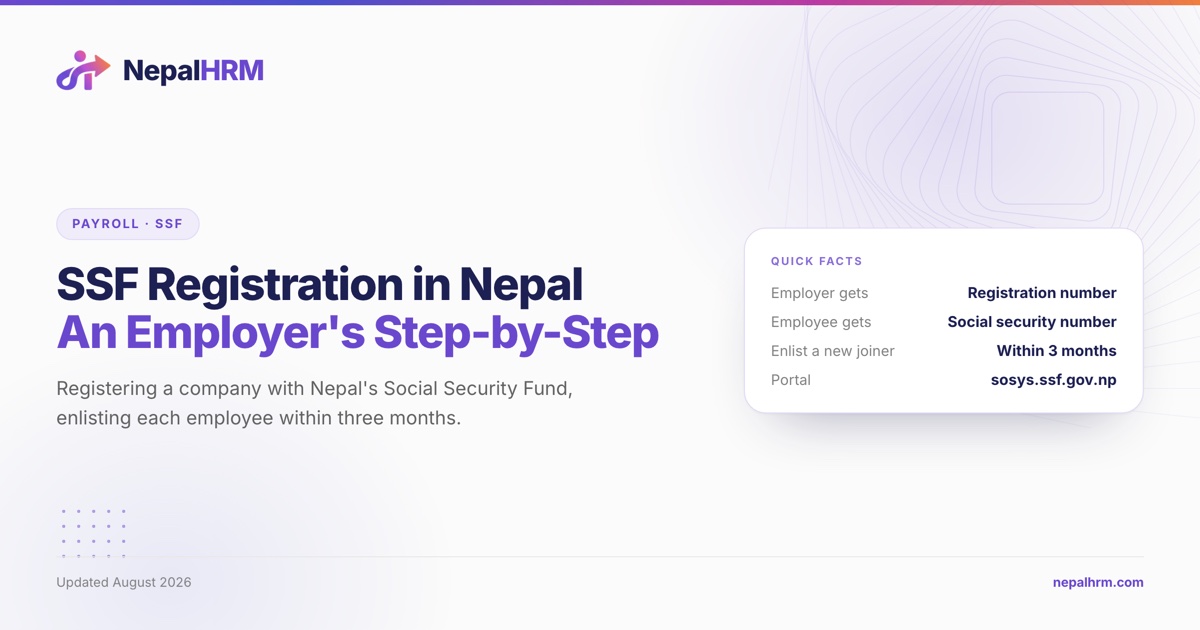
Registering with Nepal's Social Security Fund is two steps, not one. The company gets a registration number under Section 19 of the Contribution Based Social Security Act 2074, and then every employee has to be separately enlisted and issued their own social security number under Sections 20 and 41. Section 22(1) treats an employer and a contributor as listed only once both numbers exist.
Companies that stop after step one show up in the Fund's records as registered and non-contributing, which is precisely the state the labour audit form asks about in two separate questions. This guide walks both steps. For what the contribution costs, our SSF contribution calculator puts a number on any basic salary.
Table of Contents
- Step 1: register the employer
- Step 2: enlist every employee
- What happens when you do not
- Registered is not the same as compliant
- What registration changes in your payroll
- The duties that continue after registration
- A registration checklist
- Frequently asked questions
- How do I register my company for SSF in Nepal?
- Is SSF registration compulsory for employers in Nepal?
- How long do I have to enlist a new employee in SSF?
- What happens if an employer does not register employees in the SSF?
- What is the difference between the SSF registration number and the social security number?
- Does an SSF-registered company still deduct provident fund?
- What is the penalty for not obeying an SSF order?
- Sources
Step 1: register the employer
Section 19 sets the mechanism. The Ministry, on the Committee's recommendation, publishes a notice in the Nepal Gazette requiring employers running industries, services, businesses or transactions of a specified area and nature to be listed within the period Section 20 sets. The employer then applies to the Fund's office, with the prescribed particulars, in the prescribed format, and the Fund lists the employer and issues a registration number in the prescribed form.
In practice that application is made through the Fund's employer portal at sosys.ssf.gov.np, which carries a separate employer login and a contributor login. The Fund's own public page titled "what documents are required to be listed" is currently a placeholder with no content on it, so the operative document list is the one the portal asks for at the time you apply, and the Fund's listing support desk (reg@ssf.gov.np, and the listing line published on ssf.gov.np) is the right place to confirm it rather than a third-party blog. We are deliberately not publishing a document checklist we cannot source from the Fund.
What the Act does fix is the timing. Section 20(1) required employers already operating when the Act commenced to be listed within six months of commencement. That window closed years ago, which means an unregistered employer today is not early, it is late.
Step 2: enlist every employee
Section 20(1) also carries the ongoing duty, and this is the one that keeps slipping. A listed employer must, within three months of establishing an employment relation with a person they appoint or engage, get that person listed with the Fund.
Three months is generous, and it is also a trap: a company that batches enlistment quarterly will routinely have joiners at month two and month three whose contributions have not started. Section 4(2) says contributions run from the day the worker was listed to the last day they remain in employment, so a late enlistment is not neutral. It is a gap in the employee's contribution record, and contribution records are what benefit eligibility is built on.
Section 20(6) closes the loop: a worker listed under this section is given a social security number under Section 41.
What happens when you do not
The Act does not rely on goodwill here, and the enforcement ladder is unusually concrete.
The employee can go around you. Section 20(2): where the employer has not listed a worker within the period, that worker may apply to the Fund directly. Section 20(3): on such an application, or on any other information that a covered employer has not listed itself or its workers, the Fund may set a period and order the employer to do it. Section 20(4) makes compliance with that order the employer's duty.
Back-contributions run from the start of the relationship. Section 17(1) lets the Executive Director order an employer who is unlisted, has not listed its workers, or has not deposited on time to:
- register with the Fund immediately and enlist its workers;
- deposit the contributions payable from the date the employment relation was established, together with the interest under Section 9; or
- where the employment relation has already ended, pay the worker the equivalent of the benefits they should have received, within the prescribed period.
Section 17(2): if the employer does not pay the worker under (3), the Fund recovers it and pays the worker itself.
The interest is ten percent. Section 9(1): where a listed employer does not deposit within the Section 4 period, the Fund recovers the contribution with ten percent interest. Section 9(2) allows an employer to apply within thirty days explaining a genuinely uncontrollable circumstance, and Section 9(3) lets the Fund waive the interest partly or wholly.
And the recovery powers are not ordinary. Section 9(4) lets the Executive Director write to the relevant authorities to freeze bank accounts, freeze movable and immovable property, suspend legal concessions, suspend licences and permits, and withhold the person's passport. Section 9(5) requires the receiving authority to begin the process within fifteen days. Section 56 makes anything the Fund is owed recoverable as government dues.
The uninsured gap is the employer's. Section 9(6) is the one that should end the debate internally: where the employer has not deposited and an accident or death occurs during that period, the employer must provide the worker the equivalent of the benefit the Act would have given.
Registered is not the same as compliant
Schedule 10 of the Labour Rules 2075, the labour audit report every enterprise prepares under Section 100 of the Labour Act, asks two separate questions in its social security block:
- Is the enterprise registered with the Social Security Fund?
- Are contributions actually being deposited?
They are separate because the answers routinely differ. Our labour audit compliance checklist covers the whole form, and our guide to monthly SSF filing covers the deposit deadline, which the 2082 amendment moved to twenty-five days after the month ends.
What registration changes in your payroll
Enrolment is not an additional deduction on top of the old scheme. It is a replacement.
| Outside the SSF | Inside the SSF | |
|---|---|---|
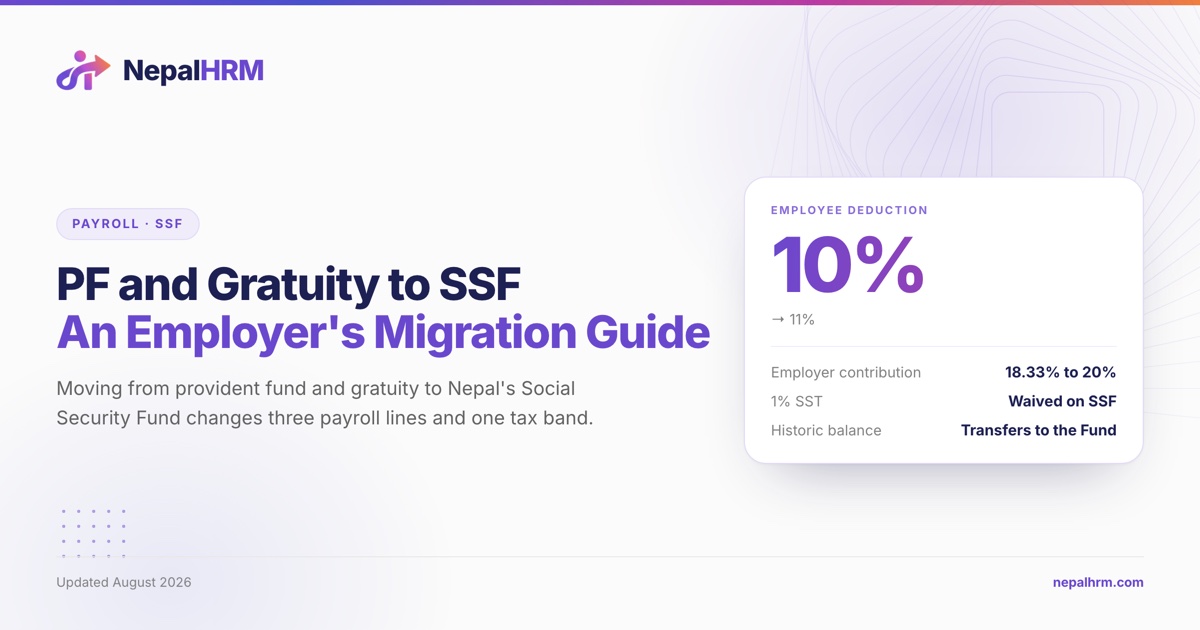
| Employee deduction | Provident fund 10% of basic | SSF 11% of basic |
| Employer contribution | PF 10% + gratuity 8.33% of basic | SSF 20% of basic |
| Medical insurance, §54 | Arranged separately, NPR 100,000 minimum | Covered by the scheme, per §57 |
| Accident insurance, §55 | Arranged separately, NPR 700,000 minimum | Covered by the scheme, per §57 |
| 1% social security tax on the first band | Charged | Waived |
Section 57 of the Labour Act is what makes the right-hand column lawful: an employer or worker contributing to a social security scheme providing provident fund, gratuity and medical treatment insurance need not make a further contribution or arrange separate insurance under that chapter, to the extent the scheme covers it. A company running SSF and a separate PF deduction is deducting twice. Our PF and gratuity to SSF migration guide covers the switch month by month, and gratuity in Nepal explains where the 8.33% went.
See the Social Security Fund and provident fund for the terms.
The duties that continue after registration
Registration is the start of a standing relationship with the Fund, not a one-off filing.
- Deposit monthly. Section 4(3): contributions are deposited monthly, pro-rated where a full month is not due.
- Deposit on time. Section 4(4), as amended in 2082: within twenty-five days of the end of the month the contributable income relates to.
- Cover unpaid months. Section 8(1): where a worker receives no remuneration and so cannot make their own contribution, the employer deposits the worker's share for up to three months, and Section 8(2) lets the employer recover it later from that worker's pay, allowances or benefits as prescribed.
- Report leavers. Section 24: when a contributor leaves employment for any reason, the employer informs the Fund within one month.
- Keep the registration alive. Section 25(1): the registration number ceases where a listed employer is dissolved, goes into liquidation, or becomes insolvent.
Section 24 is the quiet one. An employer that never reports leavers accumulates a contributor list longer than its headcount, and every month-end reconciliation after that fails for a reason nobody can find.
A registration checklist
- Confirm whether the Gazette notice under Section 19 covers your industry and area.
- Apply through the employer portal at sosys.ssf.gov.np and record the registration number.
- Enlist every employee, and record each social security number on their employee file.
- Set the enlistment trigger at joining, not at the quarter end. Three months is the deadline, not the plan.
- Switch payroll to 11% employee, 20% employer of basic, and stop the separate PF deduction.
- Stop separate §54 and §55 insurance policies only to the extent the scheme covers them, per Section 57.
- Diarise the twenty-five day deposit deadline.
- Report leavers within one month, per Section 24.
- Reconcile the Fund's contributor list against your headcount every month end.
Registration is a form; the contribution is every month, forever. NepalHRM calculates the 11% employee and 20% employer SSF on each employee's basic automatically on every payroll run, shows both sides on the payslip, and prepares the deposit figures. See how payroll works, or book a walkthrough.
Frequently asked questions
How do I register my company for SSF in Nepal?
Apply to the Social Security Fund with the prescribed particulars in the prescribed format under Section 19(2) of the Contribution Based Social Security Act 2074, through the Fund's employer portal at sosys.ssf.gov.np. The Fund then lists the employer and issues a registration number under Section 19(3).
Is SSF registration compulsory for employers in Nepal?
For employers covered by the Ministry's Gazette notice under Section 19(1), yes. Section 20(1) required employers already operating at the Act's commencement to be listed within six months, and the labour audit form under the Labour Rules 2075 asks every enterprise whether it is registered with the Fund.
How long do I have to enlist a new employee in SSF?
Three months from the date the employment relation is established, under Section 20(1). Contributions then run from the day the worker is listed to the last day of their employment, under Section 4(2).
What happens if an employer does not register employees in the SSF?
The employee may apply to the Fund directly under Section 20(2). The Fund can order registration and enlistment, and order back-contributions from the date the employment relation started plus ten percent interest, under Sections 17 and 9. Section 9(6) also makes the employer personally liable for the equivalent of any benefit an unlisted worker would have received had an accident or death occurred in that period.
What is the difference between the SSF registration number and the social security number?
The registration number is issued to the employer under Section 19(3). The social security number is issued to each contributor under Sections 20(6) and 41. Section 22(1) treats both parties as listed with the Fund only once both numbers have been issued.
Does an SSF-registered company still deduct provident fund?
No. Section 57 of the Labour Act 2074 relieves an employer contributing to a social security scheme that covers provident fund, gratuity and medical treatment insurance from making those contributions separately. Running SSF and a separate PF deduction together deducts twice.
What is the penalty for not obeying an SSF order?
Up to NPR 50,000, under Section 51 of the Contribution Based Social Security Act 2074. A person dissatisfied with an order or decision of the Fund may appeal to the Labour Court within thirty-five days, under Section 52 as amended in 2082.
Sources
- Contribution Based Social Security Act, 2074 (2017), consolidated Nepali text as amended through 2082, published by the Social Security Fund: ssf.gov.np. Sections 3, 4, 8, 9, 17, 19 to 25, 41, 51, 52 and 56 were read from that text, retrieved 2026-08-06.
- Labour Act, 2074 (2017), Nepal Law Commission: lawcommission.gov.np. Sections 52 to 57 and 100, retrieved 2026-08-06.
- Labour Rules, 2075 (2018), Schedule 10 labour audit report: ssf.gov.np, retrieved 2026-08-06.
- Employer and contributor portals at sosys.ssf.gov.np, linked from ssf.gov.np, checked 2026-08-06.
Related reading: Monthly SSF filing in Nepal · PF and gratuity to SSF: a migration guide · SSF contribution calculator