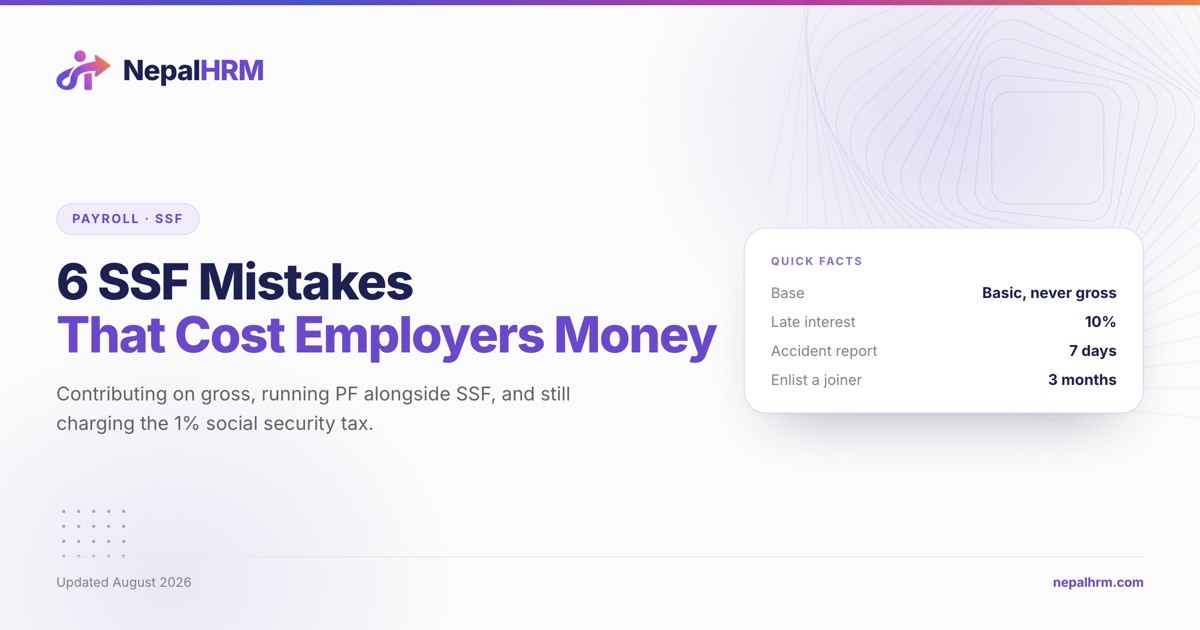
Every SSF error we see in Nepali payroll is one of six, and five of them cost money in a direction nobody intended: two overpay, two underpay into penalties, and one quietly over-withholds tax from employees. None of them is exotic, and each has a number attached.
The figures below are generated from lib/nepal-payroll.ts, the module behind this site's calculators, on FY 2083/84 slabs. For your own numbers, the SSF contribution calculator takes any basic salary.
Table of Contents
- 1. Contributing on gross instead of basic
- 2. Running provident fund alongside SSF
- 3. Still charging the 1% social security tax
- 4. Enlisting employees late, or in batches
- 5. Missing the deposit deadline, and then missing the relief window
- 6. Not reporting an employment accident within seven days
- Three more worth checking
- Frequently asked questions
- Is SSF deducted on basic or gross salary in Nepal?
- Can a company deduct both PF and SSF in Nepal?
- Do SSF contributors pay the 1% social security tax?
- How late can an SSF contribution be before interest applies?
- What happens if an employer does not report a workplace accident to the SSF?
- Does an employer have to tell the SSF when an employee leaves?
- What is the penalty for not depositing SSF contributions in Nepal?
- Sources
1. Contributing on gross instead of basic
Section 25 of the Social Security Scheme Operation Procedure 2075 is unambiguous: the employer deducts 11 percent of the worker's basic remuneration and adds 20 percent of the same basic.
A Nepali salary structure splits gross into basic plus allowance, commonly at around 60/40. Contribute on gross at that ratio and you deposit 1.67 times what is due.
| On a gross of NPR 50,000, basic NPR 30,000 | Correct | On gross |
|---|---|---|
| Employee share, 11% | 3,300 | 5,500 |
| Employer share, 20% | 6,000 | 10,000 |
| Total deposited | 9,300 | 15,500 |
| Excess a month | 6,200 |
Across fifty employees on that structure, the mistake costs NPR 3.7 million a year, of which more than a third comes out of employees' take-home. It is also hard to unwind, because a deposited contribution is not an easy thing to reverse.
How to check: take one payslip and divide the SSF deduction by 11%. The answer should be the basic on that same payslip, not the gross. See basic salary and gross salary for why the two are separate legal terms.
2. Running provident fund alongside SSF
Section 57 of the Labour Act 2074 says an employer or worker contributing to a social security plan that provides provident fund, gratuity and medical treatment insurance need not make a further contribution, or arrange separate insurance, under that chapter, to the extent the plan covers it.
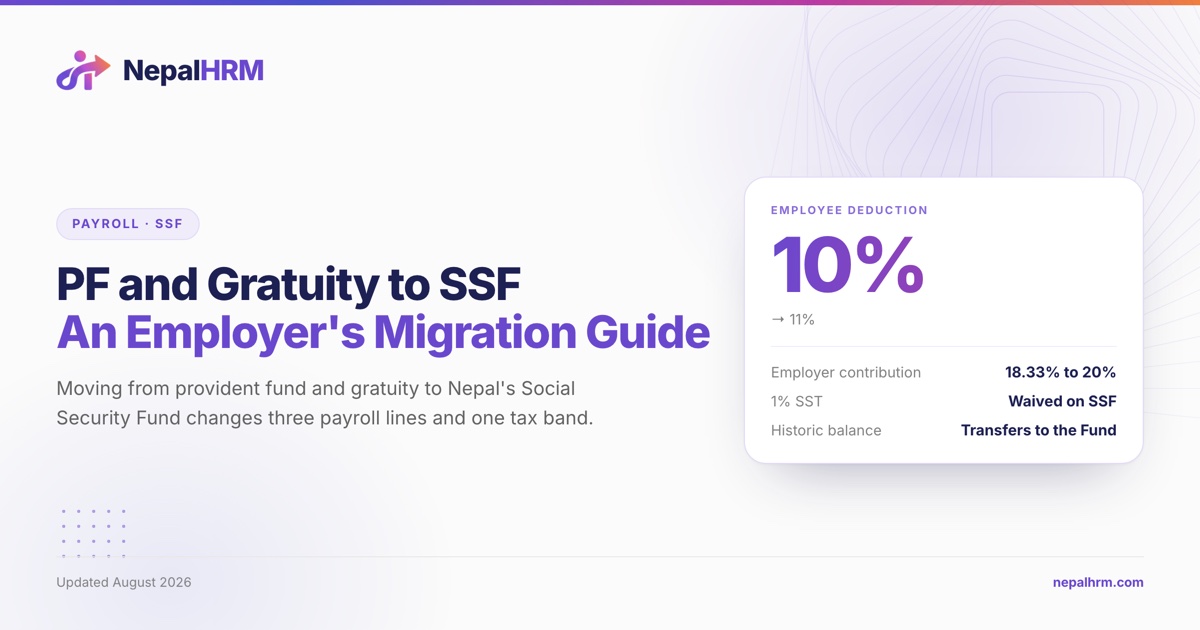
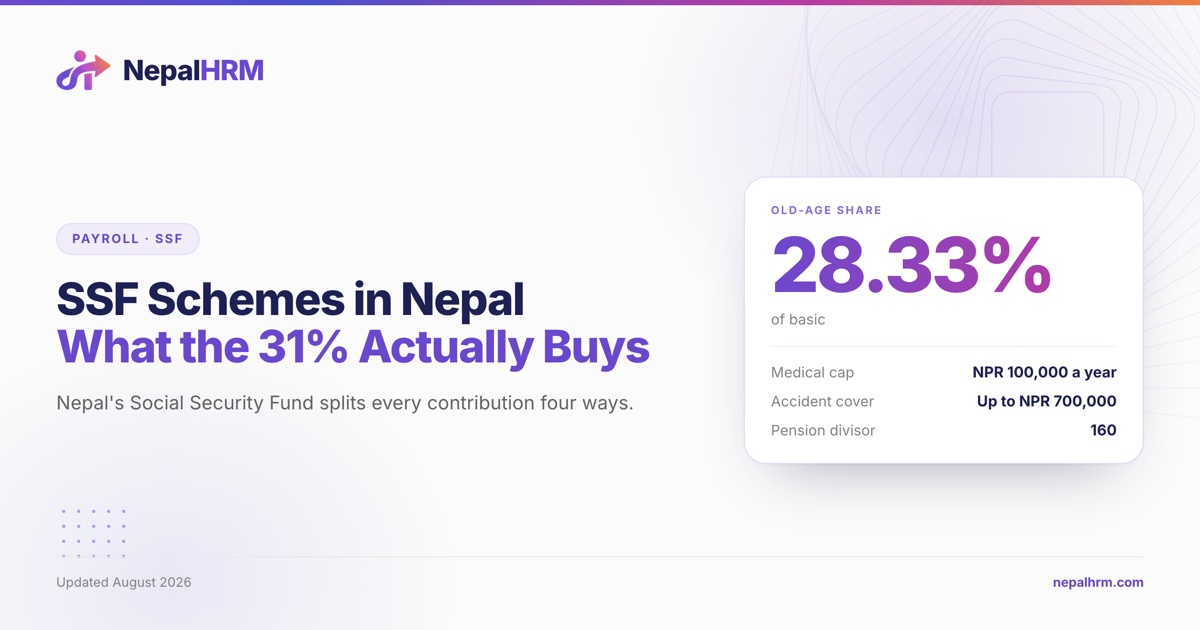
The old-age protection share is not a coincidence. Section 19(1) of the operating procedure describes the scheme as being run from the employer's 10% provident fund plus 8.33% gratuity, being 18.33%, and the worker's 10% provident fund contribution, totalling 28.33%. That is exactly Sections 52(1) and 53(1) of the Labour Act, restated as a contribution. Our guide to gratuity in Nepal works through the arithmetic.
So an employee enrolled in the SSF who still carries a 10% PF deduction is paying twice for the same entitlement.
| On a basic of NPR 30,000 | |
|---|---|
| Wrongly deducted PF, 10% of basic | 3,000 a month |
| Over twelve months | 36,000 |
| Employer's duplicated 10% match | another 36,000 |
How to check: open one payslip of an enrolled employee and count the retirement lines. There should be one.
3. Still charging the 1% social security tax
The first income-tax band in Nepal is a 1% social security tax. An SSF contributor is exempt from it, because the SSF contribution already funds what that band pays for. Every band above the first is charged normally.
An employer that enrolled in the SSF but never turned the band off in payroll goes on withholding tax the employee does not owe. On FY 2083/84 slabs the first band runs to NPR 1,000,000 of taxable income, so the maximum over-withholding is NPR 10,000 a year per employee.
| Gross | Monthly TDS with the 1% band | Monthly TDS as an SSF contributor | Over-withheld a year |
|---|---|---|---|
| 33,333 | 313 | 0 | 3,760 |
| 50,000 | 470 | 0 | 5,640 |
| 83,333 | 783 | 0 | 9,400 |
| 166,667 | 11,333 | 10,300 | 12,400 |
The money is not lost to the employee forever, since it is a withholding rather than a charge, but it depresses take-home all year and it makes the payslip wrong. See social security tax and check your own case in the salary tax calculator.
4. Enlisting employees late, or in batches
Section 20(1) of the Contribution Based Social Security Act 2074 gives an employer three months from the establishment of the employment relation to enlist a new joiner. Section 4(2) then runs contributions from the day the worker is listed, not from the day they joined.
Three months reads as slack. It is not, because every SSF entitlement is measured in months of regular contribution:
| Benefit | Contribution required |
|---|---|
| Medical, health and maternity protection | 3 of the previous 6 months |
| Dependent family protection, non-accidental death | 12 months |
| Fatal-disease treatment, up to NPR 1,000,000 | 24 of the previous 28 months |
| Enhanced hospital benefit, 50% of costs above NPR 100,000 | 60 months |
| Old-age pension | 180 months |
A batch-enlistment habit shifts every one of those dates for every joiner. And Section 20(2) lets the employee apply to the Fund directly when it is not done, which turns an internal process gap into a regulatory file. Our guide to the SSF schemes sets out what each qualifying period buys.
How to check: compare joining dates to enlistment dates for the last twelve months of hires. If the gap is ever more than a few days, the trigger is in the wrong place.
5. Missing the deposit deadline, and then missing the relief window
Section 4(4), as amended in 2082, requires the contribution to reach the Fund within twenty-five days of the end of the month the contributable income relates to. Content still publishing fifteen days is not describing the current provision.
Late payment is not simply a fine:
- Section 9(1): the Fund recovers the contribution with ten percent interest.
- Section 9(2): the employer may apply within thirty days, stating the reason and grounds, where circumstances beyond its control caused the delay.
- Section 9(3): the Fund may then waive that interest wholly or partly.
- Section 9(4): the Executive Director may write to authorities to freeze bank accounts and property, suspend concessions, suspend licences and permits, and withhold a passport.
- Section 9(6): where an accident or death occurs in a period whose contributions were not deposited, the employer provides the benefit equivalent itself.
- Section 163(2)(d), Labour Act: the Labour Office may separately order recovery of the unpaid amount plus double as damages.
The thirty-day window in Section 9(2) is the one that gets missed. Relief for a genuine cash-flow failure is available, but it is an application with reasons, made inside a month, not a conversation held later. Our guide to monthly SSF filing covers the full cycle.
6. Not reporting an employment accident within seven days
This one costs the employee rather than the employer, which is why it survives so long unnoticed.
Section 11(1) of the operating procedure covers all costs of treatment for an employment-related accident or an occupational disease. Section 11(1क) attaches a duty: the employer, the contributor, or a member of the contributor's family must inform the Fund within seven days. It can be done through the Fund's system, by phone, or by message or email quoting the social security number.
Section 11(1ख) supplies the consequence. Where the Fund was not informed and the treatment took place at a hospital that has no agreement with the Fund, costs above NPR 700,000 are not borne by the Fund.
Seven days, an email, a social security number. There is no version of this that is worth getting wrong.
How to check: does your accident procedure name the Fund at all? Most Nepali workplace-accident checklists stop at the hospital and the insurer.
Three more worth checking
Not reporting leavers. Section 24 requires the employer to inform the Fund within one month when a contributor leaves. Skip it and the Fund's contributor list drifts above your headcount, after which every month-end reconciliation fails for a reason nobody can find.
Leaving the old retirement fund open. Sections 52(5) and 53(5) of the Labour Act require amounts accumulated in a retirement fund under the then-prevailing law, or held by the employer, to be transferred to the Fund. The Retirement Fund Act 2042 was repealed by Section 183(1). Our PF and gratuity to SSF migration guide covers the transfer.
Assuming registration equals compliance. Schedule 10 of the Labour Rules 2075 asks two separate questions: is the enterprise registered with the Fund, and are contributions being deposited. They are separate because the answers frequently differ. See our labour audit compliance checklist.
Five of these six are settings, and settings are checkable. NepalHRM calculates SSF at 11% employee and 20% employer of basic automatically on every payroll run, resolves the base through the employee's basic rather than gross, shows both sides on the payslip, and prepares the deposit figures. See how payroll works, or book a walkthrough with one of your own payslips.
Frequently asked questions
Is SSF deducted on basic or gross salary in Nepal?
Basic. Section 25 of the Social Security Scheme Operation Procedure 2075 sets the deduction at 11 percent of the worker's basic remuneration and the employer's addition at 20 percent of the same basic. On a 60% basic structure, contributing on gross overstates the deposit by two-thirds.
Can a company deduct both PF and SSF in Nepal?
No. Section 57 of the Labour Act 2074 relieves an employer contributing to a social security plan covering provident fund, gratuity and medical treatment insurance from making those contributions separately. An enrolled employee should carry one retirement line, not two.
Do SSF contributors pay the 1% social security tax?
No. SSF contributors are exempt from the 1% social security tax charged on the first income band, because the SSF contribution already funds it. Under FY 2083/84 slabs, leaving that band switched on over-withholds up to NPR 10,000 a year per employee.
How late can an SSF contribution be before interest applies?
Interest applies as soon as the Section 4(4) deadline passes, which is twenty-five days after the end of the month. Section 9(1) recovers the contribution with ten percent interest, and Section 9(2) allows an application within thirty days where circumstances beyond the employer's control caused the delay.
What happens if an employer does not report a workplace accident to the SSF?
Section 11(1ख) of the operating procedure provides that where the Fund was not informed within seven days and treatment took place at a hospital with no agreement with the Fund, costs above NPR 700,000 are not borne by the Fund.
Does an employer have to tell the SSF when an employee leaves?
Yes, within one month, under Section 24 of the Contribution Based Social Security Act 2074. Without it, the Fund's contributor list stays longer than the company's headcount and monthly reconciliation stops balancing.
What is the penalty for not depositing SSF contributions in Nepal?
Several apply together: ten percent interest under Section 9(1); recovery powers including freezing accounts and withholding a passport under Section 9(4); liability for the benefit equivalent if an accident occurs, under Section 9(6); and, under Section 163(2)(d) of the Labour Act, an order from the Labour Office to recover the amount plus double as damages.
Sources
- Contribution Based Social Security Act, 2074 (2017), consolidated Nepali text as amended through 2082: ssf.gov.np. Sections 4, 9, 20 and 24 were read from that text, retrieved 2026-08-06.
- Social Security Scheme Operation Procedure, 2075, including the fifth amendment: ssf.gov.np. Sections 4, 6, 11, 19 and 25, retrieved 2026-08-06.
- Labour Act, 2074 (2017), Nepal Law Commission: lawcommission.gov.np. Sections 52, 53, 57, 163 and 183, retrieved 2026-08-06.
- Labour Rules, 2075 (2018), Schedule 10 labour audit report: ssf.gov.np, retrieved 2026-08-06.
- Every rupee figure in the tables is generated from
lib/nepal-payroll.ts, the module behind this site's salary tax, payslip and SSF calculators, on FY 2083/84 slabs with a 60% basic structure.
Related reading: Monthly SSF filing in Nepal · SSF registration in Nepal: an employer's step-by-step · SSF schemes in Nepal: what the 31% buys