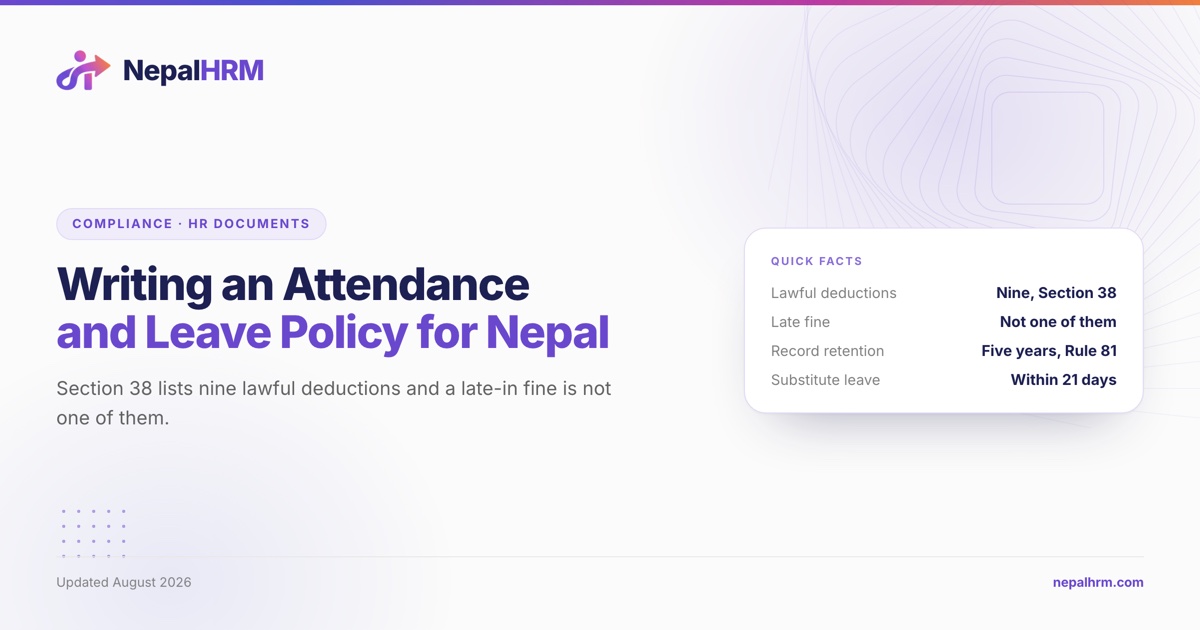
The most common clause in a Nepali attendance policy is a monetary fine for arriving late. Section 38(1) of the Labour Act 2074 does not permit it. That sub-section is a closed list of nine cases in which remuneration may be deducted at all, and a penalty for lateness is not on it. What is on it, at item (e), is the remuneration for the time actually absent from work, which is a different instrument with a different arithmetic.
This guide covers what an attendance and leave policy in Nepal can enforce, what it cannot, and the record-keeping duties underneath it. It is a chapter of our employee handbook guide, and it sits under the complete guide to the Nepal Labour Act 2074.
Table of Contents
- The nine things you may deduct
- So how do you handle lateness
- Fixing working time
- The leave half
- Records: the part that decides disputes
- A policy outline that survives review
- Five clauses to delete from an existing policy
- Frequently asked questions
- Can an employer fine an employee for coming late in Nepal?
- How much can be deducted from salary in Nepal?
- Is attendance record keeping mandatory in Nepal?
- Can leave be refused in Nepal?
- When does the leave year start in Nepal?
- How many public holidays must we give?
- How long must we keep attendance records?
- Sources
The nine things you may deduct
Section 38(1) opens with a prohibition, not a permission: remuneration payable to a worker shall not be deducted except in the following cases.
| Deduction | Notes | |
|---|---|---|
| (a) | Tax or fees payable under law | |
| (b) | Provident fund, insurance or other social security contributions | |
| (c) | Amounts under an order or decision of a judicial or quasi-judicial body, or arbitration | Rule 19(1): within the stated period, else at up to 50% a month |
| (d) | The prescribed amount for a prescribed service or facility the employer provided | Rule 19(2): up to 33% a month |
| (e) | Remuneration for the time absent from work | The only attendance-linked item |
| (f) | The employer's cash or goods lost or damaged in bad faith or by negligence | Book value, or production cost for produced goods. Rule 19(3): up to 33% |
| (g) | An amount stated as deductible in a collective agreement | Rule 19(5): the agreement's own percentage applies |
| (h) | Trade union membership fees | |
| (i) | A loan or advance the employer gave the worker |
Section 38(2) sets the order: deductions under (c) to (i) come out of what is left after (a) and (b). Rule 19(6) computes the percentage on the amount remaining once union dues, collective bargaining fees and Citizen Investment Trust deposits are set aside.
Section 38(4) lets you recover an uncollected deduction from anything owed to a worker who dies or leaves, and Rule 19(4) lifts the 33% cap at the end of employment where 33% would not recover it. Section 38(5) and 38(6) then set the fifteen-day notice to heirs and the 35-day window to apply to court.
So how do you handle lateness
Not with a fine. Three routes are available, and each one has a section behind it.
Deduct the time, under 38(1)(e). If someone is absent for two hours, the remuneration for two hours is deductible. This is proportionate by construction, it needs no separate authority, and it is the only monetary response the Act contemplates. It also means your policy has to define absence in units of time, which is a better policy than one written in fines.
Treat it as misconduct, under 131. Section 131(1)(a) makes absence from work without approved leave a misconduct attracting a warning (नसिहत). Section 131 works through a graded scale, and Section 135 requires seven days to show cause with the alleged facts and the possible penalty stated in writing. Section 137 requires proceedings to begin within two months of the conduct coming to notice and to conclude within three months of starting. Section 136(1) puts the decision with the chief executive unless the by-laws delegate it under 136(2).
Withhold nothing else. Leave, festival expense and the annual grade are statutory entitlements with their own sections. A policy that forfeits Section 37 festival expense for poor attendance is deducting something Section 38 does not list.
Fixing working time
Rule 16(1) puts the duty squarely on the employer: determine the establishment's working time on the basis of the nature of the work, and inform all workers of it. Rule 16(2) allows the time to be set so that workers can be rostered in rotation.
The floor it has to sit above is Section 28:
- Eight hours a day and 48 hours a week, under 28(1).
- Half an hour of rest after five continuous hours, under 28(2).
- Where work cannot be interrupted, the rest is given in rotation, under 28(3).
- The rest time counts inside the working hours of 28(1), under 28(4).
Rule 17 adds a duty that most policies miss: a woman worker with a child under three, and a pregnant worker, get an extra half hour for feeding and care, in one block or several, on top of the Section 28(2) rest.
Section 29(1) prohibits compelling overtime. Section 29(2) is the narrow exception: where not completing the work could adversely affect someone's life, safety or health, or cause the employer serious loss, subject to Section 30(1). Our guides to working hours and the weekly holiday and to overtime rules cover the limits and the rate.
The leave half
The policy chapter has to do two things: restate the floor correctly, and decide the things the Act deliberately leaves open.
The floor
| Leave | Entitlement | Section |
|---|---|---|
| Weekly holiday | One day a week | §40 |
| Public holidays | 13 days paid, and 14 for women | §41(1) |
| Substitute leave | For working a weekly or public holiday, within 21 days | §42 |
| Home leave | One day per 20 days worked | §43(1) |
| Sick leave | 12 days paid a year | §44(1) |
| Maternity leave | 14 weeks | §45(1) |
Accumulation is capped by Section 49(1): home leave to 90 days, sick leave to 45. Section 49(3) pays out anything above the cap at the end of each year at the basic rate, and Section 49(2) pays the accumulated balance as a lump sum at the last basic drawn when the worker leaves or dies. Every leave type is set out here, and see leave encashment.
The three things the Act hands to you
Which days you close on. Section 41(1) fixes the count, not the calendar. Section 41(2) then says that where a regulator determines the public holidays for an establishment it decides, and in all other cases the employer determines them. That is the whole reason a company holiday calendar is a policy document rather than a copy of a government notice. See public holidays.
When your leave year starts. Section 50 gives a strict order: as fixed by law, else as fixed by the regulator, else as stated in the employment contract, else the Government of Nepal's fiscal year. If your contracts are silent, your leave year is Shrawan to Ashad whether you intended it or not. See the Nepali fiscal year.
Whether leave can be refused. Section 51(1) is the provision policies are written without: leave other than sick leave, mourning leave and maternity leave is a facility only, and cannot be claimed as a right. Home leave can therefore be scheduled around the business. Sick, mourning and maternity leave cannot be treated the same way.
Records: the part that decides disputes
- Rule 81(1): keep a personal record for every worker with name, address, family details, citizenship, contact number, email and anything else you need.
- Rule 81(2): it is the worker's duty to inform you promptly when those details change.
- Rule 81(3): preserve attendance and remuneration records for at least five years.
- Rule 63(3): preserve performance evaluation forms for at least three years.
Section 12(4) explains why the retention period is the operative rule rather than an administrative one. If the Labour Office orders an employer to produce evidence or records relating to the employment and the employer does not, the employment relation is deemed to have been established. The party with the records carries the burden, and Rule 81 makes sure that party is you.
Our labour audit compliance checklist covers what an auditor asks for under Rule 56 and the Schedule 10 report.
A policy outline that survives review
- Scope: which workers, which locations, which employment types under Section 10.
- Working time: the hours fixed under Rule 16(1), the rest under Section 28(2), rotation under 28(3), and the Rule 17 extra half hour.
- Recording attendance: the method, who approves corrections, how long records are kept (Rule 81(3)).
- Late arrival and early departure: defined in time, with the 38(1)(e) consequence, not a fine.
- Absence without approved leave: routed to Section 131(1)(a) with the Section 135 and 137 procedure spelled out.
- Leave types and balances: the Section 40 to 49 floor, plus anything you add.
- The leave year: named, so Section 50 does not name it for you.
- Applying for and approving leave: notice periods, approver, and an honest statement of Section 51(1).
- The company holiday calendar: your list under Section 41(2), at or above the 13 and 14 day counts.
- Substitute leave: the 21-day rule in Section 42(2).
- Overtime: request, approval and rate, with Section 29(1)'s prohibition on compelling it.
- Where this sits: a line confirming the policy is part of the by-laws, which Rule 4(c) then makes part of every contract.
Five clauses to delete from an existing policy
- "NPR 100 fine per late arrival." Not in Section 38(1).
- "Three lates equal one day's salary." A fine dressed as arithmetic. Deduct the actual time under 38(1)(e), or use Section 131.
- "Unused leave lapses." Section 49(1) accumulates it and Section 49(3) pays out the excess annually.
- "Sick leave requires prior approval." Section 51(1) removes sick leave from the facility category precisely because it cannot be planned.
- "Ten public holidays." Section 41(1) sets 13, and 14 for women.
A policy that cannot be enforced from the record is not a policy. NepalHRM builds attendance days from the raw device punches, holds leave balances against the entitlement, and carries both into payroll, so the deduction is the time absent rather than a number someone chose. See how attendance works, or see how leave management works.
Frequently asked questions
Can an employer fine an employee for coming late in Nepal?
No. Section 38(1) of the Labour Act 2074 permits deduction from remuneration only in nine listed cases, and a monetary penalty for lateness is not one of them. What is permitted is item (e), the remuneration for the time the worker was absent from work.
How much can be deducted from salary in Nepal?
It depends on the ground. Rule 19(1) allows up to 50% of monthly remuneration to satisfy a judicial, quasi-judicial or arbitral order. Rule 19(2) and 19(3) cap deductions for an employer-provided service or facility, and for loss or damage, at 33%. Rule 19(4) lifts the cap at the end of employment where 33% would not recover the amount.
Is attendance record keeping mandatory in Nepal?
Yes. Rule 81(1) of the Labour Rules 2075 requires a personal record for every worker, and Rule 81(3) requires attendance and remuneration records to be preserved for at least five years. Section 12(4) provides that an employer who fails to produce employment records when ordered is treated as having had the employment relation.
Can leave be refused in Nepal?
Some of it. Section 51(1) says that leave other than sick leave, mourning leave and maternity leave is a facility only and cannot be claimed as a right. Those three are not in the facility category.
When does the leave year start in Nepal?
Section 50 fixes the order: as determined by law, then by the regulator, then as stated in the employment contract, and only if none of those applies, the Government of Nepal's fiscal year. Naming it in the contract is what stops it defaulting.
How many public holidays must we give?
Section 41(1) requires 13 paid public holidays a year including May Day, and 14 for women workers including International Working Women's Day. Section 41(2) then leaves the choice of days to the regulator where one determines them, and otherwise to the employer.
How long must we keep attendance records?
At least five years, under Rule 81(3), which covers both remuneration paid and attendance. Performance evaluation forms are kept for at least three years under Rule 63(3).
Sources
- Labour Act, 2074 (2017), consolidated Nepali text as amended through 2082, Nepal Law Commission: lawcommission.gov.np. Sections 10, 12, 28, 29, 30, 37, 38, 40, 41, 42, 43, 44, 45, 49, 50, 51, 131, 135, 136 and 137 were read from that text, retrieved 2026-08-07.
- Labour Rules, 2075 (2018), Nepali text, Nepal Law Commission. Rules 4, 16, 17, 19, 56, 63 and 81 were read from that text, retrieved 2026-08-07.
Related reading: Employee handbook in Nepal · Leave types under the Labour Act · Working hours and weekly holiday rules