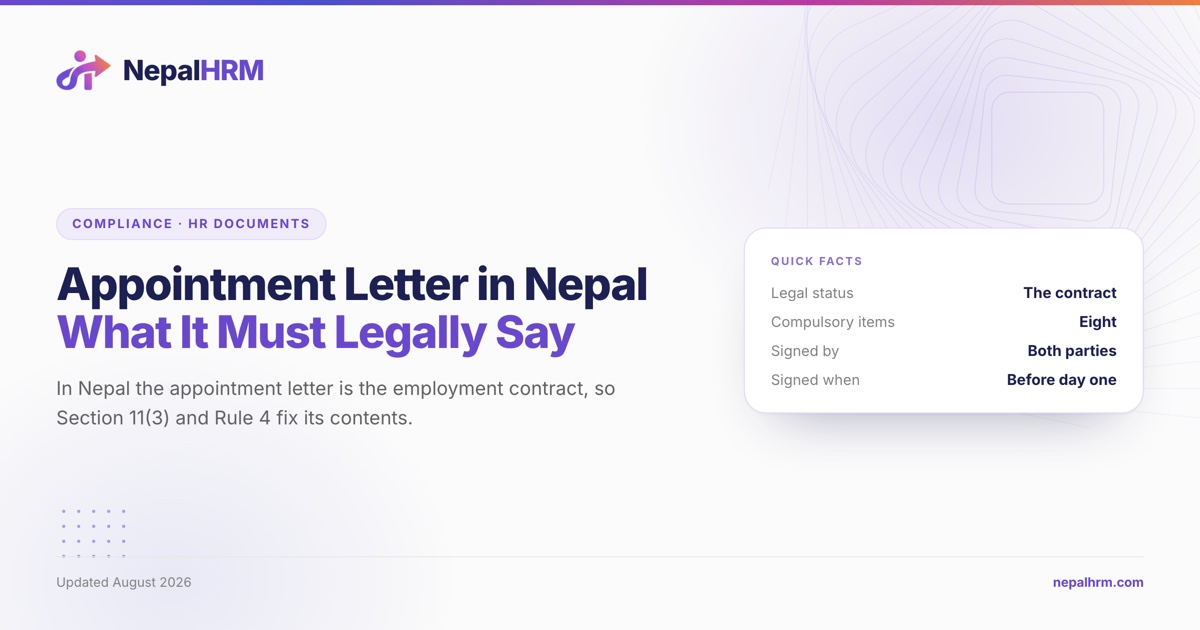
In Nepali practice the appointment letter is the document the employee signs and keeps, which makes it the employment contract for the purposes of Section 11 of the Labour Act 2074. That is not a naming convention, it is the whole reason its contents are regulated: Section 11(3) and Rule 4 of the Labour Rules 2075 between them list eight compulsory items, and a letter missing any of them is an incomplete contract rather than an informal one.
This guide covers those eight items, the four that are almost always missing from Nepali appointment letters, and the clauses that are void the day they are signed. It sits under our complete guide to the Nepal Labour Act 2074.
Table of Contents
- The eight compulsory items
- The four that get missed
- What else belongs in it
- Clauses that are void the day they are signed
- Signing, delivering and filing it
- Amending it later
- Frequently asked questions
- Is an appointment letter mandatory in Nepal?
- What must an appointment letter contain in Nepal?
- Is an appointment letter the same as an offer letter?
- Can an appointment letter set a probation period longer than six months?
- Should the appointment letter show basic salary separately?
- How long must we keep a signed appointment letter?
- What is an appointment letter called in Nepali?
- Sources
The eight compulsory items
| # | Item | Source |
|---|---|---|
| 1 | The remuneration the worker will receive | §11(3) |
| 2 | The facilities the worker will receive | §11(3) |
| 3 | The terms of employment | §11(3) |
| 4 | The type of employment | Rule 4(a) |
| 5 | The main work and the position | Rule 4(b) |
| 6 | That the by-laws under Section 108 are an integral part of the contract | Rule 4(c) |
| 7 | The place, the time, and the date the contract takes effect | Rule 4(d) |
| 8 | Other necessary conditions about the service or work | Rule 4(e) |
Items 1 to 3 are in nearly every Nepali appointment letter. Items 4, 6 and 7 are in very few. Item 7 is worth a moment: the place and time the contract was made and the date it takes effect are three separate facts, and they are not always the same day.
The four that get missed
Rule 4(c), the by-laws clause. The contract must state that the by-laws made under Section 108 form an integral part of it. This is what makes your handbook enforceable against the individual, and it is the single sentence most Nepali appointment letters do not carry. If you have no registered by-laws, you cannot write the line honestly, and Section 139(1) then limits you to the Act's own grounds for ending employment.
Rule 4(a), the employment type. Section 10 recognises five: regular, work-based, time-based, casual and part-time. Naming one is compulsory. Not naming one does not leave the question open, because Section 10(2) says a dispute about whether employment is regular is decided on the nature of the work notwithstanding anything written in the contract, and Rule 3 sets out how the Labour Office makes that call within a month. Our guide to employment types in Nepal works through all five.
A separately identified basic. The Act does not word it this way, but it is unavoidable in practice. Section 53(1) computes gratuity on basic remuneration. Section 52(1) computes provident fund on basic. The SSF contribution is 11% employee and 20% employer of basic. Section 2(a) defines basic to include the annual increment amount once a year of service is complete. A letter quoting one gross number gives you nothing to calculate any of that on. See basic salary and gross salary.
The probation term, in writing. Section 13 lets the contract make the worker subject to a six-month probation. Nothing happens automatically in your favour if the letter is silent, and a worker not released within the probation period is automatically confirmed. Our guide to the probation period in Nepal covers ending one properly.
What else belongs in it
Not compulsory, but each one settles something you would otherwise argue about:
- Pay date. Section 35(1) says as stated in the contract, and where it is not stated, as the employer determines. Section 35(2) caps the gap between payments at one month. Workers engaged for under a month must be paid within three days of the work ending; casual workers on completion.
- Annual grade. Section 36 gives a worker who completes a year at least half a day's basic per month as the annual increment. Saying so avoids the belief that it is discretionary.
- Festival expense. Section 37(1) is one month's basic per year, pro-rated under 37(3) for a worker who has not completed a year. Section 37(2) lets the worker request it in writing for their own main festival; absent a request it is paid at Dashain. See festival expense.
- Working hours. Section 28: eight hours a day, 48 a week, with the weekly holiday under Section 40.
- Leave. Point to the by-laws chapter rather than restating the Act badly. Every leave type is here.
- SSF enrolment, and what the 31% covers under Section 57.
- Notice on separation, matching the Act rather than undercutting it.
- Confidentiality and company property. These are yours to write.
Clauses that are void the day they are signed
Section 3(1) makes the Act a minimum standard. Section 3(2) makes a contract term giving less than the Act or Rules prescribe, or running against the Act, void to that extent. The letter survives; the clause is read out and the statutory floor takes over.
| The clause | Why it fails |
|---|---|
| "Probation of one year" | §13 caps it at six months |
| "Gratuity after five years of service" | §53 makes it 8.33% of basic monthly from day one |
| "Provident fund after confirmation" | §52(1) has no confirmation condition |
| "Ten days of paid public holiday" | §41(1): 13 days, and 14 for women |
| "Sick leave of six days" | §44(1): 12 days paid |
| "Employment at the company's discretion" | §139 requires a lawful ground and an adequate stated reason |
| "Festival expense forfeited on resignation" | §37(3) pro-rates it; §148(1) pays it within 15 days |
| "Retirement at 58" | §147 sets sixty, and a lower age needs Council permission and a by-law provision |
The last row catches people out because Rule 73 of the Labour Rules still speaks of fifty-eight. The Act was amended later, by the Good Governance (Amendment of Some Nepal Acts) Act 2081, and the Act governs.
Signing, delivering and filing it
- Sign before the first day. Section 11(1) prohibits engaging anyone without a contract, so a letter signed in week three leaves three weeks of breach behind it.
- Both parties sign, and the worker keeps a copy. Section 108(4) separately obliges you to give them the by-laws if they ask.
- Open the personal record. Rule 81(1) requires a record for every worker with name, address, family details, citizenship, contact number, email and anything else you need. Rule 81(2) makes it the worker's duty to tell you when those change.
- Keep it for five years at least. Rule 81(3) sets that floor for attendance and remuneration records, and Section 12(4) is the reason it matters: if the Labour Office orders you to produce employment records and you cannot, the employment relation is deemed established.
Amending it later
A promotion, a transfer or a restructure changes the contract, so it needs the same treatment.
- Section 34(3): what a worker has been receiving cannot be reduced except as recorded in a collective agreement. A revised letter that quietly drops an allowance does not work.
- Section 109(1): a transfer between offices, branches or units is allowed where it does not adversely affect service conditions or facilities and does not change the nature or level of the work. Beyond that, Section 109's proviso requires the worker's consent, and Rules 59 and 60 govern transfer agreements and entitlements.
- Section 14(1): a change of ownership, a handover of operations or a merger keeps the employment relation intact, and Section 14(2) carries the obligations across.
Issue an amendment letter that references the original, rather than replacing it silently. The five-year retention in Rule 81(3) means both versions should be findable.
Every appointment letter creates a record someone will ask for later. NepalHRM keeps the employment type, position, salary structure, probation date and signed documents on one employee record. See how employee records work, or check the salary structure against the tax slabs.
Frequently asked questions
Is an appointment letter mandatory in Nepal?
An employment contract is. Section 11(1) prohibits an employer from engaging anyone without one, and in normal Nepali practice the appointment letter is that contract. The only exception is Section 11(2): casual employment, defined by Section 10 as work of seven days or fewer in a month, does not need it in writing.
What must an appointment letter contain in Nepal?
Eight items. Section 11(3) requires remuneration, facilities and terms of employment. Rule 4 of the Labour Rules 2075 adds the type of employment, the main work and position, a statement that the Section 108 by-laws form an integral part of the contract, the place and time of the contract and its effective date, and any other necessary conditions of service.
Is an appointment letter the same as an offer letter?
No. The offer proposes the job and is not regulated by the Labour Act. The appointment letter carries the contract's compulsory contents and is what discharges Section 11(1). Our guide to offer letter rules in Nepal covers the difference.
Can an appointment letter set a probation period longer than six months?
No. Section 13 caps probation at six months, and a worker whose contract is not ended within that period is automatically confirmed. A longer term in the letter is void to that extent under Section 3(2).
Should the appointment letter show basic salary separately?
Yes, in practice. Gratuity under Section 53(1) and provident fund under Section 52(1) are both computed on basic remuneration, as is the SSF contribution. Section 2(a) also folds the annual increment into basic once a year of service is complete, so the base moves each year.
How long must we keep a signed appointment letter?
Rule 81(3) requires attendance and remuneration records to be preserved for at least five years, and Rule 81(1) requires a personal record for every worker. Section 12(4) is why: an employer who cannot produce employment records when ordered is treated as having had the employment relation.
What is an appointment letter called in Nepali?
नियुक्ति पत्र (niyukti patra). The instrument the Labour Act 2074 actually names is the रोजगार सम्झौता, the employment contract, in Section 11.
Sources
- Labour Act, 2074 (2017), consolidated Nepali text as amended through 2082, Nepal Law Commission: lawcommission.gov.np. Sections 2, 3, 10, 11, 12, 13, 14, 28, 34, 35, 36, 37, 40, 41, 44, 52, 53, 57, 108, 109, 139, 147 and 148 were read from that text, retrieved 2026-08-07.
- Labour Rules, 2075 (2018), Nepali text, Nepal Law Commission. Rules 3, 4, 59, 60, 73 and 81 were read from that text, retrieved 2026-08-07.
Related reading: Employment contracts in Nepal · Offer letter rules in Nepal · Employee handbook in Nepal