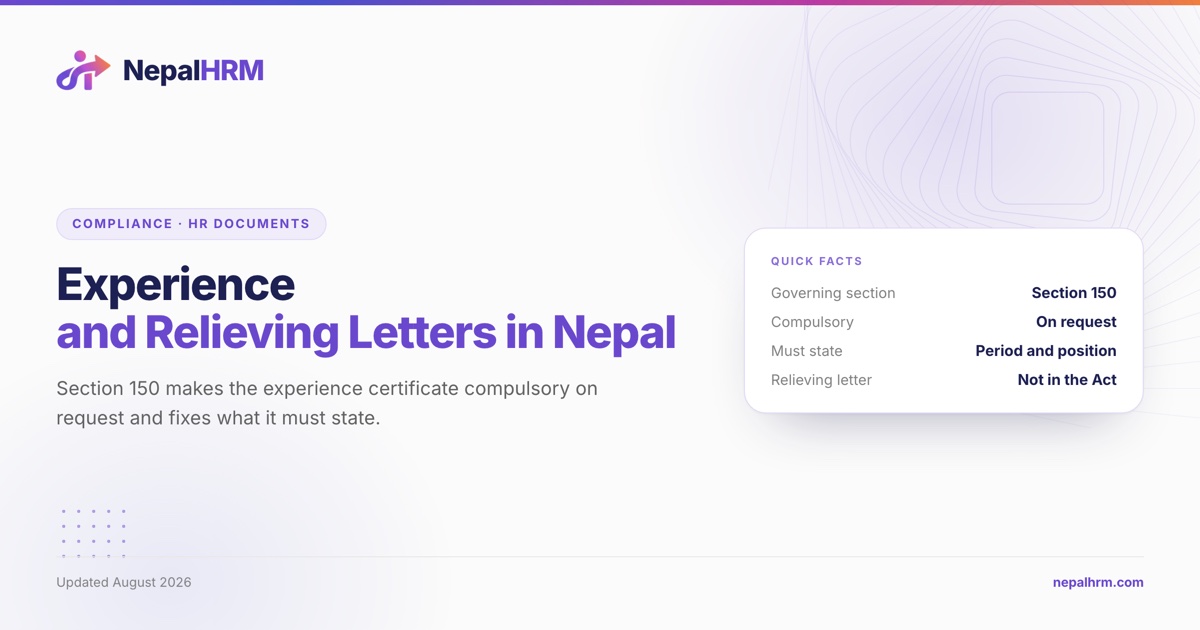
Section 150 of the Labour Act 2074 is short and absolute: where a worker whose employment has ended asks for an experience certificate, the employer shall give one, stating that worker's period of employment and position. There is no discretion in it, no conditionality, and no reference to how the employment ended.
The relieving letter is a different animal. The Labour Act does not mention it. This guide covers what Section 150 actually obliges, what a relieving letter is and is not, and how both sit against the 15-day settlement clock in Section 148. It sits under our complete guide to the Nepal Labour Act 2074.
Table of Contents
- What Section 150 requires
- What to put in it, and what to leave out
- The relieving letter
- What is in the final settlement
- When someone leaves badly
- The exit sequence
- Frequently asked questions
- Is an experience letter mandatory in Nepal?
- Can an employer refuse to give an experience certificate?
- What must an experience certificate state in Nepal?
- Is a relieving letter required by law in Nepal?
- How long does an employer have to settle dues in Nepal?
- What happens if a leaver never collects their money?
- What is an experience letter called in Nepali?
- Sources
What Section 150 requires
Read it as three conditions and one duty.
| Who can ask | A worker whose employment has ended |
| What triggers it | The worker asks for it |
| What you must give | A work experience certificate |
| What it must state | The period of employment and the position |
Three things follow that are worth being explicit about.
It is on request, not automatic. The duty is triggered by the worker asking. That does not make it good practice to wait: issuing it with the settlement is cleaner, and it removes an argument later.
The reason for leaving is irrelevant. Section 150 does not distinguish resignation from retrenchment from removal for misconduct. A worker dismissed under Section 133 who asks for a certificate is entitled to one stating their period and position.
Conduct and performance are outside the section. Section 150 names period and position. It does not require you to certify that someone was diligent, and it does not entitle them to a good word. Adding praise is a choice. Adding criticism is a choice with consequences, since the document circulates.
What to put in it, and what to leave out
Include
- The worker's full name, as it appears in the personal record kept under Rule 81(1).
- The period of employment, from the joining date to the last working day. This is the date Section 12(1) attached the employment relation to, so it should match the contract and the attendance record.
- The position, matching Rule 4(b), which requires the appointment letter to state the main work and the position. A certificate naming a title the contract never used invites a question.
- The employment type, if it helps. Section 10's five categories are not interchangeable, and "work-based employment" is a fact, not a judgement.
- Company letterhead, a date, an authorised signature and a stamp.
Leave out
- Conduct grades and performance ratings, unless you have a reason and a record. Rule 63(3) requires appraisal forms to be kept for three years, so a rating you write should be one you can produce.
- The reason for leaving, unless the worker asks you to state it.
- Salary figures. Those belong on a salary certificate, which is a separate document with a separate purpose.
- Anything that contradicts the settlement you just made.
The relieving letter
Nepali employers issue one, next employers ask for one, and the Labour Act 2074 says nothing about it. That silence means its content is entirely a matter of practice, and in practice it does one job: it confirms the person has been released, on a stated date, with nothing outstanding on either side.
That makes it a companion to Section 148 rather than to Section 150.
- Section 148(1): on the end of employment, whether for misconduct or in any other manner, the employer must pay the worker's remuneration, facilities and all amounts due within fifteen days.
- Section 148(2): the employer must give the worker the assistance needed to obtain amounts or facilities payable from the Social Security Fund, an insurer or another body. Handing over a settlement sheet is not the whole duty.
- Section 148(3): if the employer does not pay within that period or does not give that assistance, the worker must be paid remuneration as though still in service until it is paid. The clock does not simply expire.
- Section 148(4) and Rule 74: if the worker does not come to collect, pay into the bank account they gave you; Rule 74(2) allows a consenting family member's account where the worker has none; Rule 74(3) sets the order of family entitlement on death; Rule 74(4) requires the money to be deposited into the Social Security Fund if it cannot be paid or goes unclaimed for three years.
So a relieving letter that says dues are settled is a statement about Section 148 compliance. Do not sign one before the payment is actually made.
What is in the final settlement
The relieving letter usually accompanies the settlement, so it is worth listing what Section 148(1)'s "all amounts" covers:
- Salary to the last working day.
- Accumulated leave, encashed. Section 49(1) allows home leave to accumulate to 90 days and sick leave to 45. Section 49(2) pays the lump sum at the rate of the last basic remuneration drawn. Section 49(3) pays out anything above the caps at the end of each year.
- Festival expense, pro-rated. Section 37(3) gives a worker who has not completed a year the proportionate amount.
- Any gratuity month not yet deposited. Section 53 makes gratuity 8.33% of basic every month into the Fund, so it is normally not an exit computation at all. Our guide to gratuity in Nepal explains why.
- Any overtime not yet paid.
- Less lawful deductions only. Section 38 lists the cases in which remuneration may be deducted at all.
See full and final settlement for the term, and leave encashment for the leave half.
When someone leaves badly
The two documents behave differently, and the difference matters most in the case where you least want to issue anything.
| Experience certificate | Relieving letter | |
|---|---|---|
| In the Act | Yes, §150 | No |
| Compulsory | Yes, on request | No |
| Depends on how they left | No | In practice, yes |
| Depends on dues being cleared | No | Yes, that is its content |
| Content fixed by law | Period and position | Nothing |
A worker removed for misconduct under Section 133 who asks for an experience certificate gets one. What they do not get is a relieving letter saying nothing is outstanding, if something is. And withholding the certificate as leverage over unreturned property is not a lawful option, because Section 150 does not condition the duty on anything.
If money is owed to you, Section 38 governs whether it can come out of remuneration, and the settlement is where it is resolved. The certificate is not the lever. Our guide to termination and notice period in Nepal covers the enquiry and the grounds.
The exit sequence
- Last working day fixed, and the notice period run out.
- Settlement computed: salary, accumulated leave at last basic, pro-rated festival expense, any undeposited gratuity, less lawful deductions.
- Paid within 15 days, under Section 148(1).
- Assistance given for anything payable by the SSF, an insurer or another body, under Section 148(2).
- Experience certificate issued with the period and position, under Section 150.
- Relieving letter issued once step 3 is actually done.
- Records retained. Rule 81(3) requires attendance and remuneration records for at least five years, and Rule 63(3) requires appraisal forms for three.
Steps 5 and 6 are often merged into one document. That is fine, provided the Section 150 content is in it and step 3 has happened.
The exit paperwork is only as fast as the settlement behind it. NepalHRM holds leave balances, the salary structure and the payroll history on one record, so a final settlement is a computation rather than a reconstruction. See how offboarding works, or see how payroll works.
Frequently asked questions
Is an experience letter mandatory in Nepal?
Yes, on request. Section 150 of the Labour Act 2074 requires an employer to give a work experience certificate stating the period of employment and the position where a worker whose employment has ended asks for one.
Can an employer refuse to give an experience certificate?
No. Section 150 attaches no conditions. It does not depend on how the employment ended, on dues being cleared, or on company property being returned. Those are dealt with through the settlement under Section 148 and, where relevant, the deduction rules in Section 38.
What must an experience certificate state in Nepal?
Two things, under Section 150: the worker's period of employment and their position. Anything beyond that, including conduct or performance, is the employer's choice rather than a legal requirement.
Is a relieving letter required by law in Nepal?
No. The Labour Act 2074 does not mention it. In practice it confirms release on a stated date with dues settled, which makes it a statement about Section 148 rather than about Section 150.
How long does an employer have to settle dues in Nepal?
Fifteen days from the end of employment, under Section 148(1). Section 148(3) provides that if payment is not made within that period, or the assistance required by Section 148(2) is not given, the worker must be paid remuneration as though still in service until it is.
What happens if a leaver never collects their money?
Rule 74 handles it. The amount goes to the bank account the worker provided, or with their consent to a family member's account where they have none. If it cannot be deposited, or nobody claims it within three years of the worker leaving, the employer must deposit it into the Social Security Fund.
What is an experience letter called in Nepali?
कार्य अनुभवको प्रमाणपत्र (karya anubhavko pramanpatra), the work experience certificate, in Section 150 of the Labour Act 2074.
Sources
- Labour Act, 2074 (2017), consolidated Nepali text as amended through 2082, Nepal Law Commission: lawcommission.gov.np. Sections 10, 12, 37, 38, 49, 53, 133, 148 and 150 were read from that text, retrieved 2026-08-07.
- Labour Rules, 2075 (2018), Nepali text, Nepal Law Commission. Rules 4, 63, 74 and 81 were read from that text, retrieved 2026-08-07.
Related reading: Termination and notice period in Nepal · Salary certificate in Nepal · Employee handbook in Nepal