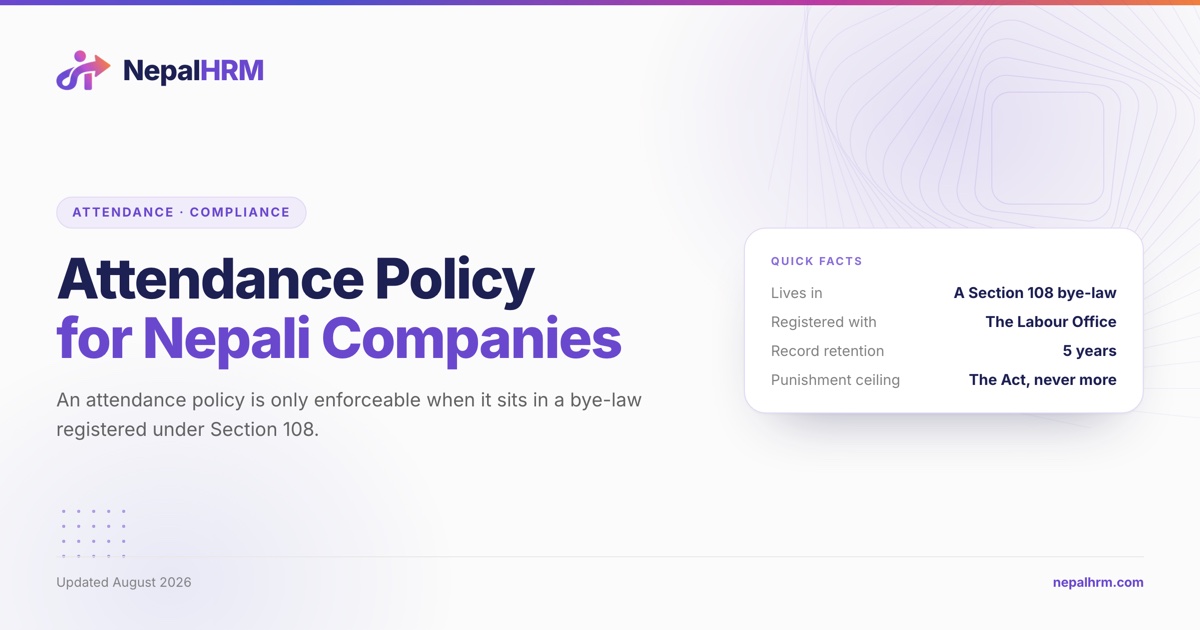
An attendance policy in Nepal is enforceable when it lives inside a bye-law made under Section 108 of the Labour Act 2074, registered with the Labour Office, and written after consulting the trade union. A policy circulated by email is a statement of expectations. It is not a rule you can act on.
That single distinction decides whether the rest of the document is worth writing, so it comes first here. What follows is the clause set that belongs in a Nepali attendance policy, the statutory provision each clause has to obey, and the four things a policy must never say. If you are still deciding how presence gets captured, our guide to biometric attendance setup in Nepal covers the hardware side of the same decision.
Table of Contents
- Where an attendance policy gets its authority
- The twelve clauses
- Working a holiday, in the policy
- Night shifts and female workers
- The four things a policy must not say
- The records the policy commits you to
- Rolling it out
- Frequently asked questions
- Is an attendance policy legally required in Nepal?
- Can a company in Nepal fine an employee for coming late?
- Does an attendance policy have to be registered?
- How long must attendance records be kept in Nepal?
- Can the attendance policy set a punishment the Labour Act does not have?
- Who signs off attendance punishment in a Nepali company?
- Should the attendance policy set the working days per week?
- Sources
Where an attendance policy gets its authority
Section 108(1) lets every enterprise make a bye-law for its internal management. Four sub-sections then decide whether yours will survive a challenge:
| Sub-section | What it requires |
|---|---|
| 108(2) | The bye-law must not be contrary to the minimum standards in the Act or in the collective agreement |
| 108(4) | One copy is registered in the Labour Office, and shown to any worker who wishes to look at it |
| 108(5) | The enterprise consults the authorised trade union when making or amending it, or an active union if none is authorised |
| 108(6) | A court may void any provision that contradicts the Act, prevailing law or the collective agreement |
Section 133(1) adds a route for regulated sectors. Where the regulator of banks and financial institutions, schools, telecom providers, hospitals, air services or insurance has prescribed specific punishment for specific misconduct, the bye-law may follow the regulator. Section 108(3) preserves the same power for Nepal Rastra Bank over banks.
Section 130 is the other half of the arrangement: observing the discipline and duties set out in the Act, the Rules or the bye-law is the duty of every worker. That is the sentence a policy leans on, and it only reaches as far as the bye-law does.
The twelve clauses
Copy these, then change the numbers to match what your contracts already say. Anything in square brackets is a decision, not a default.
1. Scope. This policy applies to every worker of the enterprise, in every employment type under Section 10 of the Act, at every branch and site.
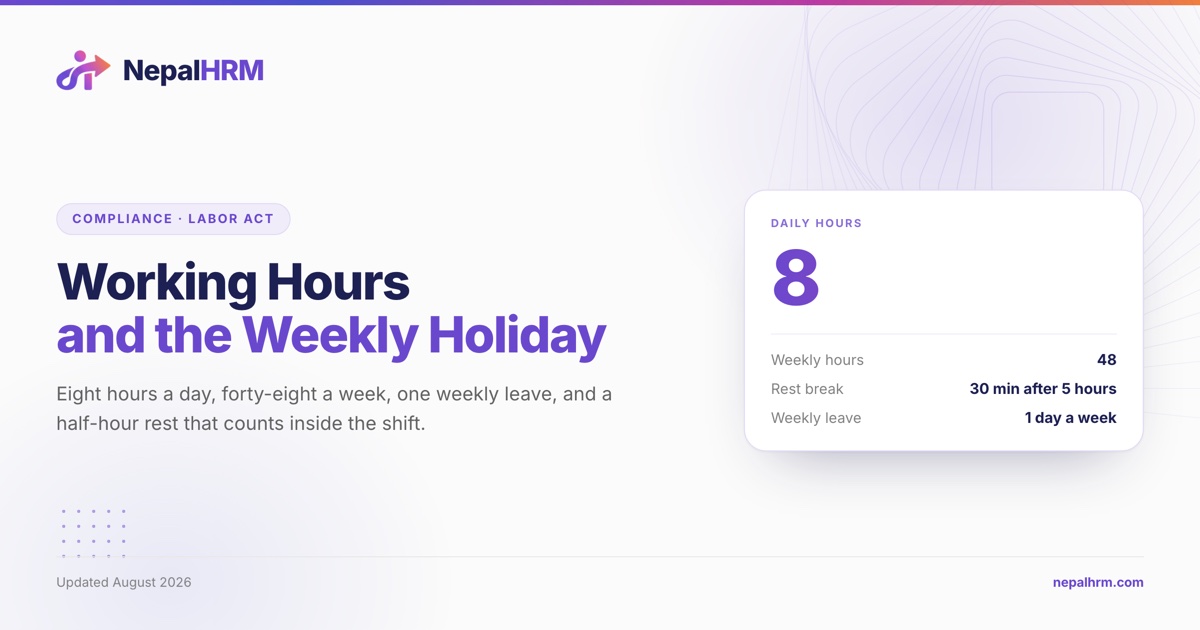
2. Working hours. The working day is eight hours and the working week is forty-eight hours, per Section 28(1). No worker shall be engaged beyond those hours except as overtime under clause 9.
3. Rest break. A rest of thirty minutes is given after five hours of continuous work, per Section 28(2). That rest is counted inside the working hours, per Section 28(4), and does not extend the finishing time. Where work cannot be stopped, the rest is rotated under Section 28(3).
4. Start and finish times. Daily start and finish times are as stated in each worker's employment contract, per Section 32(1). Where the contract is silent, the enterprise determines them and notifies the worker in writing before they take effect.
5. How presence is recorded. Presence is recorded by [biometric punch at the workplace device · geofenced check-in from the employee app · the branch register] for [role or location]. A record made by any other method is not attendance until a supervisor has regularised it under clause 10.
6. Lateness. Arrival after the contracted start time is recorded as late. Repeated late attendance without permission is misconduct under Section 131(1)(c) and is dealt with under clause 12. No fine, levy or fixed-amount penalty is charged for lateness, because Section 38 does not permit one.
7. Absence and leave. Leave is applied for and sanctioned before it is taken, except for sick and emergency leave, which is notified on the first day and regularised on return. Absence without sanctioned leave is unpaid for the period of absence, per Section 38(1)(e), and is misconduct under Section 131(1)(a).
8. Weekly leave and public holidays. Every worker receives one day of weekly leave each week, per Section 40. The enterprise publishes its public holiday list for the fiscal year, totalling the days set by Section 41. The weekly leave day may differ between workers on a roster.
9. Overtime. Overtime is approved in writing before it is worked. It shall not exceed four hours a day or twenty-four hours a week, per Section 30(1), and is paid at not less than one and a half times basic remuneration, per Section 31(1).
10. Regularisation. A missed, duplicated or mis-mapped punch is corrected by the worker raising a regularisation request within [three] working days, approved by the reporting supervisor. The original record is retained alongside the correction and the approver is recorded.
11. Records. Attendance and remuneration records are retained for not less than five years, per Rule 81 of the Labour Rules 2075. Personal records are maintained under Rule 81(1) and updated when the worker notifies a change.
12. Consequences. Attendance misconduct is dealt with under Chapter 20 of the Act. Before any punishment, the worker is given seven days to submit a clarification under Section 135, stating the alleged facts and the punishment possible if proved. Action commences within two months of the enterprise knowing of the misconduct and a decision is taken within three months of commencement, per Section 137.
Clause 5 is the one that changes company to company. If you have not settled it yet, biometric versus mobile GPS attendance works through which method fits which role.
Working a holiday, in the policy
Section 42(1) gives substitute leave to a worker engaged on a weekly or public holiday where the work cannot be stopped. Section 42(2) puts a deadline on it: within twenty-one days of the date worked.
Section 30(2) supplies what happens if you miss the deadline. The work becomes deemed overtime, payable at one and a half times basic under Section 31(1), whether or not anyone called it overtime at the time. There is no third outcome, and the default is the expensive one. A policy that says "compensatory off will be arranged" without naming the twenty-one day clock has already chosen overtime pay without knowing it.
Add one line to clause 8: holiday working is settled by a substitute day within twenty-one days of the date worked, failing which it is paid as overtime. Our guide to working hours and weekly holiday rules covers Sections 40 to 42 in full.
Night shifts and female workers
Section 33 is short and is almost never in a Nepali attendance policy. Where a female worker's working time begins before sunrise or ends after sunset, the employer shall arrange the necessary transport for her to come to the workplace and to return from it.
It is not conditional on the shift being formally designated as a night shift, and a transport allowance where no transport is arranged does not satisfy it. Schedule 10 of the Labour Rules 2075, the labour audit form, asks the question directly: when engaging a woman after sunset or before sunrise, has transport and security been arranged under Section 33?
If your roster has early or late shifts, that is a clause, not a footnote. Shift rosters and night-shift allowance in Nepal covers what else a roster owes.
The four things a policy must not say
- "A fine of NPR [x] is charged for late arrival." Section 38(1) opens with "except in the following circumstance, no amount shall be deducted" and then lists nine circumstances. A late fine is not one of them. What is lawful is not paying for time not worked, under Section 38(1)(e).
- "Punishment for [misconduct] is [heavier than the Act]." Section 138(2) only recognises a bye-law that provides lesser punishment. Anything heavier is the provision Section 108(6) lets a court void.
- "Overtime is not payable unless pre-approved." Prior approval is a control you are entitled to require, and clause 9 requires it. It does not extinguish the Section 31(1) entitlement for hours actually worked. Discipline the unapproved hours; pay them too.
- "Attendance records are kept for [less than five years]", or no retention clause at all. Rule 81(3) sets the floor at five years, and the record you cannot produce is the one the inspector asks for.
The records the policy commits you to
Section 100 requires every enterprise to carry out a labour audit on whether it is operating in accordance with the Act, the Rules and prevailing law, and to produce the report to the Labour Office or an inspector on demand. Rule 56 makes it annual, due within the end of Poush, on the Schedule 10 form.
Three rows of that form are pure attendance, and each is a record rather than a policy statement:
- Row 7. Are workers being engaged beyond eight hours a day and forty-eight hours a week, under Section 28?
- Row 8. Is a half-hour rest given after five hours, and is additional remuneration paid under Section 31 for work beyond working hours?
- Row 9. When engaging a woman after sunset or before sunrise, has transport and security been arranged under Section 33?
Section 163(2)(b) prices a false entry at up to NPR 20,000, each time. So the honest answer to row 7 is worth more than the flattering one, and both need the daily record behind them. Our labour audit compliance checklist walks the whole Schedule 10 form.
Rolling it out
- Draft the clauses against the contracts you already have, so clause 4 and the contracts agree.
- Consult the authorised trade union under Section 108(5), before adoption rather than after.
- Register one copy with the Labour Office under Section 108(4), and keep the acknowledgement.
- Publish it where a worker can read it without asking, which is what "available to any labour if he or she wishes to look at" means in practice.
- Give it an effective date in the future, and acknowledge receipt per worker.
- Re-consult on every amendment. Section 108(5) applies to amendment as well as to making.
A policy is a promise about records. NepalHRM builds each day from real punches against the employee's assigned shift, keeps the original alongside every regularisation with the approver's name on it, and carries approved overtime into the same month's salary sheet. The statutory ceilings in Section 30(1) still need a supervisor rule and an exception report behind them, because the software prices overtime rather than blocking it. See how attendance works, or book a walkthrough with your own shift pattern.
Frequently asked questions
Is an attendance policy legally required in Nepal?
The Labour Act 2074 does not require one by name. Section 108(1) says an enterprise may make a bye-law for internal management, and Section 130 makes observing the bye-law a worker's duty. So the policy is optional, but acting on it is only safe once it exists in that form.
Can a company in Nepal fine an employee for coming late?
No. Section 38(1) permits deduction only in the nine listed circumstances and a fine is not among them. Section 131(1)(c) treats frequent lateness without permission as misconduct punishable by reprimand. You may leave the late period unpaid under Section 38(1)(e), which is a different thing from a fine.
Does an attendance policy have to be registered?
The bye-law it sits in does. Section 108(4) requires one copy of the bye-law to be registered in the Labour Office and made available to any worker who wishes to look at it.
How long must attendance records be kept in Nepal?
At least five years. Rule 81(3) of the Labour Rules 2075 requires the employer to keep records of remuneration paid and attendance for a minimum of five years.
Can the attendance policy set a punishment the Labour Act does not have?
No. Section 138(2) recognises a bye-law that provides lesser punishment than Chapter 20 allows, and Section 108(6) lets a court void a bye-law provision that contradicts the Act. Lighter is yours to choose; heavier is not.
Who signs off attendance punishment in a Nepali company?
The chief executive of the enterprise, under Section 136(1). Section 136(2) allows the bye-law to give a managerial-level worker the power to investigate and take the final decision, which is how a branch or plant delegates it.
Should the attendance policy set the working days per week?
It should state the hours, and stay consistent with Section 28(1). Forty-eight hours across six days is eight a day. Across five days it is 9.6 a day, which breaches the daily ceiling, so a lawful five-day week runs at forty hours or pays the excess as overtime.
Sources
- Labour Act, 2074 (2017), consolidated Nepali text as amended through 2082, Nepal Law Commission: lawcommission.gov.np. Sections 28 to 33, 38, 40 to 42, 100, 108, 130, 131, 133, 135 to 138 and 163 were read from that text, retrieved 2026-08-07.
- Labour Rules, 2075 (2018), Nepal Law Commission. Rule 56 (labour audit, Schedule 10) and Rule 81 (personal records and attendance, five-year retention), retrieved 2026-08-07.
Related reading: Biometric attendance setup in Nepal · Late coming and absence: what you can legally deduct · Working hours and weekly holiday rules in Nepal