Section 11(1) of the Labour Act 2074 is one line: an employer shall not engage anyone in work without an employment contract. It is not a formality that HR completes later. It is a prohibition on the act of employing, and the two sections around it decide what happens when it is ignored.
This guide covers what the contract must contain, when it must be in writing, when the employment relation exists anyway, and why Section 12(4) makes the missing contract an evidentiary problem rather than a paperwork one. It sits under our complete guide to the Nepal Labour Act 2074.
Table of Contents
- What the contract must disclose
- When it has to be in writing
- The relation exists whether or not you signed anything
- What the contract cannot do
- Probation, in the contract
- Foreign nationals
- Ownership changes do not reset it
- A practical sequence
- Frequently asked questions
- Is a written employment contract mandatory in Nepal?
- What must an employment contract include in Nepal?
- What happens if there is no employment contract?
- Can an employment contract in Nepal give less than the Labour Act?
- How long can a probation period be in Nepal?
- Does the employment contract survive a change of ownership?
- What is an employment contract called in Nepali?
- Sources
What the contract must disclose
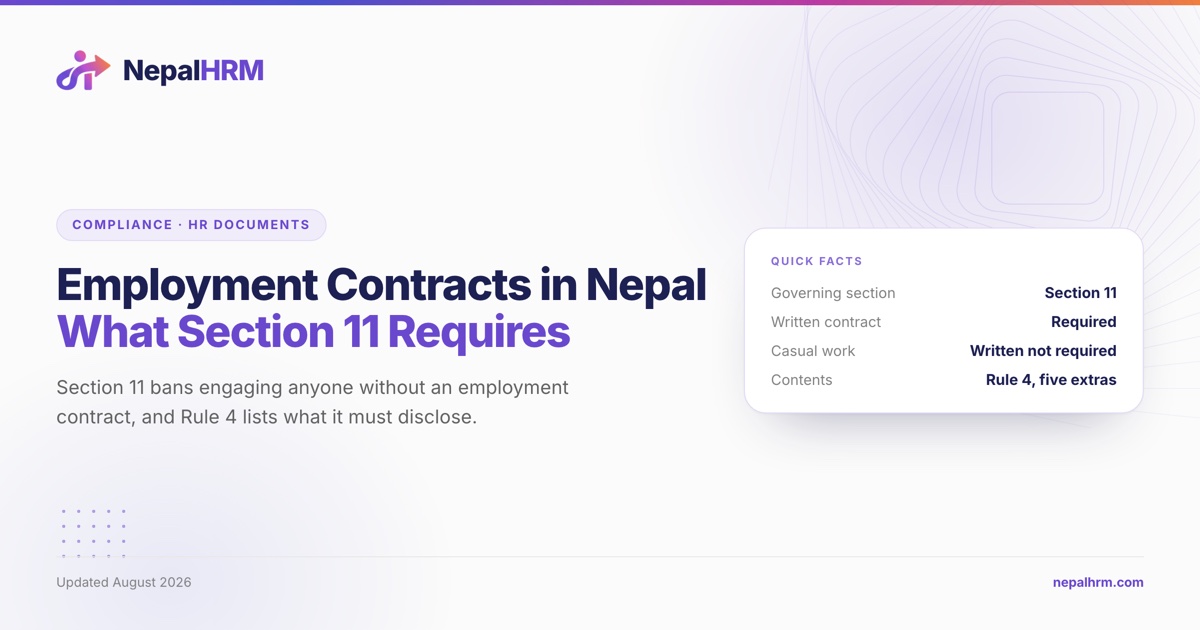
Two provisions stack. Section 11(3) names three things, and Rule 4 of the Labour Rules 2075 adds five more.
| Source | Item |
|---|---|
| §11(3) | The remuneration the worker will receive |
| §11(3) | The facilities the worker will receive |
| §11(3) | The terms of employment |
| Rule 4(a) | The type of employment |
| Rule 4(b) | The main work the worker has to do, and the position |
| Rule 4(c) | That the by-laws made under Section 108 form an integral part of the contract |
| Rule 4(d) | The place and time the contract was made, and the date it takes effect |
| Rule 4(e) | Any other necessary conditions about the service or work |
Rule 4(c) is the item nobody copies across, and it is the one that connects the two documents. If you have registered by-laws, the contract has to say they are part of it. If you do not have by-laws, that line has nothing to point at, which is itself a finding.
Rule 4(a) is the second most-skipped. Section 10 recognises five types of employment and the contract has to name which one this is. Our guide to employment types in Nepal sets out how regular, work-based, time-based, casual and part-time differ.
When it has to be in writing
Section 11(2) is the entire exception: for casual employment, a written employment contract is not required.
Section 10's explanation defines casual employment as work given for seven days or fewer in a month. That is the whole boundary. Eight days in a month is not casual, and a person you call casual for eleven months is a question of the nature of the work rather than of the label, because Section 10(2) says a dispute about whether employment is regular is decided on the nature of the work notwithstanding anything written in the contract.
Rule 3 sets out how that decision is made: on application to the Labour Office, which decides within one month on the nature of the work, whether the task needed to continue past the stated period, whether another worker would be needed immediately, and whether an unspecified engagement has in fact run over a year.
The relation exists whether or not you signed anything
This is where employers lose. Section 12(1) says the employment relation is established from the date or time of any of these:
- the employer makes an employment contract with the worker, or
- the employer gives employment orally, or
- in casual employment, the worker starts work or provides the service.
There is no fourth branch where nothing happened. Skipping the contract does not defer the relation, it just removes your record of its terms.
Section 12(2) sends a dispute about whether a relation exists to the Labour Office. Section 12(3) lets the Department or the court decide it inside a case already before them. And then Section 12(4) closes it:
For the purpose of sub-section (2), the Office may order the employer to produce any evidence or record relating to the employment held by the employer, and if the employer does not produce it, the employment relation between the employer and the worker shall be deemed to have been established.
The burden sits on the party holding the records, and that is you. Rule 81(1) separately requires the employer to keep a personal record of every worker, and Rule 81(3) requires attendance and remuneration records to be preserved for at least five years. A dispute over whether someone worked for you is decided out of your own filing cabinet.
What the contract cannot do
Section 3(1) makes the Act a minimum standard. Section 3(2) then says an employment contract that takes or gives less remuneration or facilities than the Act or the Rules prescribe, or that runs against a term of the Act, is deemed contrary to the Act and is void to that extent.
Void to that extent, not void entirely. The rest of the contract survives and the bad clause is read out of it, replaced in practice by the statutory floor. So a contract promising eight days of sick leave does not void the employment, it just delivers the 12 days Section 44(1) guarantees and leaves you with a document that misstates your own obligation.
Three clauses that fail this test regularly:
- Probation over six months. Section 13 caps it at six, and a worker not released within it is automatically confirmed.
- A notice period below the Act's. Covered in termination and notice period in Nepal.
- Gratuity after a qualifying number of years. Section 53 makes it 8.33% of basic every month from the first day. The qualifying-period formula came from the repealed Labour Act 2048.
Section 34(2) makes the same point from the other direction: remuneration and facilities are as stated in the contract, provided they are not less than the Act and Rules prescribe. And Section 34(3) says what a worker has been receiving cannot be reduced except as recorded in a collective agreement, so a renewal that quietly cuts a benefit does not work either.
Probation, in the contract
Section 13 lets the employer make the contract subject to a six-month probation period. If the work is not found satisfactory during it, the contract can be ended. If the probation ends without that happening, the employment relation is automatically confirmed. Nothing needs to be signed for confirmation to happen, which is why a company that forgets a confirmation letter has still confirmed the person. Our guide to the probation period in Nepal covers how to end one properly.
Foreign nationals
Section 22(1) requires a work permit from the Department before an employer engages a foreign citizen, obtained through the Rule 7 application with the advertisement, passport copy, biodata, tax clearance and a plan to replace the foreign worker with a Nepali one. Section 27 governs their remuneration, service conditions and facilities. The employment contract is additional to the permit, not a substitute for it.
Ownership changes do not reset it
Section 14(1): where a business or part of it changes hands, is transferred, is handed to someone else to run, or two or more establishments merge into a new one, the employment relation of the workers continues. Section 14(2) carries the obligations under the Act, the Rules and any collective agreement to whoever takes over. The proviso allows an interim arrangement agreed between the old employer, the new employer and the union.
So a share transfer or a merger is not a moment to re-paper everyone onto worse terms. Section 34(3) is still there.
A practical sequence
- Decide the employment type under Section 10 before you write anything. It drives most of the rest.
- Set probation under Section 13, six months or fewer, with the review date in a calendar.
- Write the remuneration and facilities at or above the statutory floor, structured so basic is identifiable, because gratuity, provident fund and SSF all compute on basic.
- Add the Rule 4 items: type, main work and position, the by-laws clause, the place, time and effective date.
- Sign it before the first day, not after. Section 11(1) prohibits the engagement, not the delay.
- File it. Rule 81(1) requires the personal record; Rule 81(3) requires the pay and attendance records for five years.
- Give the worker a copy, and give them the by-laws if they ask, under Section 108(4).
Frequently asked questions
Is a written employment contract mandatory in Nepal?
Section 11(1) prohibits an employer from engaging anyone in work without an employment contract, with one exception: Section 11(2) says a written contract is not required for casual employment, which Section 10 defines as work of seven days or fewer in a month.
What must an employment contract include in Nepal?
Section 11(3) requires the remuneration, facilities and terms of employment. Rule 4 of the Labour Rules 2075 adds the type of employment, the main work and position, a statement that the by-laws under Section 108 form an integral part of the contract, the place, time and effective date, and any other necessary conditions of service.
What happens if there is no employment contract?
The employment relation still exists. Section 12(1) establishes it on a contract, an oral engagement, or the date the worker started work. Section 12(4) then provides that if the Labour Office orders the employer to produce employment records and the employer does not, the relation is deemed established.
Can an employment contract in Nepal give less than the Labour Act?
No. Section 3(1) makes the Act a minimum standard and Section 3(2) makes any contract term giving less remuneration or facilities than the Act or Rules prescribe void to that extent. The rest of the contract stands.
How long can a probation period be in Nepal?
Six months, under Section 13. A worker whose contract is not ended within the probation period is automatically confirmed.
Does the employment contract survive a change of ownership?
Yes. Section 14(1) keeps the employment relation of the workers in place through a transfer of ownership, a handover of operations or a merger, and Section 14(2) moves the obligations to whoever takes over.
What is an employment contract called in Nepali?
रोजगार सम्झौता (rojgar samjhauta). Chapter 3 of the Labour Act 2074, Sections 10 to 15, governs it.
A contract is worth what your records can prove. NepalHRM keeps the employment type, position, probation date, salary structure and document trail on one employee record, which is the file Section 12(4) asks you to produce. See how employee records work.
Sources
- Labour Act, 2074 (2017), consolidated Nepali text as amended through 2082, Nepal Law Commission: lawcommission.gov.np. Sections 3, 10, 11, 12, 13, 14, 22, 27, 34, 44, 53 and 108 were read from that text, retrieved 2026-08-07.
- Labour Rules, 2075 (2018), Nepali text, Nepal Law Commission. Rules 3, 4, 7 and 81 were read from that text, retrieved 2026-08-07.
Related reading: Employee handbook in Nepal · Appointment letters in Nepal · Employment types in Nepal