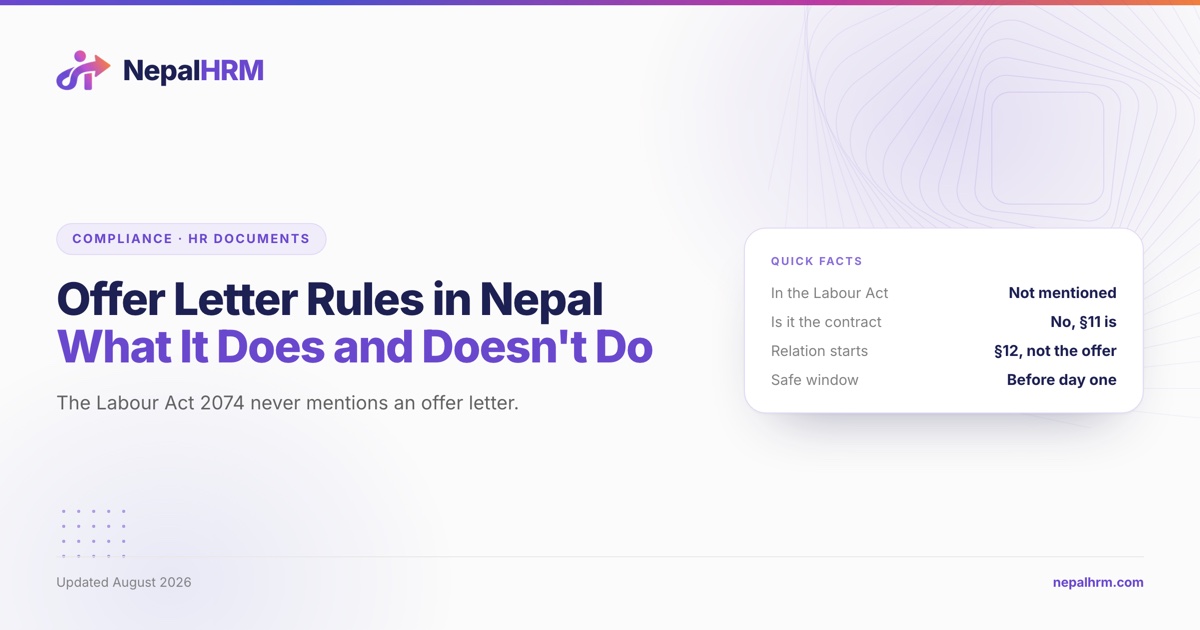
The Labour Act 2074 does not contain the words offer letter. It regulates the employment contract under Section 11 and the moment the employment relation begins under Section 12, and an offer letter is neither. Everything an employer needs to know about offer letters in Nepal follows from that silence.
This guide covers what the offer stage actually is under Nepali law, why an offer letter cannot substitute for the contract, how conditional offers and withdrawals work, and where the risk moves once someone starts work. It sits under our complete guide to the Nepal Labour Act 2074.
Table of Contents
- Why Nepal's law is quiet about it
- The three moments that matter
- What to put in an offer letter
- Conditional offers
- Withdrawing an offer
- Where offer letters go wrong
- The sequence that works
- Frequently asked questions
- Is an offer letter legally binding in Nepal?
- Is an offer letter the same as an appointment letter in Nepal?
- Can an employer withdraw a job offer in Nepal?
- What should an offer letter include in Nepal?
- Can we let someone start work before the contract is signed?
- Do foreign nationals need anything before an offer?
- Sources
Why Nepal's law is quiet about it
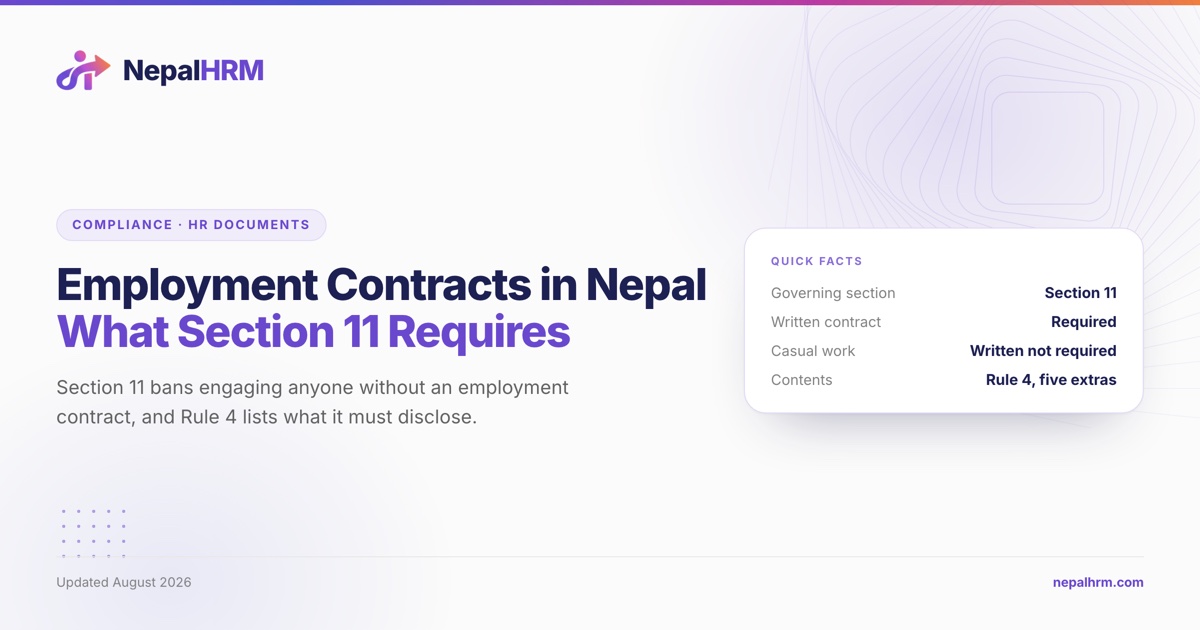
Nepali labour law is built around a single instrument. Section 11(1) says the employer shall not engage anyone in work without an employment contract. Section 11(3) says what it must contain. Rule 4 of the Labour Rules 2075 adds five more items. Section 12(1) says when the relation starts.
Nowhere in that chain is there a preliminary document. The offer letter exists because recruitment needs one, not because the Act asked for it, and it takes its force from general contract law rather than from the Labour Act. That gives it two properties worth understanding before you send the next one.
First, it does not satisfy Section 11. An employer who sends an offer, receives an acceptance, and lets the person start work on the first of the month has still not made an employment contract. Section 11(1) is breached from that first day.
Second, it does not delay anything. Section 12(1) establishes the employment relation on the contract, on an oral engagement, or from the date the worker commenced work in casual employment. An offer letter is not a way to keep a new joiner outside the Act until the paperwork catches up.
The three moments that matter
| Moment | What it is | What governs |
|---|---|---|
| The offer is sent and accepted | A promise about a future contract | General contract law |
| The contract is signed | The employment terms come into existence | §11, §11(3), Rule 4 |
| Work begins | The employment relation exists | §12(1) |
The window between the first and the third is where an offer can be withdrawn at low cost. Once the third has happened, you are in the Act, and ending the employment requires a lawful ground and an adequate stated reason under Section 139.
Most Nepali employers collapse moments two and three into one: the contract is signed on the joining date. That is fine, and it is why the joining date is the date that matters most in the sequence.
What to put in an offer letter
An offer letter is a commercial document, so its content is your choice. But because it is very often the only thing the candidate reads carefully, and because they will hold you to it, keep it consistent with what the contract will say.
- Position and reporting line, matching Rule 4(b), which requires the contract to state the main work and the position.
- Which of the five employment types the role is, under Section 10. Regular, work-based, time-based, casual or part-time. Guessing here and correcting later is how a work-based hire ends up arguing they were regular. Our guide to employment types in Nepal sets out the five.
- The remuneration structure, with basic identified separately from allowances. Basic drives gratuity, provident fund and SSF, so an offer that quotes only a gross figure is quoting the one number none of those compute on. See basic salary and gross salary.
- The probation period, if any. Section 13 caps it at six months.
- The joining date, which is the date Section 12 keys off.
- Every condition, in writing, with what happens if one is not met.
- A line saying the employment contract will follow and will govern. This is the sentence that stops an offer letter from being argued as the contract.
- A validity date for the offer itself.
Do not put in an offer letter anything you cannot honour in the contract, because Section 3(2) will void the below-floor parts of the contract and leave you having promised the rest.
Conditional offers
A conditional offer works only if the condition is stated in the offer, is capable of being checked, and is actually checked before the joining date. Common conditions in Nepal:
- Verification of academic certificates and the previous employer's experience certificate.
- Reference checks.
- A medical check where the role's nature requires one.
- A work permit for a foreign national. This one is not optional. Section 22(1) requires the Department's labour permit before an employer engages a foreign citizen at all, obtained through the Rule 7 application. An offer to a foreign candidate that does not treat the permit as a precondition is an offer you may be unable to honour lawfully.
- Regulatory clearance where the sector requires it.
Check the conditions before the start date. Once the person has begun work, Section 12(1) has done its job and a failed reference check is no longer a condition, it is a termination.
Withdrawing an offer
Before the joining date and before any contract is signed, the exposure is a contractual one about the promise, not a labour-law one. Reduce it by:
- Stating a validity period on the offer.
- Naming every condition and its consequence.
- Withdrawing in writing, promptly, with the reason, rather than going quiet.
- Never letting the person start while you decide. The start date is the line.
After the joining date the position changes completely. Section 139(1) permits termination only under the Act, the Rules or the by-laws, and Section 139(2) requires a proper and adequate reason to be stated. If the person is on probation, Section 13 gives you the six-month window and the ground of unsatisfactory work; that is a real route, and it is the only reason a hiring mistake caught in week two is manageable.
Where offer letters go wrong
- The offer is treated as the contract. No Rule 4 items, no by-laws clause, no employment type. Section 11(1) is unmet for as long as it lasts.
- The offer promises more than the contract delivers. Two documents, different numbers, and the candidate has both.
- The offer quotes gross only. The first payslip splits it into basic and allowances and looks like a cut.
- Probation is written as a year. Section 13 caps it at six months, so month seven is a confirmed employee regardless of the letter.
- A foreign hire is onboarded before the labour permit. Section 22(1) prohibits the engagement, not just the payroll.
- The person starts before signing. The relation exists under Section 12(1) and the terms do not exist anywhere.
The sequence that works
- Offer letter, with conditions and a validity date.
- Written acceptance.
- Conditions cleared, in writing, on file.
- Employment contract signed, covering Section 11(3) and Rule 4.
- Joining date. Section 12 relation begins, with terms already in place.
- Personal record opened under Rule 81(1), and pay and attendance records kept for the five years Rule 81(3) requires.
Steps 4 and 5 can share a date. They cannot swap places.
Getting the joining date right is a records problem. NepalHRM opens the employee record, the document checklist and the probation review date from the same joining date, so nothing depends on someone remembering. See how onboarding works.
Frequently asked questions
Is an offer letter legally binding in Nepal?
The Labour Act 2074 does not regulate offer letters, so its force comes from general contract law rather than labour law. What it is not is an employment contract: Section 11(1) still prohibits engaging anyone without one, and Section 12(1) starts the employment relation on the contract, on an oral engagement, or on the day work begins.
Is an offer letter the same as an appointment letter in Nepal?
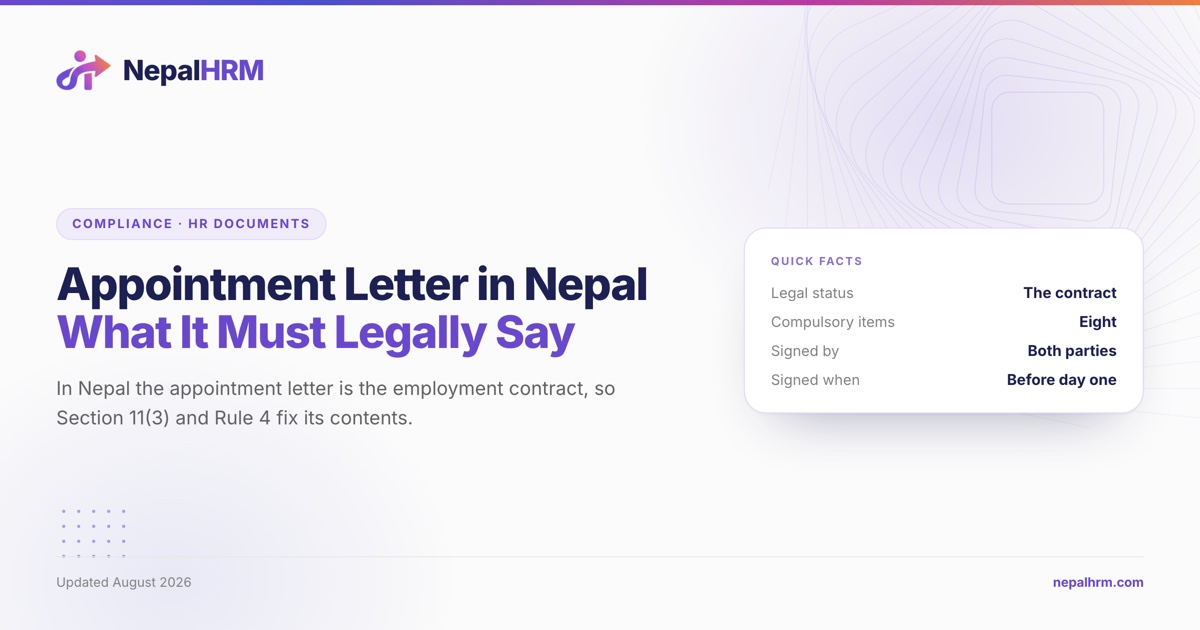
No. In normal Nepali practice the offer letter proposes the job and the appointment letter is the employment contract itself, carrying the Section 11(3) and Rule 4 contents. Only the second one discharges Section 11(1).
Can an employer withdraw a job offer in Nepal?
Before the joining date, and before an employment contract is signed, this is a contractual question about the promise. After the person starts work the employment relation exists under Section 12(1), and Section 139 then requires a lawful ground and an adequate stated reason.
What should an offer letter include in Nepal?
Position and reporting line, the employment type under Section 10, the salary structure with basic identified separately, the probation period if any, the joining date, every condition in writing, a validity date, and a statement that an employment contract will follow and will govern.
Can we let someone start work before the contract is signed?
You can, and Section 11(1) is breached when you do. The employment relation exists from that day under Section 12(1) regardless, so the only thing missing is your written record of the terms, which is what Section 12(4) will ask you to produce in a dispute.
Do foreign nationals need anything before an offer?
A labour permit from the Department under Section 22(1), applied for under Rule 7 with the published advertisement, passport copy, biodata, tax clearance and a replacement plan. Treat it as a precondition in the offer, not as onboarding paperwork.
Sources
- Labour Act, 2074 (2017), consolidated Nepali text as amended through 2082, Nepal Law Commission: lawcommission.gov.np. Sections 3, 10, 11, 12, 13, 22, 27, 53 and 139 were read from that text, retrieved 2026-08-07.
- Labour Rules, 2075 (2018), Nepali text, Nepal Law Commission. Rules 4, 7 and 81 were read from that text, retrieved 2026-08-07.
Related reading: Employment contracts in Nepal · Appointment letters in Nepal · Probation period in Nepal