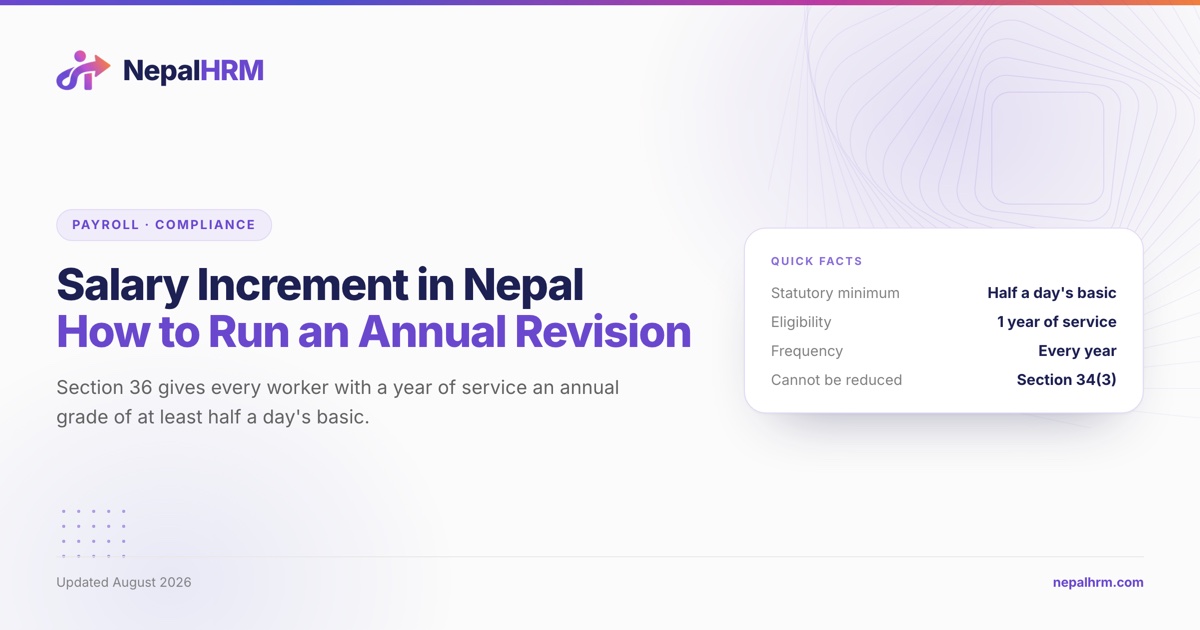
Nepal's Labour Act 2074 does set a floor for annual salary increases, and it is lower than almost everyone assumes. Section 36 entitles a worker who has completed one year of service to an annual grade worth at least half a day of their monthly basic remuneration, every year. On a basic of NPR 24,000 that is about NPR 400 a month, using the thirty-day month Nepali payroll conventionally applies.
That floor is a legal minimum, not a market rate, and the gap between them is where the actual decision lives. This guide covers what Section 36 requires, what an increment really costs an employer once the statutory contributions move with it, when to run the revision, and the order the work has to happen in. It sits under our guide to switching HR and payroll software at the new fiscal year, because the revision and the year boundary are usually the same conversation.
Table of Contents
- What Section 36 actually says
- The increment you cannot undo
- What an increment really costs
- Fiscal year or joining anniversary
- Running the revision, in order
- Four mistakes that cost real money
- Frequently asked questions
- Is an annual salary increment mandatory in Nepal?
- How much is the minimum salary increment in Nepal?
- Can a company skip the annual increment in Nepal?
- Can salary be reduced in Nepal?
- When do salary increments happen in Nepal?
- Does a salary increment change PF, SSF and gratuity?
- How are salary arrears handled after a backdated revision?
- Sources
What Section 36 actually says
The provision is one sentence: a worker who has completed a service period of one year shall receive, every year, an annual salary increment or grade equal to at least half a day's remuneration of the basic remuneration they receive monthly.
Four things follow from it.
It is annual and recurring. The words are every year, not once on confirmation. A grade skipped in a bad year is a grade owed.
It attaches to service, not to performance. Section 36 sets no rating, no appraisal and no target. Performance-based increases sit on top of the grade; they do not replace it.
One year of service is the qualifying condition. An employee who has not yet completed a year has no Section 36 entitlement, though they are already earning provident fund or Fund contributions, gratuity and leave from day one. See probation period in Nepal.
It is measured on basic, not on gross. Where basic is a small share of a large allowance-heavy package, the statutory grade shrinks with it. Half a day of basic on a package that is 30% basic is half of what it is on a package that is 60% basic.
| Monthly basic | Half a day, 30-day convention | Annual cost of the Section 36 floor |
|---|---|---|
| NPR 12,170 | NPR 203 | NPR 2,436 |
| NPR 24,000 | NPR 400 | NPR 4,800 |
| NPR 60,000 | NPR 1,000 | NPR 12,000 |
The Act fixes the fraction and leaves the divisor open. Nepali payroll conventionally divides a monthly figure by thirty, and that is what the table above does, but it is a convention rather than a statutory rule. Where the employment contract states a divisor, that is the number that governs.
The increment you cannot undo
Section 34(3) is short and absolute: except as provided in a collective agreement between the employer and the workers, the remuneration and benefits an employee has been drawing shall not be reduced.
That makes every increment a one-way ratchet. A generous year sets a new floor that a lean year cannot walk back, which is the real argument for splitting a revision into a permanent grade component and a variable component that is genuinely variable: a bonus, a festival payment, a project allowance with a stated end. Once a figure lands in the basic column, Section 34(3) keeps it there.
What an increment really costs
Raising gross by 10% does not raise employer cost by 10%. Basic moves, and everything that is priced on basic moves with it. The figures below are generated from the same engine as our salary tax calculator, on the FY 2083/84 tables, with basic set at 60% of gross.
| Before | After a 10% revision | |
|---|---|---|
| Gross | NPR 40,000 | NPR 44,000 |
| Basic, at 60% | NPR 24,000 | NPR 26,400 |
| SSF employee, 11% of basic | NPR 2,640 | NPR 2,904 |
| SSF employer, 20% of basic | NPR 4,800 | NPR 5,280 |
| Employee net | NPR 37,360 | NPR 41,096 |
| Employer cost | NPR 44,800 | NPR 49,280 |
So a NPR 4,000 rise costs NPR 4,480, and the useful budgeting rule under the Social Security Fund is 1.12 times gross. On the older arrangement the arithmetic differs and the answer is close: provident fund adds 10% of basic and gratuity accrues at 8.33% of basic a month under Section 53(2), which together take the same NPR 40,000 package to about NPR 44,400 of employer cost, or 1.11 times gross.
Gratuity is the line most budgets forget, because it is an accrual rather than a payment. It is nonetheless a cost incurred in the month the higher basic is paid.
Five other things move when basic moves, and each of them is worth checking in the same pass:
- Overtime, at 1.5 times the basic hourly rate under Section 31(1).
- Festival expense, one month's basic under Section 37(1), so an increment before Dashain raises it.
- Leave encashment, paid at the last basic remuneration drawn under Section 49(2), which prices old leave days at the new rate.
- Retrenchment compensation, one month's basic per year of service under Section 145(7).
- TDS, because annual taxable income has changed and Nepali salary withholding is a projection over the remaining months, not a recomputation of one month.
Fiscal year or joining anniversary
Both are lawful. Section 36 speaks of completing a year of service, which points at the anniversary, and nothing in the Act requires a single company-wide date. Practice in Nepal splits roughly along size, and each choice has a cost.
| Fiscal-year cycle | Anniversary cycle | |
|---|---|---|
| Effective date | Shrawan 1 for everyone | Each employee's own date |
| Budgeting | One decision, one number | Twelve smaller ones |
| Tax projection | Recomputed once, cleanly | Recomputed on a rolling basis |
| Section 36 risk | A joiner mid-year can drift past a year of service without a grade | Naturally aligned to service |
| Fairness optics | Comparable across a team | Two peers on different clocks |
The practical middle: run the revision on the fiscal-year cycle, and run a Section 36 sweep alongside it for anyone whose service year completed since the last cycle. That gets the budgeting benefit without letting the statutory floor slip for people who joined at the wrong time of year.
One date is not optional. Section 106(1) requires the Ministry to fix minimum remuneration at least every two years, and Section 106(4) applies the revised figure from the first day of the new fiscal year, unless the trade union and employer have agreed otherwise. If a revision has been gazetted, anyone below the new floor has to be moved at Shrawan 1, whatever your appraisal calendar says. See minimum wage and Nepal's fiscal year explained.
Running the revision, in order
Freeze the data first. Confirmed service length, current basic and allowance split, current grade history and any mid-year changes already applied. A revision computed on stale basic is a revision you will redo.
Check the two floors before the budget. The Section 36 grade for everyone past a year of service, and the gazetted minimum remuneration for everyone near the bottom of the scale. These are not negotiable, so they belong in the budget rather than in the negotiation.
Set the pot, then the distribution. Budget on employer cost, not on gross, using the 1.12 or 1.11 multiplier above. A pot set on gross is 11 to 12% short before anyone argues about who gets what.
Decide what is permanent. Anything added to basic is protected by Section 34(3) forever. Anything genuinely variable should be structured, named and dated as variable.
Fix the effective date and handle the arrear honestly. A revision decided in Bhadra with effect from Shrawan 1 owes two months of arrears. Pay them as an arrear line in the month they are paid, and recompute the annual tax projection at the same time so the remaining months carry the correct withholding.
Reconfigure the statutory lines in the same run. New basic means new provident fund or Fund base, new gratuity accrual, new overtime rate and a new festival expense figure. See six SSF mistakes that cost Nepali employers money for what happens when the base and the deduction drift apart.
Issue letters that state the components. An increment letter that names only a gross figure leaves the basic-to-allowance split unrecorded, and that split is what the Act prices everything else on.
Four mistakes that cost real money
Revising gross without revising the split. A 10% rise applied entirely to allowance leaves basic flat, which quietly holds down gratuity, the Fund contribution, overtime and the festival expense. It also drifts the package away from whatever ratio was agreed in the contract.
Skipping the grade for a poor performer. Section 36 is not conditional on performance. Poor performance has its own route in Section 142, which requires three consecutive unsatisfactory evaluations before termination, and withholding a statutory grade is not part of it. See termination and notice period in Nepal.
Forgetting mid-year joiners. On a fiscal-year cycle, someone who joined in Magh completes a year in the middle of the next cycle. Without a sweep, their Section 36 entitlement waits eighteen months.
Leaving the tax projection alone. Withholding is computed across the year. A revision in Bhadra that does not recompute the projection produces eleven months of one figure and a violent correction in Ashad, which the employee experiences as an unexplained pay cut.
A revision is one decision and about nine downstream recalculations. NepalHRM holds the basic and allowance structure on the employee record, applies a revision with its effective date and its arrears, moves the statutory deductions with basic automatically, and recomputes the annual tax projection so the remaining months carry the right withholding. See how payroll works, or book a walkthrough.
Frequently asked questions
Is an annual salary increment mandatory in Nepal?
Yes, at a minimum level. Section 36 of the Labour Act 2074 entitles a worker who has completed one year of service to an annual grade equal to at least half a day's remuneration of their monthly basic, every year. Anything above that is the employer's decision.
How much is the minimum salary increment in Nepal?
At least half a day's basic remuneration a year. On a basic of NPR 24,000, applying the conventional thirty-day month, that is about NPR 400 a month or NPR 4,800 a year. The Act fixes the fraction, not a percentage, and does not itself state the divisor.
Can a company skip the annual increment in Nepal?
Not the Section 36 grade, for an employee past a year of service. Performance is dealt with under Section 142, which requires three consecutive unsatisfactory evaluations before termination, and is not a route to withholding a statutory entitlement.
Can salary be reduced in Nepal?
Section 34(3) prohibits reducing the remuneration and benefits an employee has been drawing, except where a collective agreement between the employer and the workers provides otherwise. That is why anything permanent should be added to basic deliberately.
When do salary increments happen in Nepal?
There is no statutory date. Larger employers usually run a company-wide revision effective Shrawan 1, the first day of the fiscal year, and smaller ones use the joining anniversary. A minimum-wage revision is different: Section 106(4) applies it from the first day of the new fiscal year.
Does a salary increment change PF, SSF and gratuity?
Yes, whenever basic moves. Provident fund is 10% deducted and 10% matched under Section 52(2), gratuity accrues at 8.33% of basic a month under Section 53(2), and Social Security Fund contributions are 11% and 20% of basic. All three are recalculated from the new basic in the first period the revision applies.
How are salary arrears handled after a backdated revision?
Pay the difference for the elapsed months as an arrear line in the period it is actually paid, and recompute the annual tax projection at the same time so the remaining months of the year carry the corrected withholding rather than a single large adjustment at the year end.
Sources
- Labour Act, 2074 (2017), consolidated Nepali text as amended through 2082, Nepal Law Commission: lawcommission.gov.np. Sections 31, 34, 36, 37, 49, 52, 53, 106, 142 and 145 were read from that text, retrieved 2026-08-07.
- Income Tax Act, 2058 (2002), consolidated Nepali text as amended by the Finance Act 2082, Inland Revenue Department: ird.gov.np, for the annual projection basis of salary withholding.
- Every payroll figure in the cost table is computed with
lib/nepal-payroll.ts, the same module behind the salary tax calculator, on the FY 2083/84 tables.
Related reading: Nepal's fiscal year explained · Payroll year-end checklist for Nepal · Gratuity in Nepal