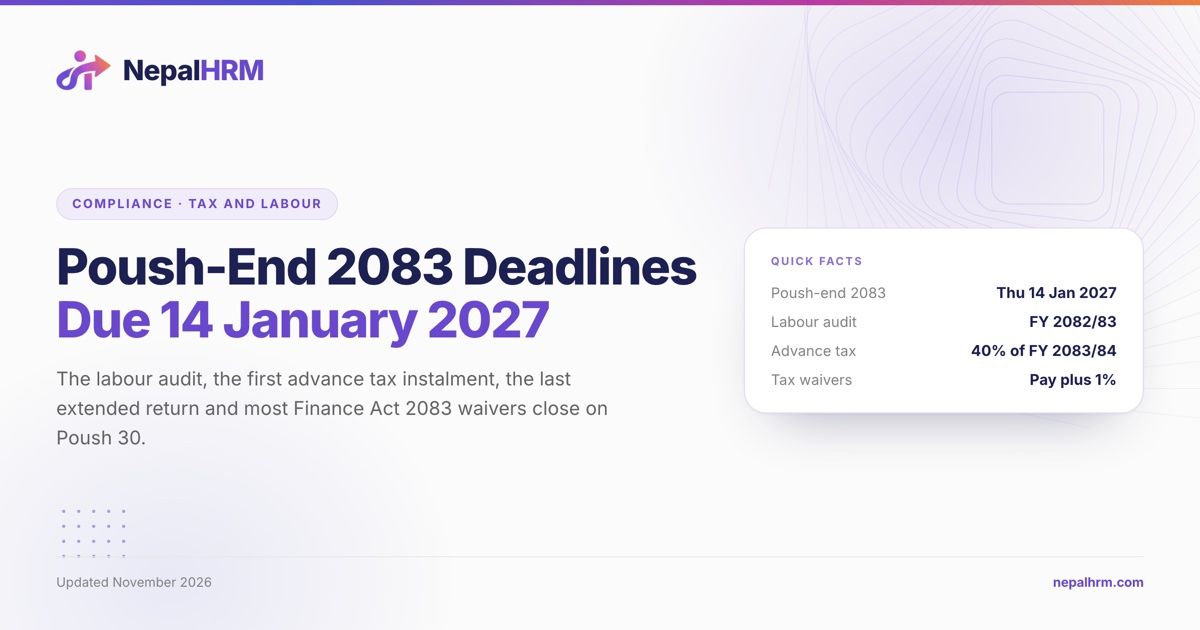
Poush masanta (पुस मसान्त) 2083, the last day of Poush, is Thursday 14 January 2027, and it is the busiest compliance day of the Nepali year for a private employer. The labour audit for FY 2082/83, the Bonus Act accounts to the Labour Office, a private company's annual financial statements to the Company Registrar, the first advance tax instalment and estimate for FY 2083/84, and the last day for a FY 2082/83 income return filed on an extension all fall on it, and so do most of the Finance Act 2083 waiver windows. Magh 1, the next day, is Maghe Sankranti.
What makes Poush-end hard is that the duties land together, in the same weeks as the Mangsir TDS and SSF deposits, and each one is owned by a different person: HR for the audit, finance for the tax, the company secretary or auditor for the filings. This page puts them on one list with the section behind each, so one person can check that all of them have an owner.
Table of Contents
- Everything due by Poush 30, 2083
- 1. The labour audit for FY 2082/83
- 2. The first advance tax instalment for FY 2083/84
- 3. The last date for an extended FY 2082/83 return
- 4. Company annual filing (company renewal) with the Office of the Company Registrar
- 5. Finance Act 2083 waivers that close at Poush-end
- 6. Also in Poush: the Mangsir TDS and SSF deposit
- A four-week plan for Poush
- Frequently asked questions
- What is the Poush-end deadline in Nepal?
- When is the labour audit due for FY 2082/83?
- When is company renewal (annual filing) due for a private company in Nepal?
- Who has to pay advance tax in Poush?
- Can I still file my FY 2082/83 income tax return in Poush?
- What is the Finance Act 2083 waiver for unpaid TDS?
- Sources
Everything due by Poush 30, 2083
| Duty | What has to happen | Law |
|---|---|---|
| Labour audit, FY 2082/83 | Every enterprise: Schedule 10 report done and kept; last year the Department asked for it to be submitted | Labour Act §100; Labour Rules r.56 |
| Bonus Act accounts | Ten or more people: balance sheet and profit and loss to the Labour Office | Bonus Act §4(1) |
| First advance tax instalment | Business or investment income: estimate filed, and 40% of FY 2083/84 estimated tax paid | Income Tax Act §94(1), §95 |
| Extended FY 2082/83 return | Returns on the full three-month extension: file and pay | Income Tax Act §96, §98 |
| Company annual filing | Private companies: audited statements to the Company Registrar | Companies Act §80(2) |
| Finance Act 2083 waivers | Unpaid tax or missing filings: pay plus 1% and file | Finance Act 2083 |
| Mangsir TDS and SSF | Every employer, by Poush 25, Saturday 9 January | Income Tax Act §90; SSF Act §4(4) |
The sections below take each one in turn. For the rest of the year, see the payroll compliance calendar for FY 2083/84.
1. The labour audit for FY 2082/83
Section 100(1) of the Labour Act 2074 requires every enterprise to audit whether it operates in accordance with the Act, the Rules and other law, and to prepare a report. Rule 56(1) of the Labour Rules 2075 dates it: by the end of Poush each year, on the format in Schedule 10. The audit due this Poush covers FY 2082/83, the year that closed at the end of Ashad 2083.
Rule 56(2) frames the report as something the enterprise keeps on Schedule 10 and produces to an inspector, and Rule 56(4) requires copies to its labour relations committee and its sector regulator. In practice the Department of Labour and Occupational Safety has asked for more: its notice for last year's audit asked enterprises to submit the report to their Labour and Employment Office, online through the department's ILMIS system or by email, and the department reported receiving 3,390 reports between Shrawan 2082 and Jestha 2083. As of Kartik 18, 2083 it had not yet published this year's notice, so check its notices page in Poush for the current route.
There is no size threshold. Every enterprise owes the audit; only the copy to a labour relations committee depends on size, because Section 111 requires that committee at ten or more workers.
The form asks about thirty things, from appointment letters and overtime to provident fund, gratuity and bye-laws, plus a headcount split by employment type. A false entry is fineable up to NPR 20,000 under Section 163(2)(b), on the person who gave it and on the manager, each time.
Our labour audit checklist sets out every Schedule 10 question in English with the section behind it, and the labour audit working form is a free Excel copy you can fill in.
The same office is owed a second document on the same day. Section 4(1) of the Bonus Act 2030 requires the manager of an enterprise to prepare its balance sheet and profit and loss statement under the Companies Act 2063 and send them to the Labour Office within six months of the fiscal year ending, which for FY 2082/83 is also the end of Poush. The Bonus Act applies to enterprises with ten or more people, and the bonus itself is due later, by the end of Falgun, under Section 9(2). See bonus and festival expense in Nepal.
2. The first advance tax instalment for FY 2083/84
Section 94(1) of the Income Tax Act 2058 requires a person with assessable income from a business or an investment to pay tax in instalments during the year, against an estimate of the year's tax:
| Instalment | Due by | Cumulative share of estimated tax |
|---|---|---|
| First | End of Poush 2083 (14 January 2027) | 40% |
| Second | End of Chaitra 2083 (13 April 2027) | 70% |
| Third | End of Ashad 2084 | 100% |
Each instalment is cumulative, measured against tax already paid for the year, including tax withheld at source from the company's own receipts. The Inland Revenue Department's FAQ sets out the same 40, 70 and 100 split.
The estimate is due with the first payment. Section 95 requires every person who pays instalments to file an estimate of the year's assessable income and tax with the Department by the date of the first instalment, so by the end of Poush. The estimate holds for the year unless a revised one is filed with reasons, and a revision changes only the instalments that fall after it.
Two points catch people. First, taxpayers on the turnover-based presumptive scheme pay in two instalments instead, under Section 94(1ka): by the end of Poush on turnover up to Poush 20, and by the end of Ashad on the rest of the year, less what was paid in Poush. Second, an underpaid instalment costs interest under Section 118 at the normal rate, which Section 2 sets at 15% a year, for each month and part of a month.
A salaried employee whose only income is employment income does not pay instalments: their tax is withheld every month by the employer under Section 87. A salaried person who also runs a business is a different case. For how the monthly withholding works, see TDS on salary in Nepal.
3. The last date for an extended FY 2082/83 return
The ordinary deadline for the FY 2082/83 income return was the end of Asoj 2083, Saturday 17 October 2026, under Section 96(1). Section 98 lets the Department extend that by up to three months on a written application made inside the original window. Three months from the end of Asoj is the end of Poush, so this is the last day any FY 2082/83 extension can reach.
The IRD's own FAQ is direct about the cost: an extension of time to file does not waive the interest. Interest under Section 119 on tax payable with the return runs from the end of Asoj until it is paid. An extension buys time for the paperwork, not for the money. Our payroll year-end checklist covers what goes into the return.
4. Company annual filing (company renewal) with the Office of the Company Registrar
Section 80(2) of the Companies Act 2063 requires every private company to file a copy of its annual financial statements, certified by its auditor, with the Office of the Company Registrar within six months of the fiscal year ending. For FY 2082/83 that is the end of Poush 2083. Section 80(3) allows the filing to be uploaded electronically, and in practice it is made from the company's account on the Registrar's online system, CAMIS, which also works out any fine.
Late filing is fined under Section 81(2), on a scale set by paid-up capital and by how late the filing is:
| Delay after the deadline | Paid-up capital up to NPR 25 lakh | Up to NPR 1 crore | Above NPR 1 crore |
|---|---|---|---|
| First three months | NPR 1,000 | NPR 2,000 | NPR 5,000 |
| Next three months | NPR 1,500 | NPR 3,000 | NPR 7,000 |
| Next six months | NPR 2,500 | NPR 5,000 | NPR 10,000 |
| Each year after that | NPR 5,000 | NPR 10,000 | NPR 20,000 |
Companies already behind have a one-time window to the same date. A notice from the Office of the Company Registrar dated 2083/07/17, issued under Section 48 of the Finance Act 2083, extends to the end of Poush 2083 a waiver for companies with unpaid fees or fines. A company that files its missing returns through CAMIS and pays what the notice sets as due for FY 2082/83 has the fees and fines of all earlier years waived. Read the notice itself for what counts as due.
5. Finance Act 2083 waivers that close at Poush-end
The Finance Act 2083 (आर्थिक ऐन, २०८३, also published in English as the Economic Act 2083), gazetted on 2083/03/30 (14 July 2026), opened a set of one-time tax windows alongside the company filing waiver above. In each, a taxpayer who pays the outstanding tax, usually with 1% extra, and files what is missing, has the fees, interest and penalties waived. The section numbers and deadlines below are from the Inland Revenue Department's information booklet on the Act, revised on Asoj 26, 2083.
| Section | Who | Condition | What is waived | Closes |
|---|---|---|---|---|
| §44 | Returns filed but tax still unpaid at Jestha 15, 2083 | Pay the balance plus 1% | Fees, additional fees, penalties, interest and late fees | Poush-end 2083 |
| §40(1) | Earned taxable income without a PAN | Take a PAN, file returns for FY 2079/80 to 2082/83, pay the tax | Fees and interest; earlier years need not be filed | Poush-end 2083 |
| §40(2) | PAN holders with no income or transactions | File the FY 2082/83 return, then apply to close or reactivate the PAN | Earlier unfiled returns. Without an application the PAN is cancelled | Poush-end 2083 |
| §40(3) | PAN holders with unpaid tax or unfiled returns | Pay the tax plus 1% and file | Fees and interest | Poush-end 2083 |
| §45 | Tax assessed by Jestha 15, 2083 and still unpaid | Pay the assessed amount plus 1%, then apply | Fees, additional fees, penalties, remaining interest | Poush-end 2083 |
| §46 | Assessments under administrative review or in court | Withdraw the case, pay plus 1% | As §45 | Poush-end 2083 |
| §41 | VAT-registered persons who did not collect or file | File returns to Chaitra 2082, pay the tax plus 1% | Interest, additional fees, penalties | Poush-end 2083 |
The one employers should read twice is Section 44. The IRD booklet treats TDS that was withheld from staff but never deposited, and shown as a liability in a filed return, as tax under Section 44. Its worked example: TDS of NPR 75,000 still unpaid, settled with NPR 75,750 by Poush-end, clears every fee and interest charge on it. If a past payroll withheld tax that never reached the IRD, this is the cheapest route open now to fix it.
Two related windows close a month earlier, at the end of Mangsir 2083, Tuesday 15 December 2026: Section 47, for resident staff of UN bodies, international organisations and foreign missions, who pay the income tax for FY 2079/80 to 2082/83 plus 1% and file; and Section 49, for dues under earlier Finance Acts, paid with 1% extra.
The booklet says the Act prevails wherever the two differ. Read the section that applies to you before you pay, or ask your auditor.
6. Also in Poush: the Mangsir TDS and SSF deposit
The monthly deadlines do not pause for Poush-end. Tax withheld from Mangsir salaries, with the eTDS statement, is due within 25 days of the month ending under Section 90 of the Income Tax Act, and the Mangsir SSF contribution under Section 4(4) of the Contribution Based Social Security Act 2074. Mangsir 2083 ends on 15 December, so both fall on Poush 25, Saturday 9 January 2027. That is a Saturday: plan the deposit for the working day before.
The guides to the monthly eTDS statement and monthly SSF deposits cover the mechanics.
A four-week plan for Poush
Poush 2083 runs from Wednesday 16 December 2026 to Thursday 14 January 2027. Working back from the last day:
- Week of 16 December: name the owners. One person each for the labour audit and Bonus Act accounts, the company filing, the advance tax estimate, any extended return, and any waiver. The usual failure is not a missed deadline, it is a deadline that nobody thought was theirs.
- Week of 23 December: pull the numbers. Headcount by employment type, leave actually given, and PF, gratuity and SSF deposited per employee, checked against the fund statements, for the audit. Year-to-date profit for the advance tax estimate. Any unpaid TDS or tax, for the waiver check.
- Week of 30 December: fill and decide. Complete the Schedule 10 form, write the fix and date against every "no", and settle the Section 95 estimate behind the 40% instalment.
- Week of 6 January: pay and file early. Mangsir TDS and SSF before Saturday 9 January, then the labour audit report, the Bonus Act accounts, the company statements, the estimate and instalment, the extended return and any waiver payment before Thursday 14 January. Monday 11 January (Poush 27) is Prithvi Jayanti, a public holiday, so the last week has four working days, and bank and portal queues lengthen at the end of Poush.
Most of Poush-end is pulling data that should already be in one place. NepalHRM keeps headcount by employment type, leave actually taken, and the PF, gratuity and SSF calculated for each employee every month, so most of the labour audit's numbers come from a report rather than a fortnight of spreadsheets. It also produces the monthly eTDS file and SSF figures from the closed payroll run. Your team still files and pays. See how payroll and compliance work, or book a walkthrough.
Frequently asked questions
What is the Poush-end deadline in Nepal?
Poush-end, or Poush masanta, is the last day of the Nepali month of Poush. In BS 2083 it is Poush 30, which is Thursday 14 January 2027. The annual labour audit, the Bonus Act accounts, a private company's annual financial statements, the first advance tax instalment and estimate, the last extended income return for the previous year, and most Finance Act 2083 waiver windows fall due on it.
When is the labour audit due for FY 2082/83?
By the end of Poush 2083, which is 14 January 2027. Rule 56(1) of the Labour Rules 2075 requires every enterprise to have the audit done by the end of Poush each year, on the format in Schedule 10. Last year the Department of Labour and Occupational Safety asked for the report to be submitted to the Labour and Employment Office, online through ILMIS or by email, so check its notice for this year.
When is company renewal (annual filing) due for a private company in Nepal?
Within six months of the fiscal year ending, under Section 80(2) of the Companies Act 2063. For FY 2082/83 that is the end of Poush 2083, 14 January 2027. The auditor-certified statements go to the Office of the Company Registrar, in practice through its online system CAMIS, and late filing is fined on a scale under Section 81(2).
Who has to pay advance tax in Poush?
Anyone with assessable income from a business or an investment, under Section 94(1) of the Income Tax Act 2058. The first instalment is 40% of the estimated tax for FY 2083/84, less tax already paid, and Section 95 requires the estimate itself to be filed by the same date. Taxpayers on the turnover-based scheme pay in two instalments instead, in Poush and Ashad.
Can I still file my FY 2082/83 income tax return in Poush?
Yes, but it is on time only if the Department granted an extension under Section 98, applied for before the end of Asoj 2083. The longest extension is three months, which ends at Poush-end. Without an extension the return is late and carries a late-filing fee under Section 117 as well as interest. Interest on unpaid tax runs from the end of Asoj either way.
What is the Finance Act 2083 waiver for unpaid TDS?
Under Section 44 of the Finance Act 2083, tax shown on a filed return but still unpaid at Jestha 15, 2083, including TDS withheld from employees and not deposited, can be paid with 1% extra by Poush-end 2083. The fees, penalties, interest and late fees on it are then waived.
Sources
- Labour Act, 2074 (2017), consolidated Nepali text, Nepal Law Commission: lawcommission.gov.np. Sections 100, 111 and 163.
- Labour Rules, 2075 (2018), Nepali text published by the Social Security Fund: ssf.gov.np. Rule 56 and Schedule 10.
- Department of Labour and Occupational Safety, notices: dolos.gov.np. No labour audit notice for this year as of Kartik 18, 2083. Last year's notice and its ILMIS and email routes as reported by Merojob; report count from Online Khabar, Asar 11, 2083.
- Bonus Act, 2030 (1974), Sections 1(3), 4(1) and 9(2), English translation published by the Department of Industry: doind.gov.np.
- Companies Act, 2063 (2006), Sections 80 and 81, text as published by nepallaws.com.
- Office of the Company Registrar, notice of 2083/07/17 on the Finance Act 2083 Section 48 waiver: ocr.gov.np. Checked 2026-11-04.
- Income Tax Act, 2058 (2002), consolidated Nepali text as amended by the Finance Act 2082, Inland Revenue Department: ird.gov.np. Sections 2, 87, 90, 94, 96, 98, 117, 118 and 119.
- Income Tax Act, 2058, Section 95 (estimate of tax payable), English text as published by nepallaws.com. Checked 2026-11-04.
- Inland Revenue Department, frequently asked questions: ird.gov.np/faq. Instalment shares of 40%, 70% and 100%; the two-instalment rule for turnover-based taxpayers under Section 94(1ka); the three-month return extension and the interest that still runs; the 25-day TDS deposit. Checked 2026-11-04.
- Inland Revenue Department, information booklet on the Finance Act 2083 (Economic Act 2083), revised Asoj 26, 2083: ird.gov.np. Sections 40, 41, 44 to 47 and 49, and the Section 44 TDS example. Checked 2026-11-04.
- Economic Act, 2083, Nepal Gazette dated 2083/03/30, as published by the Inland Revenue Department: ird.gov.np.
- Contribution Based Social Security Act, 2074, consolidated text published by the Social Security Fund: ssf.gov.np. Section 4(4) as amended by the Some Nepal Acts (Amendment) Act 2082.
- Dates: BS 2083 month lengths as used by NepalHRM's Nepali date converter, which agree with the Ministry of Home Affairs holiday notice for 2083 (Nepal Gazette, Falgun 18, 2082).
Related reading: Labour audit checklist and form · Payroll compliance calendar for FY 2083/84 · Nepal payroll year-end checklist