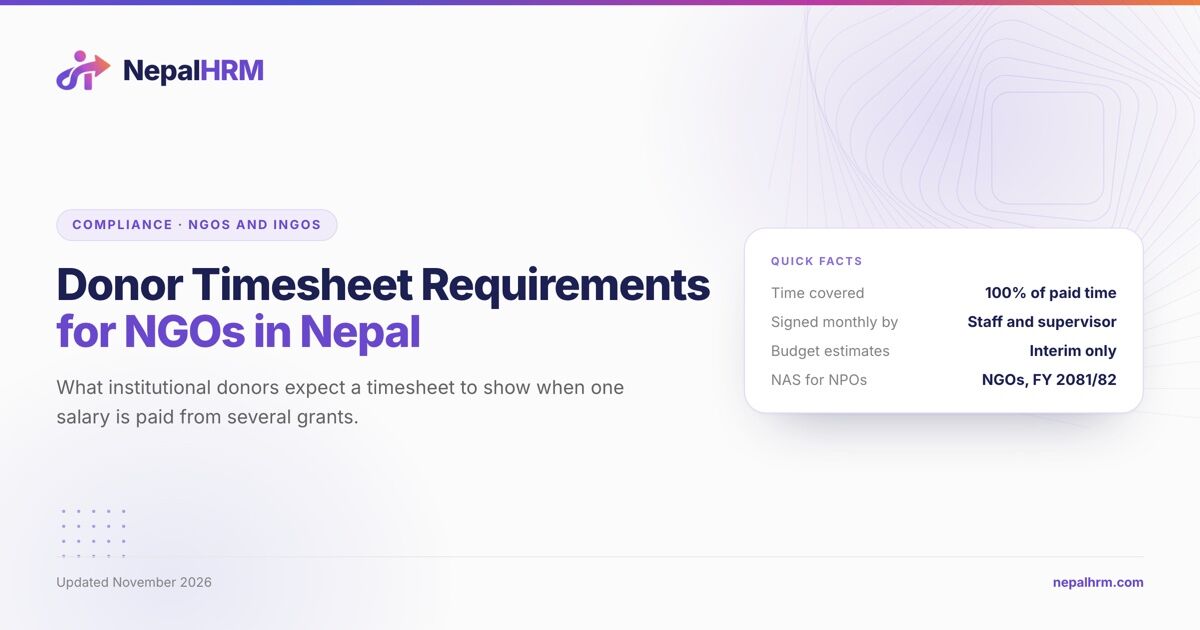
A donor-ready timesheet in a multi-donor NGO accounts for all of the time a person is paid for, splits it across every grant and every non-grant activity, is signed by the employee and approved by a supervisor each month, and reconciles to the payslip it is meant to justify. US federal awards, EU grants and UK FCDO grants each say this in their own words, and the rules converge on the same record.
Below are the rules, quoted from the primary sources, the layer Nepal adds on top, and a checklist to hold your own timesheet against. Your award agreement is what binds you, so read its staff cost clause alongside this.
Table of Contents
- Why one timesheet, not one per donor
- What the rules actually say
- US federal awards: 2 CFR 200.430(g)
- EU grants: monthly signatures and reconciliation to payslips
- UK FCDO: apportionment on time sheets and segregated reporting
- The layer Nepal adds
- NAS for NPOs
- Two calendars
- How long to keep the evidence
- A worked month
- The checklist: what a donor-ready timesheet shows
- Where NepalHRM fits
- Frequently asked questions
- What must an NGO timesheet show for donors?
- Can we charge salaries using the level of effort in the budget?
- Do staff who work only on one project need a timesheet?
- When did NAS for NPOs become mandatory in Nepal?
- Sources
Why one timesheet, not one per donor
Picture a monitoring officer paid partly from an EU-funded award, partly from an FCDO-funded award and partly from core funds. The tempting shortcut is a separate sheet per donor showing "its" hours. It fails every rule below, because a donor has to see the hours charged elsewhere to believe the hours charged to it.
The US rule says so directly: records must "encompass federally-assisted and all other activities compensated by the recipient or subrecipient on an integrated basis" (200.430(g)(1)(iv)). DG Justice's guide for EU action grants required a timesheet to show time on other grants or activities and the total time worked. A sheet showing one donor's hours cannot prove those hours were not also claimed elsewhere.
What the rules actually say
US federal awards: 2 CFR 200.430(g)
The Uniform Guidance is written for "the recipient or subrecipient", and 2 CFR 200.101 lets US agencies apply its cost principles to foreign organisations. So if your award, or a subaward from a US-funded partner, cites 2 CFR 200, this is the paragraph your salary charges answer to. Paragraph (g)(1) opens: "Charges to Federal awards for salaries and wages must be based on records that accurately reflect the work performed." The two items donors cite most:
(iii) Reasonably reflect the total activity for which the employee is compensated by the recipient or subrecipient, not exceeding 100 percent of compensated activities (for IHEs, this is the IBS);
(vii) Budget estimates (meaning, estimates determined before the services are performed) alone do not qualify as support for charges to Federal awards, but may be used for interim accounting purposes, provided that: ... (C) The recipient's or subrecipient's system of internal controls includes processes to perform periodic after-the-fact reviews of interim charges made to a Federal award based on budget estimates. All necessary adjustments must be made so that the final amount charged to the Federal award is accurate, allowable, and properly allocated.
In practice, (vii) is the one that changes month-end work. The level of effort in a proposal is a plan: you may charge payroll against it month by month, but the charges are then compared with the timesheets and corrected. Paragraph (g)(1)(viii) lets the record express activity as a percentage distribution, so hours on the sheet and percentages in the summary are both fine, provided they add up.
EU grants: monthly signatures and reconciliation to payslips
The European Commission's Annotated Grant Agreement (version 2.0, 1 April 2025) annotates the corporate grant agreement used across its 2021–2027 programmes. Article 20 sets the record-keeping duty for personnel costs: time worked for the action "must be supported by declarations signed monthly by the person and their supervisor, unless another reliable time-record system is in place." The annotation adds that "reliable time records must be dated and signed at least monthly by the person working for the action and their supervisor."
Two further passages matter:
- Electronic signatures are accepted in a computer-based system, with "a documented and secure process for managing user rights and an auditable log of all electronic transactions."
- Reconciliation is required. For actual costs, the beneficiary's accounting and internal controls "must enable direct reconciliation between the amounts declared, the amounts recorded in their accounts and the amounts stated in the supporting documents." The worked example for employees lists those documents: contracts, "payslips, time records, bank statements showing salary payments".
The older DG Justice and Consumers Guide for Action Grants 2015 is more concrete about the sheet. Its minimum: the grant number, employer and employee, time on the project, time on other grants or activities, total time, tasks performed, and the dated signatures of employee and manager. It added that "global sheets showing for example 'x' hours spent per month are not accepted", that time should be recorded "normally every day", and that the month's sheet should be approved "ideally during the first week of the following month". The same DG's staff cost briefing listed "costs not matching payslips" and "lack of timesheets or unsuitable timesheets" among the common reasons staff costs were ruled ineligible.
Your EU contract carries its own general conditions, so check which version governs your award.
UK FCDO: apportionment on time sheets and segregated reporting
FCDO's Eligible Cost Guidance for Accountable Grant Arrangements (version 2.4, August 2021) says support costs "should be apportioned to direct costs based on time sheets or allocated based on the key cost drivers of the activity. Supporting documentation of this apportionment should be retained and made available if required." For shared office costs it adds that "any apportionment model should be agreed with SRO", the Senior Responsible Owner on the FCDO side.
The Accountable Grant Arrangement Template (version 3.5, 25 September 2025) asks each payment request to come with financial reports showing actual expenditure against the approved budget and quarterly forecasts for FCDO's financial year, which runs 1 April to 31 March. Then the sentence every multi-donor NGO should underline: "In multi-donor arrangements, these reports should clearly segregate the FCDO proportion of funding." An integrated timesheet is what makes that segregation possible for salaries.
The layer Nepal adds
NAS for NPOs
The Accounting Standards Board of Nepal issued the Nepal Accounting Standards for Not-for-Profit Organizations 2018. ICAN's table of effective dates (29 September 2024) moved its effective date from 1 Shrawan 2078 to 1 Shrawan 2080, FY 2080/81, with an exemption for entities other than INGOs: voluntary in FY 2080/81, mandatory from FY 2081/82.
The ASB's published contents show why a timesheet matters to it. The standard has a section on common cost allocation (section 31), and its guidelines include a Fund Accountability Statement and a Statement of Budget and Expenditure. When salary is charged to a donor's restricted fund, the auditor tracing that figure back lands on your allocation policy and the timesheets behind it. The standard is sold as a book, so we have not quoted that section; read it before you write the allocation policy.
Two calendars
If your payroll runs on Bikram Sambat months while a donor reports on calendar months, a Kartik payslip covers parts of October and November and cannot be matched line for line to one calendar-month timesheet. Decide which calendar the timesheet period uses, write it into your time-recording policy, and keep the month mapping with each reconciliation. Nepal's own fiscal year runs Shrawan to Ashadh (how the Nepali fiscal year works), so a single grant can touch three year-ends: yours, the donor's and the award's.
How long to keep the evidence
| Source | Minimum retention |
|---|---|
| US federal awards, 2 CFR 200.334 | 3 years from the final financial report |
| EU grants, Annotated Grant Agreement | Generally 5 years after the balance is paid (3 years for low-value grants up to EUR 60,000) |
| FCDO accountable grant template | Not less than 5 years after the arrangement ends |
| Labour Rules 2075, Rule 81(3) | Attendance and remuneration records, at least 5 years |
Keep each timesheet for the longest period that applies to it, and longer while an audit or claim is open.
A worked month
A programme officer paid NPR 96,000 gross records 192 paid hours in a month, with time charged across four lines:
| Timesheet line | Hours | Share | NPR charged |
|---|---|---|---|
| Award A (EU) | 84 | 43.75% | 42,000 |
| Award B (FCDO) | 60 | 31.25% | 30,000 |
| Shared and core | 24 | 12.5% | 12,000 |
| Leave and holidays | 24 | 12.5% | 12,000 |
| Total | 192 | 100% | 96,000 |
Three things make this sheet defensible. The total equals all paid time, so no hour is charged twice. The salary lines add back to the payslip exactly, which is the reconciliation the EU text asks for. And leave has its own line: DG Justice's guide noted that holidays and sick leave are not days worked on a project, though their cost is carried through the productive days into the projects worked on. Your award terms decide whether that line is spread across awards or charged to a separate pool. Leave hidden inside a project line charges a donor for hours nobody worked on its project.
If the proposal had budgeted this person at 50% on Award A, the month's actual is 43.75%, and under 200.430(g)(1)(vii) the charge follows the actual.
For the payroll side of the same reconciliation, see payroll accounting in Nepal.
The checklist: what a donor-ready timesheet shows
- 100% of paid time. Every day or hour the person is paid for, including leave, public holidays and unfunded work, with a total.
- The split by grant and cost objective. One line per award or project, plus lines for shared, core or unfunded time.
- Dates. Day-level entries, the period covered and the date of each signature. No single "x hours this month" line.
- Recorded as it happens. Daily or close to it, not rebuilt from memory at month end.
- Certification by the employee. A signed statement that the time shown is a true record, made by the person who did the work.
- Supervisor approval. Dated, by someone who knows the work, ideally within the first week of the next month.
- Actuals, not the budget. Planned level of effort compared with recorded time, and charges corrected to the actual.
- Reconciliation to payroll. Each line's share of the payslip, summing to the payslip gross, matched to the accounts.
- A visible trail. Corrections shown rather than overwritten, and electronic signatures backed by user rights and an activity log.
- Evidence retention. Timesheets, payslips and allocation workings kept for the longest period that applies.
For what this looks like in software built for donor-funded teams, see NepalHRM for NGOs and INGOs.
Where NepalHRM fits
NepalHRM runs statutory payroll for NGOs and INGOs in Nepal on the Business and Enterprise plans: SSF, PF, CIT and the eTDS file. With the NGO module, switched on for your organisation on request, staff plan each month against their awards, certify a monthly timesheet that goes through your approval chain, and payroll splits each payslip across projects and grants by the time charged.
The cost split is a report you export to Excel. It is not posted to your accounting system, and budget versus actual, indirect cost recovery and the funder's own financial report template stay with your finance team. Timesheets run on calendar months; the donor audit copy also prints the matching Bikram Sambat months. See how it works for NGOs.
Frequently asked questions
What must an NGO timesheet show for donors?
All of the time the person is paid for, split between each grant and every other activity, with dates, a total, the employee's certification and a supervisor's approval each month. The salary charged to each grant should be the payslip multiplied by that grant's share of the time, so the lines add back to the payslip.
Can we charge salaries using the level of effort in the budget?
Only for interim charging. Under 2 CFR 200.430(g)(1)(vii), budget estimates alone do not qualify as support for charges to US federal awards. They may be used for interim accounting if the organisation reviews the interim charges after the fact and adjusts them so the final amount charged is accurate.
Do staff who work only on one project need a timesheet?
Under the EU's 2021–2027 grant agreement, yes in a lighter form: the Annotated Grant Agreement says that for people working on the action, full-time or part-time, exclusive or not, the beneficiary either signs a monthly declaration of days worked or keeps reliable time records. Under US federal awards the record must still reflect the person's total compensated activity.
When did NAS for NPOs become mandatory in Nepal?
ICAN's table of effective dates sets 1 Shrawan 2080, FY 2080/81, as the revised effective date. Entities other than INGOs were exempt that year and had to comply from FY 2081/82. So INGOs report under it from FY 2080/81 and other NGOs from FY 2081/82.
Sources
- 2 CFR 200.430, Compensation: personal services, paragraph (g); 2 CFR 200.334, Record retention requirements; and 2 CFR 200.101, Applicability: eCFR 200.430, eCFR 200.334, eCFR 200.101. Read 2026-10-16.
- European Commission, EU Grants: AGA, Annotated Grant Agreement, version 2.0, 1 April 2025, Article 20: ec.europa.eu. Read 2026-10-16.
- European Commission, DG Justice and Consumers, Guide for Action Grants 2015, section V.2.1.3: ec.europa.eu, and the DG's 2015 financial management briefing: ec.europa.eu. Read 2026-10-16.
- FCDO, Programme Expenditure: Eligible Cost Guidance for Accountable Grant Arrangements, version 2.4, August 2021: gov.uk. Read 2026-10-16.
- FCDO, Accountable Grant Arrangement Template, version 3.5, 25 September 2025: gov.uk. Read 2026-10-16.
- ICAN, Effective date for implementation of NFRS, NFRS for SMEs, NAS for MEs, NAS for NPOs and NSAs, 29 September 2024: ican.org.np. Read 2026-10-16.
- Accounting Standards Board Nepal, NAS for NPOs 2018, contents and effective date: asbnepal.gov.np. Read 2026-10-16.
- Labour Rules, 2075, Rule 81, Nepali text, Nepal Law Commission.
Related reading: Payroll accounting in Nepal · The Nepali fiscal year explained · Labour audit checklist