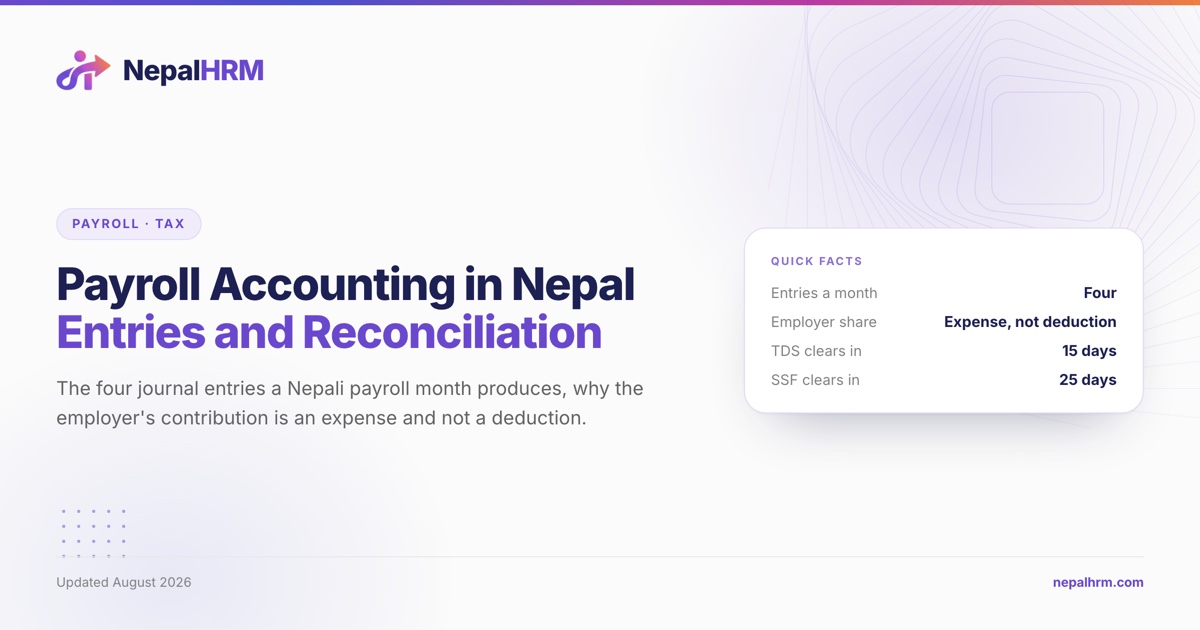
A Nepali payroll month produces four journal entries, not one. The accrual that records the cost, the payment of net salary, the deposit of tax withheld, and the deposit of the retirement contributions. Splitting them is what makes the month reconcilable, because each statutory payable then has its own balance that should return to zero on a known date.
The entry most often written wrong is the employer's own contribution: it is an expense of the company, not a deduction from the employee, and it belongs on the debit side. This guide sets out the entries with real numbers. For the run that produces them, see how to calculate employee salary in Nepal.
Table of Contents
- The example
- Entry 1: the accrual
- Entry 2: paying the employees
- Entry 3: depositing the tax, within fifteen days
- Entry 4: depositing the contributions
- The three reconciliations
- Where the ledger and the payroll disagree
- Frequently asked questions
- What is the journal entry for salary in Nepal?
- Is the employer's PF contribution an expense or a deduction?
- How is gratuity recorded in payroll accounting in Nepal?
- How do you reconcile payroll in Nepal?
- Why does the TDS in my ledger not match the TDS statement?
- Should PF payable show the employee share only?
- What accounts does a Nepali payroll need?
- Sources
The example
A ten-person Kathmandu company, basic set at 60% of gross, employees on provident fund and gratuity. One month:
| NPR | |
|---|---|
| Gross salary | 635,000 |
| Of which basic | 381,000 |
| Employee PF at 10% of basic | 38,100 |
| Employer PF at 10% of basic | 38,100 |
| Gratuity accrual at 8.33% of basic | 31,737 |
| TDS withheld | 9,158 |
| Net payable to employees | 587,742 |
Net is gross less the employee's own deductions: 635,000 minus 38,100 minus 9,158.
Entry 1: the accrual
Posted at month end, when the run closes. This records the whole cost of the month, including the parts nobody is paid directly.
| Account | Dr | Cr |
|---|---|---|
| Salary and wages expense | 635,000 | |
| Employer PF contribution expense | 38,100 | |
| Gratuity expense | 31,737 | |
| Salary payable | 587,742 | |
| TDS payable | 9,158 | |
| PF payable | 76,200 | |
| Gratuity provision | 31,737 | |
| Total | 704,837 | 704,837 |
Three things to notice.
PF payable is 76,200, not 38,100. It carries both sides: the 38,100 deducted from employees and the 38,100 the company owes on its own account. One payable, one deposit, two origins.
Gratuity is an expense and a provision from month one. Under the Labour Act the entitlement builds with service, so recognising it only when someone leaves understates every month until then and then lands a full liability in one period. See our gratuity guide.
Salary expense is gross, not net. Net is a payable, not a cost.
Entry 2: paying the employees
| Account | Dr | Cr |
|---|---|---|
| Salary payable | 587,742 | |
| Bank | 587,742 |
Salary payable should now be zero. If it is not, someone was paid a different amount from the one the run computed, and that is worth finding on the day rather than at year end. The bank file that produces this payment is the salary bank transfer file.
Entry 3: depositing the tax, within fifteen days
| Account | Dr | Cr |
|---|---|---|
| TDS payable | 9,158 | |
| Bank | 9,158 |
Section 90(2) of the Income Tax Act 2058 requires the tax to be deposited within fifteen days of the month ending, and Section 90(1) requires the statement in the same window. The amount in this entry and the total in that statement are the same number, which is the single most useful control in Nepali payroll accounting. See eTDS in Nepal.
Entry 4: depositing the contributions
| Account | Dr | Cr |
|---|---|---|
| PF payable | 76,200 | |
| Bank | 76,200 |
Under an SSF regime the same entry carries different numbers. The identical roster on the SSF contributes 41,910 from employees at 11% of basic and 76,200 from the company at 20% of basic, a 118,110 deposit due within twenty-five days of month end. Gratuity is inside that 20%, so there is no separate gratuity provision to run.
The SSF version of entry 1 balances at 711,200: gross 635,000 plus employer 76,200 on the debit side, against net 589,675, TDS 3,415, and SSF payable 118,110. Note the TDS: 9,158 under PF, 3,415 under SSF, because the 1% first band is not levied on an SSF contributor. Our CIT vs PF vs SSF comparison works through that difference.
The three reconciliations
Run these monthly. They take minutes when the entries are split and hours when they are not.
1. Gross to net. Total gross, less total employee deductions, equals total net paid. If the payroll register says 587,742 and the bank paid something else, the difference is either an unprocessed leaver or a manual override.
2. Statutory payable to statutory deposit. Each payable account should return to zero within its own window: TDS payable by day fifteen, PF or SSF payable by the deposit date. A balance still sitting there after the deadline is not a reconciling item, it is a missed filing accruing interest under Section 119.
3. Payroll register to the general ledger. Total salary expense in the ledger should equal total gross in the register for the same period. They drift when someone posts a bonus, a final settlement or an arrear directly to the ledger without putting it through payroll.
Where the ledger and the payroll disagree
- Final settlements posted outside payroll. An exit paid from a manual voucher never reaches the register, so the two never agree again. Run it through payroll. See full and final settlement in Nepal.
- Festival expense treated as a bonus. They are different obligations with different timing. Bonus and festival expense separates them.
- Employer contribution netted against the deduction. This understates both salary cost and the payable, and it makes the deposit fail to tie to anything.
- Gratuity recognised only at exit. Every prior month is understated and the exit month is overstated.
- Contributions computed on gross. On a 60% basic structure that overstates the deposit by two thirds. The base is basic.
- A part-month joiner or leaver. Contributions are pro-rated by design under Social Security Act Section 4(3), so the register will not match a flat monthly assumption.
Reconciliation is only fast when the register and the ledger come from the same run. NepalHRM closes payroll into a frozen register, carries employer contributions and gratuity accrual as separate lines, and produces the deposit figures and the IRD eTDS file from that same closed run, so the three checks above start from one set of numbers. See how payroll works, or book a walkthrough.
Frequently asked questions
What is the journal entry for salary in Nepal?
Debit salary and wages expense with the gross, debit the employer contribution and gratuity as separate expenses, then credit salary payable with the net, and credit TDS payable, PF or SSF payable and the gratuity provision with their amounts. The entry balances at gross plus employer costs.
Is the employer's PF contribution an expense or a deduction?
An expense. Only the employee's own 10% is deducted from gross pay. The employer's 10% is a cost of employment that is debited to expense and credited to the same payable, so the payable carries both halves.
How is gratuity recorded in payroll accounting in Nepal?
As a monthly expense with a matching provision, accruing at 8.33% of basic, because the entitlement builds with service. Recognising it only at exit understates every earlier month.
How do you reconcile payroll in Nepal?
Three checks: gross less employee deductions equals net paid; each statutory payable returns to zero inside its own deadline, fifteen days for TDS and twenty-five for SSF; and total salary expense in the ledger equals total gross in the payroll register.
Why does the TDS in my ledger not match the TDS statement?
Usually because something was paid outside payroll: a final settlement, an arrear or a bonus posted straight to the ledger. The statement is built from the register, so anything that bypassed the register is missing from it.
Should PF payable show the employee share only?
No. One payable holds both the employee deduction and the employer contribution, because one deposit clears both. Splitting them into two accounts makes the deposit reconcile to neither.
What accounts does a Nepali payroll need?
At minimum: salary and wages expense, employer contribution expense, gratuity expense, salary payable, TDS payable, PF or SSF payable, and a gratuity provision. Under an SSF regime the gratuity accounts are not needed separately, because gratuity sits inside the 20% employer contribution.
Sources
- Income Tax Act, 2058 (2002), Nepal Law Commission text as published by the Institute of Chartered Accountants of Nepal: en.ican.org.np. Sections 87, 90 and 119, retrieved 2026-08-07.
- Contribution Based Social Security Act, 2074, consolidated Nepali text as amended through 2082: ssf.gov.np. Sections 4(3) and 4(4).
- Social Security Scheme Operation Procedure, 2075, Section 25 (11% employee, 20% employer, on basic): ssf.gov.np.
- Labour Act, 2074 (2017), consolidated Nepali text: lawcommission.gov.np. Gratuity and remuneration provisions, retrieved 2026-08-07.
- Every amount in the worked entries is generated from
lib/nepal-payroll.tsandlib/nepal-labour.tsfor the ten-person roster described, and each entry balances as printed.
Related reading: Payroll compliance calendar for FY 2083/84 · Salary structure in Nepal · Payslip generator