
Why does an employee's take-home salary look different from the amount written in the offer letter?
Salary calculation in Nepal includes basic salary, allowances, attendance, leave, SSF, PF, CIT, tax, loans, advance salary, and other approved deductions. When HR misses even one part, the payslip can become confusing for employees and difficult for finance teams to review.
To calculate employee salary correctly, your company should separate gross salary, taxable income, employee deductions, employer contributions, and net salary. A clear payroll process helps employees understand their pay and helps HR close the monthly salary work with confidence.
Table of Contents
- What Is Employee Salary?
- Key Salary Components in Nepal
- Basic Salary
- Dearness Allowance
- Gross Salary
- Net Salary
- Allowances and Extra Earnings
- Deductions
- Taxable Income
- Employer Cost
- Minimum Salary in Nepal
- 1. SSF Employee Contribution
- 2. Salary TDS
- Salary Tax Slabs for FY 2083/84
- 3. Provident Fund
- 4. CIT Contribution
- 5. Loan, Advance Salary, and Other Approved Deductions
- Employee Salary Calculation Formula
- Step-by-Step Process to Calculate Employee Salary in Nepal
- Step 1: Confirm the Salary Structure
- Step 2: Check Attendance, Leave, and Working Days
- Step 3: Add Allowances and Extra Earnings
- Step 4: Calculate Gross Salary
- Step 5: Calculate Statutory and Retirement Contributions
- Step 6: Calculate Taxable Income and TDS
- Step 7: Deduct Loans, Advance Salary, and Other Approved Amounts
- Step 8: Prepare and Review the Payslip
- Example of Employee Salary Calculation in Nepal
- Step 4: Calculate Annual Tax
- Step 5: Calculate Net Salary
- Common Salary Calculation Mistakes Employers Make
- 1. Not Separating Basic Salary Clearly
- 2. Calculating SSF or PF on Gross Salary by Mistake
- 3. Applying SSF and PF Without Checking the Payroll Setup
- 4. Using Old Tax Slabs
- 5. Forgetting Unpaid Leave or Absence Adjustments
- 6. Not Updating Salary Structure After Salary Changes
- 7. Mixing Employee Deductions With Employer Contributions
- 8. Sharing Payslips Without Review
- Conclusion
What Is Employee Salary?
Employee salary is the pay an employee receives from an employer in exchange for work. In Nepal, salary is usually agreed in the appointment letter or employment contract and paid monthly.
Employee salary does not always mean the exact amount the employee receives in hand. HR calculates the final payment after checking attendance, leave, overtime, tax, statutory contributions, loans, advance salary, and other approved deductions. The final in-hand amount is called net salary.
Key Salary Components in Nepal
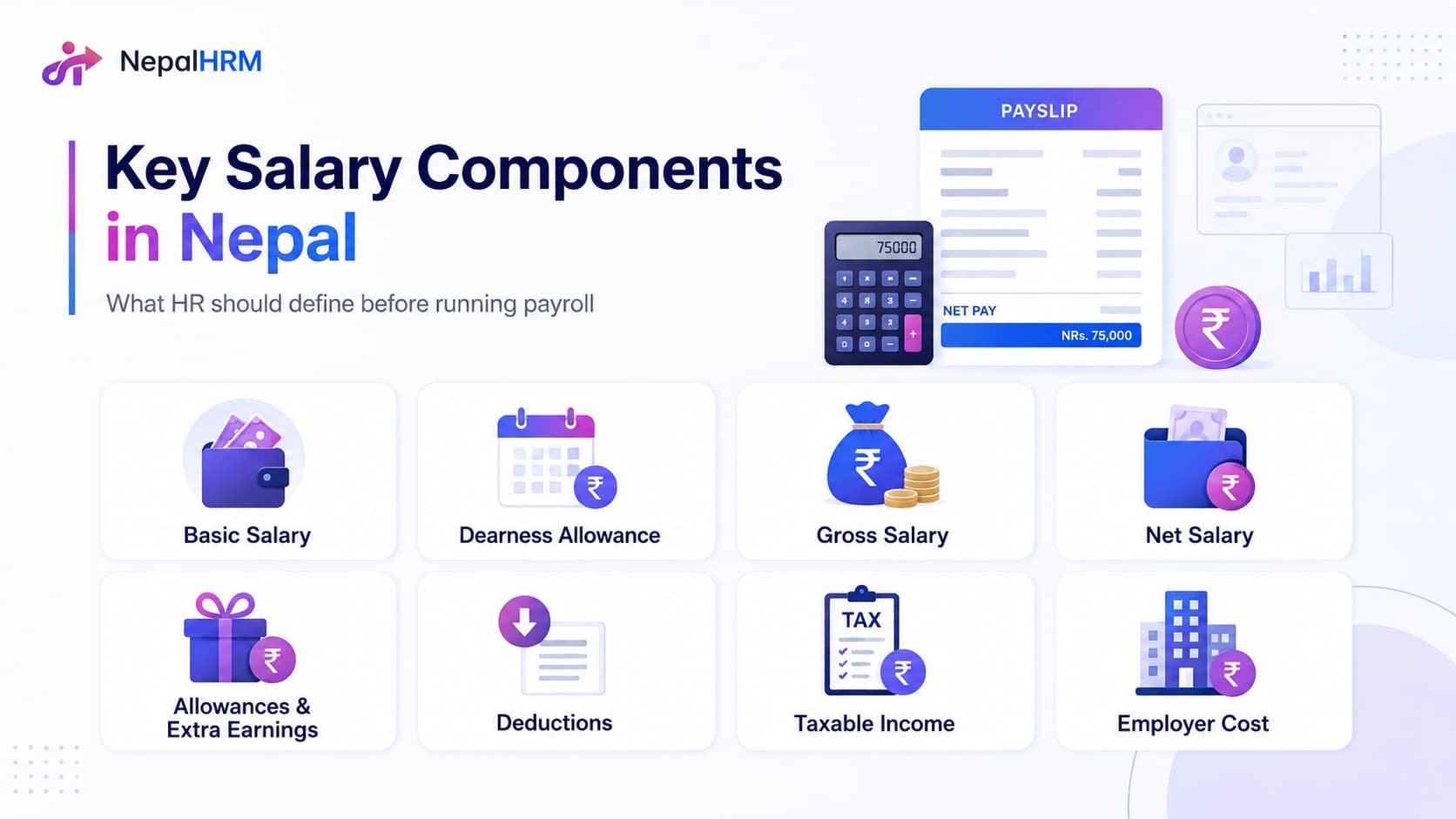
Employee salary in Nepal usually includes basic salary, dearness allowance, other allowances, gross salary, deductions, taxable income, and net salary. HR should define each component clearly before running payroll because different components can affect SSF, PF, tax, payslip records, and employer cost.
Basic Salary
Basic salary is the fixed salary amount used as the base for many payroll calculations. SSF, PF, gratuity, and some other benefits are commonly linked with basic salary or basic remuneration, so HR should not treat the full gross salary as the base by default.
Dearness Allowance
Dearness allowance is an allowance paid to support employees against living-cost changes. In NNepal'sminimum wage structure, the monthly minimum wage from 1 Shrawan 2082 includes both basic remuneration and dearness allowance.
Gross Salary
Gross salary is the total earning amount before deductions. It can include basic salary, dearness allowance, housing allowance, transport allowance, meal allowance, overtime, incentives, bonuses, commission, or other approved earnings.
Net Salary
Net salary is the amount the employee receives after deductions. HR calculates it by subtracting employee-side contributions, TDS, loan repayment, advance salary recovery, unpaid leave adjustment, and other approved deductions from gross salary.
Allowances and Extra Earnings
Allowances are extra amounts paid along with the basic salary. A company may provide transport, communication, meals, housing, travel, field, or role-based allowances depending on the employment terms and internal policy.
Deductions
Deductions are amounts subtracted from salary before payment. Common deductions include SSF, PF, CIT, TDS, insurance, loan repayment, advance salary recovery, unpaid leave, and other approved deductions allowed by law or company policy.
Taxable Income
Taxable income is the income amount used to calculate salary tax. HR usually estimates annual income, subtracts allowed deductions, applies the relevant tax slabs, and deducts monthly TDS from salary.
Employer Cost
Employer cost is the total cost the company carries for an employee. It can include gross salary, employer SSF or PF contribution, employer insurance contribution, bonus, benefits, and other company-side costs. Employer contributions should not be confused with employee deductions.
Minimum Salary in Nepal
From 1 Shrawan 2082, the minimum monthly wage for workers in Nepal is NPR 19,550. This includes NPR 12,170 as basic monthly remuneration and NPR 7,380 as dearness allowance. HR teams should use the latest government notice or legal update before final salary setup because the minimum wage can change.
Wage Type | Basic Remuneration | Dearness Allowance | Total |
Monthly wage | NPR 12,170 | NPR 7,380 | NPR 19,550 |
Daily wage | NPR 470 | NPR 284 | NPR 754 |
Hourly wage | NPR 63 | NPR 38 | NPR 101 |
Part-time hourly wage | - | - | NPR 107 |
Common Salary Deductions in Nepal
Salary deductions in Nepal include statutory deductions, tax deductions, and company-approved deductions. HR should show each deduction clearly on the payslip so employees can understand how gross salary turns into net salary.
1. SSF Employee Contribution
SSF applies when the employee and employer are registered under Nepal's Social Security Fund system. In the common formal-sector structure, the employee contributes 11% of basic salary, and the employer contributes 20% of basic salary, making the total contribution 31%.
SSF Contribution | Formula |
Employee SSF | Basic salary x 11% |
Employer SSF | Basic salary x 20% |
Total SSF | Basic salary x 31% |
Employee SSF reduces take-home salary because it is deducted from theemployee'ss pay. Employer SSF is an extra company-side contribution and should not reduce the employee's net salary.
2. Salary TDS
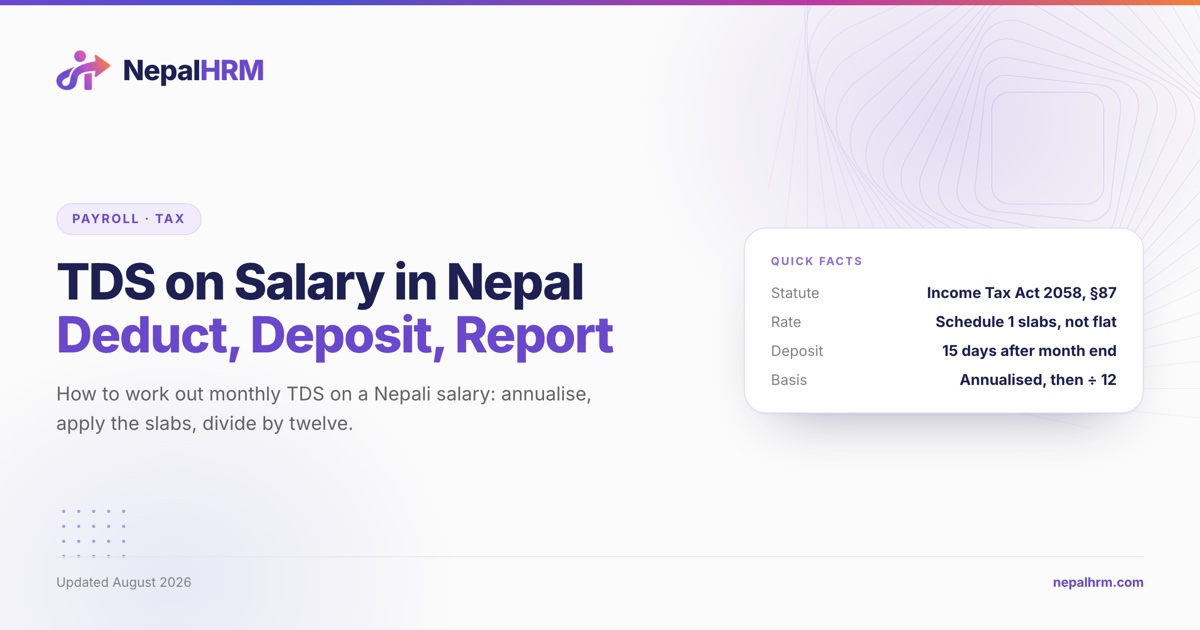
TDS is the income tax deducted from an employee's salary before payment. HR usually estimates the employee's annual taxable income, applies the relevant progressive tax rates, and deducts the calculated tax from monthly salary.
For FY 2083/84, Nepal introduced a unified personal income tax structure for resident natural persons. The same income bands and rates now apply to both unmarried individuals and married couples, so separate tax tables are no longer required.
Salary Tax Slabs for FY 2083/84
Annual Taxable Income | Tax Rate |
|---|---|
Up to NPR 1,000,000 | 1% |
NPR 1,000,001 to NPR 1,500,000 | 10% |
NPR 1,500,001 to NPR 2,500,000 | 20% |
NPR 2,500,001 to NPR 4,000,000 | 27% |
Above NPR 4,000,000 | 29% |
These rates are progressive. This means each rate applies only to the portion of taxable income that falls within the relevant income band, rather than applying one rate to the employee's entire annual income. The 29% rate consists of the 27% rate plus an additional two percentage points on taxable income above NPR 4,000,000.
Important Note: The 1% charged on the first NPR 1,000,000 is the Social Security Tax, not a complete tax exemption. However, this 1% tax does not apply when the employee contributes to Nepal’s Social Security Fund under the applicable provision. HR should also check permitted deductions, rebates, insurance benefits and retirement contributions before calculating the final annual tax and monthly TDS.
3. Provident Fund
PF is a retirement contribution based on basic remuneration. Under the Labor Act, the employer deducts 10% of the eemployee'sbasic remuneration and adds an equal employer contribution before depositing the total amount for provident fund.
If the company already contributes through SSF, HR should check the company's legal setup and payroll policy before adding a separate PF deduction. This helps avoid double deductions and keeps the payslip clear.
4. CIT Contribution
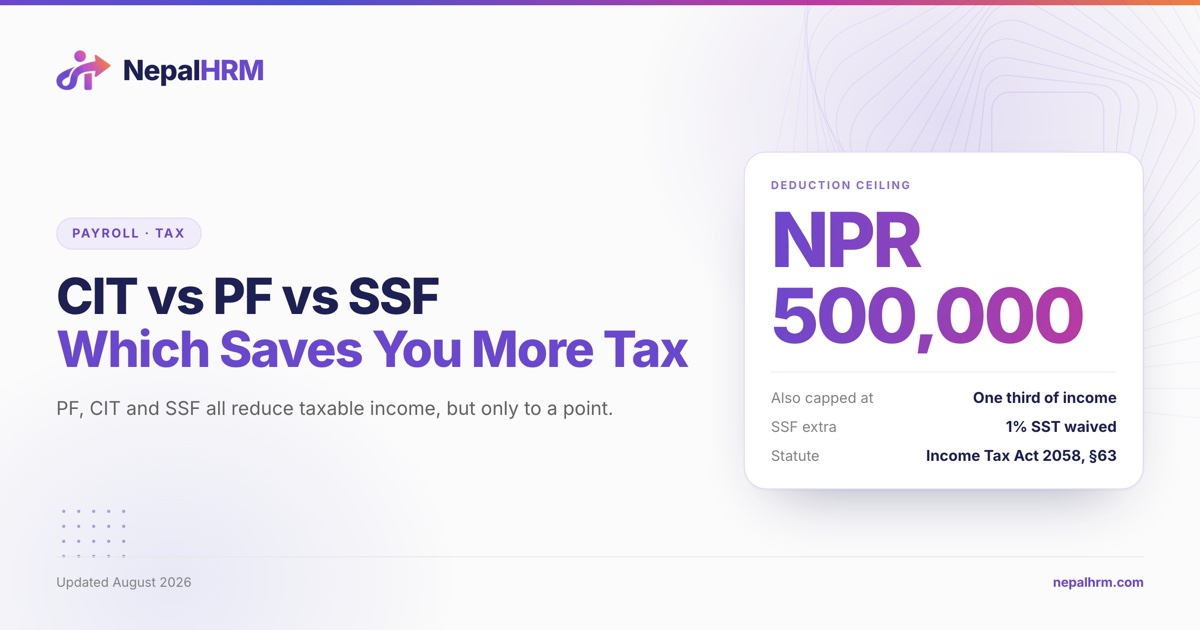
CIT is a voluntary retirement or investment contribution that may reduce taxable income within allowed limits. HR should record CIT properly because the contribution affects taxable income, tax planning, and monthly salary review.
5. Loan, Advance Salary, and Other Approved Deductions
Loan and advance salary deductions apply when an employee has taken a company loan, salary advance, or recoverable payment. HR should keep written approval, repayment schedules, and monthly deduction records so employees and finance teams can review the amount clearly.
Employee Salary Calculation Formula
The basic salary calculation formula starts with total earnings and ends with the final net salary. HR should calculate gross salary first, then subtract employee-side deductions and TDS.
Calculation Type | Formula |
Gross salary | Basic salary + Dearness allowance + Allowances + Overtime + Incentives + Bonus + Other approved earnings |
Taxable income | Annual earnings - Allowed deductions - Approved retirement contributions - Other allowed exemptions |
Net salary | Gross salary - Employee SSF/PF/CIT - TDS - Loan/advance repayment - Other approved deductions |
Employer cost | Gross salary + Employer SSF/PF + Employer benefits + Other company-side costs |
Step-by-Step Process to Calculate Employee Salary in Nepal
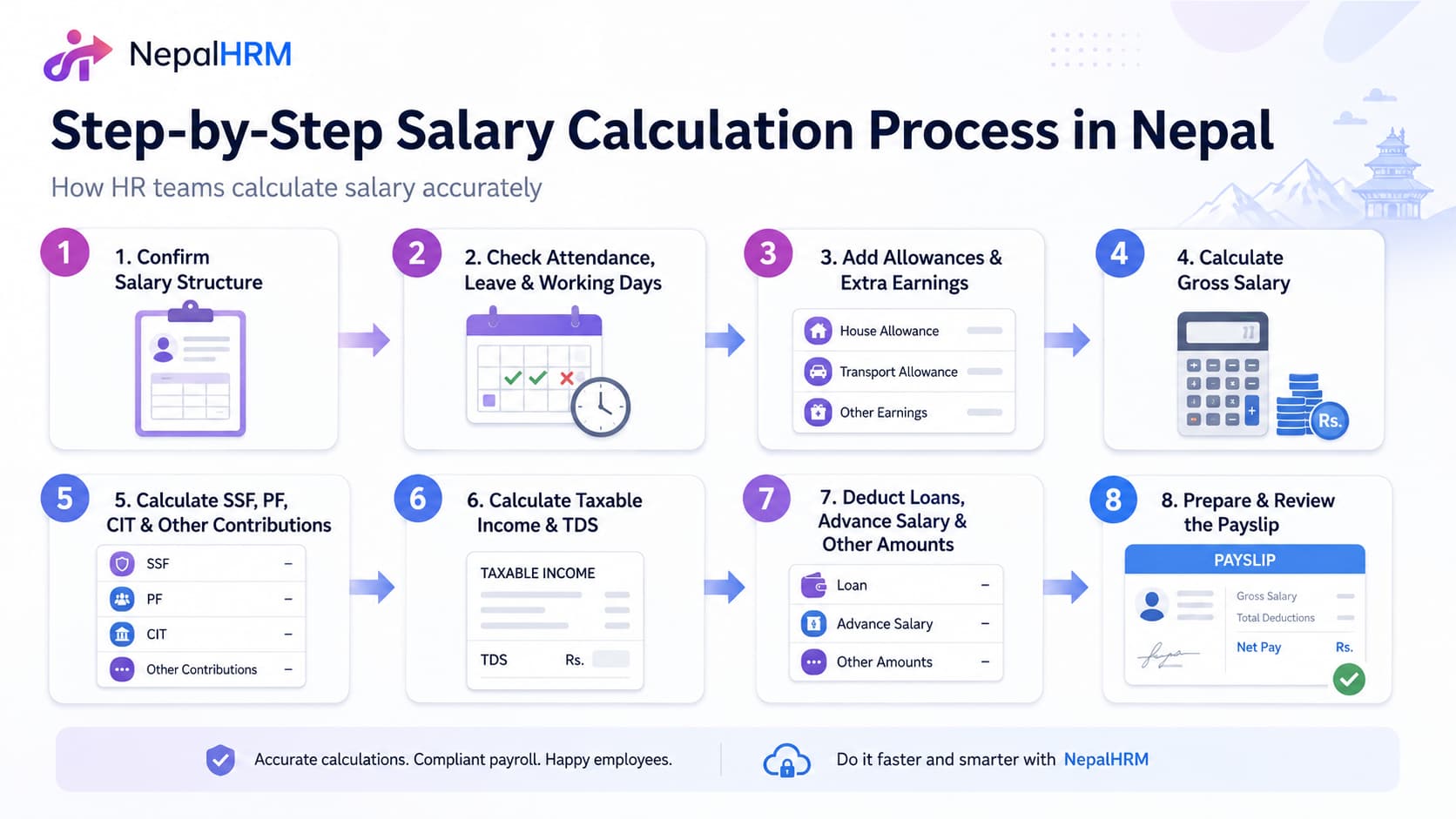
To calculate employee salary in Nepal, first confirm the salary structure, then check attendance, leave, overtime, deductions, and tax. After that, prepare the payslip and review both employee deductions and employer contributions before payment.
Step 1: Confirm the Salary Structure
Start with the employee's contract or appointment letter. Confirm basic salary, dearness allowance, allowances, benefits, payment frequency, and any fixed deductions before running payroll.
Step 2: Check Attendance, Leave, and Working Days
Review attendance, approved leave, unpaid leave, late marks, holidays, weekly offs, and working days for the month. This step helps HR decide whether the full monthly salary applies or whether any deduction or prorated salary is needed.
Step 3: Add Allowances and Extra Earnings
Add approved overtime, incentives, bonuses, commission, festival allowance, or other extra earnings. HR should include only approved amounts that follow company policy and have clear records.
Step 4: Calculate Gross Salary
After adding all earnings, HR gets the gross salary. Gross salary shows the employee's total earnings before deductions and gives HR the base for tax and payroll review.
Step 5: Calculate Statutory and Retirement Contributions
Calculate SSF, PF, CIT, or other contribution amounts based on the employee's setup and company policy. HR should keep employee contributions separate from employer contributions because only employee-side deductions reduce take-home salary.
Step 6: Calculate Taxable Income and TDS
Estimate annual taxable income by annualizing salary and subtracting allowed deductions. Then apply the current tax slab based on the employee's marital status and deduct the monthly TDS amount from the salary.
Step 7: Deduct Loans, Advance Salary, and Other Approved Amounts
Subtract monthly loan repayment, advance salary recovery, insurance, unpaid leave adjustment, or other approved deductions. Each deduction should have a record so the employee can understand the payslip.
Step 8: Prepare and Review the Payslip
Create a payslip that shows earnings, deductions, tax, contributions, and final net salary. A clear payslip reduces salary questions and helps HR handle monthly payroll records with confidence.
Example of Employee Salary Calculation in Nepal
The example below shows a simplified monthly salary calculation for an unmarried employee registered under SSF. The example does not include CIT, insurance, bonus, remote-area allowance, medical tax credit, female rebate, or other special adjustments.
Salary Item | Amount |
Basic salary | NPR 40,000 |
Allowances | NPR 20,000 |
Gross salary | NPR 60,000 |
Employee type | Unmarried |
SSF status | Registered under SSF |
Other deductions | None |
Step 1: Calculate gross salary
● Gross salary = NPR 40,000 + NPR 20,000 = NPR 60,000
Step 2: Calculate SSF contribution
● Employee SSF = NPR 40,000 x 11% = NPR 4,400
● Employer SSF = NPR 40,000 x 20% = NPR 8,000
● Total SSF = NPR 12,400
Step 3: Estimate annual taxable income
● Annual gross salary = NPR 60,000 x 12 = NPR 720,000
● Annual employee SSF deduction = NPR 4,400 x 12 = NPR 52,800
● Estimated annual taxable income = NPR 720,000 - NPR 52,800 = NPR 667,200
Step 4: Calculate Annual Tax
For FY 2083/84, the first NPR 1,000,000 of taxable income falls under the 1% Social Security Tax slab. However, employees contributing to the Social Security Fund are exempt from this 1% tax. Since the employee’s estimated annual taxable income is NPR 667,200, no income reaches the 10% tax slab.
Annual taxable income = NPR 667,200
Annual income tax = NPR 0
Monthly TDS = NPR 0 ÷ 12 = NPR 0
Step 5: Calculate Net Salary
Net salary = Gross salary − Employee SSF − Monthly TDS
Net salary = NPR 60,000 − NPR 4,400 − NPR 0
Net salary = NPR 55,600
Rounded net salary = NPR 55,600
Note: If the employee were not contributing to SSF, the 1% tax would be NPR 6,672 annually or NPR 556 monthly, resulting in a net salary of NPR 55,044.
Common Salary Calculation Mistakes Employers Make
Salary mistakes usually happen when HR calculates payroll without checking the correct salary structure, tax rules, attendance records, and deduction setup. These mistakes can affect employee trust, payslip accuracy, and company compliance.
1. Not Separating Basic Salary Clearly
Many employers show only one total salary amount without separating the basic salary. This creates confusion because basic salary is often used to calculate SSF, PF, gratuity, deductions, and benefits.
2. Calculating SSF or PF on Gross Salary by Mistake
SSF and PF are commonly linked with basic salary or basic remuneration, not the full gross salary. Using gross salary as the base can make both employee deductions and employer contributions incorrect.
3. Applying SSF and PF Without Checking the Payroll Setup
Some companies confuse PF and SSF treatment. If the employee is already covered under SSF, HR should confirm whether a separate PF deduction applies. Otherwise, the payslip can show unclear or duplicated deductions.
4. Using Old Tax Slabs
Salary tax changes can happen through the annual Finance Act. HR should update tax slabs, rebates, and exemption rules before the new fiscal year payroll starts.
5. Forgetting Unpaid Leave or Absence Adjustments
Unpaid leave and unauthorized absence can reduce payable salary for the month. HR should check attendance and leave records before final payroll so the company does not overpay or underpay employees.
6. Not Updating Salary Structure After Salary Changes
Salary revisions, promotions, allowance changes, probation confirmation, and role changes should update the full salary structure. If HR updates only the total amount, deductions and reports may become inaccurate.
7. Mixing Employee Deductions With Employer Contributions
Employee deductions reduce take-home salary, while employer contributions are company-side costs. A good payslip and payroll report should show both clearly so employees understand what was deducted and what the company added separately.
8. Sharing Payslips Without Review
A payslip should be reviewed before sharing with employees. HR should check earnings, deductions, TDS, contribution amounts, loan deductions, bank details, and final net salary before closing payroll.
Conclusion
Salary calculation in Nepal becomes easier when HR follows a clear payroll process. A proper process checks basic salary, allowances, attendance, leave, overtime, SSF, PF, CIT, TDS, loans, advance salary, and other approved deductions before finding the final net salary.
NepalHRM helps businesses manage payroll with salary structures, attendance, leave, PF, CIT, SSF, tax slabs, payslips, bank reports, and audit-ready records in one platform. When payroll data stays connected, HR and finance teams can reduce manual errors and explain salary details with confidence.