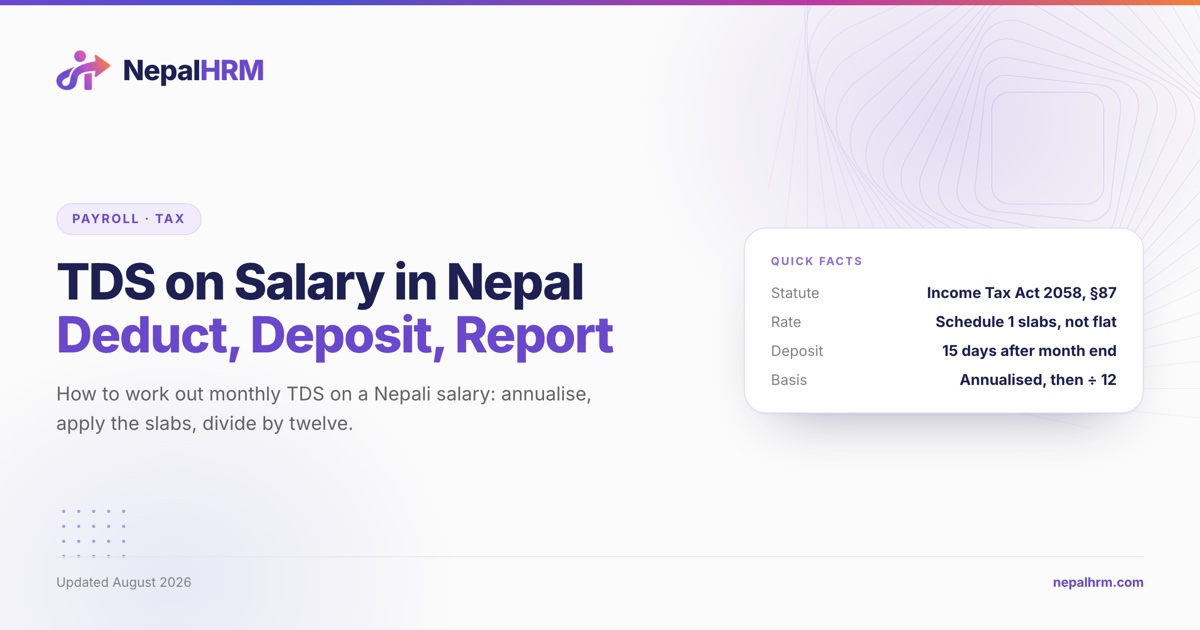
TDS on a Nepali salary is not a flat percentage. Section 87 of the Income Tax Act 2058 requires the employer to withhold at the Schedule 1 slab rates, which means you annualise the employee's remuneration, subtract the allowed retirement contribution, run the annual figure through the bands, and divide the resulting tax by twelve.
Get the order wrong and every payslip is wrong. This guide walks the calculation, the deposit, and the liability an employer carries if it does not deduct. For the wider payslip, see how to calculate employee salary in Nepal; for the bands themselves, see the FY 2083/84 income tax slabs.
Table of Contents
- The calculation, in order
- A worked month
- Withholding when pay is not flat
- Deposit, report, certify
- What happens if the employer does not deduct
- Five errors worth checking for
- Frequently asked questions
- How is TDS calculated on salary in Nepal?
- What is the TDS rate on salary in Nepal?
- Is the employer's PF or SSF contribution taxable for the employee?
- When must salary TDS be deposited in Nepal?
- What if an employer pays salary without deducting TDS?
- Does an employee on SSF pay less TDS than one on PF and CIT?
- Does a salaried employee still have to file an income return?
- Sources
The calculation, in order
1. Add up annual remuneration. Section 8(2) is broad: wages and salary, leave pay, overtime, fees, commission, prizes, gifts, bonus, and payment for other facilities; personal allowances including dearness, subsistence, entertainment and transport; reimbursement of personal expenses; payment for agreeing to terms of employment; payment for termination, loss of employment or compulsory retirement; and retirement contributions the employer deposits for the employee.
2. Take out the Section 8(3) exclusions. Food and tiffin provided at the work site on terms available to all employees on the same basis, and reimbursement of expenditure that serves the employer's business purpose, are not remuneration.
3. Subtract the allowed retirement contribution. Section 63(2) lets the beneficiary claim the year's retirement contribution as a deduction, and Section 63(3) caps it at the prescribed limit: the lowest of the actual contribution, NPR 500,000, or one third of assessable income.
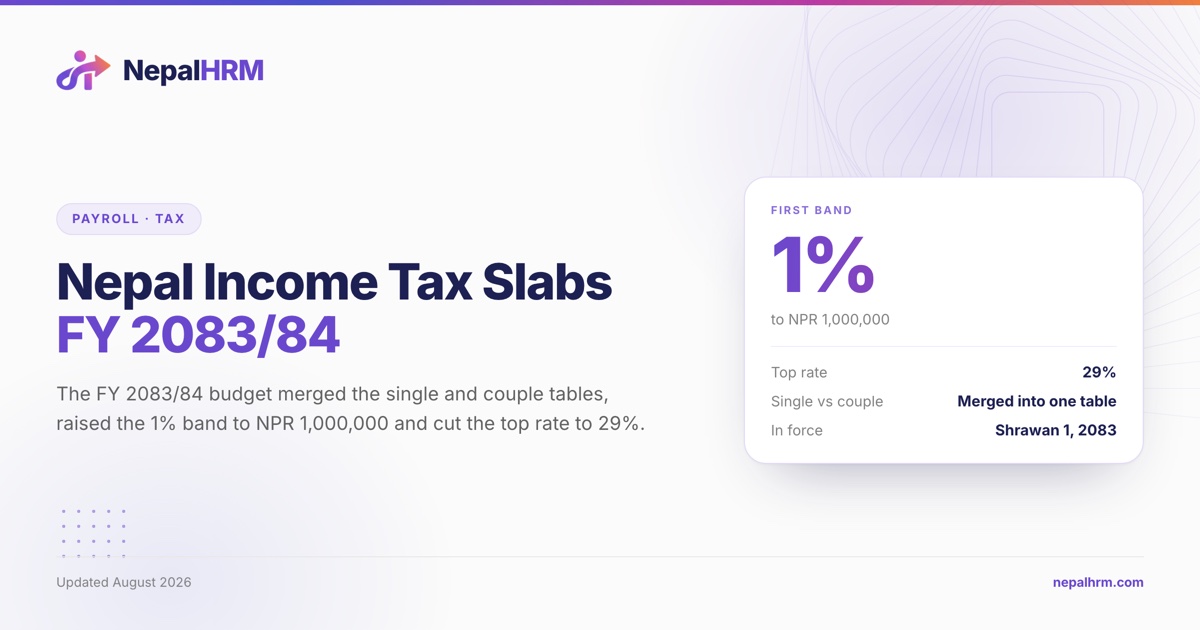
4. Run the result through the slabs. The FY 2083/84 table is 1% to 1,000,000, then 10%, 20%, 27% and 29%. The 1% first band is the social security tax and is not levied on an SSF or pension-fund contributor.
5. Divide by twelve. That is the month's withholding.
A worked month
Monthly gross NPR 100,000, basic set at 60% of gross, employee on PF and CIT with no CIT election, against the same employee moved onto SSF.
| PF and CIT | SSF | |
|---|---|---|
| Basic | 60,000 | 60,000 |
| Employee PF at 10% of basic | 6,000 | |
| Employee SSF at 11% of basic | 6,600 | |
| Annual gross | 1,200,000 | 1,200,000 |
| Retirement deduction allowed | 72,000 | 79,200 |
| Annual taxable income | 1,128,000 | 1,120,800 |
| Annual tax | 22,800 | 12,080 |
| Monthly TDS | 1,900 | 1,007 |
Nearly identical taxable income, and the tax differs by 47%, because the SSF contributor pays nothing on the first NPR 1,000,000 rather than 1% of it. Our CIT vs PF vs SSF comparison works through what that means for take-home pay across a career.
At the lower end the effect is starker still. On a monthly gross of NPR 75,000 with a 60% basic, an employee on PF and CIT withholds NPR 705 a month, while the same employee on SSF withholds nothing at all: their annual taxable income of NPR 840,600 sits entirely inside a band that is zero-rated for them.
Withholding when pay is not flat
The annualised method is what makes irregular pay work.
- A mid-year raise. Recompute the annual position from the new salary for the remaining months, then re-divide. The months already withheld are not restated; the balance of the year absorbs the difference.
- A bonus or festival expense. Both are remuneration under Section 8(2). Adding a month's basic as festival expense lifts annual remuneration and therefore lifts the withholding for the rest of the year. See bonus and festival expense in Nepali payroll.
- A joiner part way through the year. Annualise only what they will actually receive in this income year, not a notional twelve months.
- A leaver. Their final month closes the year for them. Section 91(3) makes the withholding certificate due when they leave rather than at year end, and the full and final settlement has to carry the right closing tax position.
Deposit, report, certify
| Obligation | Provision | Deadline |
|---|---|---|
| Deposit the tax withheld | §90(2) | Within 15 days of month end |
| Lodge the monthly statement | §90(1) | Within 15 days of month end |
| Employment withholding certificate | §91(3) | Within 30 days of year end, or on the employee leaving |
| Employee's own income return, where required | §96(1) | Within 3 months of year end |
The monthly statement is the eTDS lodgement. Our guide to eTDS in Nepal covers what goes in it and how the fee for lateness is computed.
What happens if the employer does not deduct
This is the part most employers underestimate, because the Act removes the obvious escape routes one by one.
The liability does not depend on the deduction happening. Section 90(3) deems tax to have been withheld at the moment it should have been. An employer that paid gross still owes the tax.
Both parties are on the hook. Section 90(5) makes the withholding agent and the employee jointly and severally liable where tax was not withheld, or where deemed-withheld tax was not paid over by the due date.
The employer can chase the tax, but not the interest. Section 90(7) allows recovery of an amount equal to the tax paid over from the person it should have come from. Section 119(3) then blocks recovery of the interest arising from the employer's own failure to pay on time.
Other deduction rights do not reduce the duty. Section 87(2) says the obligation is not decreased or ended because the employer has a right or duty to deduct or hold back some other amount from that payment, or because the employment income cannot be subtracted under another law.
Late payment carries interest and late reporting carries a fee. Section 119(1) charges interest at the normal rate for each month and part of a month on tax not paid by the due date. Section 117(3) separately charges 1.5% a year of the tax that should have been withheld for a statement lodged late.
Under the Labour Act, remember also that Section 38 restricts deductions from remuneration to specified cases, of which tax due under law is one. Withholding TDS is lawful; inventing other deductions is not.
Five errors worth checking for
- Applying a flat percentage. There is no flat TDS rate on employment income in Nepal.
- Computing on gross rather than after the retirement deduction. The deduction is allowed under Section 63(2) and changes the band the employee lands in.
- Deducting on the employer's contribution twice. It is income under Section 8(2)(f) and then part of the deductible contribution. Count it once on each side, not twice on one.
- Charging the 1% first band to an SSF contributor. They are exempt from it, and this is the single most common overcharge on a Nepali payslip.
- Forgetting that allowances are remuneration. Transport, dearness and entertainment allowances are inside Section 8(2)(b). Paying them outside the payslip does not put them outside the tax.
Annualised withholding is arithmetic no spreadsheet survives at scale. NepalHRM computes TDS per employee from the current slab table, resolves the SSF exemption from that employee's own scheme, re-spreads the year's tax after a raise or a bonus, shows the band breakdown behind the number, and carries it onto the payslip. See how payroll works, or book a walkthrough.
Frequently asked questions
How is TDS calculated on salary in Nepal?
Annualise the employee's remuneration, subtract the allowed retirement contribution, apply the Schedule 1 slab rates to the result, and divide the annual tax by twelve. Section 87(1) requires withholding at Schedule 1 rates rather than at a flat percentage.
What is the TDS rate on salary in Nepal?
There is no single rate. Employment income is withheld at the slab rates, which for FY 2083/84 run 1% up to NPR 1,000,000, then 10%, 20%, 27% and 29%.
Is the employer's PF or SSF contribution taxable for the employee?
Yes as income, under Section 8(2)(f), which includes retirement contributions the employer deposits for the employee. It then forms part of the retirement contribution the employee can claim as a deduction under Section 63(2), inside the ceiling.
When must salary TDS be deposited in Nepal?
Within fifteen days of the end of the month, under Section 90(2). The monthly statement is due in the same window under Section 90(1).
What if an employer pays salary without deducting TDS?
The tax is treated as withheld anyway under Section 90(3), and Section 90(5) makes employer and employee jointly and severally liable. The employer can later recover the tax from the employee under Section 90(7), but not the interest, which Section 119(3) leaves with the employer.
Does an employee on SSF pay less TDS than one on PF and CIT?
Usually yes, because the 1% first band is not levied on an SSF contributor. On a monthly gross of NPR 100,000 with a 60% basic, the monthly withholding is about NPR 1,007 on SSF against NPR 1,900 on PF and CIT.
Does a salaried employee still have to file an income return?
Not always. Section 97 excuses a person with no tax to pay for the year, and employment income fully withheld under Section 87 often produces that outcome. The Section 91(3) certificate is the evidence that the tax was already taken.
Sources
- Income Tax Act, 2058 (2002), Nepal Law Commission text as published by the Institute of Chartered Accountants of Nepal: en.ican.org.np. Sections 8, 63, 87, 90, 91, 96, 97, 117 and 119 read from that text, retrieved 2026-08-07.
- Labour Act, 2074 (2017), consolidated Nepali text, Nepal Law Commission: lawcommission.gov.np. Section 38 on deductions from remuneration, retrieved 2026-08-07.
- Slab rates for FY 2083/84 from the Economic Act 2083 as summarised section by section in the Institute of Chartered Accountants of Nepal, Highlights of Federal Budget of Nepal for FY 2083/84: en.ican.org.np.
- Every worked figure on this page is generated from
lib/nepal-payroll.ts, the single source behind our salary tax calculator and payslip generator.
Related reading: Nepal income tax slabs FY 2083/84 · eTDS in Nepal · Salary tax calculator