
Spreadsheets work for Payroll until salary details, leave deductions, Tax, advances, and reports start moving in different directions. Once a small business has to manage PF, CIT, SSF, payslips, salary sheets, and eTDS records, one missed update can affect the whole salary cycle.
Payroll software helps small businesses calculate salaries, track deductions, prepare payslips, and keep salary records cleaner. For businesses in Nepal, the right payroll tool should also support local payroll rules, not only basic salary calculation.
This guide compares six payroll software options for small businesses in Nepal. The goal is to help you understand what each tool offers, what pricing is public, and what you should confirm before choosing a system.
Table of Contents
- What Is Payroll Software?
- Why Small Businesses in Nepal Need Payroll Software
- What Should Small Businesses Look for in Payroll Software?
- 6 Best Payroll Software for Small Businesses in Nepal Compared
- 1. NepalHRM
- Key payroll features:
- Pricing
- Make Payroll Easier for Your Small Business
- 2. HajirHR
- Key payroll features:
- Pricing
- 3. RigoHR
- Key payroll features:
- Pricing
- 4. Nimble HRMS
- Key payroll features:
- Pricing
- 5. Pace HRMS
- Key payroll features:
- Pricing
- 6. Agile HRMS
- Key payroll features:
- Pricing
- Which Payroll Software Should Small Businesses Choose?
- Why Nepal Payroll Needs Local Support?
- Payroll Software Demo Checklist
- Final Thoughts
What Is Payroll Software?
Payroll software is a system that helps businesses calculate employee salaries, deductions, taxes, benefits, payslips, and payroll reports. A basic payroll tool can process monthly salary, while a stronger HRMS payroll system connects salary with employee records, Attendance, leave, advances, and finance reports.
Payroll in Nepal often involves more than gross salary and net pay. HR and finance teams may need to manage Provident Fund, CIT, SSF, income tax slabs, employee advances, salary sheets, payslips, and eTDS records. If a payroll tool does not support those needs clearly, teams may still depend on spreadsheets after buying the software.
Why Small Businesses in Nepal Need Payroll Software
Small businesses usually start Payroll manually because the team is small and the salary structure looks simple. Manual Payroll becomes risky when the company adds more employees, salary revisions, attendance rules, leave adjustments, advances, and statutory deductions.
A payroll system gives HR and finance a cleaner way to review monthly salary work. It reduces repeated data entry, keeps payslips consistent, and helps employees understand their salary breakdown without asking HR for every detail.
Fewer salary calculation errors
Cleaner records for employee-wise payroll history
Better link between Attendance, leave, and monthly salary
Clear payslips for employees
Faster finance review before salary payment
Easier reports for Tax, contribution, and internal review
What Should Small Businesses Look for in Payroll Software?
Small businesses in Nepal should choose payroll software based on real monthly work, not only a long list of features. The right system should help your team calculate salaries, apply approved leave and attendance changes, prepare payslips, manage local payroll rules, and export reports without rebuilding spreadsheets every month.
● Local payroll setup: The system should support Nepal tax rules, statutory deductions, salary sheets, and eTDS-ready records.
● Attendance and leave connection: Approved Attendance and leave records should flow into salary calculation, where possible.
● Clear payslips: Employees should see earnings, deductions, Tax, contributions, and net salary clearly.
● Finance reports: HR and finance should be able to export salary summaries, payroll records, and report files when needed.
● Advance salary and deductions: Loans, salary advances, reimbursements, and repayment schedules should be easy to track.
● Employee self-service: Employees should be able to view payslips, leave balances, and basic salary details on their own.
● Simple setup: Small teams should not need weeks of configuration before running basic Payroll.
● Clear pricing: Your team should understand the monthly cost, VAT, setup fees, and support terms before committing.
● Role-based access: HR, finance, managers, and employees should only see the information relevant to their role.
6 Best Payroll Software for Small Businesses in Nepal Compared
A quick comparison helps you shortlist payroll software before booking demos. Pricing and features can change, so always confirm the latest plan, VAT, setup support, payroll reports, and implementation details with the vendor before purchase.
Payroll Software | Main Payroll Strengths | Public Pricing Status | What to Confirm |
NepalHRM | Nepal payroll, PF, CIT, SSF, eTDS, payslips, Attendance, leave, advances, and finance reports. | Free forever for up to 10 employees. For teams needing payroll beyond 10 employees, the Business plan starts at NPR 99 per active employee/month, excluding VAT. Volume rates apply as the team grows. | Which plan includes the exact Payroll, Attendance, and reporting features your team needs. |
HajirHR | Attendance, leave, employee records, Payroll, reports, ESS, mobile and web access. | Standard monthly pricing listed at NPR 99 per seat/person before Tax. | PF, CIT, SSF, eTDS, salary report depth, biometric setup, and support terms. |
RigoHR | Payroll, taxes, approval flow, maker-checker controls, employee self-service, and standard reports. | Grow starts at NPR 150/employee/month. Minimum commitment fee applies. | Minimum fee, setup timeline, approval workflow, and plan-wise payroll coverage. |
Nimble HRMS | TDS, PF, CIT, SSF, medical and insurance deductions, tax reports, loans, and advances. | Public pricing not clearly listed. | Quote, setup support, implementation time, training, and lighter plans for small teams. |
Pace HRMS | Payroll structure, Tax and statutory calculation, payslips, Attendance, leave, and employee records. | Public pricing not clearly listed on checked product pages. | Payroll report samples, eTDS support, attendance-to-salary flow, and support cost. |
Agile HRMS | ERP-connected Payroll on Microsoft Dynamics 365 Business Central with statutory deductions and reports. | Custom quote/demo-based pricing. | Microsoft Dynamics requirements, implementation cost, setup time, and whether a lighter payroll setup is available. |
1. NepalHRM
NepalHRM is an HR and payroll platform built for businesses in Nepal. It connects employee records, Attendance, leave, salary structures, payslips, salary sheets, statutory deductions, and finance reports in one system.
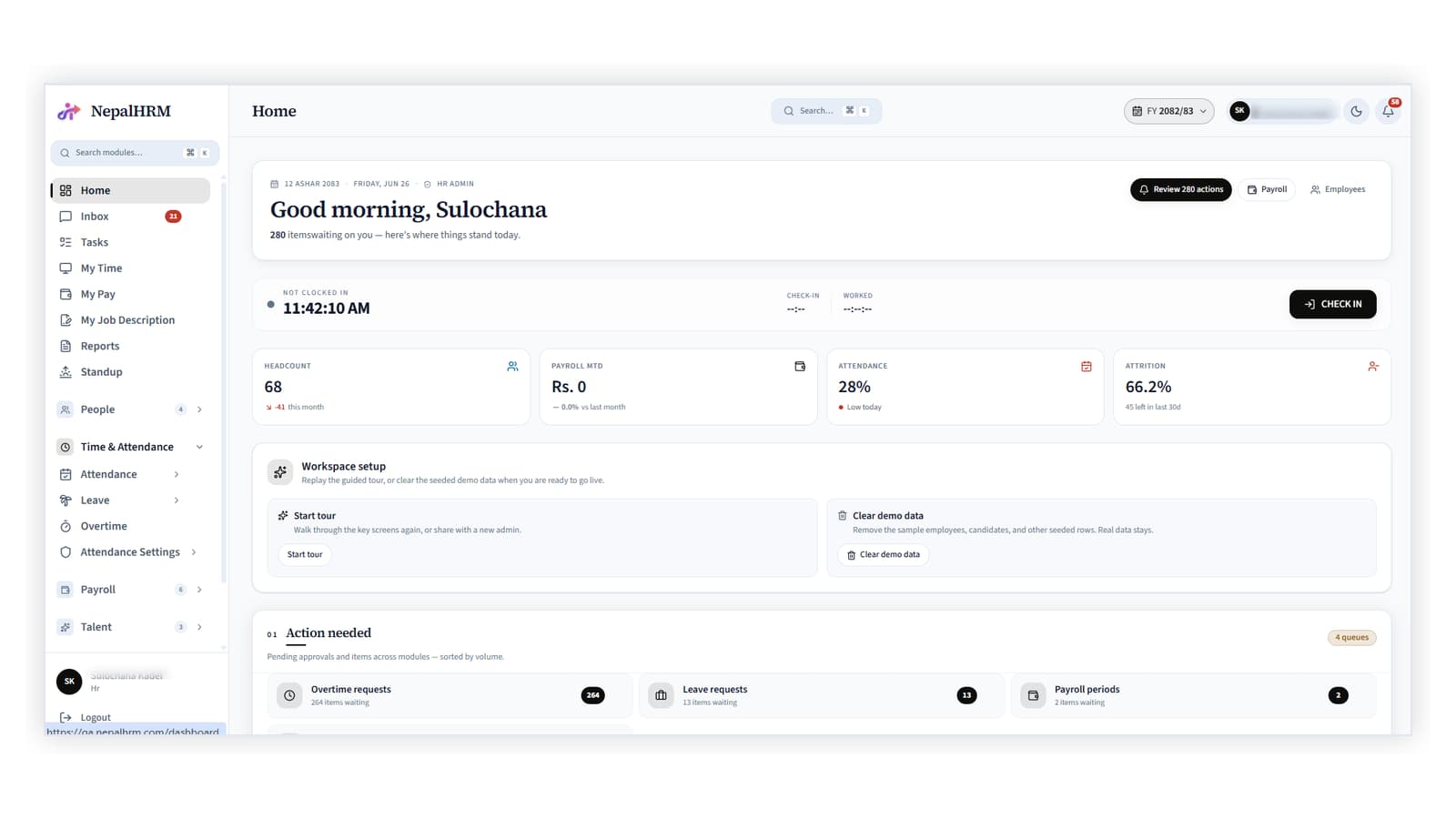
For small businesses, NepalHRM's biggest advantage is that Payroll does not sit alone. HR can manage salary, work together with Attendance, leave, employee profiles, advance salary, EMI repayment, documents, and reports. This reduces the need to move data between multiple sheets before every pay cycle.
Key payroll features:
Nepal tax slabs, PF, CIT, SSF, and eTDS support
Salary structures and payroll periods
Payslip generation and salary sheets
Advance salary and EMI repayment tracking
Attendance and leave connection for payroll review
CIT Optimizer for tax planning support
Employee self-service access for payslips and requests
Finance reports for payroll review and exports
Pricing
NepalHRM is free forever for businesses with up to 10 employees and includes the complete HR and Nepal payroll platform. Companies with more than 10 employees that need payroll can choose the Business plan, which includes payroll, attendance, leave, PF, CIT, SSF, eTDS, payslips, reports, recruitment and other HR modules.
Plan | Price |
|---|---|
Free | NPR 0 for up to 10 employees |
Essential | NPR 60 per active employee/month for employee records, attendance and leave |
Business | NPR 99 per active employee/month with full Nepal payroll and the complete HR suite |
Business above 100 employees | NPR 89 per active employee/month |
Business above 200 employees | NPR 79 per active employee/month |
Enterprise | Custom pricing for multi-company organizations and teams with 350+ employees |
Free trial | One month on Essential and Business plans |
Annual billing | Two months free |
VAT | Prices exclude 13% VAT |
The lower volume rate applies to the company's full active employee count after it crosses the relevant pricing band. NepalHRM charges only for active employees and does not require a minimum commitment.
2. HajirHR
HajirHR is a cloud HRMS that covers Attendance, leave, employee records, Payroll, reports, self-service, and mobile access. It can suit teams where attendance tracking and daily workforce visibility are closely connected with salary work.
HajirHR's pricing page lists monthly, yearly, and three-year options. The product also presents itself around Attendance, leave, Payroll, employee records, and reporting, which makes it a relevant local option for small businesses comparing HRMS payroll tools.
Key payroll features:
Attendance and leave management
Employee records and PIMS
Payroll and reports
Employee self-service
Mobile and web access
Biometric device support
Roles and permissions
Pricing
Plan | Price |
Standard Monthly | NPR 99 per seat/person |
Standard Yearly | NPR 75 per seat/person |
Standard 3-Year | NPR 65 per seat/person |
Tax | Prices are shown before Tax on the pricing page |
Before you commit: Ask for a live payroll demo that shows PF, CIT, SSF, eTDS, salary reports, and how attendance data flows into salary calculation.
3. RigoHR
RigoHR is a broader HR and payroll platform for companies that want payroll, approvals, employee self-service, finance review, and controlled HR workflows. Its pricing page lists Grow, Premium, and Enterprise plans, with Payroll and taxes included from the Grow plan.
RigoHR's payroll content highlights maker-checker control, legal compliance, income tax, SSF, PF, CIT, tax planning, loans, advances, audit trails, and salary reports. This can be useful when more than one person prepares, checks, or approves Payroll.
Key payroll features:
Payroll and taxes
Leave, time, overtime, and allowance connection
Maker-checker review controls
SSF, PF, CIT, income tax, and insurance support
Loans and advances
Monthly and annual TDS and salary reports
Audit trail and change records
Pricing
Plan | Price |
Grow | NPR 150 per employee/month |
Premium | NPR 250 per employee/month |
Enterprise | NPR 500 per employee/month |
Note | Minimum commitment fee applies |
Before you commit: Ask about the minimum commitment fee, setup time, maker-checker flow, and whether the Grow plan covers your exact Payroll and reporting needs.
4. Nimble HRMS
Nimble HRMS is an established HR and payroll software provider in Nepal. Its payroll content says the system handles TDS, PF, CIT, SSF, medical and insurance deductions, and tax reports in formats required by PF, CIT, IRD, and other regulations.
Nimble may suit companies that need Payroll as part of a broader HRMS setup. It can be useful when a business wants employee lifecycle tools, Payroll, Attendance, leave, reporting, and implementation support across a structured team.
Key payroll features:
TDS, PF, CIT, and SSF handling
Medical and insurance deductions
Tax reports and compliance-related formats
Loans and salary advance tracking
Broader HRMS workflow support
Recruitment-to-exit process coverage
Pricing
Item | Detail |
Public pricing | Not clearly listed on the checked public pages |
Next step | Ask for a quote based on employee count, payroll needs, modules, setup, and support. |
Before you commit: Ask whether a small-business plan is available, how long setup takes, and what payroll reports are included in the quoted package.
5. Pace HRMS
Pace HRMS is another local HRMS option for companies comparing Payroll, Attendance, leave, and employee management. Its product page highlights flexible payroll structure, Tax and statutory calculations, payslip management, biometric device integration, leave management, and employee information management.
Pace can be relevant for SMEs that want a locally supported HRMS, but small businesses should verify payroll depth during a live demo. The most important check is whether salary reports, contribution records, and attendance-to-salary flow match the company's real payroll process.
Key payroll features:
Flexible payroll structure, Tax and statutory calculations
Payslip management
Attendance and biometric support
Leave management
Employee records and document tracking
Pricing
Item | Detail |
Public pricing | Not clearly listed on the checked product pages |
Next step | Request pricing for your team size and ask what setup, support, and payroll reports are included |
Before you commit: Ask for payroll report samples, eTDS support, salary sheet formats, and a demo that shows Attendance and leave flowing into salary calculation.
6. Agile HRMS
Agile HRMS is built on Microsoft Dynamics 365 Business Central. It is more suitable for companies that want HR and Payroll connected with finance, ERP, reporting, and structured business workflows.
Agile's payroll content mentions TDS, PF, CIT, SSF, medical insurance, statutory deductions, compliance reports, maker-checker workflows, approval mechanisms, and reconciliation features. This makes Agile a stronger match for companies that already use Microsoft systems or need ERP-level payroll controls.
Key payroll features:
Payroll built on Microsoft Dynamics 365 Business Central
TDS, PF, CIT, SSF, medical insurance, and statutory deduction support
Compliance reports for payroll review
Maker-checker and approval workflows
Leave and attendance integration
Power BI and enterprise reporting potential
Pricing
Item | Detail |
Public pricing | Not clearly listed as a simple per-employee payroll plan |
Next step | Ask about Microsoft Dynamics licensing, implementation cost, setup timeline, and required customization. |
Before you commit: Confirm whether your business really needs ERP-connected payroll or whether a lighter HRMS payroll tool will be easier and faster to start.
Which Payroll Software Should Small Businesses Choose?
There is no single payroll software that fits every small business. The right choice depends on your team size, payroll complexity, attendance process, budget, reporting needs, and how much setup support you need.
Choose NepalHRM if your team wants clear pricing, a free plan for up to 10 employees, Nepal-focused Payroll, attendance-linked salary work, payslips, and HR tools in one system.
Choose HajirHR if Attendance, mobile access, leave records, and daily workforce tracking are your main priorities.
Choose RigoHR if your team needs stronger payroll approval, maker-checker review, finance control, and broader people operations features.
Choose Nimble HRMS if your company needs structured Payroll with broader HRMS workflows and deeper implementation support.
Choose Pace HRMS if you want to compare another local HRMS option and verify payroll depth through a demo.
Choose Agile HRMS if your company already uses Microsoft Dynamics or needs ERP-connected HR and payroll workflows.
For most small businesses in Nepal, the best starting point is the system that keeps Payroll simple, supports local salary rules, connects Attendance and leave, and shows clear pricing before purchase.
Why Nepal Payroll Needs Local Support?
Payroll in Nepal involves more than calculating a monthly salary figure. Before salaries go out, businesses often need to manage statutory deductions, income tax slabs, leave adjustments, salary advances, payslips, and eTDS-ready records.
PF (Provident Fund): PF contributions are usually calculated from basic remuneration, with employee and employer contributions recorded separately.
CIT (Citizen Investment Trust): Employee CIT contributions can reduce taxable income, which affects income tax calculation.
SSF (Social Security Fund): SSF contributions follow a different setup from PF and should not be mixed with other deductions.
Income tax slabs: Nepal uses progressive tax slabs based on annual income and tax category, not a single flat rate.
Female tax rebate: Eligible female employees may receive a tax rebate when the rule applies.
eTDS report: Businesses need TDS records for IRD reporting, including employee and tax details in the right format.
Salary sheets and payslips: HR and finance need clear records for internal review and employee communication.
A global payroll tool may treat these items as custom setup. A Nepal-focused payroll system should handle them as part of the normal salary process, so small businesses do not have to rebuild the same rules in spreadsheets every month.
Payroll Software Demo Checklist
Before buying payroll software, ask the vendor to run a real sample payroll during the demo. Use your own salary structure, attendance example, leave deduction, PF or SSF setup, CIT contribution, and payslip format if possible.
● Can the software calculate salary using your current salary structure?
● Does attendance and leave data affect salary calculation automatically or through manual import?
● Can the software handle PF, CIT, SSF, and TDS based on your company setup?
● Can HR generate salary sheets, payslips, bank transfer reports, and eTDS-ready records?
● Can the system handle salary advances, loans, EMI repayments, bonuses, and reimbursements?
● Can employees view payslips through self-service?
● Can HR export payroll data when needed?
● Does the vendor help with setup, migration, training, and payroll configuration?
● What is included in the monthly price, and what costs extra?
Final Thoughts
Payroll software for small businesses in Nepal should not be chosen only by brand name or the lowest monthly price. The right tool should reduce salary errors, support Nepal-specific payroll needs, connect Attendance and leave, generate useful reports, and fit your team's budget.
Before choosing a system, verify payroll compliance, confirm pricing, and run a real payroll cycle during the demo or trial. The best payroll software is the one your team can use every month without rebuilding the same work in spreadsheets.


