
Many employees in Nepal see a Provident Fund deduction on their salary slip, but do not always know how the amount is calculated. HR and finance teams also need to calculate PF correctly because one small mistake can affect pay slips, employer contributions, monthly records, and employee trust.
Provident Fund becomes simple when the salary base is clear. In Nepal, the usual PF calculation is 10% from the employee and 10% from the employer, calculated from basic remuneration. The employee share appears as a salary deduction, while the employer share is an additional company contribution.
Table of Contents
- What Is Provident Fund in Nepal?
- What Is the Provident Fund Rate in Nepal?
- Provident Fund Calculation Formula in Nepal
- Provident Fund Calculation Example
- How Provident Fund Appears on a Salary Slip
- Basic Remuneration vs Gross Salary: Why the Difference Matters
- Provident Fund vs SSF: What Is the Difference?
- Who Pays Provident Fund and When Should HR Review It?
- Provident Fund Calculation Checklist for HR and Finance Teams
- Use basic remuneration as the PF base
- Keep employee and employer contributions separate
- Review PF after salary changes
- Check joining and exit months carefully
- Show PF clearly on pay slips
- Keep monthly employee-wise records
- Manage PF and Payroll Records More Clearly
- Common PF Calculation Mistakes to Avoid
- Using gross salary instead of basic remuneration
- Showing employer PF as an employee deduction
- Missing salary revisions before payroll
- Mixing PF, SSF, gratuity, and tax in one line
- Keeping PF records only in separate spreadsheets
- Conclusion
What Is Provident Fund in Nepal?
Provident Fund, often called PF, is a retirement savings fund for employees. A fixed amount is deducted from the employee's basic remuneration every month, and the employer adds an equal contribution from the company side.
For employees, PF builds long-term savings. For HR and finance teams, PF is a monthly payroll responsibility because the deduction, employer contribution, pay slip entry, and employee-wise records must stay accurate.
What Is the Provident Fund Rate in Nepal?
The standard Provident Fund rate in Nepal is 10% from the employee and 10% from the employer. Together, the total PF contribution becomes 20% of the employee's basic remuneration.
The employer deducts the employee share from salary and adds an equal employer share before depositing the total amount into the applicable fund. The exact deposit route can depend on whether the employer is under SSF, EPF, or another approved retirement arrangement.
Provident Fund Calculation Formula in Nepal
PF calculation in Nepal starts with basic remuneration. HR should first confirm the employee's basic salary component, then calculate the employee and employer contributions separately.
Contribution | Formula | Meaning |
Employee PF | Basic Remuneration × 10% | Amount deducted from the employee's salary |
Employer PF | Basic Remuneration × 10% | Amount added by the employer from the company side |
Total PF Contribution | Employee PF + Employer PF | Total amount deposited for the employee |
PF should not be calculated on gross salary by default. Gross salary may include allowances, incentives, bonuses, overtime, reimbursements, or other earnings that may not form part of basic remuneration.
Provident Fund Calculation Example
Take an employee with basic remuneration of NPR 40,000 per month.
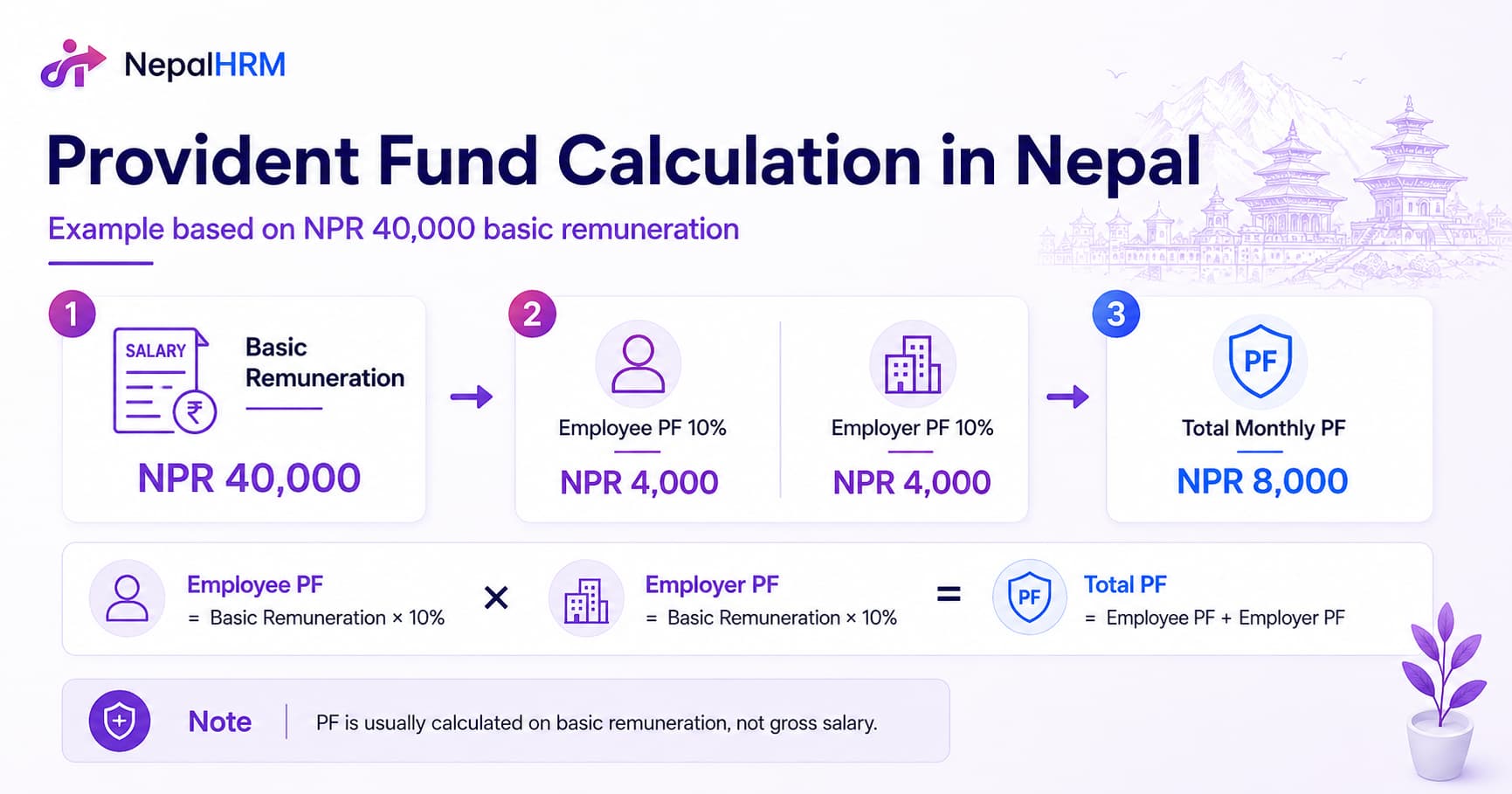
In this example, NPR 4,000 is deducted from the employee's salary. The employer adds another NPR 4,000 separately, so the total monthly PF contribution becomes NPR 8,000.
How Provident Fund Appears on a Salary Slip
A salary slip should show PF clearly so employees understand what was deducted and what the employer contributed separately. Employee PF affects take-home pay, but employer PF does not reduce the employee's salary.
Salary Slip Component | Amount | How to Read It |
Basic remuneration | NPR 40,000 | Base used for PF calculation |
Allowances | NPR 10,000 | Additional earnings included in gross salary |
Gross salary | NPR 50,000 | Total earnings before deductions |
Employee PF deduction | NPR 4,000 | Deducted from employee salary |
Employer PF contribution | NPR 4,000 | Added by employer separately |
Total PF contribution | NPR 8,000 | Total monthly PF amount |
Basic Remuneration vs Gross Salary: Why the Difference Matters
Basic remuneration is the salary base used for PF calculation. Gross salary is the wider total that may include basic salary, allowances, incentives, overtime, and other earnings.
This difference matters because a company can over-deduct or under-deduct PF when the wrong salary base is used. HR and finance teams should define the basic salary clearly in the salary structure before running payroll.
Provident Fund vs SSF: What Is the Difference?
Provident Fund and Social Security Fund are connected, but they are not always the same thing in payroll conversations. PF usually refers to the 10% employee and 10% employer retirement contribution, while SSF is a wider social security system that includes different contribution headings and benefit schemes.
Area | Provident Fund (PF) | Social Security Fund (SSF) |
Main idea | Long-term retirement savings contribution | Wider social security contribution system |
Common payroll rate | 10% employee + 10% employer | 11% employee + 20% employer under common SSF contribution structure |
Salary base | Basic remuneration | Basic salary/remuneration as per contribution structure |
Payroll impact | Employee share reduces take-home salary; employer share is company cost | Includes PF, gratuity, and other social security scheme allocations |
HR action | Calculate employee and employer PF correctly | Confirm registration, monthly contribution, and reporting requirements |
For most HR teams, the practical point is simple: do not mix PF, gratuity, and SSF amounts in one unclear salary line. Show the employee deduction, employer contribution, and total contribution clearly in payroll records.
Who Pays Provident Fund and When Should HR Review It?
Both the employee and employer contribute to PF. The employee share is deducted from salary, and the employer share is added as a separate company contribution.
HR should review PF whenever the basic remuneration changes, especially during salary revision, promotion, probation confirmation, department transfer, mid-month joining, unpaid leave, or final settlement. These events can change the amount shown on the salary slip or payroll report.
Provident Fund Calculation Checklist for HR and Finance Teams
PF calculation looks simple, but small mistakes can affect pay slips, employee trust, finance reviews, and monthly records. HR and finance teams should confirm the salary base, contribution split, salary changes, and final pay slip before closing payroll.
Use basic remuneration as the PF base
Confirm the employee's basic remuneration before running payroll. Do not calculate PF on gross salary unless your approved policy or salary structure clearly requires that treatment.
Keep employee and employer contributions separate
Employee PF is a salary deduction, while employer PF is a company-side contribution. Both amounts should appear separately in payroll records.
Review PF after salary changes
Salary revisions, promotions, probation confirmations, and role changes can change the PF amount. Update the salary structure before the next payroll cycle.
Check joining and exit months carefully
Mid-month joining, unpaid leave, resignation, and final settlement can affect salary calculation. HR should review partial-month treatment before closing payroll.
Show PF clearly on pay slips
Employees should understand their deductions and the employer's contribution. A clear pay slip reduces confusion and repeated questions to HR.
Keep monthly employee-wise records
Finance teams should keep PF records by employee and by month. Clean records make it easier to answer employee questions and review past payroll data.
Common PF Calculation Mistakes to Avoid
Most PF mistakes happen when HR teams use unclear salary structures or update payroll manually. The following errors are common in growing companies that still depend on spreadsheets.
Using gross salary instead of basic remuneration
Gross salary can include allowances, incentives, and other pay components. PF should be linked to the correct basic remuneration base, not the total gross amount by default.
Showing employer PF as an employee deduction
Employer PF is not deducted from the employee's take-home salary. It is a separate contribution from the company side.
Missing salary revisions before payroll
If HR updates salary after payroll is prepared, PF may not match the new basic remuneration. Salary changes should be reviewed before pay slips are generated.
Mixing PF, SSF, gratuity, and tax in one line
Employees should be able to understand each deduction and contribution. Clear payroll labels reduce confusion and make salary slips easier to review.
Keeping PF records only in separate spreadsheets
Separate files increase the risk of a mismatch between salary setup, pay slips, and monthly reports. HR should keep PF records connected with payroll data where possible.
Conclusion
Provident Fund in Nepal is calculated from basic remuneration. The employee contributes 10%, the employer adds another 10%, and the total monthly PF contribution becomes 20% of the PF base.
For HR and finance teams, accurate PF work depends on the right salary base, clear pay slip details, and organized monthly records. NepalHRM helps businesses keep PF details connected with payroll, so teams can review contributions more easily and avoid scattered manual checks.