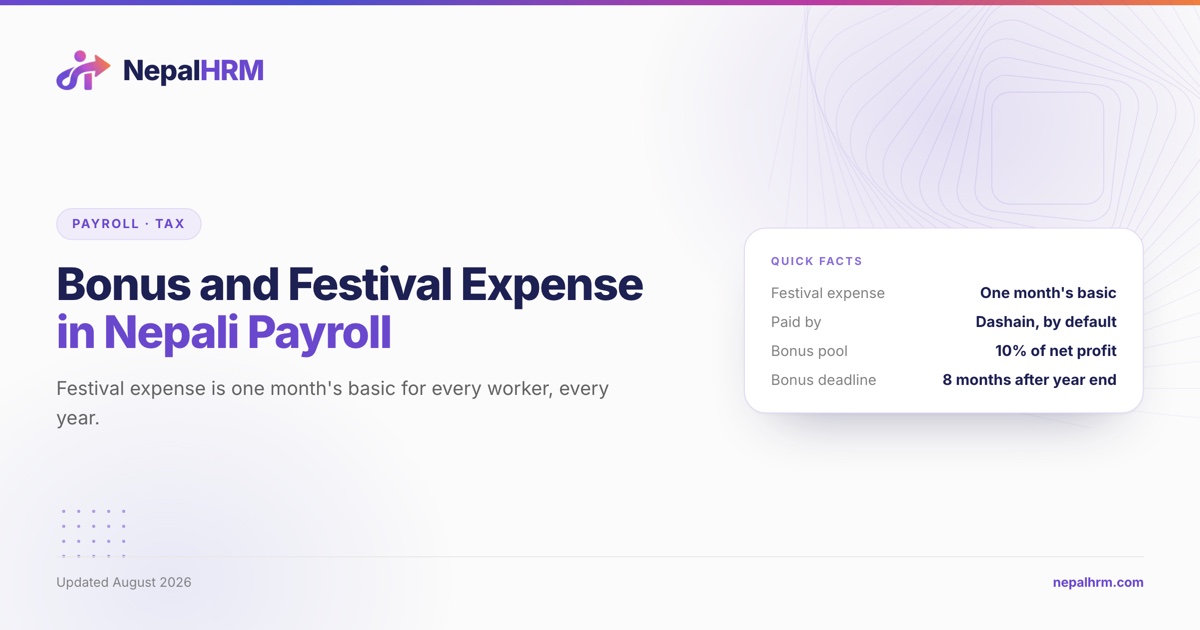
These are two different obligations and confusing them is expensive. Festival expense is due under Section 37 of the Labour Act 2074 to every worker, every year, at one month's basic remuneration, whether or not the enterprise made a profit. Bonus is due under the Bonus Act 2030, out of a pool of 10% of net profit, and only where there is a profit to allocate from.
An employer that pays "the Dashain bonus" and considers both discharged has met one obligation and missed the other. This guide separates them. For the payroll run that carries both, see how to calculate employee salary in Nepal.
Table of Contents
- The two side by side
- Festival expense, Section 37
- Bonus, under the Bonus Act 2030
- Both are taxable, and both move the withholding
- Where employers get this wrong
- Frequently asked questions
- Is festival expense compulsory in Nepal?
- Is Dashain bonus and annual bonus the same thing in Nepal?
- How much festival expense is payable in Nepal?
- When must bonus be paid in Nepal?
- Who is eligible for bonus in Nepal?
- Do I have to pay festival expense if the company made a loss?
- Is bonus taxable in Nepal?
- Sources
The two side by side
| Festival expense | Annual bonus | |
|---|---|---|
| Statute | Labour Act 2074, §37 | Bonus Act 2030 |
| Trigger | Employment, always | A profit in the fiscal year |
| Amount | One month's basic remuneration | Share of a pool of 10% of net profit |
| Who qualifies | Every worker | Worked at least half the working period in the year |
| Timing | The worker's main festival, Dashain by default | Within 8 months of the year closing |
| Pro-rated | Yes, under a year of service | Eligibility is a threshold, not a proportion |
| If the company loses money | Still payable | Not payable |
See festival expense and annual bonus for the definitions in isolation.
Festival expense, Section 37
Section 37(1). Every worker receives, each year, an amount equal to one month's basic remuneration they have been drawing, as festival expense, for the festival celebrated according to their religion, culture and tradition.
Three details in that sentence carry weight. It is basic, not gross, which is one more reason the basic figure in a salary structure matters. It is every worker, without a profit condition. And it is tied to the worker's own festival, not to a single company-wide date.
Section 37(2). The worker may make a written request to the employer to receive it once in a fiscal year at their own main festival. Where no such request is made, it must be paid at Dashain each year. So Dashain is the statutory default rather than the statutory rule, and an employer with a religiously mixed workforce should be collecting those written requests rather than assuming.
Section 37(3). A worker who has not completed one year of service by the day the festival expense is paid receives it in proportion to the service period completed. A joiner six months in receives half a month's basic, not nothing and not a full month.
Bonus, under the Bonus Act 2030
The pool. Section 5(1): each profit-making enterprise allocates an amount equal to ten percent of its net income for one fiscal year for bonus to employees. Section 5(2) sets out what is deducted in arriving at that net income, computed under the Income Tax Act 2058.
Who is eligible. Section 6(1): an employee who has worked for half the period to be worked in a fiscal year is entitled to bonus. The proviso excludes those who have worked casually or on a shift basis. Section 6(2) counts as worked: periods on reserve under a contract, periods of paid leave, and periods of disablement from an accident arising in the course of the enterprise's business.
Who is excluded. Section 8: an employee punished or dismissed for theft of or damage to enterprise property, illegal strike or abetment of one, or riots or breach of discipline. The proviso preserves bonus for the period before the punishable act.
How much each person gets. Section 7(2) sets the allocation mechanism against each employee's pay. Section 7(3) then caps the individual amount by reference to salary bands, and Section 7(4) prevents the bands from inverting. We are not quoting those band figures here. The English translation on the Law Commission record still carries thresholds expressed in the salary levels of an earlier era and refers to the Labour Act 2048, which the Labour Act 2074 replaced. Before applying a ceiling to a real bonus calculation, check the current consolidated Nepali text or take advice. Publishing a stale ceiling is worse than publishing none.
Form and timing. Section 9(1): bonus is paid in cash. Section 9(2): it must be distributed within eight months of the close of the fiscal year, which puts the ordinary deadline at the end of Falgun. Section 9(3): on a reasoned application, the Labour Office may extend by up to three months, or allow two years' bonuses to be distributed together in the next fiscal year.
The residue. Section 13: seventy percent of the amount left after distribution goes to the welfare fund established under that section, and the remainder to the national level welfare fund. Section 178(6) of the Labour Act 2074 keeps those funds operating as before until separate social security legislation covers the ground.
Reporting and penalty. Section 4(1): the enterprise submits its balance sheet and profit and loss statement to the Labour Office within six months of the fiscal year completing. Section 20: the Department of Labour may impose a fine of up to NPR 5,000.
Both are taxable, and both move the withholding
Section 8(2)(a) of the Income Tax Act 2058 lists bonus explicitly among the payments included in remuneration, alongside wages, salary, leave pay, overtime, fees, commission, prizes and gifts. Festival expense is remuneration on the same footing.
That matters for the mechanics of TDS on salary, because Nepali withholding is annualised. Paying a month's basic as festival expense in Ashoj raises the employee's annual remuneration, which raises the annual tax, which is then spread across the remaining months of the year. It does not create a one-off deduction in the festival month unless you choose to take it that way.
Practical consequence: tell people before Dashain. An employee who receives an extra month's basic and then sees their monthly withholding rise for the rest of the year will read it as an error unless someone explains the annualisation first.
Where employers get this wrong
- Paying festival expense on gross. It is one month's basic.
- Skipping it in a loss-making year. Section 37 has no profit condition. Only bonus does.
- Paying a full month to a six-month joiner, or nothing. Section 37(3) says proportionate.
- Assuming Dashain for everyone. It is the default where no written request has been made, not a universal rule.
- Treating the two as one line in the ledger. Different statutes, different triggers, different deadlines, and an auditor will want them separated. See payroll accounting in Nepal.
- Missing the balance sheet lodgement. Section 4(1) of the Bonus Act is a Labour Office filing, separate from anything the tax authority wants.
- Distributing bonus in kind. Section 9(1) says cash.
One is a payroll rule and the other is a profit calculation, and they belong in different places. NepalHRM holds festival expense against each employee's own basic with the service-period proportion applied, carries it through the same tax engine as the monthly run so the annualised withholding stays right, and keeps it separate from a bonus payout in the register. See how payroll works, or book a walkthrough.
Frequently asked questions
Is festival expense compulsory in Nepal?
Yes. Section 37(1) of the Labour Act 2074 entitles every worker to an amount equal to one month's basic remuneration each year as festival expense. There is no profit condition attached to it.
Is Dashain bonus and annual bonus the same thing in Nepal?
No. What is commonly called the Dashain bonus is the festival expense under Labour Act Section 37, payable to everyone each year. The annual bonus is a separate entitlement under the Bonus Act 2030, paid from a pool of 10% of net profit and only where the enterprise is profitable.
How much festival expense is payable in Nepal?
One month's basic remuneration that the worker has been drawing. A worker who has not completed a year of service by the payment day receives it in proportion to the service period completed, under Section 37(3).
When must bonus be paid in Nepal?
Within eight months of the close of the fiscal year, under Section 9(2) of the Bonus Act 2030, so ordinarily by the end of Falgun. The Labour Office may extend that by up to three months on a reasoned application.
Who is eligible for bonus in Nepal?
An employee who has worked at least half of the period to be worked in the fiscal year, under Section 6(1). Those working casually or on a shift basis are excluded by the proviso, and Section 8 excludes employees dismissed for specified misconduct.
Do I have to pay festival expense if the company made a loss?
Yes. Section 37 is unconditional. Only the bonus under the Bonus Act depends on there being net profit to allocate from.
Is bonus taxable in Nepal?
Yes. Section 8(2)(a) of the Income Tax Act 2058 names bonus among the payments included in employment remuneration, so it is withheld against in the same annualised calculation as salary. Festival expense is treated the same way.
Sources
- Labour Act, 2074 (2017), consolidated Nepali text, Nepal Law Commission: lawcommission.gov.np. Section 37 and Section 178(6) read from that text, retrieved 2026-08-07.
- Bonus Act, 2030 (1974), Nepal Law Commission English text. Sections 4, 5, 6, 7, 8, 9, 13 and 20, retrieved 2026-08-07. Note: that translation refers to the Labour Act 2048 and carries Section 7(3) salary bands that predate the Labour Act 2074, which is why no ceiling figure is quoted on this page.
- Income Tax Act, 2058 (2002), Nepal Law Commission text as published by the Institute of Chartered Accountants of Nepal: en.ican.org.np. Section 8(2)(a) and Section 87, retrieved 2026-08-07.
Related reading: Payroll compliance calendar for FY 2083/84 · Salary structure in Nepal · Gratuity in Nepal