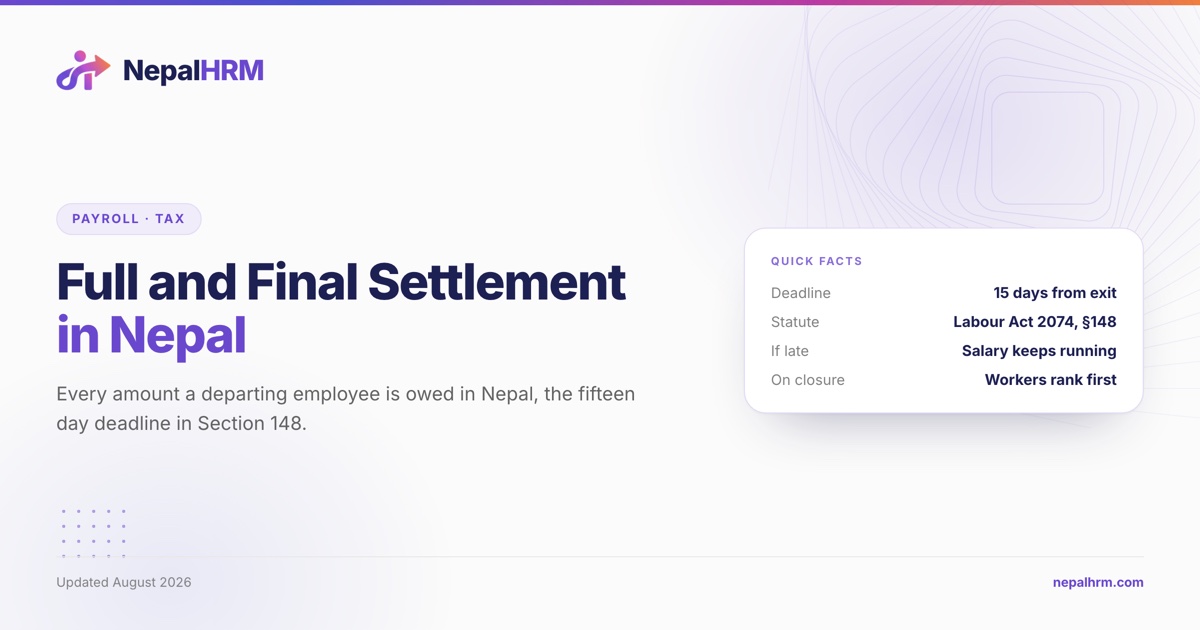
Nepal gives an employer fifteen days. Section 148(1) of the Labour Act 2074 requires that where employment ends for misconduct or in any other manner whatsoever, the employer pays the worker all remuneration, benefits and amounts due within fifteen days of the employment ending. There is no separate, longer clock for a dismissal, and no exception for a disputed exit.
Miss it and Section 148(3) applies a remedy most employers do not expect: the employer must keep paying remuneration as though the worker were still in service until the dues are paid. This guide covers what goes in the settlement, in what order, and how it is taxed.
Table of Contents
- What goes into the settlement
- Step by step
- How the settlement is taxed
- If the worker does not collect
- Five ways settlements go wrong
- Frequently asked questions
- How many days does an employer have to settle final dues in Nepal?
- What happens if an employer does not pay the final settlement on time?
- Is leave encashed on resignation in Nepal?
- Is a final settlement taxable in Nepal?
- How is a provident fund lump sum taxed at exit in Nepal?
- When must the TDS certificate be given to a departing employee?
- What if the employee will not come to collect their settlement?
- Do workers get paid before other creditors if a company closes in Nepal?
- Sources
What goes into the settlement
| Component | Basis | Source |
|---|---|---|
| Salary to the last working day | Days worked in the final month | Contract |
| Unpaid overtime | 1.5 times the hourly basic rate | Labour Act §31(1) |
| Leave encashment | Accumulated home leave and sick leave, at last basic drawn | Labour Act §49(2) |
| Festival expense | One month's basic, pro-rated to service in the year | Labour Act §37 |
| Gratuity | Accrued at 8.33% of basic, or inside the SSF contribution | Labour Act, and see below |
| Bonus already declared but unpaid | Share of the declared pool | Bonus Act 2030 |
| Retrenchment compensation, where it applies | One month's basic per year of service | Labour Act §145(7) |
| Notice pay in lieu, where applicable | Per the notice period | Labour Act §144 |
| Less: statutory deductions | TDS, and the final month's contributions | Income Tax Act §87 |
| Less: recoverable amounts | Outstanding advances and loans, per the clearance step | Contract |
Leave encashment is the line most often understated. Section 49(1) sets two separate accumulation ceilings, 90 days for home leave and 45 days for sick leave, and Section 49(2) encashes both on separation at the last basic remuneration drawn. A settlement that encashes home leave only is short. See every leave type under the Labour Act and leave encashment.
Gratuity depends on the regime. Under provident fund and gratuity it accrues at 8.33% of basic and is paid from the accrued provision. Under the SSF it sits inside the 20% employer contribution and is a Fund matter rather than a settlement line. Our gratuity guide covers both.
Retrenchment compensation is narrower than people assume. Section 145(7) sets one month's basic per year of service, it is not owed where an SSF unemployment benefit applies, and Section 145 does not apply to an enterprise with ten or fewer workers.
Step by step
1. Fix the last working day. Everything else counts from it, including the fifteen days.
2. Close attendance and leave. Pull the final leave balance for both home leave and sick leave against the Section 49(1) ceilings, and settle any pending regularisation. Anything unapproved on the last day becomes a dispute after it.
3. Run the final payroll as a payroll run, not as a manual voucher. This is what keeps the register and the ledger reconcilable, and it is what makes the tax right. See payroll accounting in Nepal.
4. Complete the clearance. Assets returned, handover done, and outstanding advances or loans identified from the loan record so the clearance step has a figure to settle against.
5. Compute the closing tax position. The employee's income year has ended for this employer. Their annual remuneration is now known rather than projected, so the final withholding trues up what the earlier months estimated.
6. Pay, within fifteen days. Every amount, not the uncontested part.
7. Issue the withholding certificate. Section 91(3) makes it due when the employee leaves employment during the year, not at year end.
8. Report the leaver to the SSF within one month, under Section 24 of the Contribution Based Social Security Act 2074. Skipping this is how a contributor list drifts from headcount.
9. Assist with the Fund. Section 148(2) requires the employer to give the necessary assistance for amounts or benefits the worker receives from the Social Security Fund, insurance or another body.
How the settlement is taxed
Termination payments are remuneration. Section 8(2)(e) of the Income Tax Act 2058 includes payment made for termination, loss of employment or compulsory retirement in employment income. A severance is not tax-free because it is called severance.
A retirement lump sum is treated differently. Section 65(1)(b): where a payment from an approved retirement fund is made in a lump sum, the amount treated as a gain is what remains after subtracting the higher of 50% of the payment or NPR 500,000. On a payment of NPR 800,000, that is 800,000 less 500,000, leaving 300,000, because 500,000 is higher than half of 800,000.
Withholding on the fund payment is 6%, not 15%. The proviso to Section 88(1) takes provident fund and gratuity paid by an approved retirement fund to six percent of the payment, against the fifteen percent that heading otherwise carries.
An unapproved fund is worse. Section 65(2) taxes the excess of payments over contributions, withheld finally where a resident person pays it.
If the worker does not collect
Section 148(4) closes the loophole in both directions: where the worker does not come to take the remuneration or benefit, the employer may pay it directly into the worker's account or deposit it at the Office. An uncontactable employee is not a reason to hold money and it is not a defence to Section 148(3).
And on closure, Section 149 puts workers first: when an enterprise is closed or liquidated, remuneration and other benefits still payable to workers must be given first priority, subject to insolvency law where that applies.
Five ways settlements go wrong
- Treating the fifteen days as starting from the clearance, not from the exit. The Act says from the employment ending.
- Encashing home leave and not sick leave. Section 49(2) covers both.
- Paying it from a manual voucher. The tax is then wrong, the register never matches the ledger, and the year-end reconciliation fails for a reason nobody can locate.
- Holding the whole settlement over one disputed line. The undisputed amount is still due inside fifteen days, and Section 148(3) does not carve out disputes.
- Forgetting the certificate and the SSF report. One is due on leaving under Section 91(3), the other within a month under Section 24.
A settlement is a payroll run with a deadline attached. NepalHRM runs the final settlement through payroll so the closing tax position, the leave encashment at last basic drawn and the accrued gratuity all come from the same record, and the outstanding loan balance stays visible on the loan record for the exit clearance step to settle against. See how payroll works, or book a walkthrough.
Frequently asked questions
How many days does an employer have to settle final dues in Nepal?
Fifteen days from the employment ending, under Section 148(1) of the Labour Act 2074. That applies whether the exit is a resignation, a dismissal for misconduct, or an ending in any other manner.
What happens if an employer does not pay the final settlement on time?
Section 148(3) requires the employer to keep paying remuneration as though the worker were still in service until the dues are paid. The obligation does not simply attract a fine; the salary clock carries on running.
Is leave encashed on resignation in Nepal?
Yes, and both types. Section 49(2) encashes accumulated home leave and sick leave on separation at the last basic remuneration drawn, against the separate ceilings in Section 49(1) of 90 days and 45 days.
Is a final settlement taxable in Nepal?
Yes. Section 8(2)(e) of the Income Tax Act 2058 includes payments for termination, loss of employment or compulsory retirement in employment income. A lump sum from an approved retirement fund is treated separately under Section 65(1)(b).
How is a provident fund lump sum taxed at exit in Nepal?
Section 65(1)(b) subtracts the higher of 50% of the payment or NPR 500,000 before treating the balance as a gain, and the proviso to Section 88(1) withholds on provident fund and gratuity from an approved retirement fund at 6%.
When must the TDS certificate be given to a departing employee?
When they leave. Section 91(3) makes the employment withholding certificate due within thirty days of the year ending, or on the employee ceasing to serve during the year, whichever comes first.
What if the employee will not come to collect their settlement?
Section 148(4) lets the employer pay the amount directly into the worker's account or deposit it at the Office. The employer cannot simply hold it and rely on the worker's absence.
Do workers get paid before other creditors if a company closes in Nepal?
Section 149 gives workers' unpaid remuneration and other benefits first priority when an enterprise is closed or liquidated, subject to insolvency law where that applies.
Sources
- Labour Act, 2074 (2017), consolidated Nepali text, Nepal Law Commission: lawcommission.gov.np. Sections 31, 37, 49, 144, 145, 148 and 149 read from that text, retrieved 2026-08-07. Section 148 was read in the consolidated Nepali because the circulating English translations predate the 2081 and 2082 amendments.
- Income Tax Act, 2058 (2002), Nepal Law Commission text as published by the Institute of Chartered Accountants of Nepal: en.ican.org.np. Sections 8, 65, 87, 88 and 91, retrieved 2026-08-07.
- Contribution Based Social Security Act, 2074, consolidated Nepali text as amended through 2082: ssf.gov.np. Section 24 on reporting a leaver.
- Gratuity at 8.33% of basic and the leave ceilings are held in
lib/nepal-labour.ts, the repository's single source for Labour Act figures.
Related reading: Termination and notice period in Nepal · Gratuity in Nepal · Payroll compliance calendar for FY 2083/84