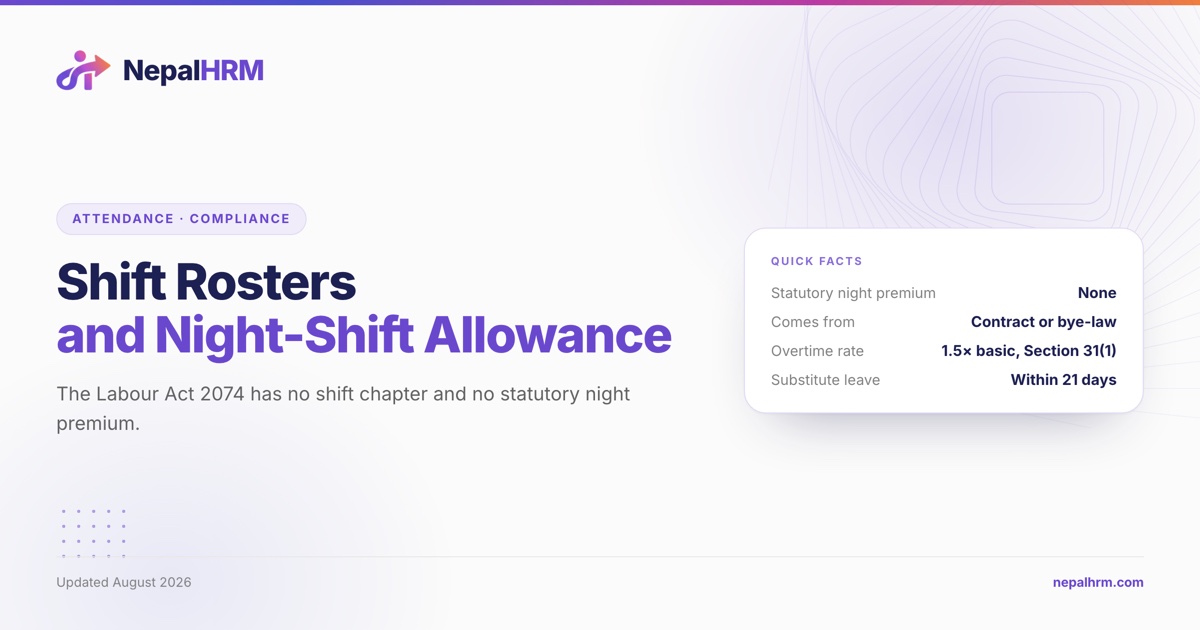
Nepal's Labour Act 2074 contains no shift chapter and no statutory night-shift allowance. A night premium in Nepal is contractual: it comes from the employment contract under Section 34(2), from a bye-law under Section 108, or from a collective agreement. Nothing in the Act obliges an employer to pay more for a shift simply because it runs at night.
What the Act does constrain is everything around the roster: the daily and weekly hour ceilings, the rest break, overtime, the weekly leave day, holiday working, and transport for female workers on shifts that start before sunrise or end after sunset. Getting those right matters more than the premium, because they are the ones an inspector asks about. This guide sits under our biometric attendance setup guide, which covers how the punches behind a roster are captured in the first place.
Table of Contents
- What actually constrains a roster
- Night work: what is owed and what is not
- Where a night allowance becomes binding
- What the allowance actually costs
- Night overtime is a different line
- Building the roster
- Frequently asked questions
- Is night-shift allowance mandatory in Nepal?
- How much is night-shift allowance in Nepal?
- Is overtime payable for a night shift in Nepal?
- Does the Labour Act 2074 regulate shift work?
- Can a company in Nepal put women on night shifts?
- Is night-shift allowance taxable in Nepal?
- How is the weekly leave handled on a rotating roster?
- Sources
What actually constrains a roster
| The rule | The number | Section |
|---|---|---|
| Maximum hours a day | 8 | 28(1) |
| Maximum hours a week | 48 | 28(1) |
| Rest after continuous work | 30 minutes after 5 hours | 28(2) |
| Rest counted inside working hours | Yes | 28(4) |
| Rest may be rotated where work cannot stop | Yes | 28(3) |
| Worker cannot be compelled beyond the hours | Yes | 29(1) |
| Maximum overtime | 4 a day, 24 a week | 30(1) |
| Overtime rate | 1.5× basic remuneration | 31(1) |
| Start and finish times | As per the employment contract | 32(1) |
| Transport for a female worker before sunrise or after sunset | Employer arranges both ways | 33 |
| Weekly leave | 1 day every week | 40 |
| Substitute leave for holiday working | Within 21 days | 42(2) |
| Holiday work with no substitute leave | Deemed overtime | 30(2) |
Section 28(3) is the provision that makes a continuous operation lawful. Where work cannot be stopped or must be run continuously, the half-hour rest is rotated rather than removed. Hospitals, hotels, security posts and production lines all live here, and a roster that simply omits the break for those roles is not using 28(3), it is breaching 28(2).
Section 40 is the one rosters break most often. One day of weekly leave every week, per worker. A rotation that gives four people three rest days between them across a fortnight has not complied, however fair it looks on the sheet. Our guide to working hours and weekly holiday rules works through Sections 28 to 33 and 40 to 42 in full.
Night work: what is owed and what is not
Not owed by statute. A premium for working at night. There is no provision setting one, and none of the general remuneration provisions creates one by implication.
Owed by statute. Everything the daytime shift is owed, plus Section 33. Where a female worker is engaged such that her working time begins before sunrise or ends after sunset, the employer shall arrange the necessary transport for her to come to the workplace and to return from it. It is not conditional on the shift being formally designated as a night shift, and a transport allowance where no transport is arranged does not satisfy it.
Schedule 10 of the Labour Rules 2075, the annual labour audit form, asks about it directly at row 9: when engaging a woman after sunset or before sunrise, has transport and security been arranged under Section 33? That is the question your labour audit has to answer with a record rather than an intention.
Two nearby duties belong in the same roster review. Section 74 requires a safety and health committee at any workplace with twenty or more workers. Section 81 requires lighter work for a pregnant worker where a health check supports it, which on a rotating roster usually means moving her off nights.
Where a night allowance becomes binding
Once you decide to pay one, three instruments can carry it, and each binds differently.
The employment contract, Section 34(2). Remuneration and benefits are as stated in the employment contract, provided they are not less than the Act and the Rules prescribe. An allowance written into the contract is a contractual entitlement from that day.
The bye-law, Section 108. A bye-law on service, conditions and benefits binds the enterprise's workers, must not fall below the Act's minimum standards or the collective agreement under 108(2), and is registered with the Labour Office under 108(4). This is where a rate that applies to a whole grade or a whole plant belongs, rather than in seventy separate contracts.
The collective agreement. Where one exists it sets the floor for the bye-law, so a night rate agreed collectively cannot be reduced by a later bye-law. Section 133(1) also lets a sector regulator prescribe terms for banks and financial institutions, schools, telecom providers, hospitals, air services and insurance, and the bye-law follows the regulator where it has.
One thing an allowance cannot do is make up the minimum. The minimum remuneration notice fixes basic remuneration and dearness allowance separately, so a night allowance sits above that floor rather than counting toward either part of it.
What the allowance actually costs
An allowance is remuneration, so it is taxable in the month it is paid. It is not basic remuneration, and SSF and PF are both calculated on basic, so neither contribution moves. That combination makes the real cost easy to state and easy to get wrong.
Take an employee on NPR 60,000 basic plus NPR 40,000 in other allowances, contributing through SSF, and add a NPR 4,000 night allowance for the month:
| Without | With NPR 4,000 | |
|---|---|---|
| Gross for the month | NPR 100,000 | NPR 104,000 |
| SSF employee contribution (11% of basic) | NPR 6,600 | NPR 6,600 |
| SSF employer contribution (20% of basic) | NPR 12,000 | NPR 12,000 |
| Monthly TDS | NPR 1,007 | NPR 1,407 |
| Net in hand | NPR 92,393 | NPR 95,993 |
The allowance costs the employer NPR 4,000 and delivers NPR 3,600, because the employee's next rupee falls in the 10% band. Move the same NPR 4,000 onto a NPR 90,000 basic and NPR 60,000 allowance package and the marginal band is 20%, so TDS rises by NPR 800 and NPR 3,200 lands. On smaller packages, where annual taxable income stays under the first NPR 1,000,000 at 0%, the whole NPR 4,000 reaches the employee, which is a genuinely useful fact when you are setting the rate.
All four figures come from the FY 2083/84 slabs and rates in the same module our salary and tax calculator runs on. Change the salary and it changes the answer; do not carry these numbers to a different package.
Night overtime is a different line
Two mechanisms are easy to confuse, and paying one while calling it the other is how a payroll ends up short.
Night allowance prices being on a night shift. It is per night or per hour inside a defined night window, it applies to ordinary rostered hours, and its rate is yours to set.
Night overtime prices hours beyond the statutory ceiling that happen to fall at night. Section 30(1) allows up to four a day and twenty-four a week; Section 31(1) sets the rate at not less than one and a half times basic remuneration. An employer may pay above that floor, and many do for nights, weekends and holidays, but 1.5× is the number the Act guarantees.
An eight-hour night shift is therefore ordinary time. It attracts the allowance if you offer one and no overtime at all, because nothing about it exceeded eight hours. A twelve-hour night shift is eight ordinary hours plus four overtime hours, and the four are priced under Section 31(1) whatever the allowance says. Our overtime rules guide covers the caps and the rate, and /tools/overtime-calculator prices a real month.
Building the roster
- Publish it in advance, and keep the version. Section 32(1) puts start and finish times in the employment contract, so a roster that departs from the contracted pattern needs the contract to allow the variation.
- Give the weekly leave every week, per worker, per Section 40. Check it on the roster before publishing rather than in payroll afterwards.
- Mark the public holidays the roster runs through, and decide each one: substitute day inside twenty-one days under Section 42(2), or overtime pay. Silence is not the third option, because Section 30(2) resolves it to overtime by law.
- Rotate the rest break under Section 28(3) where the line cannot stop, and show it on the roster.
- Arrange transport for every female worker whose shift crosses sunrise or sunset, per Section 33, and keep the record.
- Approve overtime before it is worked. Section 29(1) prohibits compelling hours beyond Section 28(1), so the approval is a control rather than paperwork.
See shift roster and working hours for the terms, and /tools/holiday-calendar for the dates the roster has to plan around.
A roster is a payroll input before it is a schedule. NepalHRM builds each day from real punches against the employee's assigned shift, prices a night allowance either as a flat amount per night or per hour inside a night window you configure, and carries approved overtime into the same month's salary sheet through its own rate tiers. It prices overtime rather than blocking it, so the four-hour and twenty-four-hour ceilings in Section 30(1) still need a supervisor rule and an exception report behind them. See shift and overtime management, or book a walkthrough with your own roster.
Frequently asked questions
Is night-shift allowance mandatory in Nepal?
No. The Labour Act 2074 sets no night premium. An allowance becomes binding once it is written into the employment contract under Section 34(2), into a bye-law under Section 108, or into a collective agreement.
How much is night-shift allowance in Nepal?
There is no statutory rate, so it is whatever the contract, bye-law or collective agreement sets. It is commonly paid either as a flat amount per night worked or per hour inside a defined night window.
Is overtime payable for a night shift in Nepal?
Only for hours beyond the statutory ceiling. Overtime under Sections 30 and 31 begins past eight hours a day or forty-eight a week, regardless of the time of day. An eight-hour night shift is ordinary time.
Does the Labour Act 2074 regulate shift work?
Not as a separate subject. There is no shift chapter. Rosters are constrained indirectly by Section 28 on hours and rest, Section 29 on compulsion, Sections 30 and 31 on overtime, Section 32 on start and finish times, Section 33 on transport, Section 40 on weekly leave and Section 42 on substitute leave.
Can a company in Nepal put women on night shifts?
Yes. Section 33 does not prohibit it; it obliges the employer to arrange the necessary transport to and from the workplace where a female worker's working time begins before sunrise or ends after sunset.
Is night-shift allowance taxable in Nepal?
Yes. It is remuneration and is taxed in the month it is paid. Because SSF and provident fund contributions are calculated on basic remuneration, an allowance paid outside basic does not change either contribution.
How is the weekly leave handled on a rotating roster?
Each worker still receives one day of weekly leave every week, under Section 40. The Act does not name the day and does not require it to be the same day for everyone, so a rotation may stagger it as long as no worker's week goes without one.
Sources
- Labour Act, 2074 (2017), consolidated Nepali text as amended through 2082, Nepal Law Commission: lawcommission.gov.np. Sections 28 to 34, 40 to 42, 74, 81, 106, 108 and 133 were read from that text, retrieved 2026-08-07.
- Labour Rules, 2075 (2018), Nepal Law Commission. Rule 56 and Schedule 10 (labour audit form, row 9 on Section 33), retrieved 2026-08-07.
- Tax and contribution figures generated from the FY 2083/84 slabs and rates in
lib/nepal-payroll.ts, the same module behind /tools/salary-tax-calculator.
Related reading: Overtime rules in Nepal · Working hours and weekly holiday rules in Nepal · Attendance policy for Nepali companies