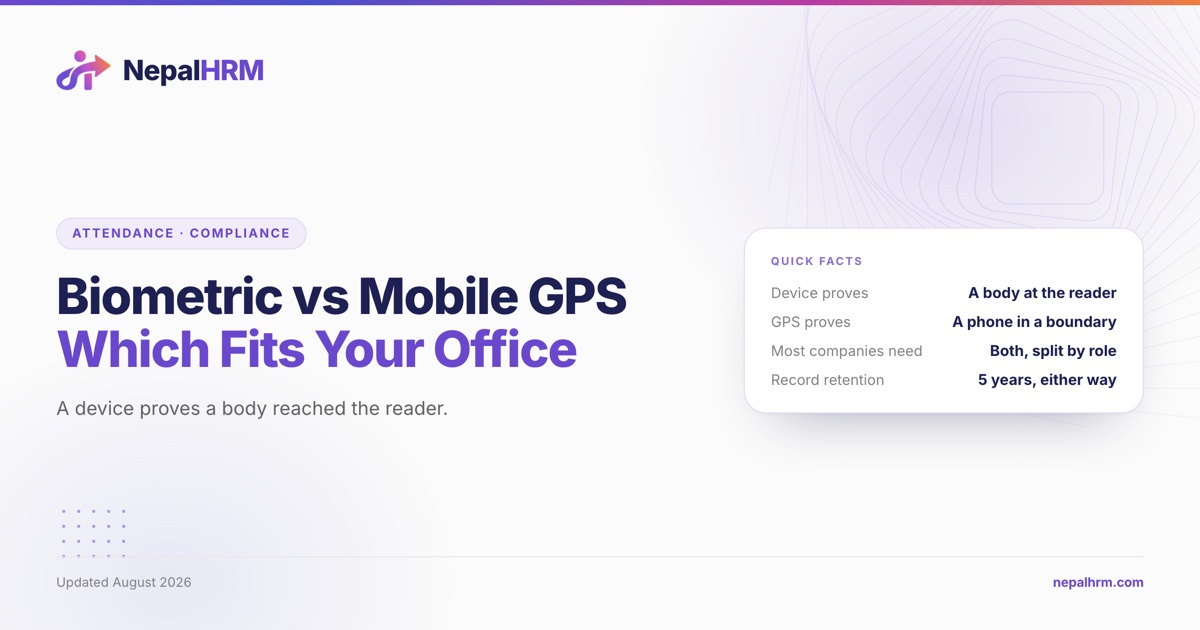
A biometric device proves that a body was at the reader. A mobile GPS check-in proves that a phone was inside a boundary. Everything else in this comparison follows from that one difference, and it is why most Nepali companies with more than one location end up running both, split by role, rather than picking a winner.
This is a choice, not a setup guide. If you have already made the choice and need the wiring, our biometric attendance setup guide for Nepal covers the device, the network mode and the connection to the HR system. What follows is how to decide, what each method costs you in failure modes rather than in rupees, and what the law expects from the record either way.
Table of Contents
- What each one actually proves
- The decision, by role
- Where each one fails
- Radius is the whole GPS decision
- What the law expects, either way
- Privacy is a policy question, not a feature
- What to put in the policy
- Frequently asked questions
- Is GPS attendance better than biometric attendance?
- Can GPS attendance be faked?
- What geofence radius should an office use in Nepal?
- Do biometric attendance devices work without internet in Nepal?
- Which biometric devices does NepalHRM support?
- Can a company use both biometric and mobile attendance together?
- How long do attendance records have to be kept in Nepal?
- Sources
What each one actually proves
| Biometric device | Mobile GPS check-in | |
|---|---|---|
| Proves | A registered fingerprint or face was presented at a known reader | A phone reported a location inside a defined boundary at a time |
| Closes | Buddy punching. The identifier cannot be lent | Absence from site. A check-in outside the fence is rejected |
| Leaves open | Nothing about what happened after the punch | Whether the person and the phone were together |
| Needs | Hardware at each location, plus enrolment | A smartphone per employee, plus data or Wi-Fi |
| Fails on | Power cut, connectivity loss, wet or worn fingers, gloves | Flat battery, weak signal indoors, low-end handsets, location spoofing |
| Fits | Fixed workplaces: office, gate, plant, reception, ward | Movement: field sales, site visits, service calls, small branches |
The row that decides most arguments is the third one. A device answers "was this specific person here" with more force than a phone can, because a fingerprint template cannot be handed to a colleague and a phone can. That is worth something in a workplace where buddy punching is the actual problem, and nothing at all for a sales executive who is legitimately in Butwal.
The decision, by role
- Head-office staff, reception, accounts. Device. They arrive at one place at roughly one time, and it is the cheapest reliable proof there is.
- Factory and warehouse lines. Device at the gate. Add a second reader if a single queue at shift change costs you five minutes across two hundred people.
- Hospital wards, hotels, security posts. Device, with the roster doing the real work. These are the operations where Section 28(3) lets the rest break be rotated rather than removed.
- Field sales, service engineers, collection staff. GPS. There is no reader on the route, and a daily register signed on return proves nothing.
- Small branches and outlets. GPS first. Hardware at a three-person outlet rarely pays for itself, and a branch manager can be authorised to approve that branch's attendance without touching anyone else's.
- Hybrid and remote roles. GPS, with a home location added deliberately rather than by leaving the fence wide.
- Construction and project sites. GPS with a site-sized boundary, because the "workplace" is a few hundred metres across and moves every few months.
Where each one fails
Biometric, in Nepali conditions. Power cuts and connectivity loss are the two that matter. The design question to ask a vendor is not whether the device is accurate; it is what the device does when the link to the HR system drops. A device that records punches locally and forwards them when the connection returns loses nothing. One that depends on a live connection to record loses the day, and you find out at month end.
The second failure is quieter. A device knows its own user IDs, not your employee codes, so the mapping between them is a separate object that can be incomplete or duplicated. Punches then land against the wrong person or against nobody, and the daily summary disagrees with reality without anything looking broken. Check it whenever a device is replaced or a branch is added, because that is when the mapping is rebuilt.
GPS, in the same conditions. The phone is the weak link in three ways: it can be flat, it can be somewhere its owner is not, and its location can be faked on a rooted handset. None of those is fatal, and all three are why GPS works best as a check on presence combined with supervisor approval, rather than as unattended proof.
Signal is the practical one. GPS accuracy degrades badly inside concrete buildings and basements, which is exactly where a tight geofence then rejects a legitimate check-in. If the office is indoors, the fence has to be drawn for the building, not for the desk.
Radius is the whole GPS decision
A geofence converts a location reading into a yes or a no. Where you draw it decides whether that yes means anything.
- An office fence wants to cover the building and its approach: too tight and staff fail at the gate, too loose and the fence includes the tea shop across the road. A sensible working range runs from a few tens of metres for a single floor up to a couple of hundred for a compound.
- A client or home fence should be small. These are pin-point locations, and a wide radius around a home address is both useless and intrusive.
- A site fence is the exception. A construction or project site is genuinely large, and a boundary measured in kilometres is the honest shape for it.
- Wi-Fi is the cheap second signal. Requiring the office network alongside the coordinates raises the cost of faking a check-in without adding hardware.
In NepalHRM, an office location carries a latitude, a longitude, a radius validated between 25 m and 2,000 m and a list of Wi-Fi networks, and can be marked shared or personal so a home working spot is a deliberate record rather than a widened office. Field geofences are separate, with office, client, home and site kinds, a 500 m ceiling on the pin-point kinds and 5 km on a site. The caps exist so nobody draws a hundred-kilometre office by accident.
See GPS attendance and biometric attendance for the terms.
What the law expects, either way
The Labour Act 2074 does not prescribe a method. It cares about the record.
- Rule 81(3) of the Labour Rules 2075 requires records of remuneration paid and attendance to be kept for at least five years. That is an argument for whichever method actually produces a durable record, and against the paper register that lives in a drawer.
- Section 32(1) puts each worker's start and finish times in the employment contract. Whatever captures the punch has to be compared against a contracted time, otherwise "late" has no meaning.
- Section 100 and Schedule 10 ask whether workers are engaged beyond eight hours a day and forty-eight a week, and whether the half-hour rest after five hours is given. Both are questions about hours, so your method has to reconstruct a day, not just log an event.
- Section 38(1)(e) allows pay to be withheld only for time actually absent, so the record has to be good enough to say how much. Our guide to late coming and absence deductions covers what you may and may not take off a salary.
There is also a third option worth naming, because it is often the right one. Where a device already exists and nobody wants to replace it, its own monthly export can be imported against a saved column mapping that records which row is the header, which column is time in, and whether the date cell is BS or AD. That is the honest answer for hardware nobody integrates with directly, and it beats retyping a spreadsheet every Shrawan.
Privacy is a policy question, not a feature
A fingerprint or face template belongs to the employee. Three things follow, and none of them costs money:
- Tell staff what is stored, where, and for how long, before enrolment rather than after a complaint.
- Delete templates when someone leaves. A device holding the fingerprints of former employees is a liability with no upside.
- For GPS, collect location at the moment of check-in, not continuously through the day. Continuous tracking answers a question nobody asked and turns an attendance rollout into an argument.
What to put in the policy
This choice is clause 5 of your attendance policy: how presence is recorded, stated per role rather than for the company as a whole. Write it as "biometric punch at the workplace device for [roles], geofenced check-in from the employee app for [roles]", then add the regularisation route for the punches that inevitably go missing. Our attendance policy template for Nepali companies has the full clause set and the Section 108 bye-law it has to sit in.
One record, two ways in. NepalHRM supports ZKTeco and Hikvision devices, listed on a fleet board by branch with their online status and how many employees each one has mapped, alongside geofenced check-in from the employee app on iOS and Android. Both land in the same daily attendance record, a branch or outlet manager can be authorised to approve their own branch, and a device nobody integrates with directly can still be imported through a saved column mapping. See how attendance works, or book a walkthrough with your own mix of sites.
Frequently asked questions
Is GPS attendance better than biometric attendance?
Neither is better in general, because they prove different things. A biometric device proves a specific person presented an identifier at a known reader, which closes buddy punching. A GPS check-in proves a phone was inside a defined area, which is the only workable proof for staff who are never near a device.
Can GPS attendance be faked?
It can be harder or easier depending on setup. A phone can be lent, and location can be spoofed on a rooted handset. Requiring the office Wi-Fi network alongside the coordinates, keeping the radius tight, and routing the day through supervisor approval all raise the cost of faking it.
What geofence radius should an office use in Nepal?
Large enough to cover the building and its entrance, small enough to exclude the street. A single floor needs only tens of metres; a compound with a car park needs a couple of hundred. Construction and project sites are the exception and are genuinely measured in kilometres.
Do biometric attendance devices work without internet in Nepal?
It depends on the device. One that records punches locally and forwards them when the link returns keeps working through an outage. One that needs a live connection to record the punch will lose those punches, so ask the question before buying rather than during a monsoon outage.
Which biometric devices does NepalHRM support?
ZKTeco and Hikvision. Those are the two vendors the application validates, and both are widely deployed in Nepal. A device from another vendor can still be used by importing its own monthly export through a saved column mapping.
Can a company use both biometric and mobile attendance together?
Yes, and most companies with field staff or multiple sites should. The two methods answer different questions, so the sensible design assigns a method per role and lands both in the same daily attendance record.
How long do attendance records have to be kept in Nepal?
At least five years, under Rule 81(3) of the Labour Rules 2075, which covers records of remuneration paid and of attendance. The rule does not distinguish between methods.
Sources
- Labour Act, 2074 (2017), consolidated Nepali text as amended through 2082, Nepal Law Commission: lawcommission.gov.np. Sections 28, 32, 38 and 100 were read from that text, retrieved 2026-08-07.
- Labour Rules, 2075 (2018), Nepal Law Commission. Rule 81 (personal records and attendance, five-year retention) and Schedule 10 (labour audit form), retrieved 2026-08-07.
Related reading: Biometric attendance setup in Nepal · Attendance policy for Nepali companies · Shift rosters and night-shift allowance in Nepal