

CIT interest rates in Nepal vary by scheme. Citizen Investment Trust, also known as Nagarik Lagani Kosh (नागरिक लगानी कोष), lists separate rates for retirement funds, pension schemes, unit schemes, insurance funds, and loans.
As of 31 July 2026, the official CIT page lists 3.75% for the Employee Savings Growth Approved Retirement Fund. CIT loan rates range from 4.25% to 7.25%, depending on the loan type.
Employees, contributors, and HR teams should always check the official CIT website before making savings, loan, or payroll decisions because rates can change.
Table of Contents
- Latest CIT Interest Rates in Nepal
- Savings, Retirement, and Pension Scheme Rates
- Insurance Fund Rates
- CIT Loan Interest Rates
- What Is CIT in Nepal?
- Why CIT Interest Rates Differ by Scheme
- CIT Deposit Interest vs CIT Loan Interest
- CIT Deposit Interest
- CIT Loan Interest
- Does CIT Contribution Reduce Tax in Nepal?
- How Employers Should Handle CIT in Payroll
- Common CIT Mistakes to Avoid
- Using One CIT Rate for Every Scheme
- Confusing Deposit Interest With Loan Interest
- Claiming the Full Contribution Without Checking the Deduction Limit
- Using Old Payroll Settings
- Conclusion
Latest CIT Interest Rates in Nepal
The latest CIT interest rates below are taken from the official Citizen Investment Trust interest rate page. The rate depends on the exact scheme, so employees should not assume one CIT rate applies to every deposit or loan.
Source note: Rates checked from the official Citizen Investment Trust interest rate page on 31 June 2026.
Savings, Retirement, and Pension Scheme Rates
CIT Scheme | Interest Rate |
Employee Savings Growth Approved Retirement Fund | 3.75% |
Citizen Unit Scheme, Individual | 5.00% |
Citizen Unit Scheme, Corporate | 3.50% |
Investor / Gratuity Fund | 2.75% |
Citizen Pension Scheme | 4.50% |
Insurance Fund Rates
CIT Insurance Fund | Interest Rate |
Insurance Fund, Civil Service | 2.75% |
Insurance Fund, Teachers | 2.75% |
Insurance Fund, Nepal Police | 2.75% |
Insurance Fund, Armed Police Force | 2.75% |
Insurance Fund, Nepal Army | 2.75% |
Insurance Fund, NARC | 3.75% |
Insurance Fund, National Investigation Department | 2.75% |
CIT Loan Interest Rates
CIT Loan Type | Interest Rate |
Employee Savings Growth Approved Retirement Fund, 90% Loan | 5.25% |
Investor and Gratuity Fund Scheme, 80% Loan | 4.25% |
NARC Insurance Fund, 80% Loan | 5.25% |
Home Loan | 7.00% |
Education Loan | 7.00% |
Easy Loan | 7.25% |
Easy Loan, Gratuity | 7.25% |
Vehicle Loan | 7.25% |
What Is CIT in Nepal?
CIT stands for Citizen Investment Trust, also called Nagarik Lagani Kosh in Nepal. It is a public financial institution that manages savings, retirement, pension, insurance, and investment-related schemes.
For salaried employees, CIT often appears as a monthly salary deduction. The deducted amount goes into an approved retirement or savings scheme, depending on the employer setup and the employee participation type.
CIT matters to both employees and employers. Employees see CIT as a long-term savings and tax-planning option, while employers need to record CIT correctly in payroll, payslips, salary sheets, and tax calculations.
Why CIT Interest Rates Differ by Scheme
CIT interest rates differ because each scheme serves a different purpose. A retirement fund, pension scheme, insurance-linked fund, unit scheme, and loan product do not carry the same risk, purpose, or repayment structure.
Savings-based schemes focus on long-term contribution and fund growth. Loan schemes work differently because members borrow money and repay it later, so the interest rate becomes a borrowing cost rather than a return.
CIT Deposit Interest vs CIT Loan Interest
CIT deposit interest and CIT loan interest are not the same. Deposit interest is money CIT pays on eligible balances, while loan interest is the cost a participant pays when borrowing from CIT.
CIT Deposit Interest
CIT deposit interest is the return paid on a deposited savings, retirement, pension, unit, or insurance fund balance. The interest rate depends on the specific CIT scheme.
For example, if a CIT scheme offers 3.75% annual interest and the eligible yearly balance is NPR 500,000, the simple annual interest would be NPR 3,750.
Example Item | Amount |
Eligible balance | NPR 100,000 |
Annual deposit interest rate | 3.75% |
Simple interest for one year | NPR 3,750 |
CIT Loan Interest
CIT loan interest applies when a participant borrows money under a CIT loan facility. The amount payable depends on the loan type, outstanding balance, repayment period, and scheme rules.
For example, the Employee Savings Growth Approved Retirement Fund currently lists a 90% loan facility at 5.25%. That rate is a borrowing rate, not an interest return on savings.
Does CIT Contribution Reduce Tax in Nepal?
CIT contribution may reduce taxable income when the contribution qualifies as an approved retirement fund contribution under Nepal income tax rules. The deduction limit is usually checked together with other retirement fund contributions, such as PF, SSF, or pension fund contributions.
For FY 2083/84 references, retirement fund contribution deduction is limited to the lower of actual contribution, one-third of assessable income, or NPR 500,000. Employees should confirm the final treatment with HR, finance, or a tax professional before relying on CIT for tax planning.
Deduction Check | Meaning |
Actual contribution | The amount the employee actually contributes to eligible retirement funds. |
One-third of assessable income | One-third of the employee income used for deduction calculation. |
NPR 500,000 cap | The maximum annual limit used in current tax references. |
The lowest amount among these three becomes the deductible limit. This is why CIT affects payroll, monthly tax deduction, payslips, and final salary calculation.
How Employers Should Handle CIT in Payroll
Employers should show CIT clearly in salary sheets and payslips. A clean payroll process should record gross salary, CIT contribution, taxable income, tax calculation, deductions, and net salary in one place.
Manual CIT tracking can create errors when HR also manages PF, SSF, tax slabs, advance salary, EMI deductions, and monthly payslips. Even a small deduction setup mistake can affect tax calculation and employees' take-home salary.
Add CIT as a salary component or deduction.
Check whether the employee contribution qualifies for retirement fund deduction.
Review CIT together with PF, SSF, and other retirement fund contributions.
Show CIT clearly on payslips and salary sheets.
Keep contribution records ready for review and reporting.
Update payroll settings when tax rules or contribution policies change.
How to Check the Latest CIT Interest Rate
The official Citizen Investment Trust interest rate page is the safest place to check updated CIT rates. Rates can change, and older screenshots, old webpages, or outdated blogs may show figures that no longer match the current official page.
Before using any rate, confirm the exact scheme name, whether the rate is for deposit or loan, and whether the page has been updated recently. HR teams should avoid using an old spreadsheet rate for payroll or employee advice.
Common CIT Mistakes to Avoid
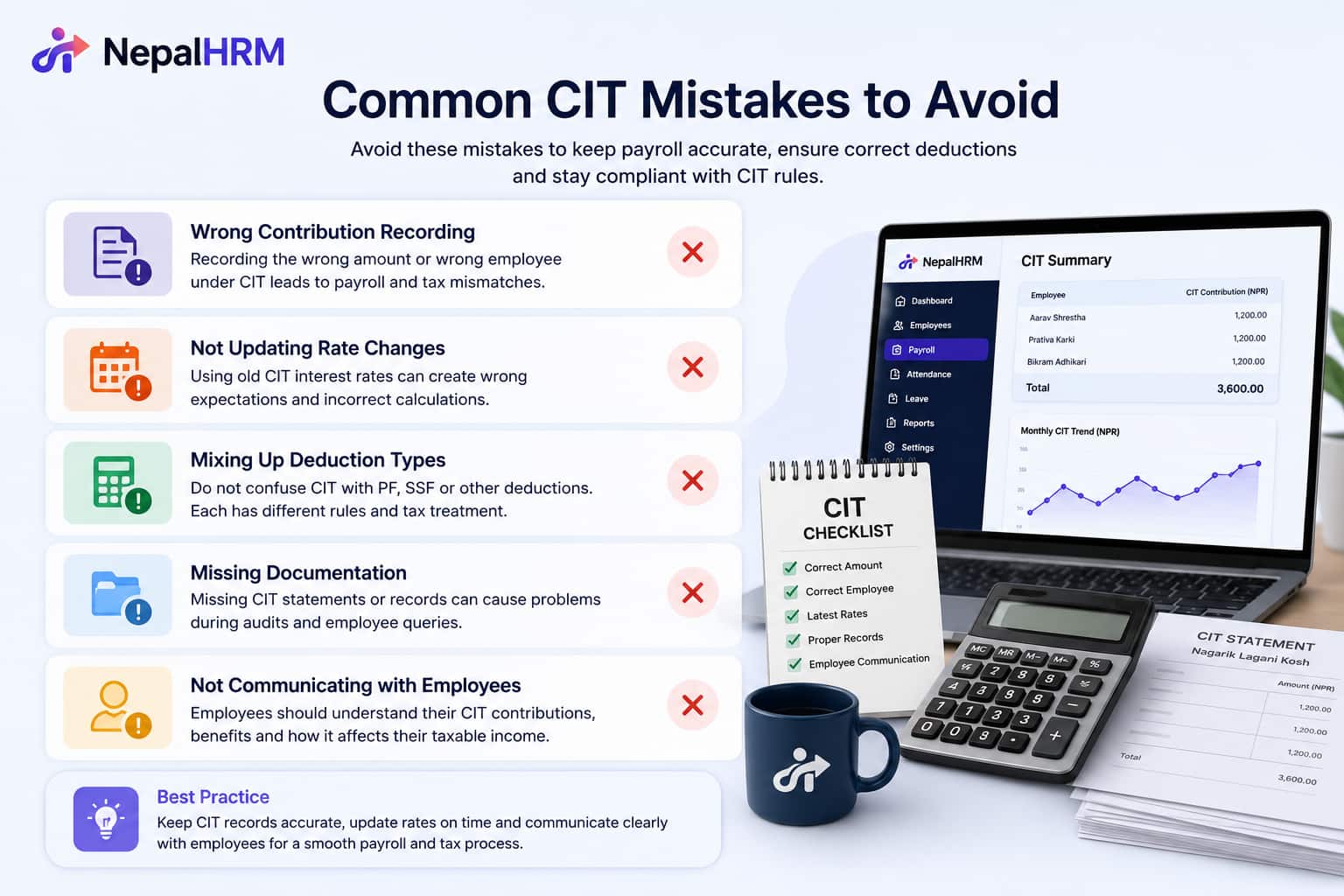
Using One CIT Rate for Every Scheme
CIT does not use one interest rate for all schemes. Retirement funds, pension schemes, unit schemes, insurance funds, and loans have separate rates.
Confusing Deposit Interest With Loan Interest
Deposit interest is a return on savings, while loan interest is a borrowing cost. Employees should check the correct rate before comparing returns or planning a loan.
Claiming the Full Contribution Without Checking the Deduction Limit
CIT contributions may reduce taxable income only within the eligible retirement fund deduction limit. HR and finance should review CIT together with PF, SSF, and other retirement contributions.
Using Old Payroll Settings
Tax rules, deduction limits, and scheme rates can change. Payroll teams should update CIT-related settings before salary calculation for a new fiscal year or after an official rate change.
Conclusion
CIT interest rates in Nepal vary by scheme, so employees should always check the official Citizen Investment Trust source before making savings or loan decisions. The current official page lists different rates for retirement funds, pension schemes, unit schemes, insurance funds, and loans.
For employers, CIT should be handled carefully in payroll because it can affect taxable income, payslips, salary sheets, and final salary calculation. NepalHRM helps HR and finance teams manage CIT, tax, and payroll records more clearly from one connected system.


