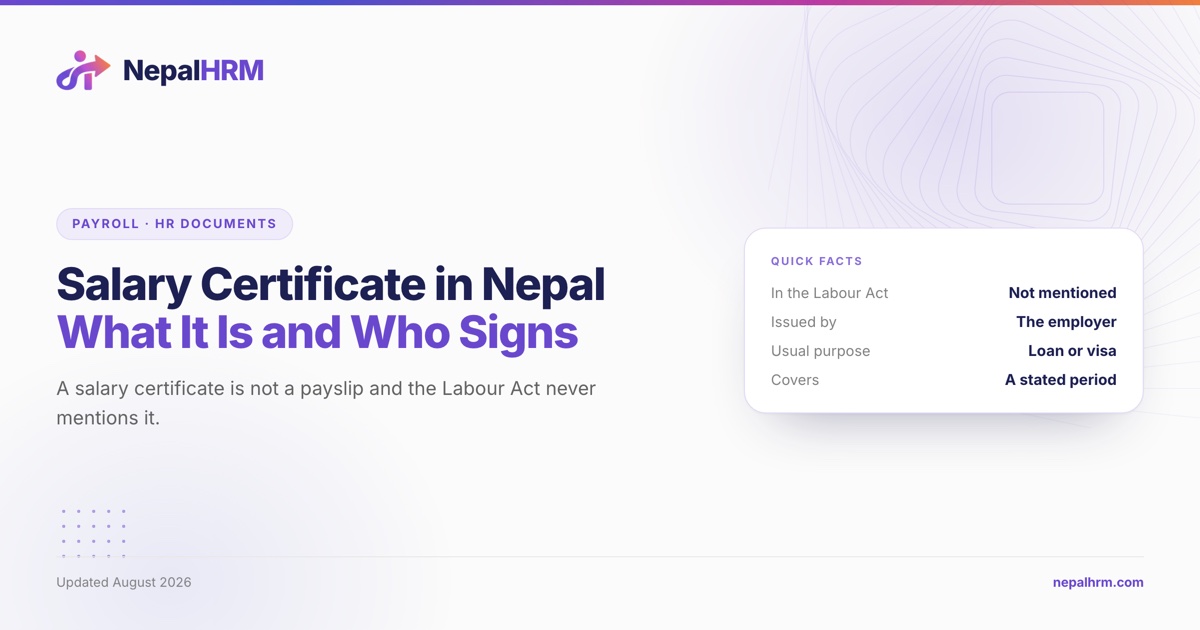
A salary certificate is a letter from an employer stating what it pays a named employee, issued because a bank, an embassy or a landlord asked for it. The Labour Act 2074 does not mention it, which means nothing about its content is fixed by law and everything about it is fixed by whoever is going to read it.
That is the useful way to think about the document: not as HR paperwork, but as a statement addressed to an underwriter. This guide covers what a salary certificate is, how it differs from a payslip and from a tax statement, the eleven lines it needs, and the three mistakes that get one rejected.
Table of Contents
- What it is not
- The eleven lines
- What the reader is actually checking
- Where the payroll numbers come from
- Three mistakes that get one rejected
- Who signs, and how to control it
- On exit
- Frequently asked questions
- What is a salary certificate in Nepal?
- Is a salary certificate the same as a payslip?
- Is an employer legally required to give a salary certificate in Nepal?
- What should a salary certificate include?
- Why do banks want basic salary shown separately?
- Can a former employee ask for a salary certificate?
- What is a salary certificate called in Nepali?
- Sources
What it is not
Three documents get called by each other's names in Nepali offices.
| Document | What it states | Period |
|---|---|---|
| Payslip | One pay period: earnings, deductions, net | One month |
| Salary certificate | Standing pay and structure, on letterhead | A stated period, usually a year |
| Tax deduction statement | Income paid and tax withheld, for tax purposes | A fiscal year |
A bank asking for "salary certificate and last three months' payslips" is asking for two different things on purpose: the certificate says what you earn, the payslips prove it was actually paid. Sending three payslips instead of a certificate answers half the question. See payslip for the first, and our payslip generator if you need one.
The tax statement is a third thing again. It reports income and withholding across a fiscal year to satisfy the income tax rules, and it is not interchangeable with a letter confirming current salary. See TDS and the Inland Revenue Department.
The eleven lines
Nothing here is statutory. Every line is here because a reader checks it.
- Company letterhead, with the registered name, address and PAN. See PAN.
- Date of issue, and where possible a validity note. Banks commonly want one issued within the last month.
- Employee's full name, as in the personal record kept under Rule 81(1), and their citizenship or PAN number.
- Position, matching the appointment letter. Rule 4(b) requires the contract to state the main work and position, so a mismatch is visible.
- Employment type under Section 10, and the joining date. A regular employee of four years reads differently from a six-month time-based engagement, and that difference is the whole point of the document.
- The period the certificate covers.
- Basic salary, stated separately. Section 2(a) defines basic remuneration to include the annual increment amount once a year of service is complete, so this figure moves each year. See basic salary.
- Allowances, itemised, reaching gross. See gross salary.
- Deductions, itemised: tax under Section 38(1)(a), provident fund or SSF contributions under 38(1)(b), any CIT deposit, and anything else within the nine grounds Section 38 permits.
- Net pay. See net pay.
- Authorised signature, name, designation and company stamp.
Two optional lines earn their place often enough to mention: festival expense, which Section 37(1) sets at one month's basic a year and which materially changes annual income, and the annual grade under Section 36, at least half a day's basic per month for a worker who has completed a year.
What the reader is actually checking
A bank is underwriting repayment capacity. It cares about net pay, about how much of gross is fixed rather than variable, about the joining date as a proxy for stability, and about whether the certificate agrees with the salary credits in the applicant's statement. A certificate quoting a gross figure that never appears in the bank account is the fastest way to a query.
An embassy is assessing ties and means. It cares about the joining date, the employment type, whether the employment continues, and whether the income supports the trip. Section 10's five types are doing real work here: "regular employment" answers a question that "employee" does not.
A landlord or a hire-purchase seller wants a stable monthly figure and a real signatory.
In each case, the document is only as good as its consistency with everything else the reader can see.
Where the payroll numbers come from
The certificate has to agree with the payroll, and the payroll has to agree with the Act.
- Section 34(2): remuneration and facilities are as stated in the employment contract, provided they are not less than the Act and Rules prescribe.
- Section 35(1) and (2): paid as the contract states, or as the employer determines where it is silent, and never at intervals longer than one month.
- Section 36: the annual grade, at least half a day's basic per month, once a year of service is complete.
- Section 37: festival expense of one month's basic a year, pro-rated under 37(3) for anyone short of a year.
- Section 38: the nine grounds on which anything may be deducted from remuneration.
- Section 52(1) and Section 53(1): provident fund at 10% plus a matching 10%, and gratuity at 8.33%, both on basic. Inside the SSF, the same money lands in the 28.33% old-age bucket.
If you want to see how a stated gross breaks into basic, deductions and net for FY 2083/84, the salary tax calculator and the SSF contribution calculator produce the figures from the current slabs and rates. Our guide to how employee salary is calculated in Nepal works through the structure.
Three mistakes that get one rejected
Signing off the offer letter instead of the payroll. The offer is a year old, the annual grade under Section 36 has been applied since, and the certificate now understates or overstates the current figure. Issue from the payroll record.
Quoting gross only. The reader cannot see what is fixed, cannot check the deductions, and cannot reconcile against a bank credit. Basic, allowances, deductions, net. Four blocks, always.
Certifying a period you cannot evidence. Rule 81(3) requires attendance and remuneration records to be kept for at least five years. If the certificate covers a period your records do not, you are signing something you cannot support, and Section 12(4) is a reminder that the records are what get produced when it is questioned.
A fourth, less common but more serious: inflating the figure as a favour. The employer's signature and stamp make it a representation to a lender. It is not a courtesy.
Who signs, and how to control it
The Labour Act does not designate a signatory, so this is your decision to make and to write down. In practice:
- Name the designations authorised to sign in your by-laws, alongside the rest of the document policy.
- Issue from payroll data, on a template, so two certificates issued in the same week agree with each other.
- Log every issue: to whom, for what period, addressed to which institution. A certificate is a statement to a third party and you will occasionally be asked to confirm one.
- Keep a copy in the personal record under Rule 81(1).
On exit
A salary certificate is a different document from the two exit documents, and the requests often arrive together.
- Section 150 requires a work experience certificate on request, stating the period of employment and the position. It does not state salary.
- The relieving letter is not in the Act at all and, in practice, confirms release with dues settled under Section 148.
- A salary certificate for a former employee is optional and covers a stated past period.
Our guide to experience and relieving letters in Nepal covers the first two, including the 15-day settlement clock in Section 148(1) and what happens when it is missed.
A certificate is a payroll extract, so it should come from payroll. NepalHRM keeps the salary structure, the monthly payroll history and the statutory deductions on one record, and HR issues the certificate from that data rather than retyping it. See how payroll works, or check a structure against the FY 2083/84 slabs.
Frequently asked questions
What is a salary certificate in Nepal?
A letter issued by an employer stating a named employee's position, employment type, joining date and pay structure over a stated period, usually for a bank loan or a visa application. The Labour Act 2074 does not require or define it, so the requesting institution sets the content.
Is a salary certificate the same as a payslip?
No. A payslip covers one pay period and shows that period's earnings, deductions and net pay. A salary certificate is a statement on letterhead about standing pay across a stated period, and banks commonly ask for both because they answer different questions.
Is an employer legally required to give a salary certificate in Nepal?
No. Nothing in the Labour Act 2074 obliges it. The one exit document that is obligatory is the work experience certificate under Section 150, which states the period of employment and the position but not salary.
What should a salary certificate include?
Company letterhead with PAN, date of issue, the employee's name and identification, position, employment type and joining date, the period covered, basic salary separately, itemised allowances to gross, itemised deductions, net pay, and an authorised signature with stamp.
Why do banks want basic salary shown separately?
Because basic is the base for the statutory computations they know about: provident fund at 10% plus a matching 10% under Section 52(1), gratuity at 8.33% under Section 53(1), and the SSF contribution. A single gross figure hides the structure and makes the deductions unverifiable.
Can a former employee ask for a salary certificate?
They can ask, and it is not obligatory. What Section 150 does make obligatory, on request, is a work experience certificate stating the period of employment and the position.
What is a salary certificate called in Nepali?
तलब प्रमाणपत्र (talab pramanpatra). It is distinct from the कार्य अनुभवको प्रमाणपत्र, the work experience certificate required by Section 150.
Sources
- Labour Act, 2074 (2017), consolidated Nepali text as amended through 2082, Nepal Law Commission: lawcommission.gov.np. Sections 2, 10, 12, 34, 35, 36, 37, 38, 52, 53, 148 and 150 were read from that text, retrieved 2026-08-07.
- Labour Rules, 2075 (2018), Nepali text, Nepal Law Commission. Rules 4 and 81 were read from that text, retrieved 2026-08-07.
Related reading: Experience and relieving letters in Nepal · How to calculate employee salary in Nepal · Employee handbook in Nepal